In this article
- 01 What an AI visibility checker measures
- 02 The test we ran on our own brand
- 03 A scorecard for choosing an AI visibility checker
- 04 How to monitor brand visibility in AI without a tool
- 05 What to fix when you’re not visible
- 06 Where PolyDraft fits
- 07 Frequently asked questions
- 08 Continue with the next task
- 09 Sources
An AI visibility checker sends a set of questions (prompts) to AI assistants such as ChatGPT, Perplexity, Gemini, or Google's AI features. It records whether your brand is mentioned, whether your site is cited as a source, and which competitors appear instead. Choose one by how much control and transparency it gives you: which prompts it runs, which assistants it checks, how often it repeats each prompt, whether it separates mentions from citations, and whether you can export the raw answers. Before you pay, run the same kind of test by hand. When we did that for PolyDraft on October 26, 2026, our own site appeared in none of the eight result sets.
This guide is for founders and marketers deciding whether to buy an AI visibility tool. It covers what these tools measure, a scorecard for choosing one, a manual test you can run today, and our own results, reported as they came out.
Key points
- AI visibility tools sample answers. They don't read a ranking, because there isn't one to read.
- Separate three things: being mentioned, being cited with a link, and the traffic or inquiries that follow.
- Prompt choice decides the result. A tool that won't show you its prompts can't tell you much.
- One run proves little. Answers change with time, location, account, and model, so repeat runs and trends matter more than a single score.
- A manual baseline is quick to run and tells you whether you need a tool at all.
What an AI visibility checker measures
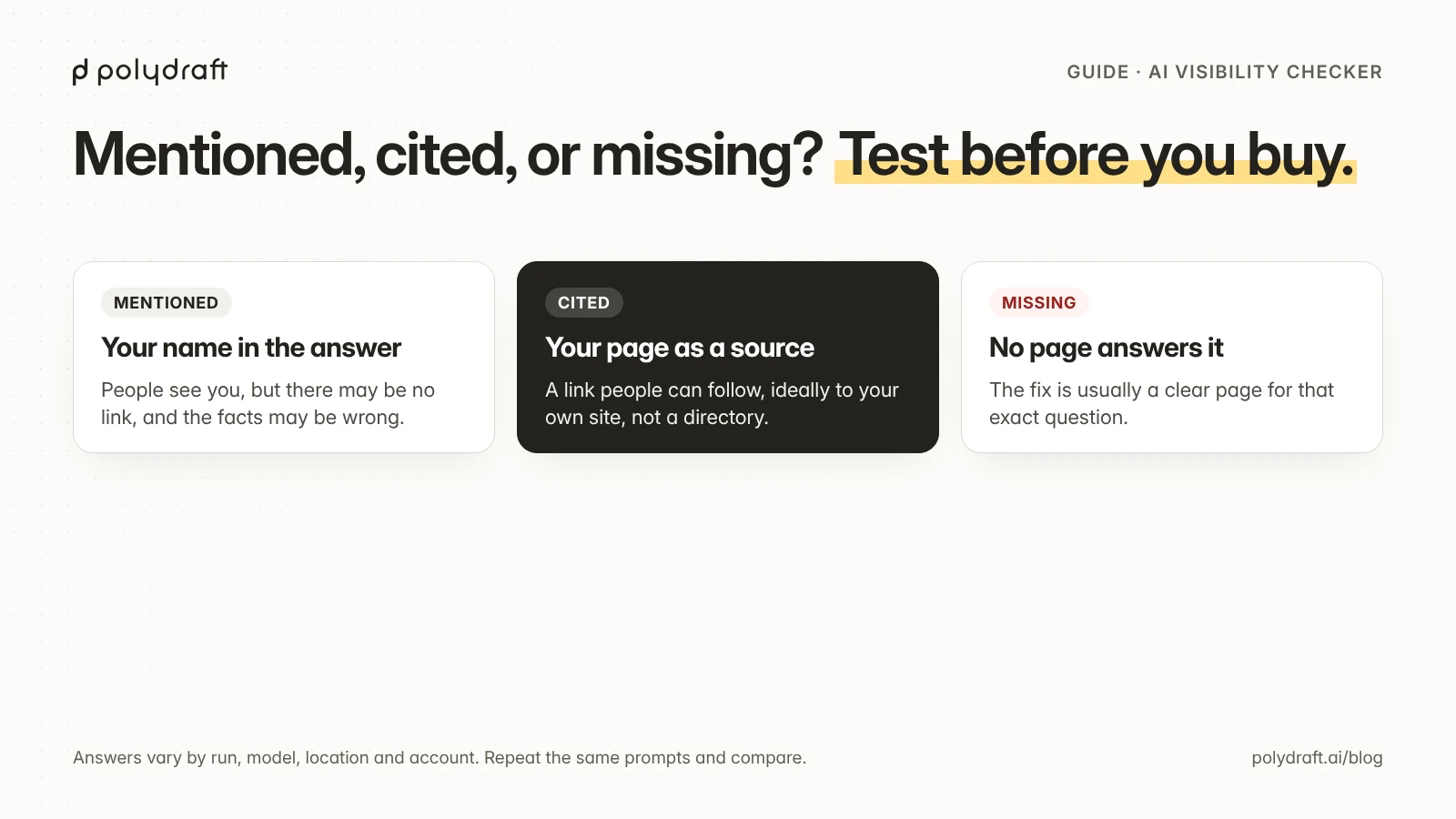
Most tools in this category measure some mix of these:
| Measure | What it means | Why it matters | Watch out for |
|---|---|---|---|
| Mention | Your brand name appears in the answer | People see your name | A mention can be negative or wrong |
| Citation | Your page is linked as a source | People can click through to you | Third-party pages about you can be cited instead of your own |
| Position | Where in the answer you appear | Earlier mentions get more attention | Answers have no stable order |
| Share of voice | Your mentions compared with competitors' across the prompt set | Shows relative presence | Only as good as the prompt set |
| Sentiment and accuracy | Whether what the answer says about you is correct | Wrong facts cost trust | Needs human review |
| Sources used | Which sites the assistant relied on | Shows where to earn mentions | Changes often |
None of these measure revenue. Our AI visibility guide explains why access, retrieval, citation, and inquiries need to be tracked separately.
The test we ran on our own brand
We wanted a baseline before writing about tools, so we ran a manual test on PolyDraft.
Method. On October 26, 2026, between 13:15 and 13:16 UTC, a fresh AI agent with no prior context about PolyDraft ran eight buyer prompts. The agent was Claude with a web search tool. It ran each prompt once, answered only from what the search returned, fetched no pages, and added no brands from memory. For each prompt we recorded the brands it named, the sources, and whether PolyDraft or polydraft.ai appeared.
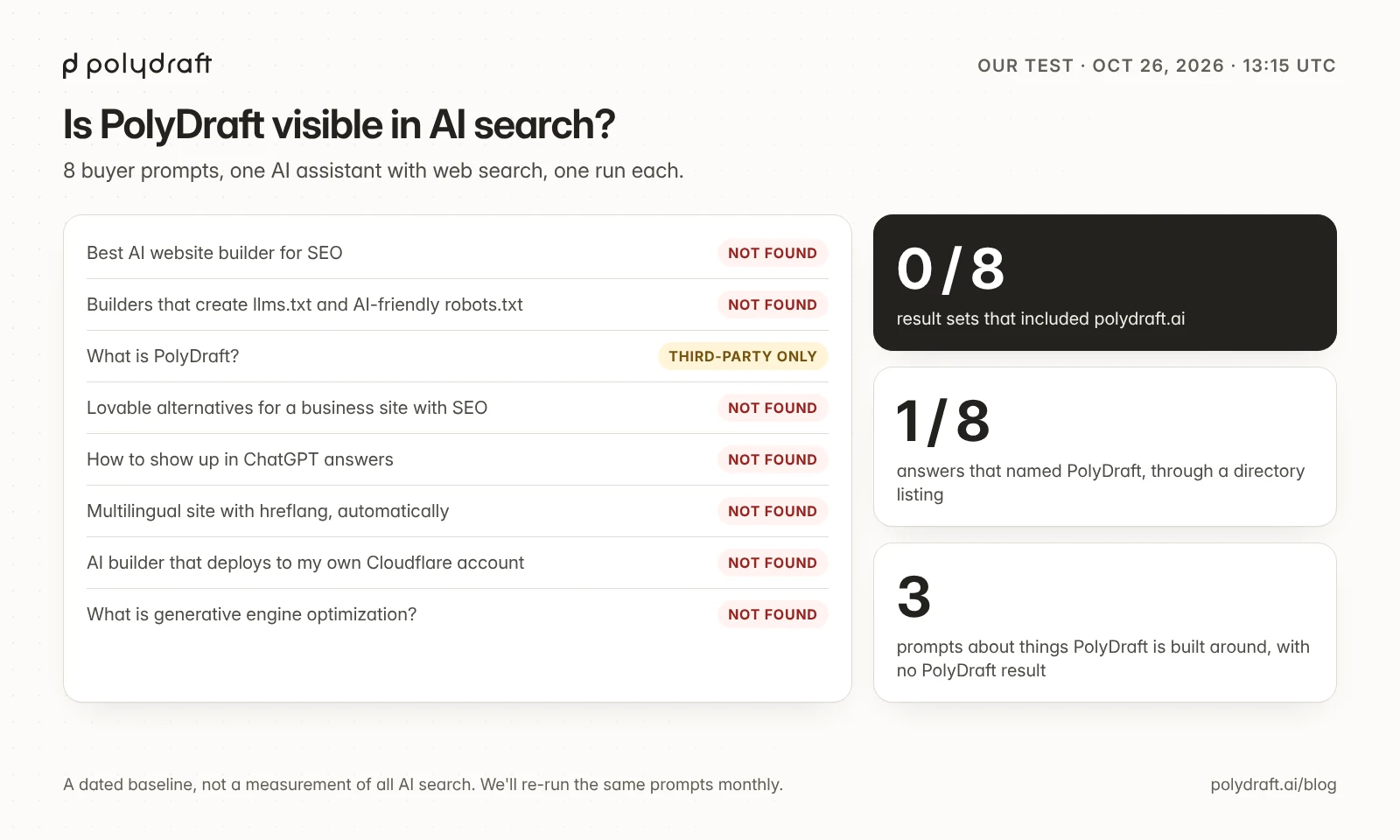
| Prompt | PolyDraft in results | In the answer | Cited | Brands the answer named |
|---|---|---|---|---|
What is the best AI website builder for SEO? |
No | No | No | B12, Wix (Wix ADI), WebFX, Hostinger, TechRadar, Durable, Wix AI, Readdy, WordPress |
Which AI website builders create an llms.txt file and an AI-crawler-friendly robots.txt? |
No | No | No | A Product Hunt listing (llms.txt Generator for AI), Fibr.ai, a WordPress plugin |
What is PolyDraft? |
Yes, through a third-party listing | Yes | Only the third-party listing (theresanaiforthat.com) | PolyDraft, There's An AI For That |
What are good alternatives to Lovable for a production business website with SEO? |
No | No | No | Fimo, Lovable, B12, Wix, Framer, Webflow, Durable, Hostinger, Softr, LovableSEO, Prerender |
How do I make my website show up in ChatGPT answers? |
No | No | No | OpenAI / ChatGPT, Bing Webmaster Tools, Google Search Console |
What tools build a multilingual website with hreflang tags automatically? |
No | No | No | MiniWebtool, Chris Lever's generator, GeoPlugin, a WordPress plugin, Weglot, Gryffin |
Is there an AI website builder that deploys to my own Cloudflare account? |
No | No | No | Cloudflare, Revdoku, InMotion Hosting, InspoAI, yusually, V-Ploy |
What is generative engine optimization? |
No | No | No | ChatGPT, Google Gemini, Perplexity |
What we learned:
- Our own site appeared in 0 of 8 result sets. Even for "What is PolyDraft?", the answer relied on a third-party directory listing, not on polydraft.ai.
- Three prompts ask about things PolyDraft is built around, and we didn't appear for any of them: AI-crawler access files, hreflang for multilingual sites, and deploying to your own Cloudflare account. Those are the gaps to close first, with pages that answer those questions directly.
- The Cloudflare question has no established answer yet. The answer named Cloudflare's own tools and several small products and guides, but no established website builder. That's the kind of question a young site can realistically win.
Limits. This was one assistant, one search tool, and one run per prompt, and the search tool summarized its own snippets. We didn't run the prompts in ChatGPT, Perplexity, or Google AI Mode. Prompt tests are also weaker evidence than access checks, as our AI visibility guide explains, so check crawler access first. It's a dated baseline, not a measurement of all AI search. We'll re-run the same prompts monthly, adding more assistants, and report the change.
A scorecard for choosing an AI visibility checker
Score one point for each clear yes you can verify in a trial:
| # | Question | A good answer |
|---|---|---|
| 1 | Can I write and edit the prompts myself? | Yes, including the exact wording |
| 2 | Does it show which assistants and models it checks, and when? | Named engines, model versions where available, and dates |
| 3 | Does it repeat each prompt and show the variation? | Several runs per prompt, with the spread shown |
| 4 | Does it separate mentions from citations? | Yes, with the cited URLs |
| 5 | Can I see the raw answers? | Yes, the full text for each run |
| 6 | Does it show which sources the assistant used? | Domains and URLs |
| 7 | Can I set location and language? | Yes, matching your market |
| 8 | Can I export the data? | CSV or API |
| 9 | Does it explain any score it shows? | A documented formula |
| 10 | Does it avoid promising citations or "AI rankings"? | Yes. No one can promise how an assistant will answer |
A tool that scores below 7 is hard to learn from. Any tool that promises placement in AI answers fails question 10 outright. The same caution applies to services. Our guide to generative engine optimization services covers what to ask an agency.
How to monitor brand visibility in AI without a tool
You can run the same test we did with a spreadsheet:
- Write 10 to 20 prompts from real customer questions: category questions ("best X for Y"), comparison questions ("alternatives to Z"), and problem questions ("how do I…"). Include one branded prompt.
- Choose the assistants your customers use, and note the date, location, and whether you were signed in.
- Run each prompt and paste the full answer, the brands named, and the cited URLs into the sheet.
- Mark three columns: mentioned, cited, and correct.
- Repeat monthly, with the same prompts and setup, and compare.
- Act on the gaps. For each prompt where you're missing, ask whether you have a page that answers that exact question clearly. If not, that's the next page to write.
In our estimate, 10 prompts on one assistant fit into an hour. The result tells you whether a paid tool would answer a question you can't answer yourself.
What to fix when you’re not visible
Being absent from AI answers usually has ordinary causes:
- No page answers the question. Assistants quote passages. If your site never states "PolyDraft deploys to your own Cloudflare account" in a clear, standalone sentence, there's nothing to quote.
- Crawlers are blocked. OpenAI's documentation says sites that block its OAI-SearchBot crawler won't appear in ChatGPT search answers. Check your robots.txt for each assistant you care about.
- Others describe you better than you do. In our test, a directory listing was the only source about PolyDraft. Make your own pages the clearest, most current source of your facts.
- Your site is new. Assistants that rely on search indexes tend to cite pages that search engines already trust.
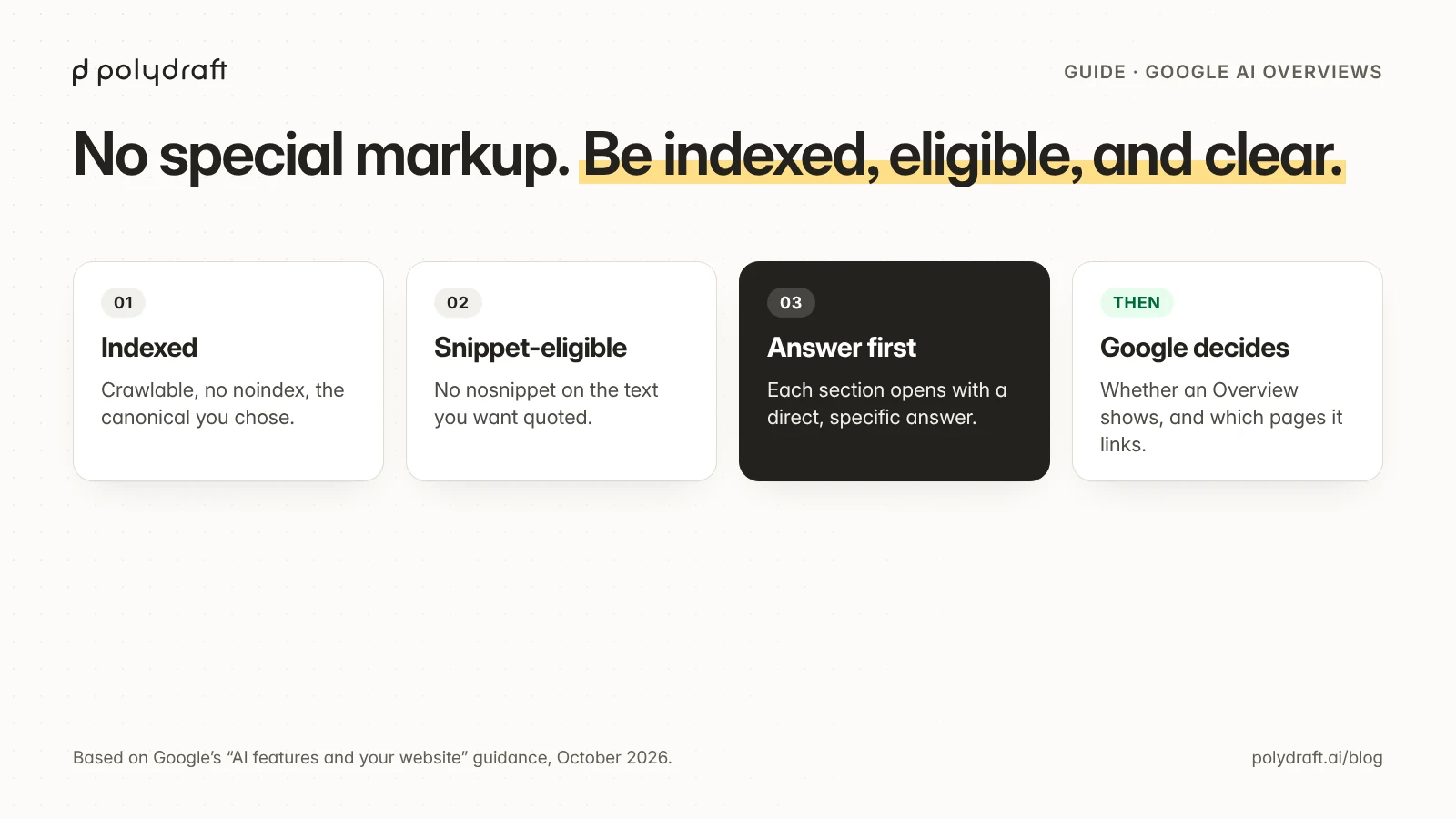
For Google specifically, see our guide on how to show up in AI Overviews. For page structure, see what makes a site quotable.
Where PolyDraft fits
PolyDraft doesn't sell an AI visibility checker or score, and we don't claim to measure citations for you. PolyDraft sites are built to be readable by AI crawlers, and our AI visibility page describes what that covers and recommends similar manual checks. If you'd rather have someone run your site and its SEO and AI-visibility work for you, PolyDraft's AI FDE service puts a PolyDraft engineer on it, and nothing goes live without your approval (contact us).
Frequently asked questions
What is an AI visibility checker?
A tool that runs a set of prompts through AI assistants and records whether your brand is mentioned or cited, and which competitors appear. Some also track sentiment, sources, and changes over time.
Are AI visibility scores reliable?
Only as reliable as their method. Answers vary between runs, models, locations, and accounts. Trust tools that show their prompts, repeat runs, and let you see the raw answers.
How do I check if my brand appears in ChatGPT?
Ask ChatGPT the questions your customers ask, with search turned on, and record whether your brand is named and whether your site is cited. Repeat with the same prompts each month. Make sure your robots.txt doesn't block OpenAI's search crawler.
Do I need a paid AI visibility tool?
Not at first. A monthly manual test of 10 to 20 prompts gives you a baseline. A tool becomes worth it when you track many prompts, several assistants, or competitors at scale.
Can a tool or agency promise AI citations?
No. Each assistant decides what to cite. Treat any promise of AI placement as a red flag.
What should I do if my brand doesn’t appear at all?
Check crawler access, then make sure you have a page that answers each missing question in clear, quotable sentences. In our own test, the gaps were exactly the questions our site didn't answer directly.
Continue with the next task
- Get cited in Google's AI features: How to show up in AI Overviews
- Decide whether to hire help: Generative engine optimization services
- Make pages easy to quote: What makes a site quotable
About this article. Drafted by an AI agent following PolyDraft's blog workflow, checked by an automated QA script, reviewed by separate AI agents, and approved by Vincent Chen. The prompt test was run by a separate AI agent on October 26, 2026. Results are reported as recorded, with the limits stated above. We haven't tested commercial AI visibility tools, so we don't rank them. The scorecard is our own recommendation, not an industry standard. The diagrams are original illustrations made for this article.
Sources
- OpenAI: Overview of OpenAI crawlers
- Google Search Central: AI features and your website
- Google Search Central: Robots meta tag, data-nosnippet, and X-Robots-Tag specifications
- Google Search Central: Creating helpful, reliable, people-first content
Written by
Founder of PolyDraft and CEO of BlackMonolith, Inc.