GEO Services: What They Include and How to Choose a Provider
What GEO and AEO services include, how they're priced, the deliverables to ask for, red flags, and how DIY, software, agencies and PolyDraft's AI FDE service compare.
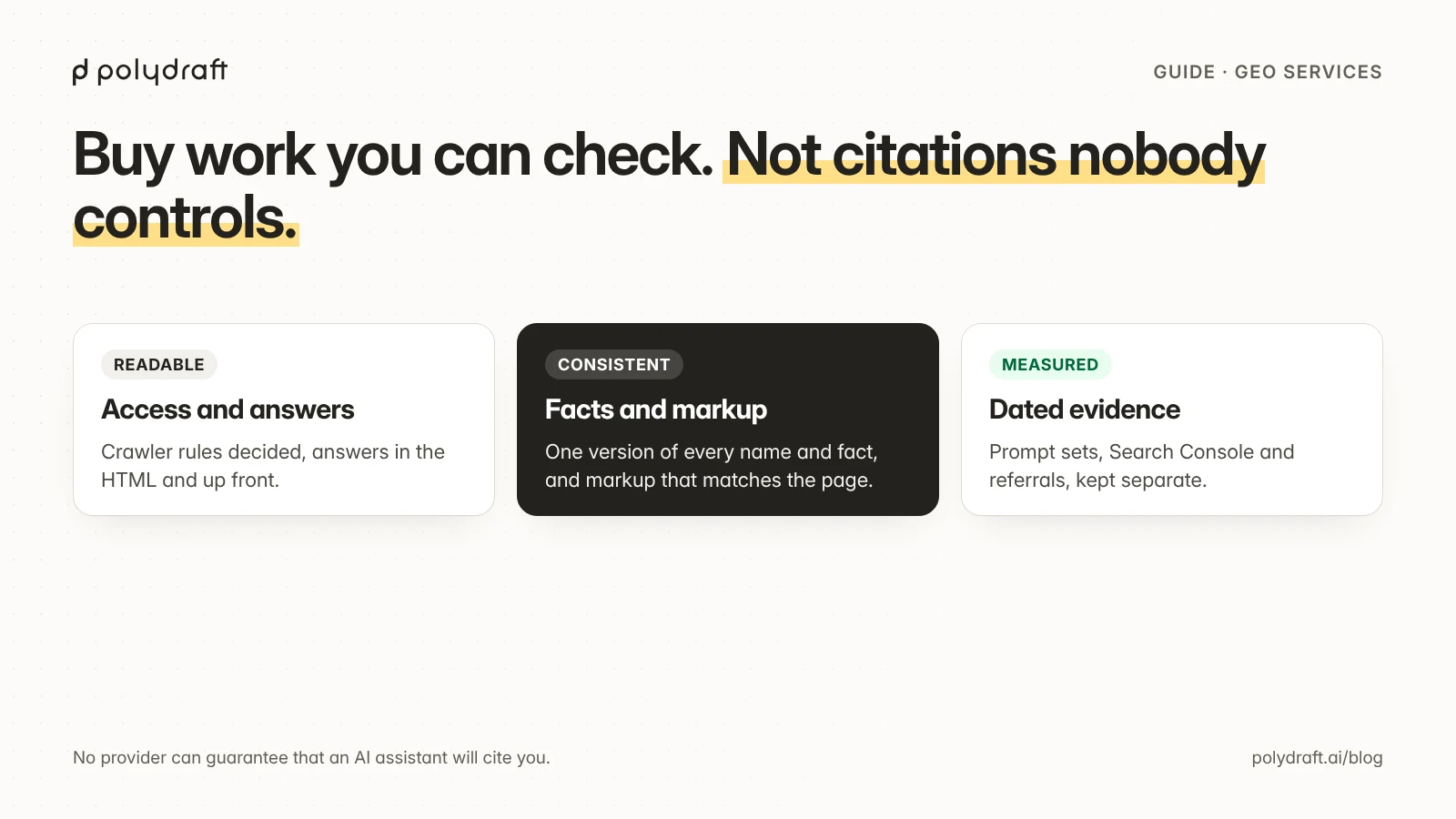
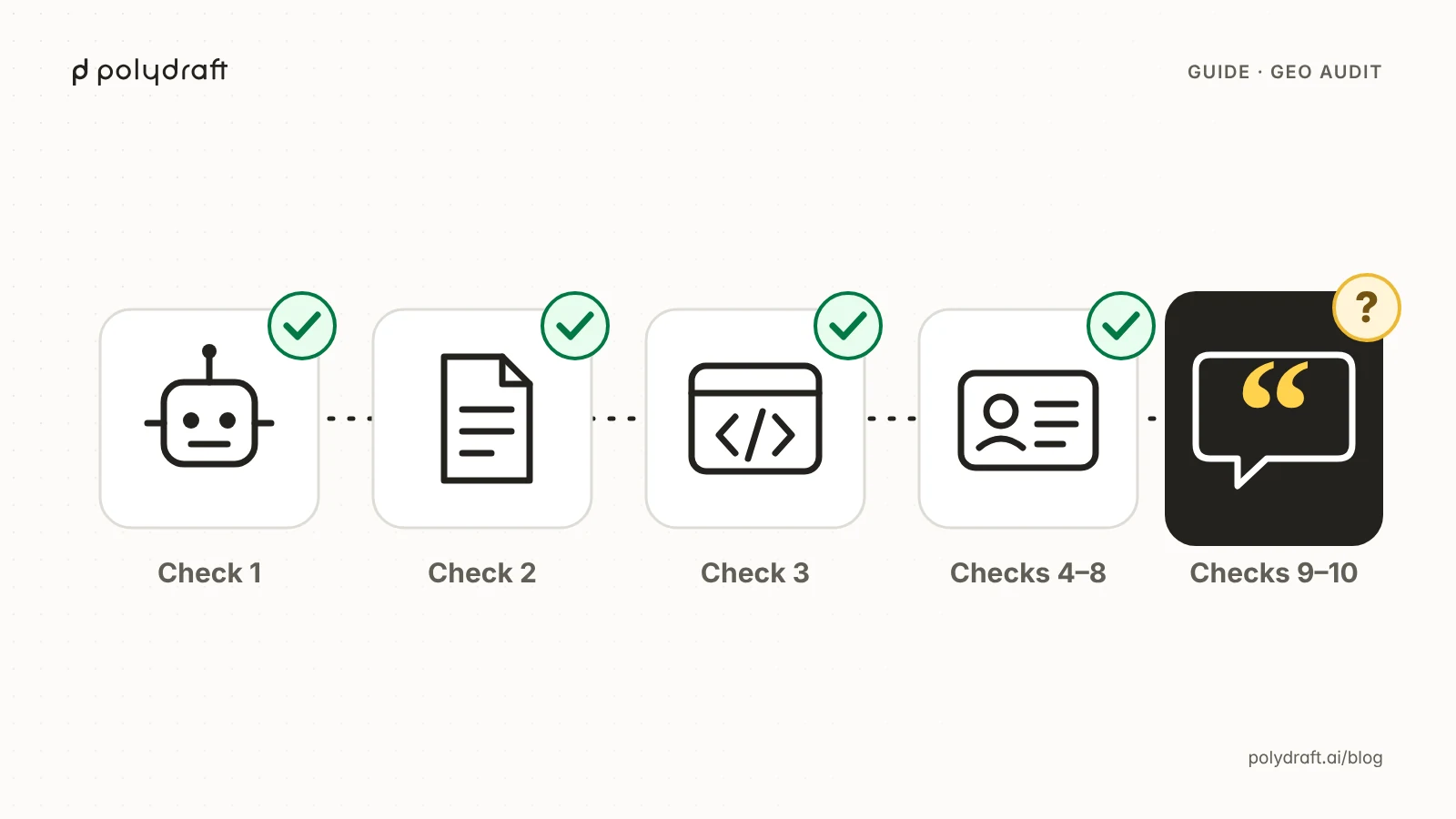
Generative engine optimization (GEO) services aim to make your website easy for AI assistants and AI search features to find, read, attribute correctly and quote. Real GEO work is checkable: crawler access, direct answers at the top of key pages, consistent company and product facts, structured data that matches the page, and measurement with dated prompt tests and analytics; our GEO audit checklist runs those checks in order. Nobody can guarantee that an assistant will cite you. Choose a provider by what you can verify: deliverables, evidence for each change, and your approval before anything goes live.
Updated November 6, 2026: noted that Search Console's generative AI report and setting have been available worldwide since August 31, 2026, and added per-crawler decisions and an FAQ on how GEO services are priced.
This guide is for founders and marketing leads comparing GEO or answer engine optimization (AEO) services. It covers what the work involves, the deliverables to ask for, the red flags, how to measure honestly, and how doing it yourself, software, an agency, and PolyDraft's AI FDE service compare. If you first want to know what GEO is and how it relates to SEO, start with our guide to generative engine optimization. We make PolyDraft and sell one of the options compared here; we say where it fits near the end.
Key points (as of November 6, 2026)
- GEO builds on SEO. Google treats its AI features as part of Search, with no separate technical requirements.
- Most real GEO work is unglamorous: access, clear answers, consistent facts, accurate markup, and measurement.
- Ask for deliverables you can check, not for "AI rankings" or guaranteed citations.
- Measure with dated prompt sets, Search Console (its generative AI report has been available worldwide since August 31, 2026), and referral analytics, and keep them separate.
- Whoever does the work, you should own the accounts and approve every change before it ships.
What generative engine optimization services are
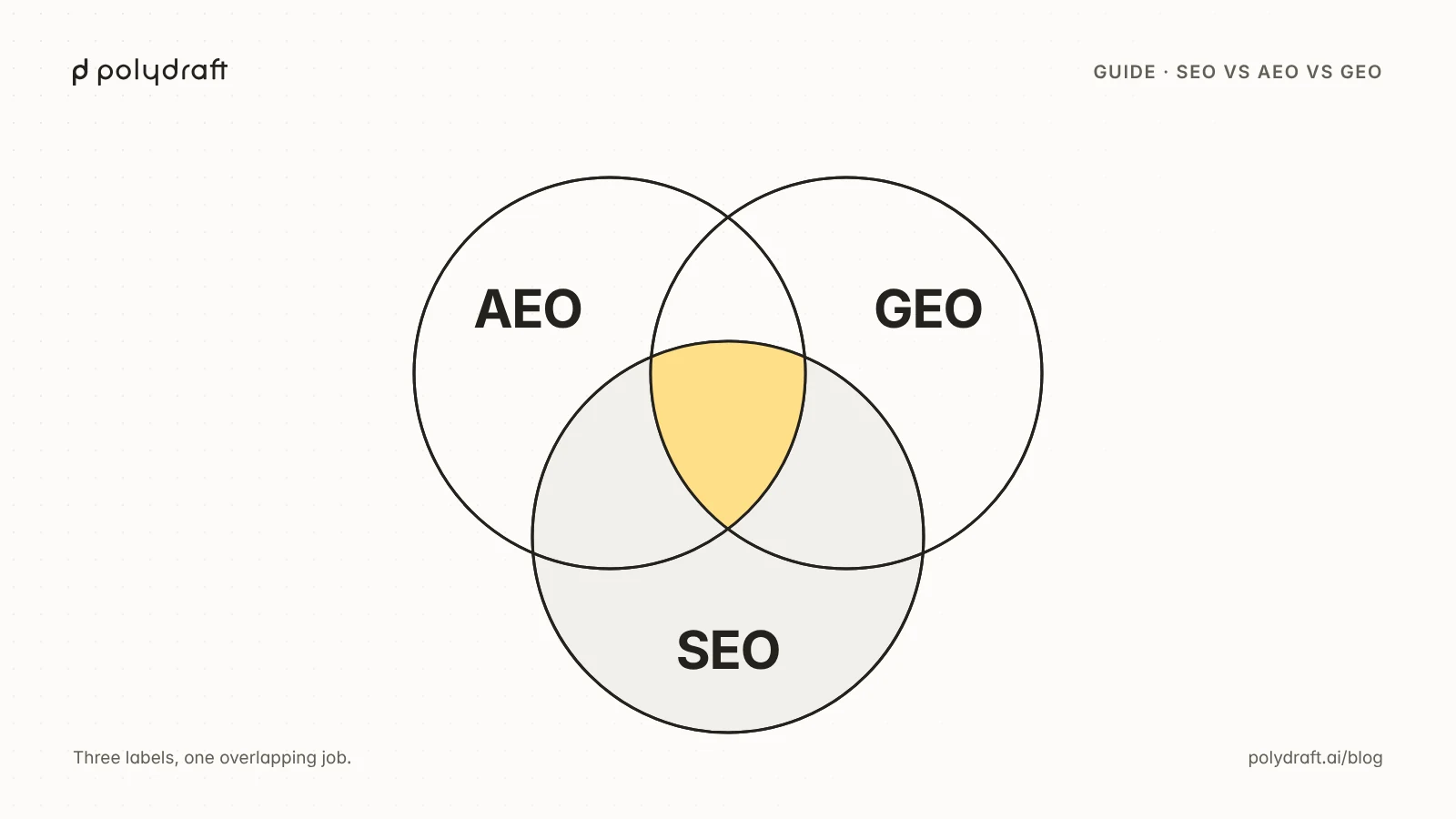
GEO services, also sold as AEO, LLM SEO, or AI search optimization, improve how AI systems such as Google's AI Overviews and AI Mode, ChatGPT, Perplexity, and Copilot find and describe your business. The names differ, but the work overlaps heavily with SEO: Google says a page only needs to be indexed and eligible to show with a snippet to appear as a supporting link in its AI features. Since August 31, 2026, every Search Console property has had a Search generative AI setting (sites are included by default) and a matching performance report. Our GEO guide covers the definitions and the page-level method, and our comparison of SEO, AEO and GEO explains how the three labels differ; this one is about buying the work.
So a GEO service that ignores the basics of search has nothing to stand on. What a good one adds is attention to how an answer engine reads a page: whether the facts can be lifted out cleanly, whether they're consistent across your site and listings, and whether a given crawler is allowed in at all.
What the work actually includes
| Task | What the provider does | What you can check yourself |
|---|---|---|
| Evidence brief | For each key page, lists the reader's question, the facts that answer it, their sources, and who verifies them | The brief exists, and every claim on the page traces to it |
| Crawler access | Reviews robots.txt rules per crawler, separating search, training, and user-triggered agents, and records your decision for each | Your robots.txt, the decision log, and a raw fetch of key pages |
| Readable pages | Makes sure the main content is in the HTML a crawler receives, not only after JavaScript runs | The raw HTML of each key page contains the answer text |
| Answer-first content | Rewrites key pages so the question is answered in the opening lines, with detail below | The first paragraph answers the page's main question |
| Entity and fact consistency | Uses one exact form of your company, product, and plan names, and the same facts (prices, locations, capabilities) everywhere | A list of canonical names and facts, and the pages where each appears |
| Structured data parity | Adds or fixes JSON-LD so every fact in the markup also appears on the page | Every price, rating, FAQ, and date in the markup is visible on the page |
| Optional files | Maintains an llms.txt if a system you care about uses it, as an index rather than a ranking tool | The file is current and points to pages that exist |
| Prompt-set measurement | Runs a fixed, dated set of questions through named assistants and records the answers and sources | The prompt list, dates, assistants, and raw answers, not just a score |
| Reporting | Separates release checks, prompt observations, and business results | Each figure has a source and a date range |
Most of this is the same discipline as good SEO and good editing. Our AI visibility guide covers the technical checks you can run yourself before hiring anyone.
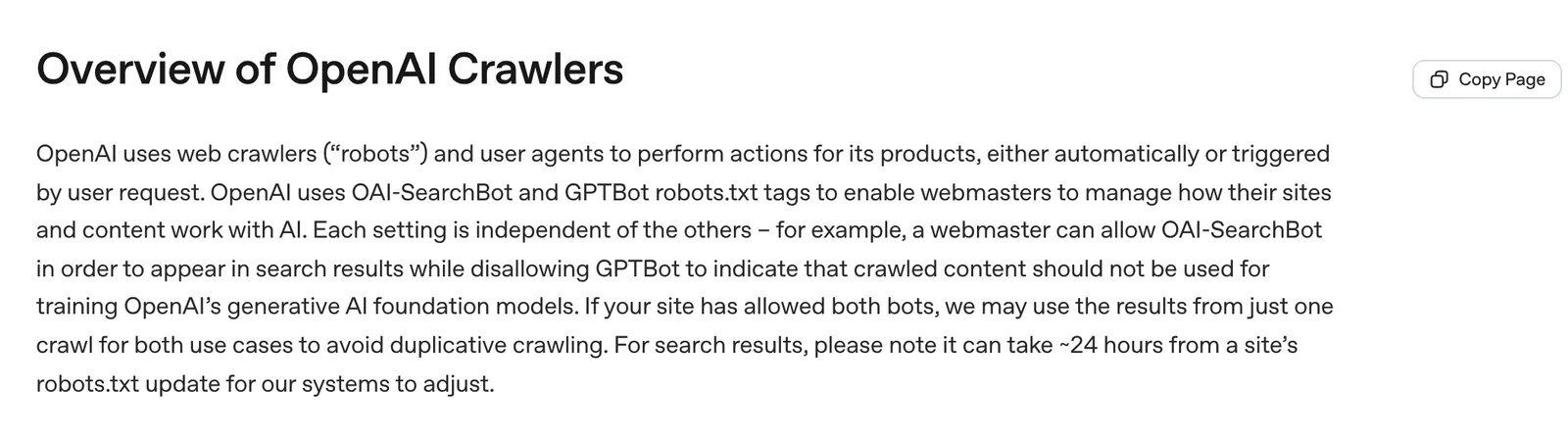
Crawler access is the row where providers most often blur the details. AI operators publish separate user agents for search, training and user-requested visits, and each setting is independent, so a provider should record a decision per crawler rather than "allow AI" or "block AI". Our robots.txt examples for AI crawlers list the main user agents by purpose.
Deliverables to ask for
A proposal for GEO services should name outputs you can open and check. Ask for:
- A baseline. A crawl or fetch of key pages, your current robots.txt decisions, and a dated prompt set with the raw answers, recorded before any change.
- A page list. The pages the service will work on, the question each one answers, and its evidence brief.
- A change log. Every change, with the date, the reason, who approved it, and how to reverse it.
- A facts sheet. The canonical names and facts the service will keep consistent across your site and listings.
- A measurement plan. Which prompts, which assistants, how often, and which analytics views. Agree it before work starts.
- A monthly report. Work done, observations with dates and sources, and what's planned next.
If a provider can't describe its deliverables this concretely, you can't tell whether the work was done.
Red flags in GEO services
Walk away from any GEO service that promises outcomes nobody controls or uses tactics Google's spam policies describe:
- Guaranteed citations or "AI rankings". No provider controls what an assistant says, and answers vary by system, session, and wording.
- Mass-produced pages. Generating many pages mainly to influence search results, without helping users, is what Google's spam policies call scaled content abuse.
- Link schemes and planted mentions. Buying links that pass ranking credit, or automated link building, falls under Google's link spam policy. Fake reviews and planted forum posts are a reputational risk too.
- "llms.txt gets you cited". Google says you don't need llms.txt or other AI text files to appear in its AI features. It's an optional file, not a lever; see what an llms.txt file can and can't do.
- Results with no raw data. A "visibility score" without the prompts, dates, and answers behind it can't be checked.
- Accounts in the provider's name. You should own Search Console, analytics, the website, and its content.
How to measure GEO honestly
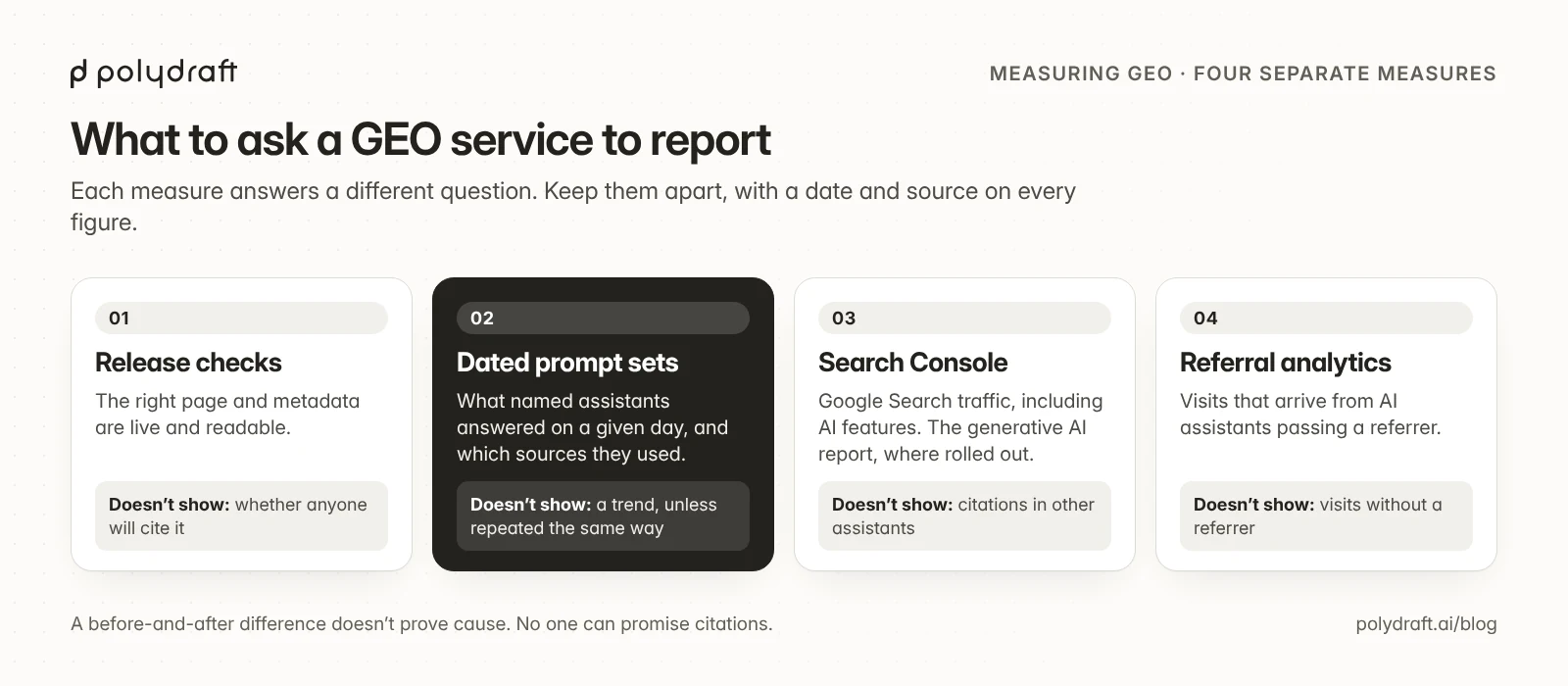
Measure four things separately, because each answers a different question:
| Measure | What it tells you | What it doesn't tell you |
|---|---|---|
| Release checks | The right page and metadata are live and readable | Whether anyone will cite the page |
| Dated prompt sets | What named assistants answered on a given day, and which sources they used | A trend, unless repeated under the same conditions |
| Search Console | Impressions, clicks, and queries in Google Search, which include AI features. The Search generative AI performance report, available worldwide since August 31, 2026, shows impressions in AI Overviews and AI Mode separately | Clicks or queries for AI features, and citations inside other assistants. Properties with little data may not see the report |
| Referral analytics | Visits that arrive from AI assistants that pass a referrer | Visits that don't pass one, which show up as direct or unknown |
Two cautions apply to every report. A before-and-after difference doesn't prove that a change caused it. And there's no reliable timetable for citations. They may come slowly, or not at all, even when the work is sound.
How to choose a GEO agency or service
Ask these questions before you sign:
- Which tasks in the table above will you do, and which will you leave to us?
- What will the baseline include, and when will we see it?
- How do you decide which AI crawlers to allow, whether to use Search Console's Search generative AI setting, and who makes the final call?
- Who reviews AI-written content, and how are facts checked against sources?
- Will anything go live without our written approval?
- Which prompts, assistants, and dates will you report on, and do we get the raw answers?
- What happens to the content, change log, and access when the contract ends? (Agencies can use our client website handover checklist.)
Write the answers into the agreement. Our SEO contract checklist covers ownership, approval, and AI terms, and our auto SEO software scorecard works for services as well as tools. If you'd rather check a provider's crawler rules yourself, you can draft the rules with a robots.txt generator and then test them.
How GEO services are priced. GEO services are usually sold as a monthly retainer, a fixed-price project (such as an audit and a set of page rewrites), or hourly consulting. If a provider proposes performance-based fees tied to citations or "visibility scores", treat that with extra care, because those metrics are easy to influence in ways that don't help your business. Ask what each fee covers in terms of the deliverables above.
DIY, software, an agency, or AI FDE?
| Option | Who does the work | Good fit when | Watch for |
|---|---|---|---|
| Do it yourself | Your team, with free checks and a prompt log | You have time and a small site | Consistency, and keeping a dated record |
| Software | A tool runs checks and tracks prompts | You want monitoring and alerts | Scores with no raw data, and tools that edit or publish without review |
| Traditional agency | Specialists, often across many clients | You want strategy and execution handed off | Rebranded SEO with no process evidence, and accounts held by the agency |
| PolyDraft AI FDE | A PolyDraft engineer runs PolyDraft for you | You want a new website and its SEO and GEO work done for you | The work runs on PolyDraft's platform. Agree scope and handover up front, as with any provider |
A note on bias: PolyDraft sells one of these options (AI FDE), so weigh our comparison accordingly and use the same questions with every provider. If you do it yourself with AI agents, our guide to running AI agents on your own SEO covers what to connect and what to let them change.
Where PolyDraft fits
We make PolyDraft. It's an AI-native website marketing system: it builds a search-ready site on your own Cloudflare account and, on sites built since November 2026, uses SEO automation to plan content from SEO and GEO data. Every week, its SEO and GEO autopilot reads your Search Console data, writes new articles, refreshes the ones that slip and reports what moved; that needs a deployed site with the platform's Search Console access added to your property. PolyDraft can't make an assistant cite you; its weekly report samples which of your pages assistants cite.
We build a website product, and we also offer AI FDE (AI forward-deployed engineering), a done-for-you AI SEO and GEO service run on it: a PolyDraft engineer runs PolyDraft for you, building your new site from your current one and doing its technical SEO, content, and AI-visibility work with PolyDraft's agents. Contact us to ask about it.
Ask any provider, including us, for a change log: what changed on which page, when and why. Our AI visibility page lists what PolyDraft ships for AI search and its limits.
How we run GEO on our own site
We apply the same rules to polydraft.ai. Every article starts from a reader question and an evidence brief. A QA script flags percentages without a source link, source domains outside an approved list, links outside a list of verified live pages, and a missing AI-assistance disclosure. Separate AI reviewers then fact-check the draft and audit it against our editorial workflow, and a person approves the final version.
In one recent batch, those reviews caught a statistic we had misstated, and product claims that went further than our own product documentation. We fixed both before publishing. For measurement, we keep a dated prompt test rather than a score. Our AI visibility checker guide describes how we ran it.
Frequently asked questions
What are generative engine optimization services?
They're services that help AI assistants and AI search features find, read, attribute, and quote your website correctly. The work covers crawler access, answer-first content, consistent facts, accurate structured data, and honest measurement.
What deliverables should a GEO service provide each month?
A change log with approvals, the pages worked on and the question each answers, an updated facts sheet if anything changed, and a report with dated prompt observations and analytics, each figure with its source and date range.
What’s the difference between GEO and answer engine optimization services?
Mostly the label. Both aim to make your content usable in AI-generated answers. Compare providers by their deliverables, not by the acronym.
Can a GEO agency promise that ChatGPT will cite my business?
No. Assistants' answers vary by system, session, and wording, and no provider controls them. A provider can commit to the work, the evidence, and the reporting.
How should a GEO service report results?
Separately for each measure: release checks, prompt observations with the raw answers, Search Console data, and referral analytics. Ask for dates and sources on every figure, and don't accept a single visibility score in place of the data behind it.
How are GEO services priced?
Usually as a monthly retainer, a fixed-price project such as an audit plus page rewrites, or hourly consulting. Be careful with fees tied to citations or visibility scores, and ask what each fee covers in deliverables you can check.
Continue with the next task
- Understand what GEO is first: What is generative engine optimization?
- Get cited in Google's AI features: How to show up in Google AI Overviews
- Pick a tool to track prompts and citations: How to choose an AI visibility checker
- Decide which AI crawlers to allow: robots.txt examples for AI crawlers
About this article. Drafted by an AI agent following PolyDraft's blog workflow, checked by an automated QA script, reviewed by separate AI agents, and approved by Vincent Chen. We paraphrase Google's, OpenAI's and Anthropic's documentation rather than quote it, and link the pages below. On November 6, 2026 we rechecked the Search Console facts against search excerpts of Google's published pages, and read OpenAI's and Anthropic's crawler pages directly. The AI FDE description reflects the service as offered on November 6, 2026. The task table and question lists are our own recommendations, not an industry standard. The diagrams are original illustrations made for this article, and the OpenAI screenshot was captured from its public page on November 6, 2026.
Sources
- Google Search Central: AI features and your website
- Google Search Central: Spam policies for Google web search
- Google Search Central: Creating helpful, reliable, people-first content
- Google Search Central: General structured data guidelines
- Google Search Central Blog: Introducing Search Generative AI performance reports in Search Console
- Search Console Help: Search generative AI setting
- OpenAI: Overview of OpenAI crawlers
- Anthropic: Does Anthropic crawl data from the web, and how can site owners block the crawler?
Sources added or rechecked in this update were checked on November 6, 2026. Google's pages couldn't be opened directly from our tools that day, so we checked those facts against Google's own search excerpts and dated them in the text.