What Is an AI Forward Deployed Engineer? The Role, and When to Use One Instead of Hiring (2027)
What an AI forward deployed engineer does, how the role differs from a consultant, agency or solutions engineer, and what to ask before you sign.
An AI forward deployed engineer (AI FDE) is a software engineer, employed by an AI vendor or service provider, who works inside a customer's business to get AI working in production. The engineer doesn't just advise or demo. The engineer scopes the problem, builds the system on the customer's real data and tools, and stays until it runs. For a buyer, an FDE service sits between a consultant, who plans, and a software subscription, which you have to run yourself.
We sell an AI FDE service ourselves, for websites, SEO and AI search, so we have a stake in this topic. How we researched this: quotes from Palantir and Anthropic were checked in a browser against their open job postings on November 18, 2026. OpenAI's pages blocked automated access. OpenAI's own news feed, read on November 19, 2026, confirms the titles and dates of the two OpenAI announcements cited here; every other OpenAI detail comes from search-engine excerpts and is marked as not confirmed on the original page. Job postings change often. PolyDraft facts come from our own live pages, opened directly on November 18, 2026. We didn't hire or evaluate any FDE provider for this article.
Key points
- Palantir says in its own job postings that it "pioneered" the forward deployed engineer role.
- Anthropic advertises forward deployed engineer roles, and search results show OpenAI does too. According to search excerpts (not confirmed on OpenAI's page), OpenAI's head of forward deployed engineering describes the job as closing a "deployment gap" between what AI models can do and what people can reliably use.
- An FDE differs from a consultant (who usually plans), an agency (which works from outside on its own stack) and a solutions engineer (who helps close a sale). An FDE builds inside your workflow, after the contract.
- An FDE service makes sense when you need production results but can't justify hiring a full-time engineer. It's the wrong choice when off-the-shelf software already does the job.
- Before you sign, settle three things in writing: scope, who approves changes, and who owns what gets built.
What an AI forward deployed engineer is
An AI forward deployed engineer is an engineer from an AI company who sits inside your business and builds AI into how you already work. "Forward deployed" means the engineer works at your front line, not back at the vendor's office building one product for every customer.
The job postings we reviewed describe four common traits:
- The FDE works closely with a small number of customers. Anthropic's London posting describes an FDE "who embeds directly with our most strategic customers to drive transformational AI adoption."
- The FDE builds, not just advises. The same Anthropic posting asks FDEs to "work within customer systems to build production applications with Claude models." OpenAI's FDE postings, according to search excerpts we couldn't confirm on the original pages, list discovery, technical scoping, system design, build and production rollout as one person's job.
- The FDE ships production work. Anthropic's posting lists "technical artifacts for customers like MCP servers, sub-agents, and agent skills that will be used in production workflows."
- The FDE works on the vendor's platform. An Anthropic FDE builds with Claude models, and an OpenAI FDE, by the same logic, deploys OpenAI's. That tie matters to a buyer, as the comparison below shows.
The word "AI" in "AI forward deployed engineer" marks the newer version of the role: engineers who deploy large language models and agents, rather than data platforms. Palantir now uses the title too. Its job board lists Forward Deployed AI Engineer roles alongside Forward Deployed Software Engineer roles.
Where the role came from, and why it is growing now
Palantir says it pioneered the forward deployed engineer role. Its open Forward Deployed Software Engineer postings say: "We pioneered this unique position, embedding engineers directly with our customers to tackle their most pressing challenges head-on." Inside Palantir the role is called a Delta: the postings carry that label, and Palantir's careers page describes Deltas as the people who "ensure the solutions we build actually work." Independent write-ups of the role's history exist, but our research environment couldn't open them, so we present the origin as Palantir's own account.
The role is growing now because AI models improved faster than companies' ability to use them. OpenAI's news feed lists a post titled What FDE means at OpenAI, dated October 22, 2026. According to search excerpts of that post, OpenAI's Head of Forward Deployed Engineering, Colin Jarvis, calls this the "deployment gap": the distance between what models appear capable of and what people can reliably use in their work. The same excerpts say he started the team in early 2025. These details are not confirmed on OpenAI's page, which blocked our access.
Three signals suggest the role is spreading:
- OpenAI set up a separate business for it. On May 11, 2026, OpenAI announced DeployCo, which its news feed describes as "a new enterprise deployment company built to help organizations bring frontier AI into production." Search excerpts of the announcement say DeployCo places forward deployed engineers inside client organizations. That detail is not confirmed on the original page, which blocked our access, so we leave out other details.
- The AI labs hire FDEs by market. On November 18, 2026, Anthropic's job board listed open Forward Deployed Engineer roles in London, Paris and Munich, plus a Staff Forward Deployed Engineer role in the US. Search results for OpenAI's careers site (pages not confirmed, since they blocked our access) showed separate FDE postings by industry, including healthcare, financial services, legal, life sciences and AI infrastructure, and by city, including Paris and Tokyo. Any of these may have closed since, so we don't link to them.
- Search demand is rising. In DataForSEO's US data, "ai forward deployed engineer" averaged 867 searches a month over the latest three months, up from 110 a year earlier.
Most of what ranks for this term is written for job seekers: salaries, interview prep and career moves. This guide is for the other side of the table: the company deciding whether to bring one in.
What an FDE does inside a client’s business
An FDE engagement usually moves through four steps: understand the work, pick a first use case, build it into real systems, then make it repeatable. The steps are our summary. The OpenAI examples come from search excerpts of its FDE postings and post and are not confirmed on the original pages.
- Discovery. The FDE learns how the work is actually done today: which tools, which data, which people, which exceptions. OpenAI's legal-sector posting describes FDEs working with senior legal practitioners to choose a first use case.
- Scoping one high-value workflow. The FDE doesn't automate everything at once. The FDE picks one workflow where AI can clearly help and agrees on what "working" means. OpenAI's healthcare posting refers to customer-specific acceptance criteria.
- Building into existing systems. The FDE connects the AI to the customer's real data, tools and controls. In financial services, OpenAI's posting emphasizes auditability and regulatory controls. In healthcare, it emphasizes HIPAA-aware safeguards.
- Making it repeatable. Jarvis's post describes two paths. Where models already handle a task, the FDE team works with OpenAI's product team to make the solution repeatable. Where models fall short, the team defines the gap and passes it to research.
The FDE also carries what it learns back to the vendor. According to search excerpts (not confirmed on the original pages), several OpenAI postings say field learnings feed into the company's product and model roadmaps. That benefits the vendor as much as the customer, and it is one reason vendors fund these teams.
FDE versus consultant, agency and solutions engineer
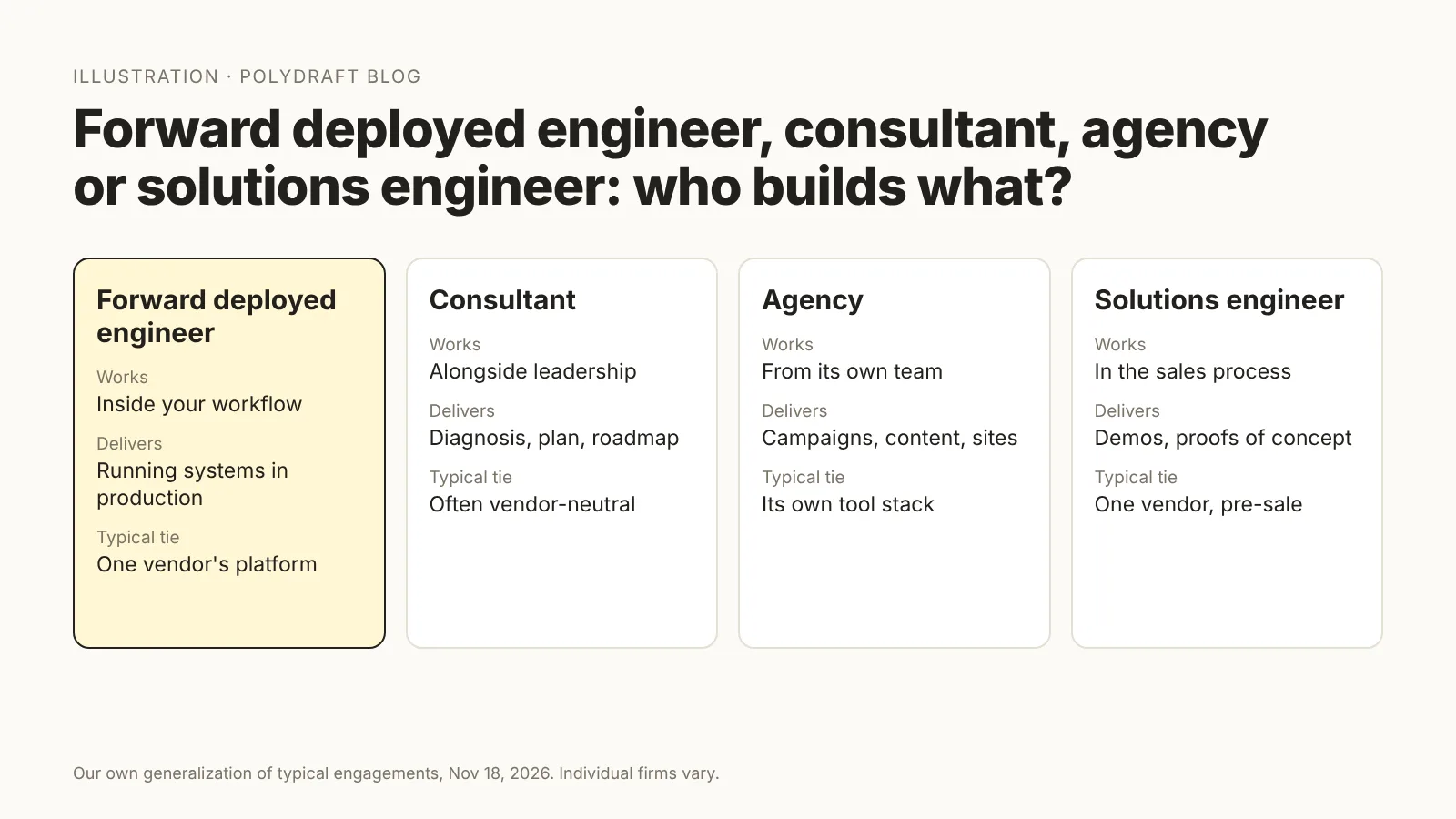
The clearest difference is what you are left with at the end. A consultant typically leaves a plan, an agency leaves campaigns or assets it may keep running, a solutions engineer leaves a proof of concept, and an FDE leaves a working system inside your business.
This table is our own generalization of typical engagements, not a ranking. Individual firms blur these lines. Some consultancies employ FDEs, for example, and some agencies write production code. Use it to ask better questions, not to label a vendor.
| Forward deployed engineer | Consultant | Agency | Solutions engineer | |
|---|---|---|---|---|
| Main output | A system running in production | Diagnosis, strategy, roadmap; sometimes implementation | Campaigns, content, creative, sites | Demos, proofs of concept, technical answers |
| Where the work happens | Inside your tools and workflows | With your leadership; implementation firms also in your systems | In the agency's own team and tools | In the vendor's sales process |
| When it happens | After the contract, through rollout (some engagements are ongoing) | Before or alongside a project | Ongoing, on a retainer or per project | Before the contract |
| Writes production code or config | Yes, that's the core of the job | Varies; implementation consultancies do | Sometimes, for its own deliverables | Prototype level, usually not production |
| Tied to a vendor | Usually one vendor's platform | Often vendor-neutral | Its own preferred stack | One vendor |
| Main strength for the buyer | Deep platform skill applied to your real systems | A view across options and vendors | Steady output without hiring a team | Free technical help while you evaluate |
| Typical risk for the buyer | Lock-in to the vendor's platform; ongoing work stops when the engagement stops; accountability depends on written acceptance criteria | A plan nobody builds | Work that stops when the retainer stops | Overpromising before the sale |
Two rows matter most when you're buying.
Vendor tie. An FDE from an AI lab or a software company builds on that company's product. That is usually why the engineer is good at it, and also why the engineer won't recommend a competitor. If you need a neutral opinion on which platform to choose, get it from a consultant before you bring in an FDE.
Accountability. An FDE should be judged on whether the agreed workflow runs, not on hours spent. If a provider calls its people forward deployed but can't name acceptance criteria, you're buying staff augmentation under a new name.
FDE applied to marketing and websites
Anthropic's FDE posting describes "enterprise AI deployments" and lists financial services and healthcare/life sciences among useful backgrounds. The same model, an engineer running the AI tool for you inside your business, also appears in smaller, narrower forms. Websites, SEO and AI search are one example, and the one we work in. We didn't survey other small FDE-style providers for this article, so we don't name any.
For a small company's marketing, an AI FDE engagement usually means one engineer who:
- Builds or rebuilds the website on the provider's platform, so changes can ship directly instead of waiting in a developer backlog.
- Reads your search data (with your permission) and plans pages and articles from it.
- Fixes technical SEO problems on the site itself, rather than handing you a list of tickets.
- Structures pages so AI assistants such as ChatGPT, Gemini and Perplexity can read them. This work is often called generative engine optimization, or GEO; our buyer's guide to GEO services covers it in more detail.
- Reports what changed and what moved, with sources and dates.
Disclosure: AI FDE is our service. PolyDraft's AI FDE service page describes it as our AI SEO and GEO service, in which a PolyDraft engineer runs PolyDraft for you. According to that page, the engineer builds or migrates your site and does its technical SEO, content and AI-visibility work. Scope and pricing are agreed per engagement, with no ranking, traffic or AI-citation guarantees (checked November 18, 2026).
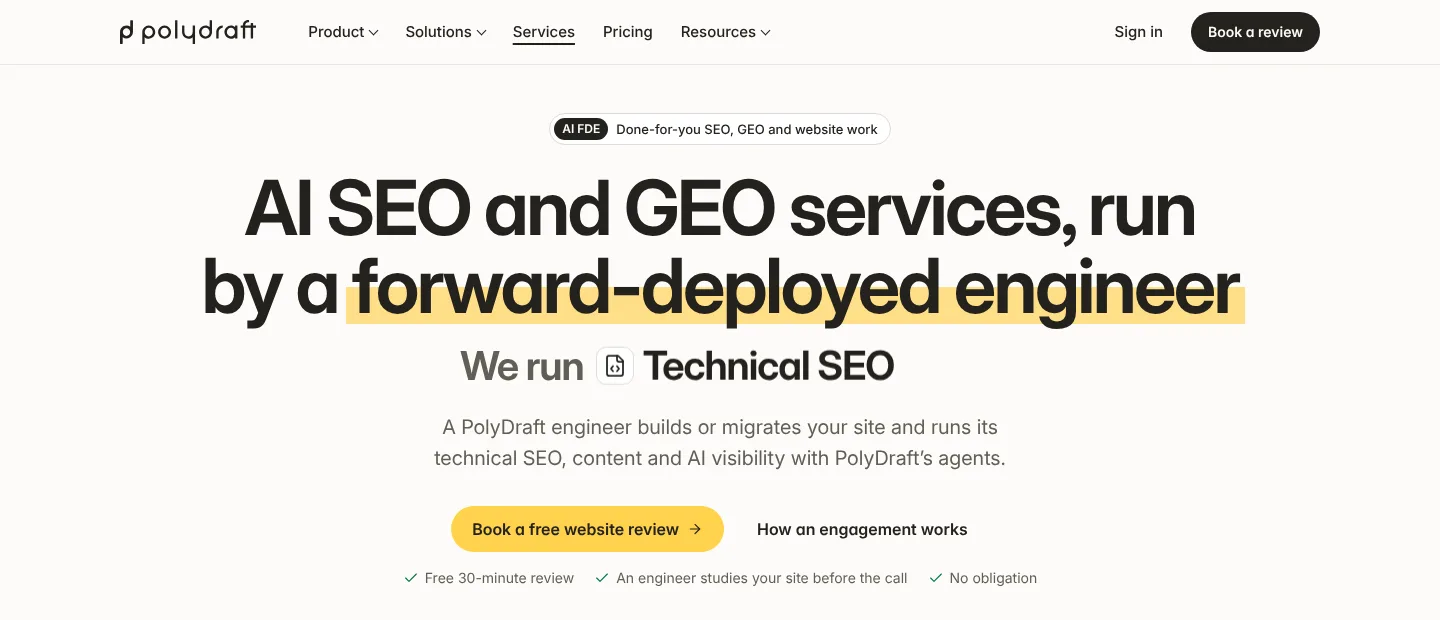
Our service has the same vendor tie as OpenAI's and Anthropic's FDE teams, and it runs like an agency retainer more than a one-time project. Weigh these points before you choose it:
- The engineer works on PolyDraft. The service page says the engineer usually rebuilds or migrates your site onto PolyDraft so changes can ship directly. If you want to keep your current platform, that's confirmed per project.
- It's ongoing, like an agency. Our pricing page describes the engineer running technical SEO, content and GEO every week. As with an agency retainer, that weekly work stops when the engagement stops. The site itself keeps running (see below).
- Moving a site is a rebuild, not an import. Our WordPress to Astro page explains that PolyDraft rebuilds a site from its public pages rather than copying the WordPress backend, and that redirects aren't generated automatically. The service page says the engineer maps and redirects every old URL before launch. Ask to see that redirect map before cutover.
- It isn't for online stores. The WordPress to Astro page says PolyDraft builds marketing and lead-generation sites, not a storefront. If your site's main job is selling products online, choose a commerce platform instead.
- What you keep. PolyDraft sites deploy to your own cloud account, and canceling a subscription doesn't take a deployed site down (per the WordPress to Astro page). Full source-code export is on the Agency plan, and project transfer is on Pro and above (per the pricing page, checked November 18, 2026).
If you need neutral advice on your marketing stack, or a team that will work on the platform you already have, a conventional agency or an independent consultant is usually the better fit.
When to use an FDE service instead of hiring or buying software
Use an FDE service when you need a working AI system in production, have no one in-house to build it, and the work is too specific for off-the-shelf software. If any of those three isn't true, a different option probably fits better.
| Your situation | Better fit | Why |
|---|---|---|
| A tool already does the job and your team can run it | Buy the software | Paying an engineer to run a tool your team could run is a common way to overspend. |
| You need the capability for years and it's core to your product | Hire | Knowledge stays in the company, and an employee isn't tied to one vendor. |
| You don't yet know what to build or which vendor to pick | Consultant first | An FDE is tied to one vendor's platform. Choose the platform before you bring in that platform's engineer. |
| You need ongoing campaigns, content or ads more than systems | Agency | Agencies are set up for recurring creative and marketing output. |
| You know the outcome, the work is technical and specific, and you can't justify a full-time hire | FDE service | You get an engineer who already knows the platform, without hiring and onboarding one. |
Three warning signs suggest an FDE engagement is premature:
- No one on your side owns it. An FDE builds inside your workflow, so someone at your company has to give access, answer questions and approve changes, usually every week.
- You can't say what "done" looks like. Without acceptance criteria, the engagement turns into open-ended hours.
- Your data or access isn't ready. If the engineer can't get read access to the systems that matter, such as Search Console for SEO work, the first weeks go to waiting.
What to ask before you sign: scope, approval, ownership of the output
The most important questions are about what gets built, who approves it, and who owns it when the engagement ends. Ask these in writing and keep the answers in the contract or statement of work. Several overlap with our SEO contract checklist, which covers contract terms for search work in more detail.
Scope
- What is the first workflow or outcome you will deliver, and what are the acceptance criteria?
- What is explicitly out of scope?
- Which platform will you build on, and what happens if we want to change platforms later?
- What access do you need from us (systems, data, accounts), and is any of it write access?
- Who on your side does the work, and is it the same person through the whole engagement?
Approval
- Which changes do you make on your own, and which need our sign-off?
- How do we review a change before it goes live, and how is it rolled back?
- For content or anything customer-facing: who checks facts and claims before publishing?
- How often do you report, and does each number in the report come with its source and date?
Ownership and exit
- Who owns the code, content, prompts, configuration and data you create?
- Where does the finished work live: in our accounts, or in yours?
- If we end the engagement, what keeps running, and what stops?
- Can we export everything in a usable format, and is that included or extra?
- Do you promise rankings, traffic or other outcomes you can't control? (A provider that promises AI citations or rankings is overpromising.)
You can ask us the same 14 questions. For PolyDraft's AI FDE, the short answers are on the service page and above: the work happens on PolyDraft, sites deploy to your own cloud account, the weekly work stops when the engagement does, and there are no ranking or citation guarantees.
Frequently asked questions
What is an AI forward deployed engineer?
An AI forward deployed engineer is an engineer from an AI vendor or service provider who works inside a customer's business to put AI systems into production. Unlike a typical strategy consultant, the FDE builds the system. Unlike a solutions engineer, the FDE works after the sale, through rollout.
What is the difference between a forward deployed engineer and a consultant?
A forward deployed engineer builds and ships a working system inside your business, usually on one vendor's platform. A consultant usually diagnoses problems and recommends a plan, often without vendor ties. Some consultancies also implement, and some employ FDEs.
Is a forward deployed engineer the same as a solutions engineer?
No. A solutions engineer supports the sales process with demos and proofs of concept before a contract is signed. A forward deployed engineer works after the contract, building production systems with the customer.
Which companies have forward deployed engineers?
Palantir says it "pioneered" the role, and it still advertises forward deployed engineer jobs. Anthropic advertises FDE roles in several cities. OpenAI also hires FDEs, according to search excerpts we couldn't confirm on its site. In May 2026 it announced DeployCo, an enterprise deployment company that, according to the same kind of excerpts, places FDEs inside client organizations. Smaller providers, including PolyDraft, offer FDE-style services in narrower areas such as websites and SEO.
When should a small business use an FDE service?
A small business should use an FDE service when it needs a specific technical outcome, has no engineer to build it, and can't justify a full-time hire. If existing software already does the job and someone on the team can run it, buying the software is cheaper.
Should AI FDE services promise rankings or AI citations?
They shouldn't. An FDE can be held to acceptance criteria for what gets built, but not to outcomes the provider doesn't control, such as search rankings or AI citations. PolyDraft's AI FDE makes no ranking, traffic or AI-citation guarantees.
Continue with the next task
- See how we run the service: PolyDraft AI FDE
- Evaluate GEO providers: Generative engine optimization services: a buyer's guide
- Put the answers in writing: SEO contract checklist
- Compare agency options: Best AI SEO agencies
About this article. Drafted by an AI agent following PolyDraft's blog workflow: Claude, made by Anthropic, one of the companies discussed here. PolyDraft sells the AI FDE service described in this article. Palantir and Anthropic quotes were checked in a browser against their open job postings on November 18, 2026. OpenAI's pages returned a bot challenge. The titles and dates of two OpenAI announcements were confirmed in OpenAI's own news feed on November 19, 2026; other OpenAI details come from search-engine excerpts and are marked as not confirmed on the original page. Job postings change often, so check the live listings. PolyDraft facts come from our service, pricing and WordPress to Astro pages, opened directly on November 18, 2026. We didn't hire, interview or test any FDE provider. The comparison tables and the hero diagram are our own generalizations, made for this article.
Sources
Palantir and Anthropic pages were opened and checked on November 18, 2026. OpenAI pages could not be opened (bot challenge). OpenAI's news feed was read on November 19, 2026 for announcement titles and dates; other OpenAI facts come from search excerpts.
- Palantir: Forward Deployed Software Engineer posting, London, Forward Deployed AI Engineer posting, Palantir careers: types of roles
- OpenAI: OpenAI news RSS feed (read November 19, 2026; confirms the next two titles and dates). Not opened, search excerpts only: What FDE means at OpenAI (Colin Jarvis, October 22, 2026), OpenAI launches DeployCo to help businesses build around intelligence (May 11, 2026), plus FDE postings on OpenAI's careers site by industry and city (not linked; they may have closed).
- Anthropic: Forward Deployed Engineer posting, London, Anthropic job board
- PolyDraft (opened directly, November 18, 2026): AI FDE service, Pricing, WordPress to Astro
- Search demand: DataForSEO Keywords Data, US / English, pulled November 17–18, 2026