In this article
- 01 What an SEO contract is for
- 02 The clauses, one by one
- 03 Ownership and access: the clause to read twice
- 04 Approval and change control
- 05 AI and automation terms
- 06 Results: what can and can’t be promised
- 07 Term, termination, and handover
- 08 The client’s side: what an agency should ask for
- 09 A fill-in template with sample clauses
- 10 Where PolyDraft fits
- 11 Frequently asked questions
- 12 Continue with the next task
- 13 Sources
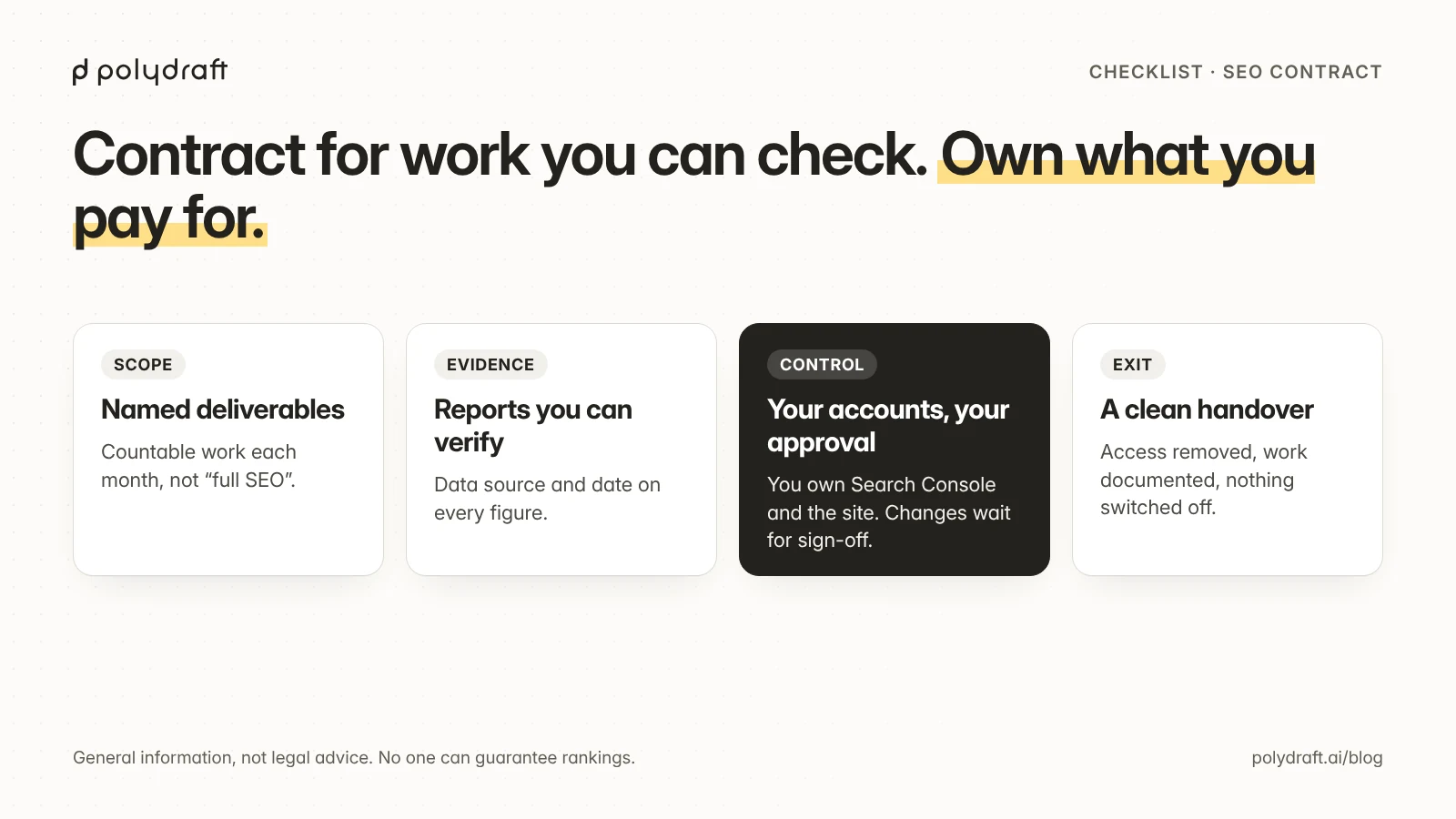
An SEO contract should say exactly what work will be done, how you'll check it, who owns the accounts and content, and what happens when the contract ends. Most templates cover scope, payment, and term. Put just as much detail into ownership of Search Console, analytics, and your website accounts. Require written approval before anything goes live, set terms for AI and automation, and agree a handover. Leave out ranking guarantees: Google's own guidance on hiring an SEO warns that no one can guarantee a top ranking.
This guide is for business owners hiring an SEO freelancer or agency, and for agencies and freelancers writing their own agreement. It walks through each clause from both sides, the red flags to push back on, and a fill-in template with sample wording you can take to your lawyer. It isn't legal advice. Have a qualified lawyer in your jurisdiction review any contract before you sign it.
Key points
- Contract for activities and deliverables you can check, not for rankings.
- Your business should own its Search Console property, analytics, domain, website, and content. The SEO provider gets user access, which you can remove.
- Require approval of the exact change before anything is published, redirected, or removed.
- Say how the provider may use AI and automation, and rule out automated link building and unreviewed mass publishing.
- Agree a handover in advance: access returned, work documented, redirects and content kept.
What an SEO contract is for
An SEO contract, also called an SEO services agreement, turns a vague promise ("we'll improve your SEO") into specific work you can check. The best ones answer five questions:
| Question | The clause that answers it |
|---|---|
| What exactly will you do each month? | Scope and deliverables |
| How will I know it was done and whether it helped? | Reporting and measurement |
| Who owns what we create and the accounts we use? | Ownership and access |
| What can change on my site without my sign-off? | Approval and change control |
| What happens if we stop working together? | Term, termination, and handover |
Templates from contract and SEO tool vendors usually cover the first and last questions well. They tend to be thinnest on ownership, approval, and automation, which is where a business has the least protection.
The clauses, one by one
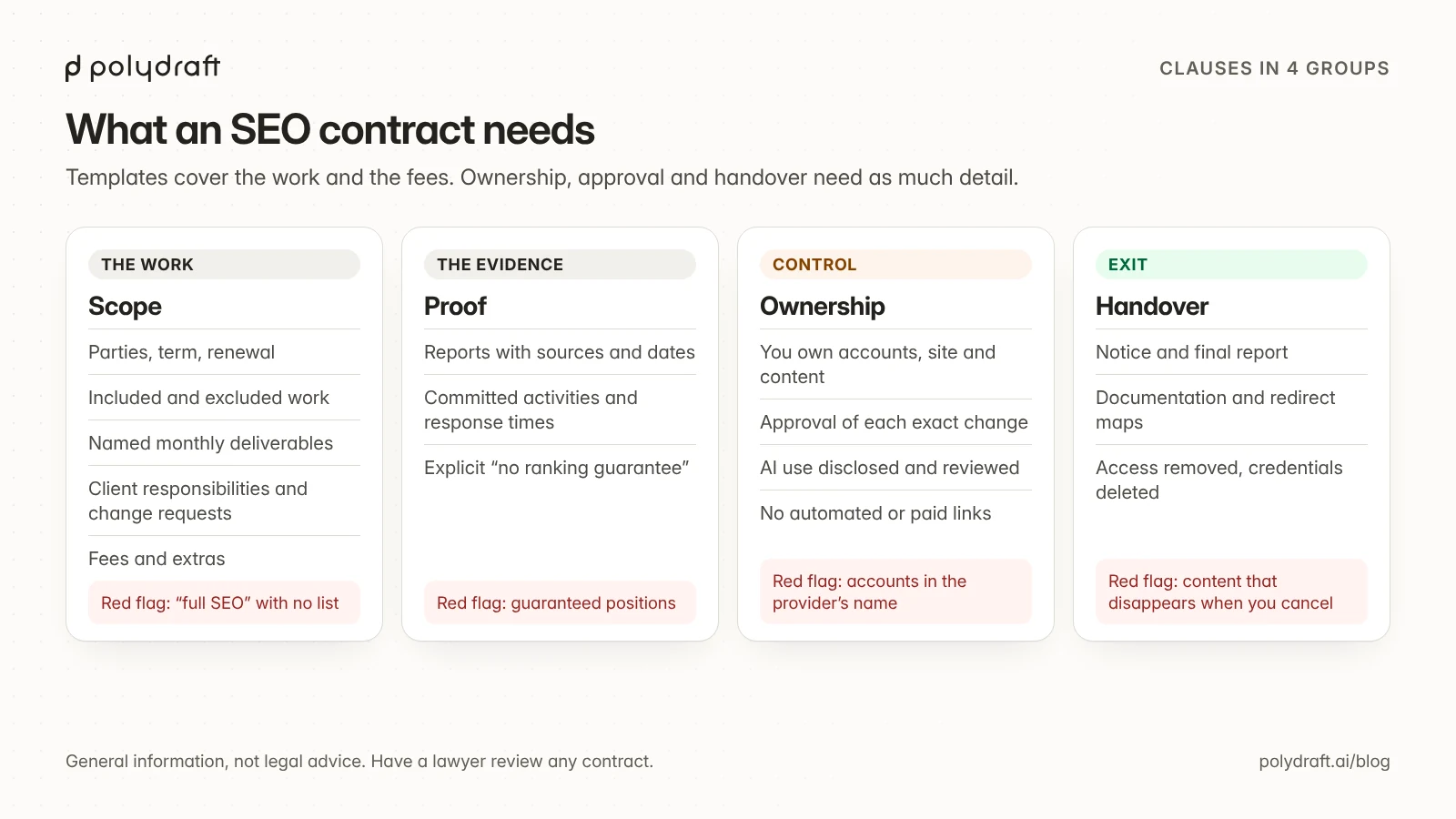
| Clause | What to write | Red flag |
|---|---|---|
| Parties and term | Legal names, start date, length, renewal, and notice period | Automatic renewal with a long notice period |
| Scope | The work types included (technical, on-page, content, local, links) and what's excluded | "Full SEO" with no list |
| Deliverables | Named outputs per month: an audit, a number of pages updated, a report | Deliverables measured only in "hours" or "effort" |
| Reporting | Frequency, metrics, data sources, and the date range of each figure | Reports from a private dashboard you can't check yourself |
| Results language | What the provider commits to (activities, response times) and an explicit "no ranking guarantee" | Guaranteed positions or traffic numbers |
| Ownership of accounts | You own Search Console, analytics, the domain, the CMS, and any business profiles. The provider gets user access | Accounts created and owned by the provider |
| Ownership of work | You own the content, code, and reports once paid for | The provider keeps rights to content on your site |
| Approval and change control | Nothing is published, redirected, removed, or set to noindex without written approval of that exact change. Every change is logged |
"We'll implement best practices" with no approval step |
| AI and automation | Whether AI is used, who reviews its output, and a ban on automated link building and unreviewed bulk publishing | Silence, or "proprietary methods" |
| Links | How links are earned, a ban on buying links that pass ranking credit, and disclosure of every link built | "X links per month" from undisclosed sources |
| Confidentiality and data | How your data and credentials are stored, and deleted at the end | Passwords shared by email or kept after the contract ends |
| Client responsibilities | Access granted by a set date, approvals within a set number of business days, a named contact, and the schedule pausing while approvals are late | Delays on the client side counted against the provider |
| Change requests | Work outside the scope is quoted and agreed in writing before it starts | "Small extras" that grow the scope without a price |
| Fees and payment | Amount, schedule, late-payment terms, what costs extra (content, tools, ads) | Tool costs billed with no list |
| Termination and handover | Notice, final report, access removed, documentation delivered, nothing switched off | Content, redirects, or pages that disappear when you cancel |
The rest of this guide covers the clauses that templates usually get wrong.
Ownership and access: the clause to read twice
Your SEO provider needs access to your data and your site. It doesn't need to own them. Search Console lets a property have owners and users, and owners control who else can see or change the property. Set yourself up as the owner, add your provider as a user, and remove them when the work ends. Do the same for analytics, your domain registrar, your website or CMS, and any business listings.
Write it into the contract:
- The business is the owner of every account used for the work, or the owner is moved to the business before the contract ends.
- The provider uses named user accounts, not a shared login, and gets the lowest access level each task needs.
- At the end of the contract, the provider's access is removed and any credentials it held are deleted.
The same applies to the work itself. Content, page templates, redirect maps, and reports should belong to the business once they're paid for. If your provider builds your website too, check where it's hosted and in whose account. A site in the provider's account can be hard to move.
Approval and change control
SEO work changes a live website, and some changes are hard to undo. Redirects, deleted pages, noindex tags, and robots.txt edits can take pages out of search. A clause that requires approval of each change before it goes live costs the provider little and protects you a lot.
What to write:
- Approval covers the exact change. A draft, a diff, or a list of URLs and redirects, approved in writing. Changes made after approval need approval again.
- Risky changes need a second look. URL changes, redirects, deletions,
noindex, robots.txt, and anything that changes prices, service promises, or other claims. - Every change is logged. What changed, when, who approved it, and how to reverse it.
- The live result is checked. After publishing, the provider confirms the change is live and nothing else moved.
We learned why this matters on our own site. Before we let our publishing pipeline write to our CMS, we audited its API and found four ways a write could go wrong. One was that a post sent without a status is published immediately. Our AI agents in SEO guide lists all four and the control we added for each. A provider with access to your CMS can hit the same traps, so the approval clause should be explicit about drafts.
AI and automation terms
Most SEO providers use AI and automation somewhere: for research, drafting, audits, or reports. That's fine. Google's guidance says appropriate use of AI or automation isn't against its guidelines. Its spam policies target automation used mainly to manipulate rankings, such as generating many pages that don't help users, or using automated programs or services to create links. Your contract should keep the useful part and rule out the risky part.
A short clause can cover it:
- The provider discloses which deliverables involve AI or automated tools.
- A named person reviews every piece of content, metadata, and structured data before it's submitted for approval, and checks facts against sources.
- No automated link building, link networks, or paid links that pass ranking credit.
- No bulk publishing of pages without individual review.
- Your data and documents aren't used to train third-party models without your consent.
If you're comparing tools rather than services, our auto SEO software guide has a 12-question scorecard that works for both. If you're still deciding which searches the work should target, start with our guide to choosing SEO keywords.
Results: what can and can’t be promised
Google's guidance on hiring an SEO says no one can guarantee a top ranking, and warns against providers who claim a special relationship with Google. Google also says it doesn't accept payment to crawl a site more often or rank it higher in its organic results. So a contract can't honestly promise positions.
What a contract can promise:
| Can be promised | Can't be promised |
|---|---|
| The work in the scope, on a schedule | A ranking position |
| Response times for issues and questions | A traffic or revenue figure |
| A monthly report with named data sources | That Google will index every page |
| Fixes for problems the provider caused | Citations in AI answers |
Performance-based fees, where the provider is paid per ranking or per lead, need extra care. It can push a provider toward tactics that move a number quickly and leave you with the risk. If you choose it, define the metric precisely, cap it, and keep the AI and link clauses above.
Term, termination, and handover
Agree how the relationship ends before it starts. A good handover clause includes:
- Notice. A notice period in proportion to the term. For a monthly retainer, we'd suggest something like 30 days.
- A final report. The work done, open issues, and the state of each account.
- Documentation. Redirect maps, a list of pages changed, content files, and anything set up in tools or the CMS.
- Access removed. The provider's user accounts are removed, and credentials are deleted.
- Nothing switched off. Content, redirects, tracking, and pages stay in place when the contract ends.
If URLs changed during the contract, keep the redirect map. Our website redesign SEO checklist explains how to maintain one.
The client’s side: what an agency should ask for
A fair contract protects the provider too. If you're the agency or freelancer, make sure the agreement covers:
- Access on time. The client grants Search Console, analytics, and CMS access by a set date. Work that depends on it starts when access arrives.
- Approvals on time. The client approves or rejects submitted changes within a set number of business days. Deadlines move while approvals are late.
- One decision-maker. A named contact who can approve changes, so drafts don't wait on a committee.
- Change requests. New work is quoted and agreed in writing before it starts.
- Payment terms. Due dates, late-payment terms, and the right to pause work when invoices are overdue.
- Claims the client supplies. The client is responsible for the accuracy of prices, credentials, and other facts it provides.
These clauses keep the approval and ownership terms above workable. A provider can't be held to a schedule if the client controls the approvals.
A fill-in template with sample clauses
Copy this into a document, replace the bracketed text, and have your lawyer turn it into a contract that fits your jurisdiction. It's a starting point, not a finished agreement:
SEO SERVICES AGREEMENT

1. Parties and term
   This agreement is between [Business legal name] ("Client") and
   [Provider legal name] ("Provider"). It starts on [date], runs for
   [number] months, and then continues month to month until either
   party gives [30] days' written notice.

2. Scope
   Provider will perform: [technical SEO / on-page / content / local /
   link outreach]. Not included: [paid ads / web development / ...].

3. Monthly deliverables
   Each month Provider delivers: [e.g. 1 technical audit update,
   4 page updates, 2 new articles, 1 report]. Unused deliverables
   [do / do not] roll over.

4. Reporting
   By the [5th] business day of each month, Provider sends a report
   showing the work done and the metrics agreed in Schedule A, with the
   data source and date range for every figure.

5. Results
   Provider commits to the work, schedule, and response times in this
   agreement. Provider does not guarantee any ranking, traffic, or
   revenue outcome.

6. Ownership of accounts
   Client owns its Search Console properties, analytics accounts,
   domain, website, CMS, and business listings. Provider receives
   named user access at the lowest level each task needs. Client may
   remove that access at any time.

7. Ownership of work
   On payment, Client owns all content, code, redirect maps, and
   reports created for Client under this agreement.

8. Approval and change control
   Provider will not publish, redirect, delete, set to noindex, or
   change robots.txt for any page without Client's written approval of
   that exact change. Provider keeps a log of every change, including
   who approved it and how to reverse it, and checks the live result
   after each release.

9. AI and automation
   Provider will disclose which deliverables use AI or automated tools.
   A named person reviews every deliverable and checks its facts before
   submitting it for approval. Provider will not use automated link
   building, link networks, or unreviewed bulk publishing, and will not
   use Client data to train third-party models without consent.

10. Links
    Provider will not buy links that pass ranking credit and will list
    every link it builds or requests, with the date and source.

11. Client responsibilities
    Client grants the access in Schedule B by [date], names [contact]
    as the approver, and responds to approval requests within [3]
    business days. Deadlines move by the length of any delay.

12. Change requests
    Work outside section 2 is quoted in writing and starts only after
    Client approves the quote.

13. Fees and payment
    Client pays [amount] per [month], invoiced on [date], due within
    [14] days. Tools and third-party costs are [included / billed at
    cost with prior approval]. Provider may pause work while an
    invoice is more than [30] days overdue.

14. Confidentiality and data
    Each party keeps the other's confidential information private.
    Provider stores credentials securely and deletes them when the
    agreement ends.

15. Termination and handover
    Either party may end this agreement with [30] days' written notice.
    Within [10] business days of the end, Provider delivers a final
    report, documentation of all changes, and redirect maps, and
    removes its access. Provider will not remove content, redirects,
    or tracking from Client's site.

16. Liability, disputes, and governing law
    [To be drafted by your lawyer.]

Schedule A: metrics and data sources
Schedule B: accounts and access levels
Where PolyDraft fits
PolyDraft is an AI website builder, not an SEO agency, but several of these clauses depend on how the website is set up. As of October 26, 2026, paid plans deploy sites to the client's own Cloudflare account, where the client connects their own domain, and cancelling a subscription doesn't take a deployed site down. Agencies can work with Owner, Editor, and Viewer roles. Project transfer to a client account is on Pro and above, and full source-code export is on the Agency plan. That makes the ownership and handover clauses easier to keep. See PolyDraft for agencies, and our guide to delivering client websites with AI.
Frequently asked questions
What should an SEO contract include?
Scope, named deliverables, client responsibilities, reporting with data sources, results language without ranking guarantees, ownership of accounts and work, approval before changes go live, AI and automation terms, link methods, fees, and a termination and handover clause.
Can an SEO agency promise a ranking?
No. Google's guidance on hiring an SEO says no one can guarantee a top ranking. An agency can commit to work, schedules, response times, and reporting.
Who should own the Search Console account?
The business. Make yourself the owner of the Search Console property, add your SEO provider as a user, and remove that access when the contract ends.
How long should an SEO contract be?
Long enough to complete and measure the agreed work. Changes in search often take months to show, so many retainers run several months with a short notice period after that. Avoid long automatic renewals.
What happens to content and links when an SEO contract ends?
That depends on the contract, so write it down. Content, redirects, and pages should stay on your site and belong to you. The provider should list every link it built and must not remove your content when you leave.
Should an SEO contract mention AI?
Yes. Ask the provider to disclose AI use, have a person review every deliverable, and rule out automated link building and unreviewed bulk publishing.
Continue with the next task
- Decide what to do yourself and what to hire out: SEO for business
- Score a tool or service before you sign: Auto SEO software
- Plan the budget around the build: Website cost breakdown
About this article. Drafted by an AI agent following PolyDraft's blog workflow, checked by an automated QA script, reviewed by separate AI agents, and approved by Vincent Chen. This article is general information, not legal advice. We paraphrase Google's guidance rather than quote it. Its pages are linked below. PolyDraft plan details come from our agency page as of October 26, 2026. The clause checklist and fill-in template are our own. The diagrams are original illustrations made for this article.
Sources
- Google Search Central: Do you need an SEO?
- Google Search Central: In-depth guide to how Google Search works
- Google Search Central: Spam policies for Google web search
- Google Search Central Blog: Google Search's guidance about AI-generated content
- Search Console Help: Managing owners, users, and permissions
Written by
Founder of PolyDraft and CEO of BlackMonolith, Inc.