Best GEO Tools in 2026: 5 We Ran on Our Own Brand, 5 We Could Not Test
We tried 10 GEO tools on our own brand on 18 Nov 2026. Five returned results and five we could not test. Prices, free plans, limits and where results differ.
Short answer. The best GEO tools depend on what you need, and we could only run five of these ten ourselves. For a free baseline today, run the Ahrefs and Semrush free AI visibility checkers, then keep your own prompt sheet. For real prompt tracking without paying, AthenaHQ's free credits gave us the only tracker we ran from start to finish. If you already pay for Semrush or Ahrefs, price their AI visibility add-ons first. Our guide to SEO tools for small business covers their free tiers. HubSpot's and Mangools' free graders check how models describe your brand, but they don't track anything over time. We could not test Otterly.AI, Peec AI, Profound, Scrunch or Writesonic, so we compare those five on published prices and plan limits only. Of those, Otterly.AI has the lowest listed entry price ($29 a month), and Writesonic bundles tracking with AI content.
We tried to run all ten on one brand, PolyDraft (polydraft.ai), on 18 November 2026. Five gave us results. Five we could not test, and each entry says why. Those reasons are limits of our test setup, not verdicts on the tools. The clearest finding: the tools that did run disagreed with each other, and one described our own product wrongly.
In brief
- "GEO tools" here means generative engine optimization tools: software that checks or tracks how a brand shows up in ChatGPT, Perplexity, Gemini, Google AI Overviews and similar assistants.
- This is for founders and marketers choosing a first tool. It doesn't apply if you need a GEO agency; see our guide to choosing a GEO service and our comparison of the best AI SEO agencies.
- No tool can make an assistant cite you. The good ones show you their prompts, their raw answers and their sources.
- We make PolyDraft, an AI website builder. It is not a GEO tracker, so it isn't ranked below. We explain where it fits near the end.
At a glance
Prices were re-checked on each vendor's own page on 18 November 2026, in US dollars, excluding tax. For the five tools we didn't test, "Best for" reflects their published plans, not our experience.
| Tool | Best for | Starting price | Free plan | Key limit | How we evaluated it |
|---|---|---|---|---|---|
| AthenaHQ | Trying real prompt tracking for free | Free (300 credits, one time); Starter $295/mo | Yes | Free credits run out; some sections locked | Hands-on: free account |
| Ahrefs Brand Radar | Teams already on Ahrefs | Free checker; Prompt Tracking from $50/mo, with a quota included on paid plans from Lite ($129/mo) | Free checker only | Free view shows totals only | Hands-on: free checker, in a browser signed in to an existing Ahrefs account (paid Brand Radar not tested) |
| Semrush AI Visibility Toolkit | Teams already on Semrush | Free checker; toolkit $99/mo | Free checker only | No free trial for the toolkit | Hands-on: public tool (paid toolkit not tested) |
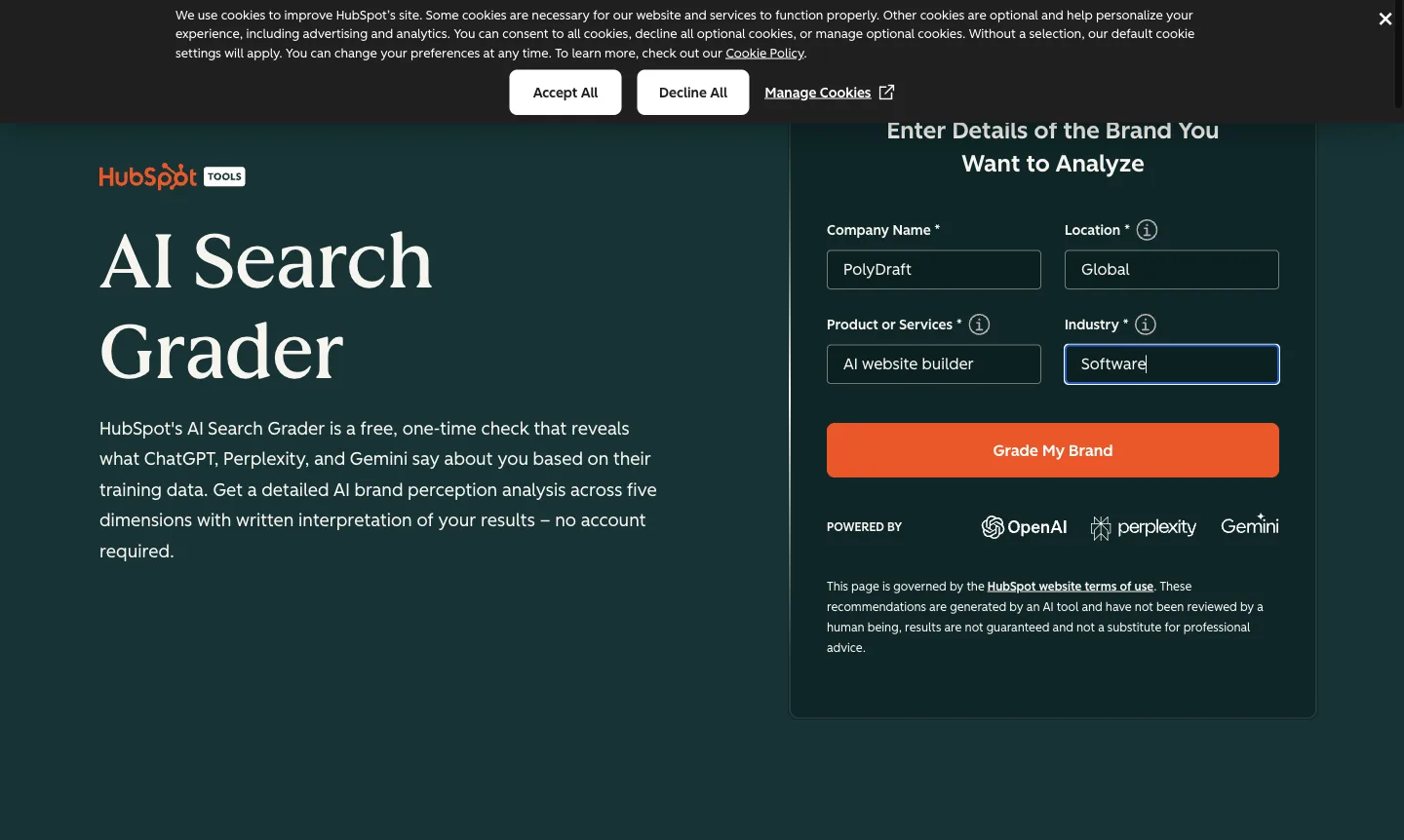
| HubSpot AI Search Grader | A one-time brand perception check | Free | Yes | One-time; full report behind a form | Hands-on: public tool |
| Mangools AI Search Grader | Seeing which competitors models name | Free | Yes | Three models without an account | Hands-on: public tool |
| Otterly.AI | A low entry price for a dedicated tracker | Lite $29/mo (20 prompts) | Free trial | Small prompt count on Lite | Not tested: pricing page only |
| Peec AI | Teams tracking several markets | Starter $95/mo (50 prompts) | Free trial | Three models and one country on Starter | Not tested: pricing page only |
| Profound | Enterprise AI search programs | Free 7-day trial; Enterprise custom | Trial only | No self-serve paid plan listed | Not tested: pricing page only |
| Scrunch | Monitoring plus site audits | Core $250/mo | 7-day trial | Four engines on Core | Not tested: pricing page only |
| Writesonic | AI visibility plus AI content in one tool | Starter $79/mo, billed annually | Free start, no card | Three engines on Starter | Not tested: pricing page only |
How we tested, in short
We used one subject for every tool: PolyDraft, polydraft.ai, described as an "AI website builder" in software, with a global or United States audience. Where a tool wrote its own prompts, we accepted them and recorded them. Where we could sign up for free with Google and no card, we did. Our test rules kept everything in one browser tab. Where a tool needed a card, a password account, or a sign-in flow that left that tab, we stopped and marked it "Not tested". The full method, including what we didn't test, is at the end.
What the five hands-on tools said about the same brand
| Tool | What it checked | Result for PolyDraft | Time to first result |
|---|---|---|---|
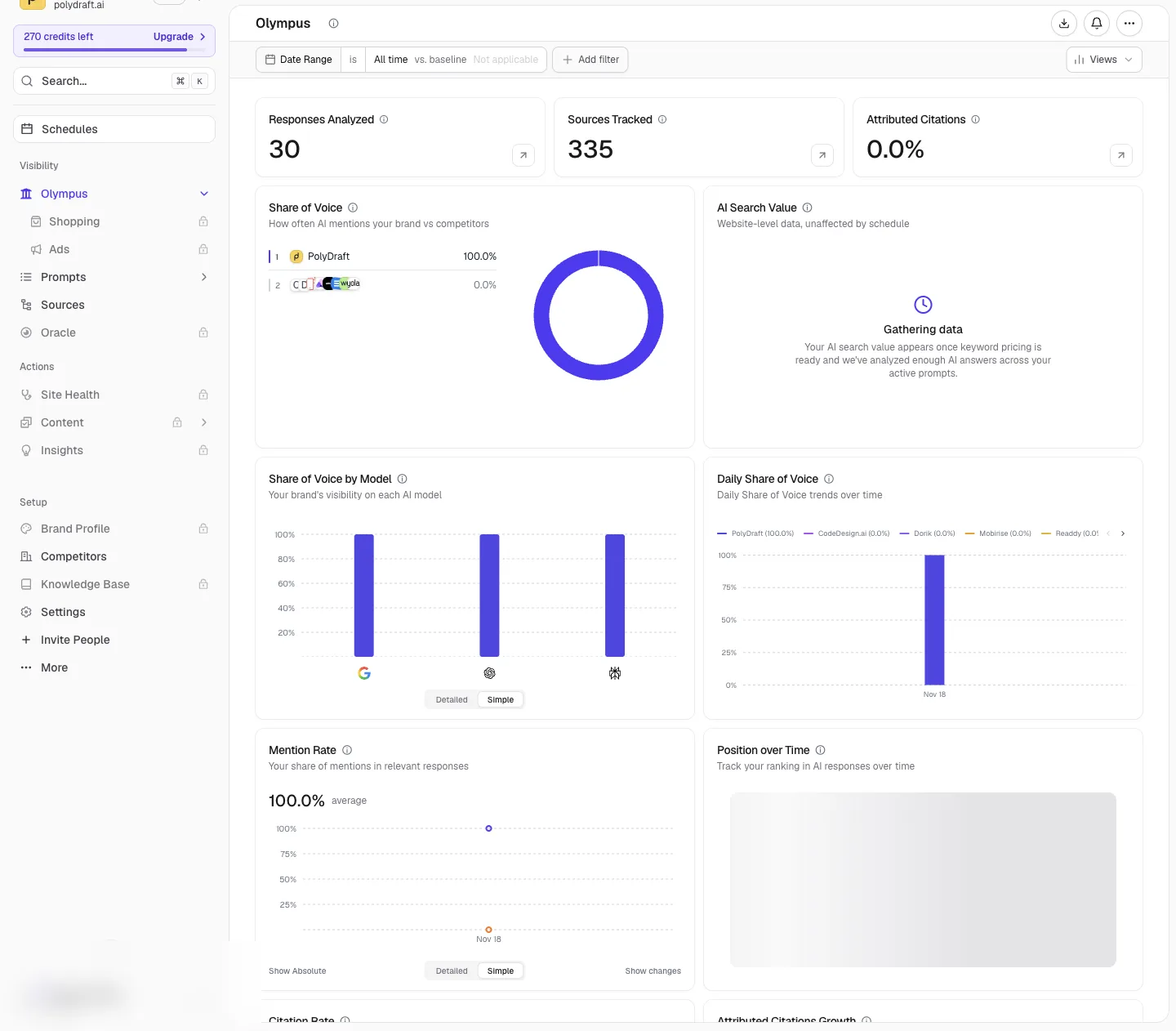
| AthenaHQ | 10 prompts it generated; 30 responses | Mentioned in 3 of 10 prompts, all three branded; 0% on the 7 non-branded prompts; 0.0% attributed citations | One scheduled run, completed within the same session |
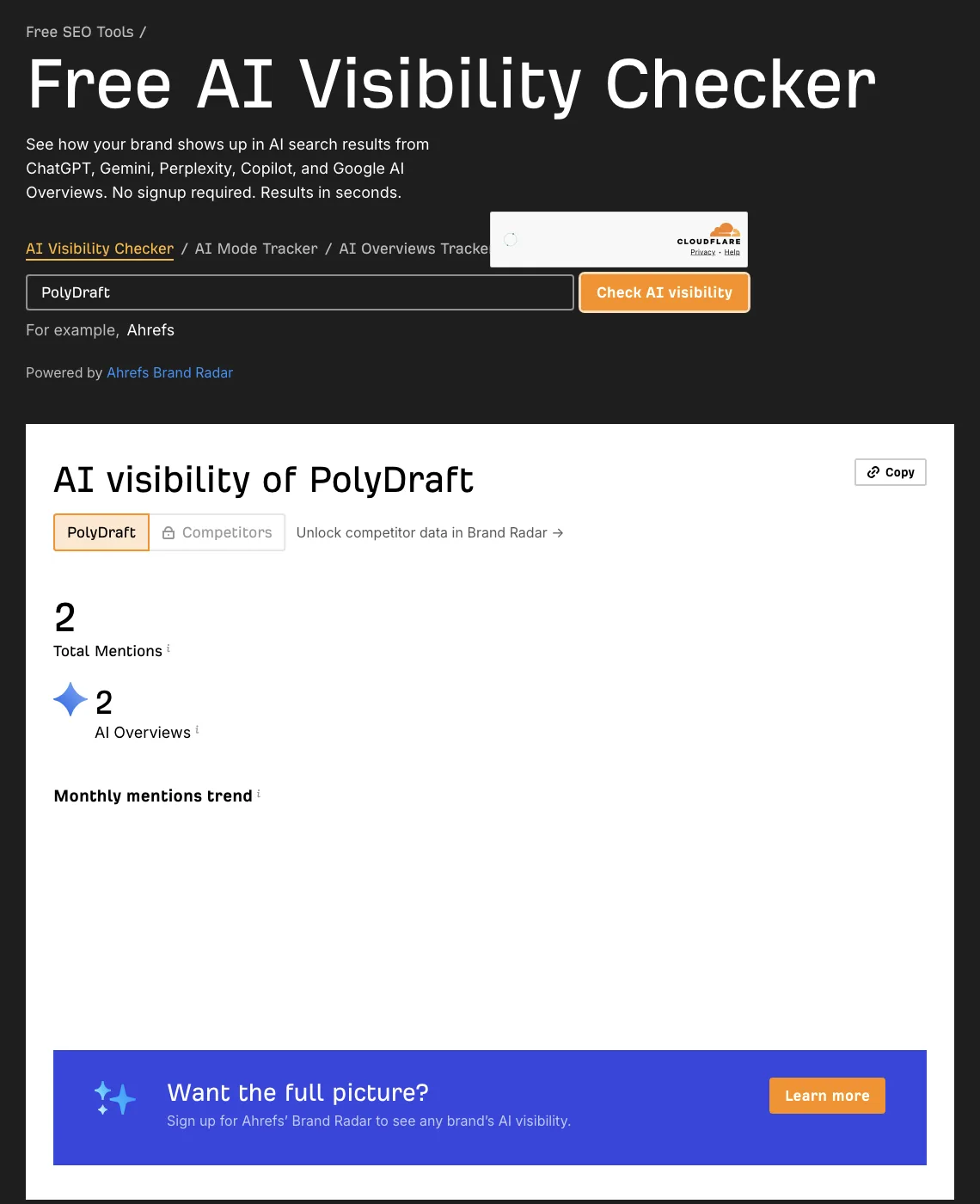
| Ahrefs free checker | Brand name in its AI answer database | 2 mentions, both in Google AI Overviews | About 20 seconds |
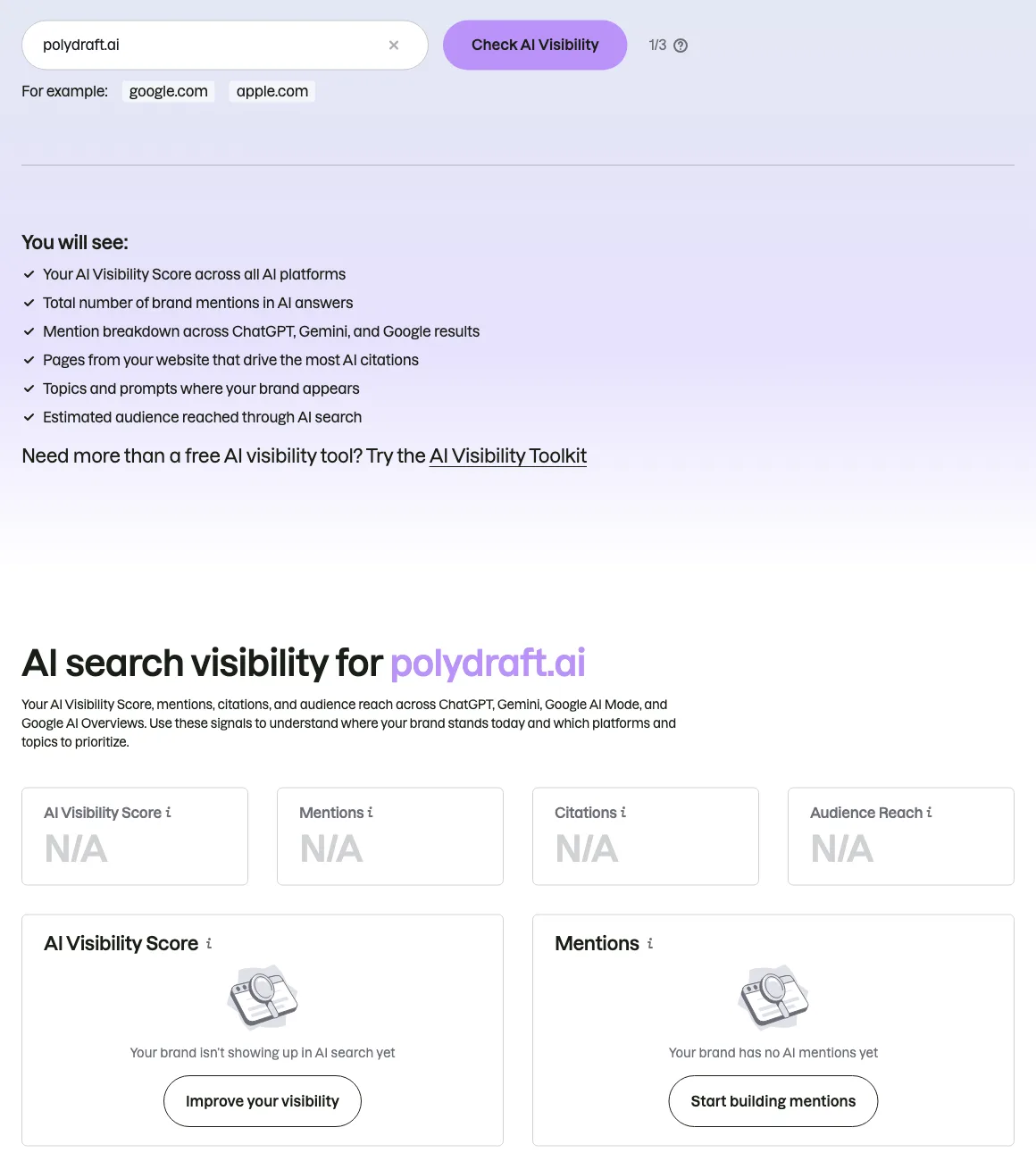
| Semrush free checker | Domain across ChatGPT, Gemini, AI Mode, AI Overviews | N/A for score, mentions, citations and reach | About a minute of polling, on the third click |
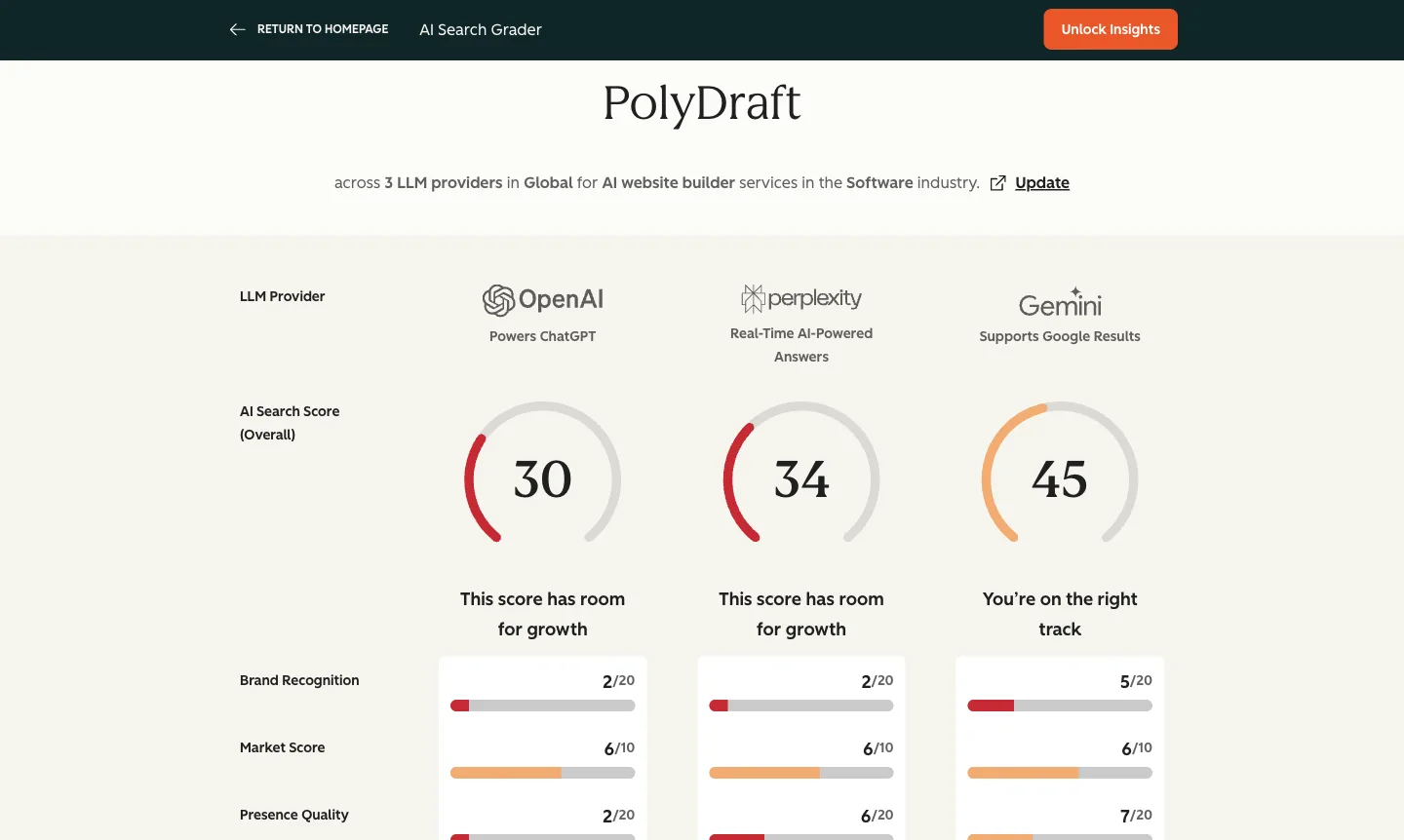
| HubSpot grader | How ChatGPT, Perplexity and Gemini describe the brand | Scores of 30, 34 and 45 out of 100; share of voice 0/10 on all three | About 45 seconds |
| Mangools grader | Category prompts it generated, on three free models | AI Search Score 0; brand described as CAD and BIM drafting software | Under a minute |
Three lessons came out of this:
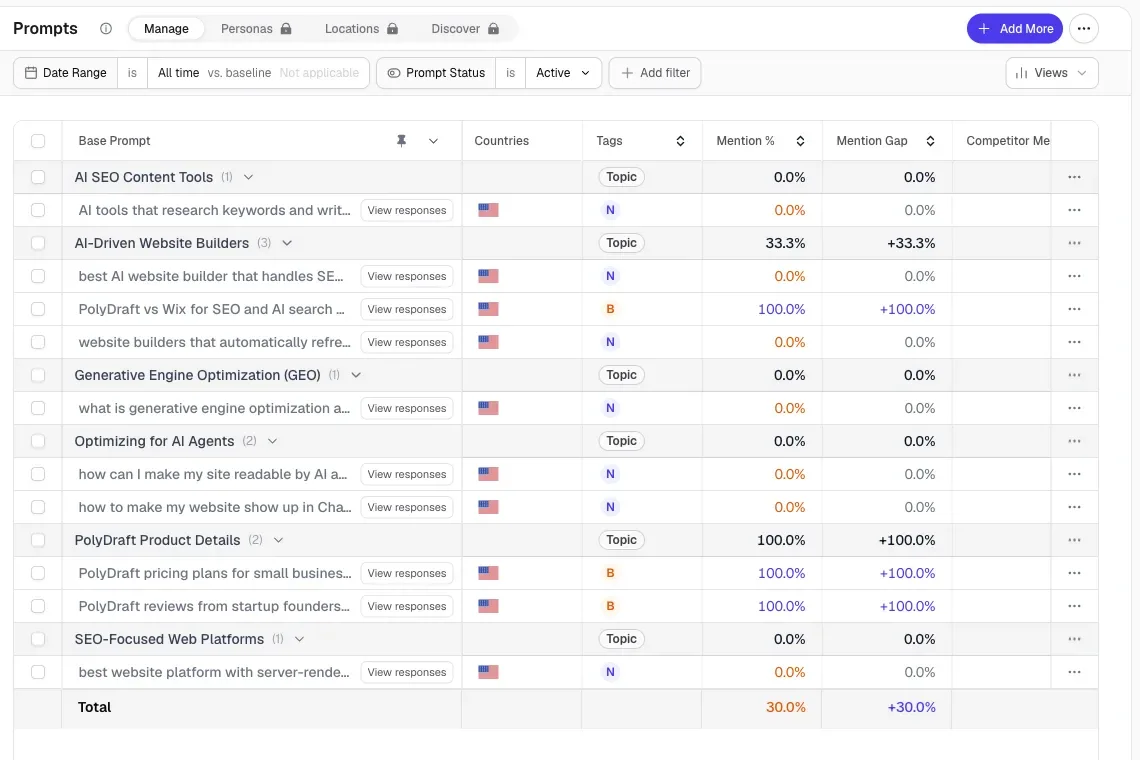
- Branded prompts inflate the headline number. AthenaHQ's chart showed PolyDraft at 100% share of voice. Every one of those mentions came from the three prompts that had "PolyDraft" in them. On the seven category prompts, we were mentioned 0 times. Filter branded prompts out before you read any share-of-voice chart.
- Free graders mostly test what a model remembers. HubSpot says its grader works from the models' "training data". Mangools' free tier runs small models, which is the likely reason it described PolyDraft as drafting software for architects. That makes a grader a useful accuracy check, but not a measure of live AI search.
- Data coverage decides what you see for a small brand. Semrush had no data for the domain polydraft.ai. Ahrefs found two mentions of the name "PolyDraft". The two take different inputs and sample different prompt sets, so the results aren't comparable. For a new site, a tracker that runs your own prompts tells you more than an index of someone else's.
This matches what we found when we ran our own eight-prompt test twice: polydraft.ai was absent from category answers both times.
The 10 GEO tools: five tested, five not
The order reflects how much we could verify, not a ranking of quality. Entries 1 to 5 are hands-on. Entries 6 to 10 rest on each vendor's pricing page as of 18 November 2026. "Not tested" means our setup couldn't complete the signup. It doesn't mean the tool failed.
1. AthenaHQ: best free way to try real prompt tracking
What it is. A prompt tracker. You add a website, and it writes a brand profile, a competitor list and a starter prompt set, then runs those prompts on a schedule.
Who it suits. A founder or small marketing team that wants to see real tracked answers before paying for a tool.
What we saw. We signed in with Google and added polydraft.ai. AthenaHQ read the site and described PolyDraft correctly as an AI website builder with SEO and GEO features. It then suggested eight competitors and ten prompts: seven non-branded and three branded. It offered a Google Search Console connection, which we skipped. We picked the free plan, and no card was asked for.
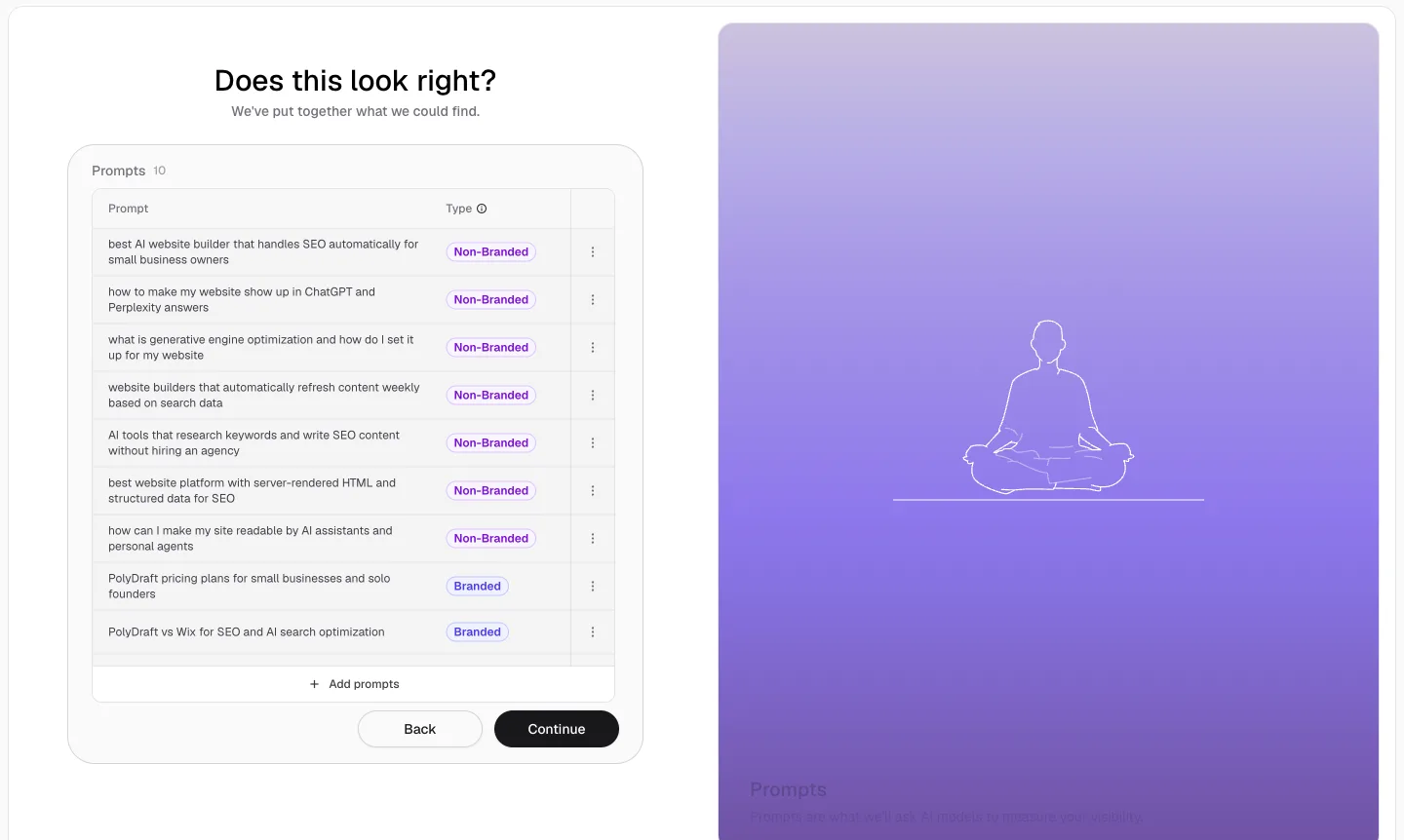
The first run analyzed 30 responses and tracked 335 sources. It cost 30 credits, so our balance went from 300 to 270. The prompt table was the most useful screen of the whole test. Mention rate was 100% for the three branded prompts and 0% for every non-branded one, for a 30% total.
Pricing. Free plan with 300 credits once ($25 value) across five models; Starter $295 a month with 3,600 credits and 11 models (AthenaHQ plans, checked 18 Nov 2026).
Limits. At 30 credits a run, 300 credits cover about ten runs of ten prompts. Some sections of the app are locked on the free plan. The default dashboard leads with share of voice, which reads high when branded prompts are mixed in.
Verdict. The best free starting point we found, as long as you read the prompt table and not the headline chart.
2. Ahrefs Brand Radar: best if you already use Ahrefs
What it is. Ahrefs' AI visibility product. Its AI Visibility Index looks up a brand in Ahrefs' own prompt database, and Prompt Tracking runs prompts you choose.
Who it suits. SEO teams already paying for Ahrefs, who want AI mentions next to their backlink and keyword data.
What we saw. The free Ahrefs AI visibility checker takes a brand name, not a domain. For "PolyDraft" it returned 2 total mentions, both in Google AI Overviews, in about 20 seconds. Competitor data and the trend view were locked. The free view shows totals only, so we couldn't confirm that both mentions refer to our PolyDraft and not another product with the same name. Our browser was signed in to an existing Ahrefs account, though the page says no signup is needed.
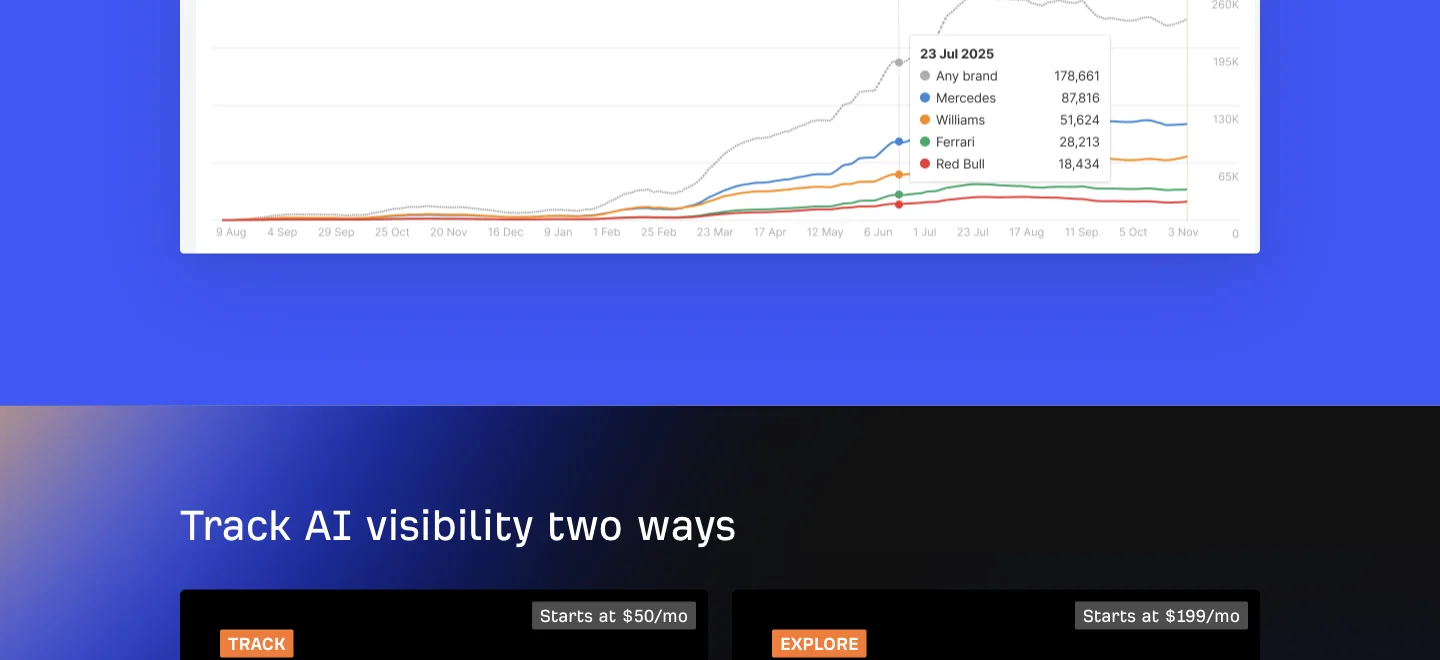
Pricing. Brand Radar lists Prompt Tracking from $50 a month, with a quota included on paid plans from Lite, which is $129 a month. The AI Visibility Index starts at $199 a month (Brand Radar, Ahrefs pricing, checked 18 Nov 2026).
Limits. We didn't test paid Brand Radar. Ahrefs' pricing FAQ says "We never run discounts" and points to the limited Ahrefs Free plan.
Verdict. Add it if Ahrefs is already your SEO tool. The free checker is a quick sanity check, but not a tracker.
3. Semrush AI Visibility Toolkit: best if you already use Semrush
What it is. A paid Semrush toolkit for AI visibility that includes Prompt Tracking.
Who it suits. Teams already on Semrush who want AI visibility data in the same account.
What we saw. The free Semrush AI visibility checker takes a domain. Our first click returned a reCAPTCHA error. The second showed nothing. The third produced the report after about a minute of polling. Every metric for polydraft.ai was N/A: score, mentions, citations, audience reach, cited pages and topics. A counter on the page fell from three checks to one along the way.
Pricing. The AI Visibility Toolkit costs $99 a month, includes 25 prompts for Prompt Tracking, and has no free trial (Semrush knowledge base, checked 18 Nov 2026). Semrush's combined SEO and AI search plans start at $139 a month, or $117.33 a month billed annually (Semrush pricing).
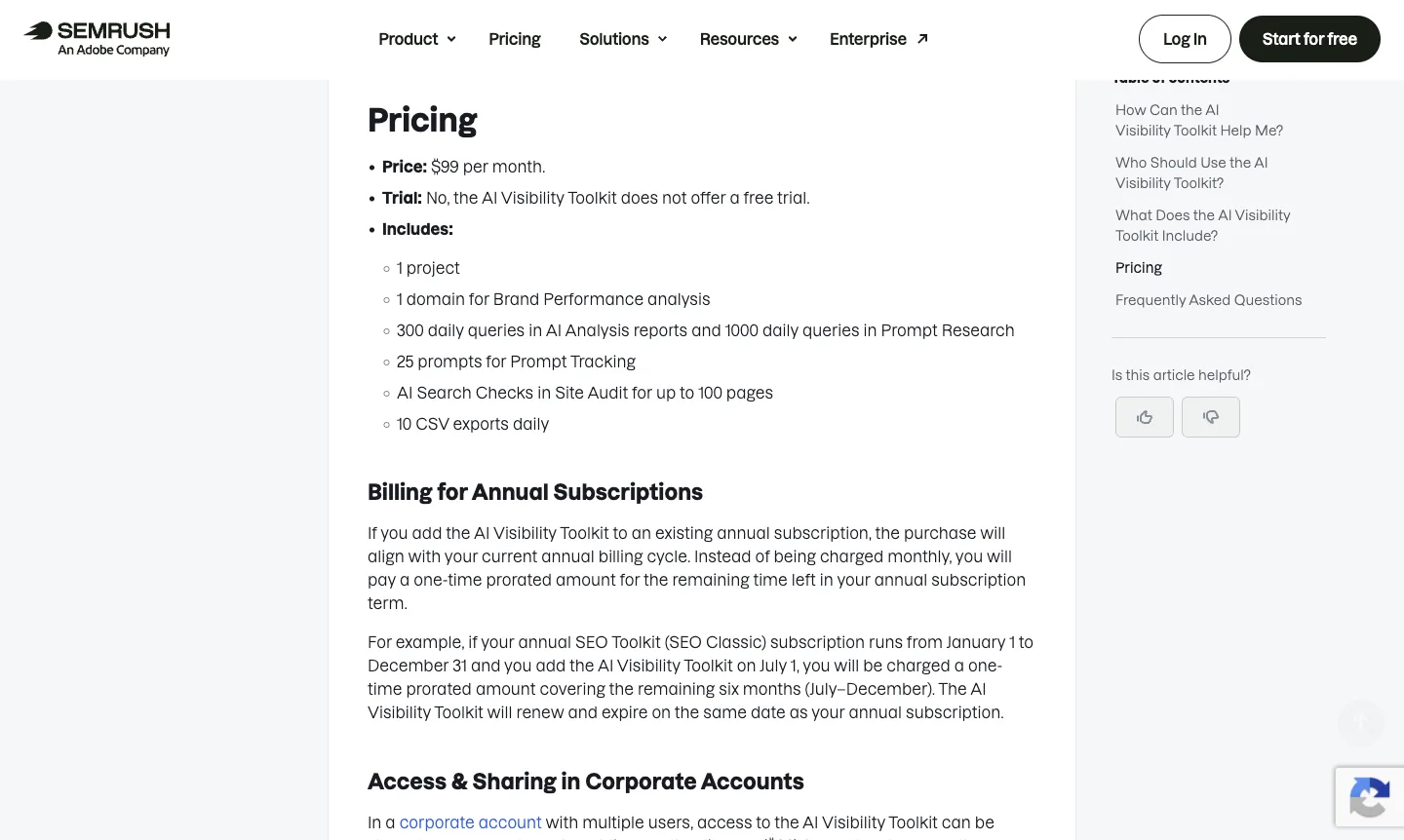
Limits. No trial, so we couldn't test the toolkit itself. An all-N/A result tells a new brand little.
Verdict. Worth pricing if you're already a Semrush customer. For a new brand, the free checker may show nothing at all.
4. HubSpot AI Search Grader: best for a quick brand perception check
What it is. A free one-time grader. It asks ChatGPT, Perplexity and Gemini how they characterize a brand and scores five dimensions.
Who it suits. Anyone who wants to know whether models recognize their brand.
What we saw. No account was needed. In about 45 seconds it scored PolyDraft 30 on OpenAI, 34 on Perplexity and 45 on Gemini. Brand recognition was 2, 2 and 5 out of 20. Share of voice was 0 out of 10 on all three. The detailed report sits behind a contact form, which we didn't submit.
Pricing. Free (HubSpot AI Search Grader, checked 18 Nov 2026).
Limits. HubSpot says it works from the models' training data, so it doesn't reflect live search results. It's one check, not a schedule.
Verdict. A good five-minute recognition check. Don't use it to measure progress.
5. Mangools AI Search Grader: best free view of who models recommend
What it is. A free grader that writes category prompts from your brand and niche, runs them on several models and ranks the brands that appear.
Who it suits. Small teams that want to see which competitors models name in their category.
What we saw. PolyDraft scored 0, present in 0% of the prompts checked. The useful part was the competitor table: Webflow, Squarespace, Strikingly, Weebly and Wix ADI led. The brand perception box described PolyDraft as "CAD-to-BIM" drafting software, which is wrong. Some of the generated prompts in locked rows were about search engines, not website builders.
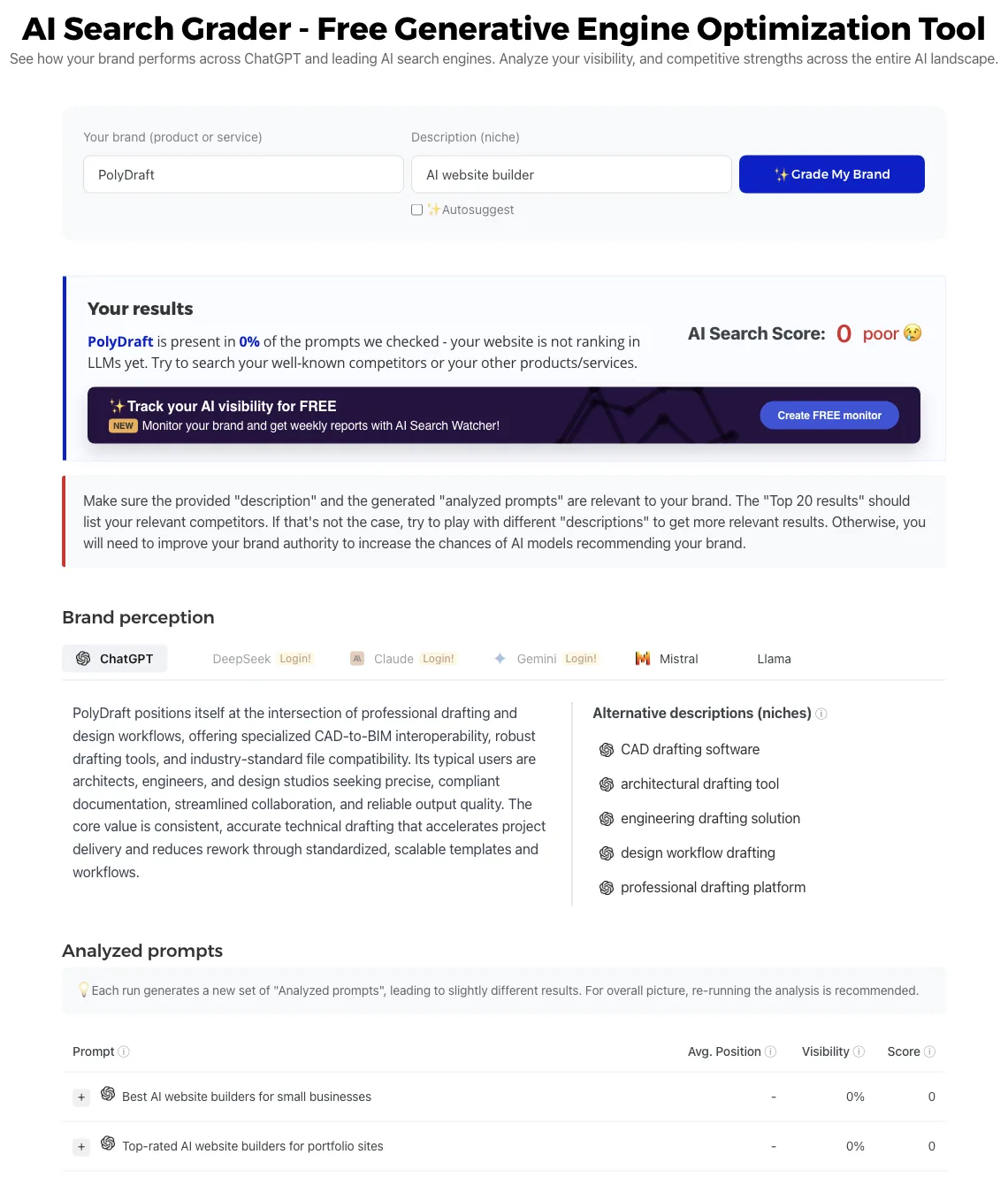
Pricing. Free, with three models (GPT-5 Nano, Mistral Small 3.2 and Llama 3.3) without an account. A free Mangools account opens all seven (Mangools AI Search Grader, checked 18 Nov 2026).
Limits. The grader writes its own prompts and we ran it once, so we can't say how stable the score is. The three free models are small ones, not the assistants most buyers use.
Verdict. Use it to find out who models think your competitors are, and to catch a wrong brand description early.
6. Otterly.AI: lowest listed price for a dedicated tracker (not tested)
What it is. A prompt tracker that covers seven AI engines, with three of them available on its entry plan.
Who it may suit. Solo marketers and small teams who want a tracker at a low monthly price.
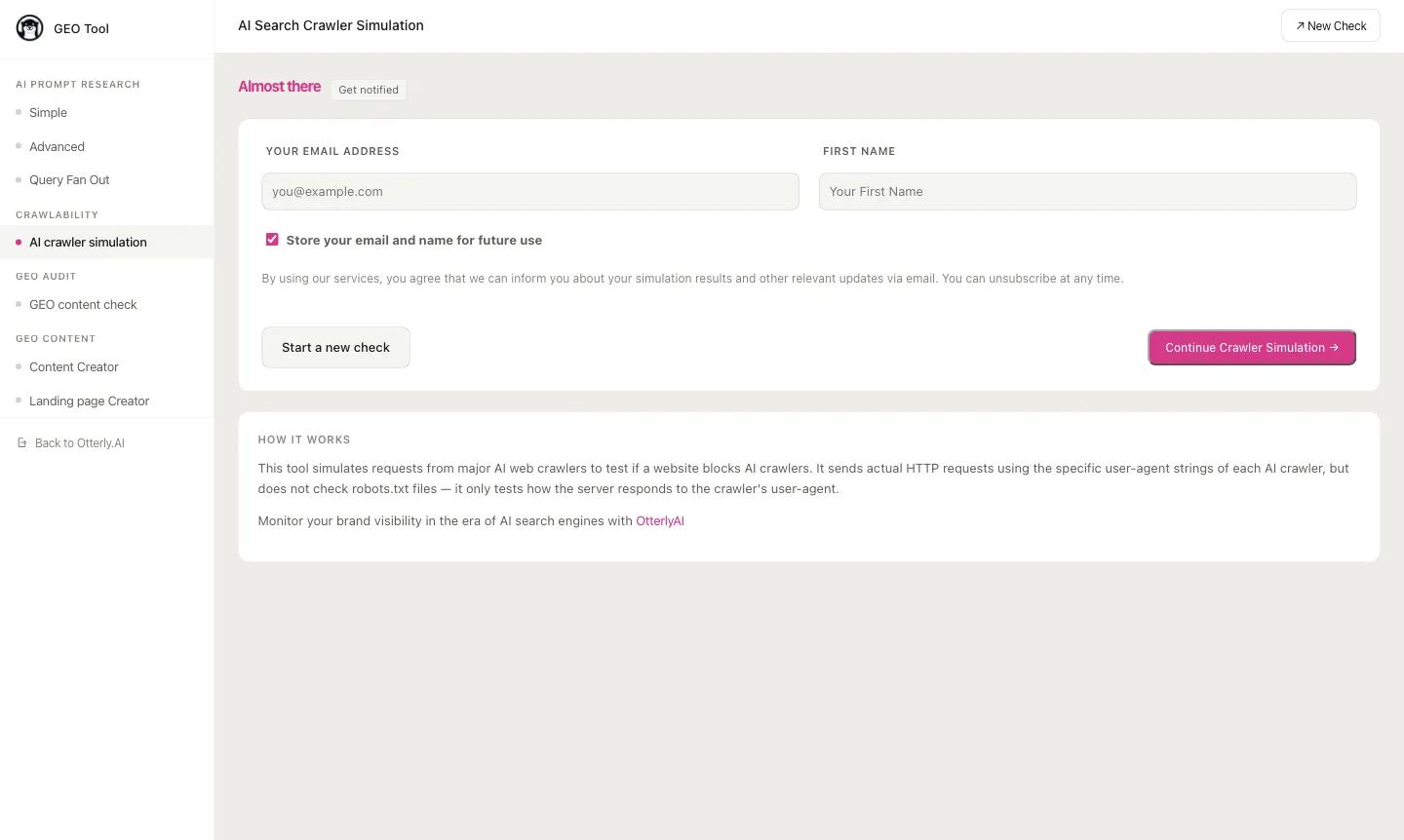
Why we didn't test it. Its "Sign up with Google" button opened a pop-up outside our browser tab, which our test rules didn't let us follow. Its free AI crawler simulation asked for an email address before showing results, so we stopped there.
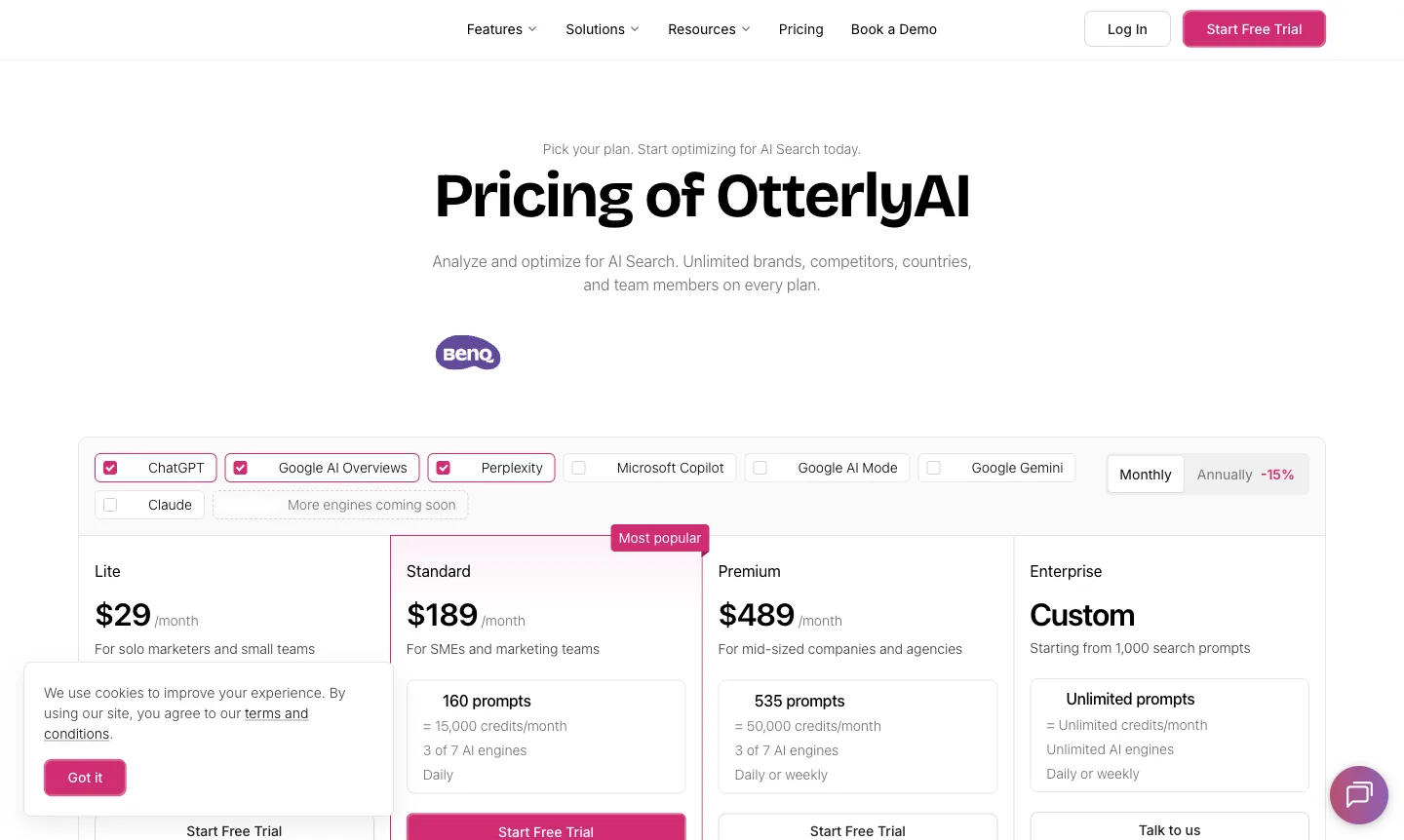
Pricing. Lite $29 a month for 20 prompts on 3 of 7 engines, daily; Standard $189; Premium $489; free trial for new users (Otterly.AI pricing, checked 18 Nov 2026).
Limits. Twenty prompts is a small panel. Otterly's own FAQ suggests 50 to 100 prompts per topic or market.
Verdict. The lowest listed entry price among the dedicated trackers here. We can't speak to the product, so trial it with your own prompts before committing.
7. Peec AI: plans built for several markets (not tested)
What it is. A prompt tracker sold in plans that scale by prompt count, AI models and countries.
Who it may suit. Marketing teams that track many prompts, or more than one country.
Why we didn't test it. "Continue with Google" opened a pop-up outside our tab. The other option, a magic link, goes to an inbox we didn't use for this test.
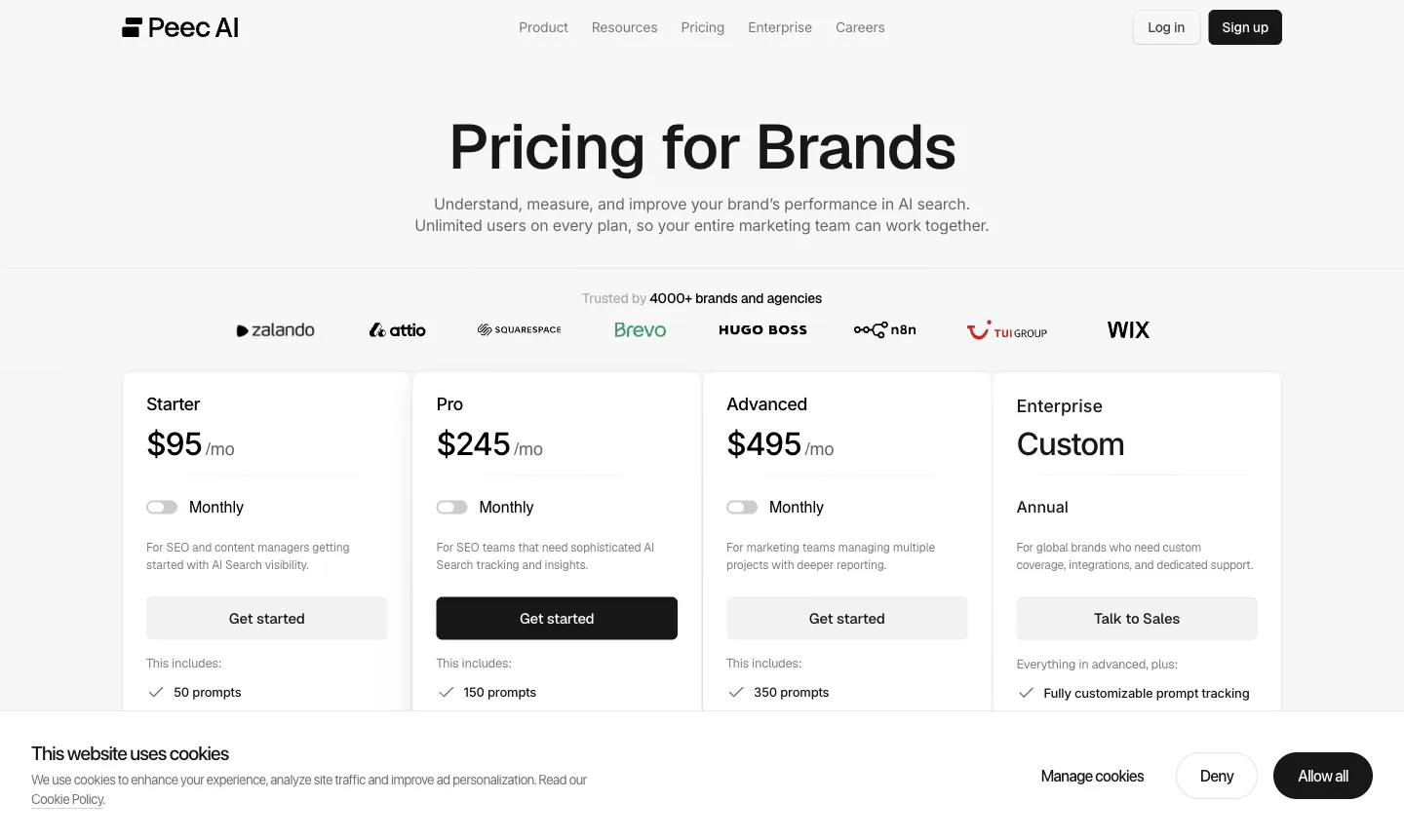
Pricing. Starter $95 a month (50 prompts, 3 models, daily, 1 project, 1 country); Pro $245 (150 prompts, 3 countries); Advanced $495 (350 prompts, 3 countries); Enterprise custom (Peec AI pricing, checked 18 Nov 2026). The page offers a free trial but doesn't state its length.
Limits. Three models and one country on Starter.
Verdict. A reasonable shortlist candidate for teams, on published limits alone. Check that the three models you pick match where your buyers ask.
8. Profound: trial and enterprise plans only (not tested)
What it is. An AI search visibility platform with prompt tracking, sold as a free trial or an enterprise contract.
Who it may suit. Larger brands with budget for an enterprise contract.
Why we didn't test it. Signup led to a form that requires a password. We didn't create a password account.
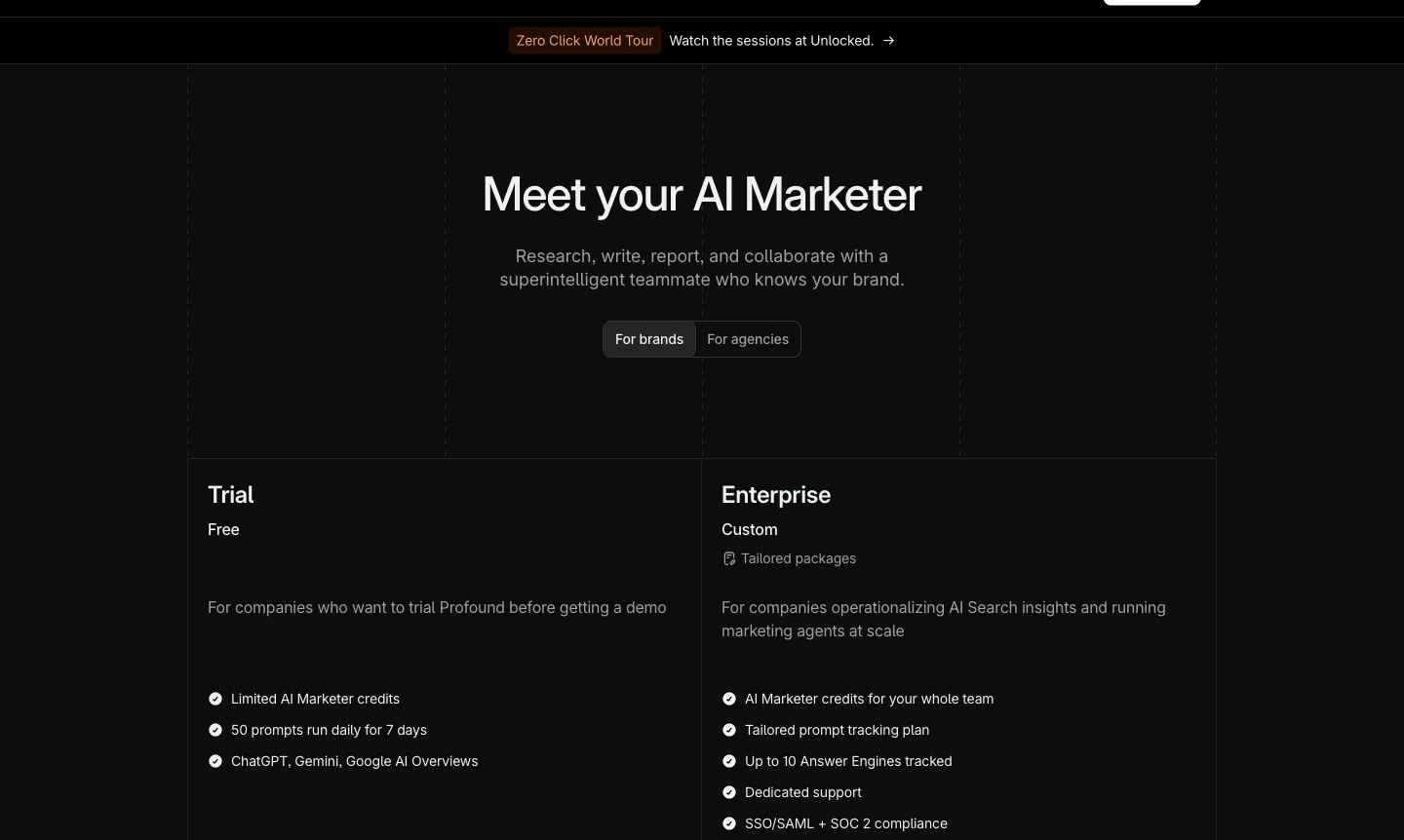
Pricing. Free trial with 50 prompts run daily for 7 days on ChatGPT, Gemini and Google AI Overviews, with no history, exports or API; Enterprise custom (Profound pricing, checked 18 Nov 2026).
Limits. No self-serve paid plan is listed. The trial lasts seven days.
Verdict. Ask for a demo if you have an enterprise budget. With no self-serve paid plan listed, it is likely more than most small businesses need.
9. Scrunch: monitoring plus site audits (not tested)
What it is. An AI search monitoring platform whose plans also include site audits.
Who it may suit. Brands that want tracking and a site-side audit in one contract.
Why we didn't test it. The signup page didn't load its form in our browser in two attempts on 18 November 2026.
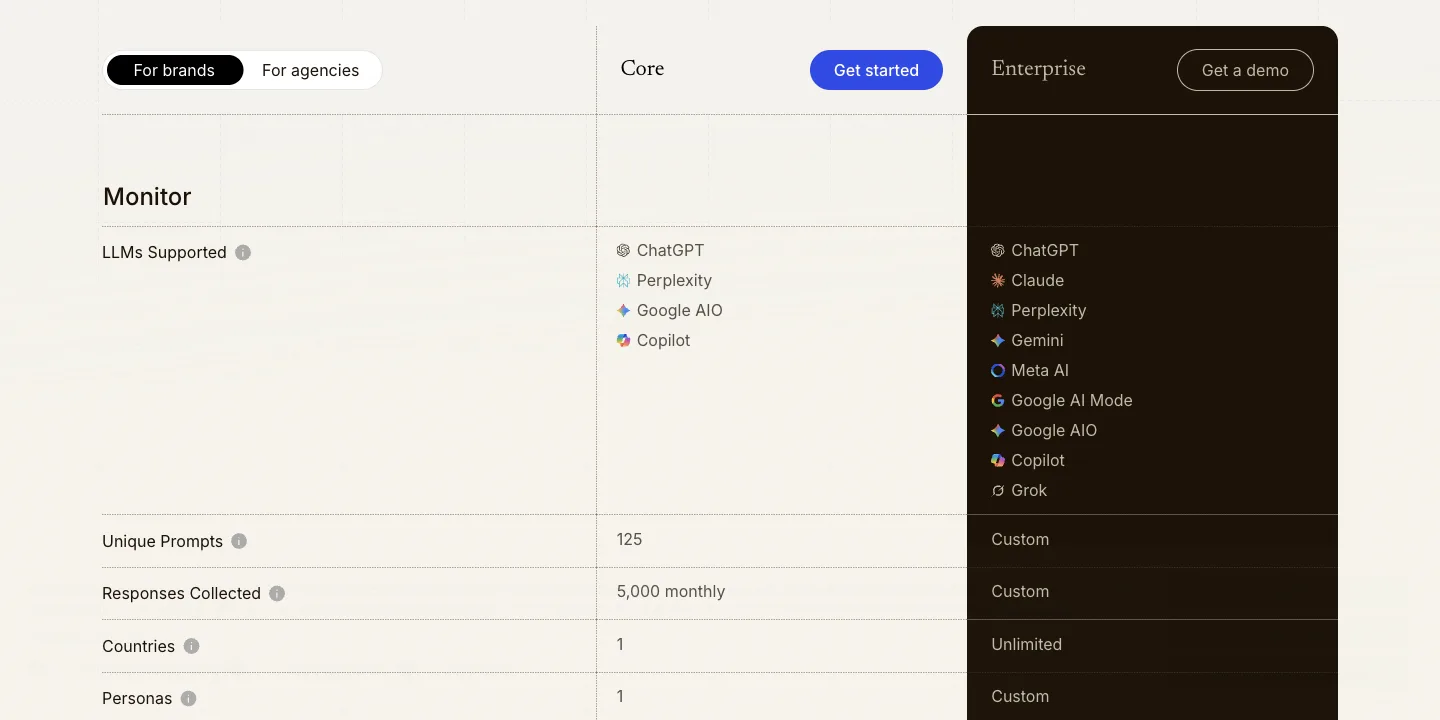
Pricing. Core $250 a month: 125 prompts, 5,000 responses a month, 5 site audits a month, and 4 engines (ChatGPT, Perplexity, Google AI Overviews and Copilot); 7-day free trial with no card required (Scrunch pricing, checked 18 Nov 2026).
Limits. Gemini and Claude are on Enterprise.
Verdict. A middle-priced option if you want audits too. Run its trial against your own prompt list.
10. Writesonic: tracking bundled with AI content (not tested)
What it is. An AI writing tool whose plans also include AI search visibility tracking and site audits.
Who it may suit. Teams that want tracking and content production in the same subscription.
Why we didn't test it. "Sign in with Google" opens in a new tab, which our test rules didn't let us follow.
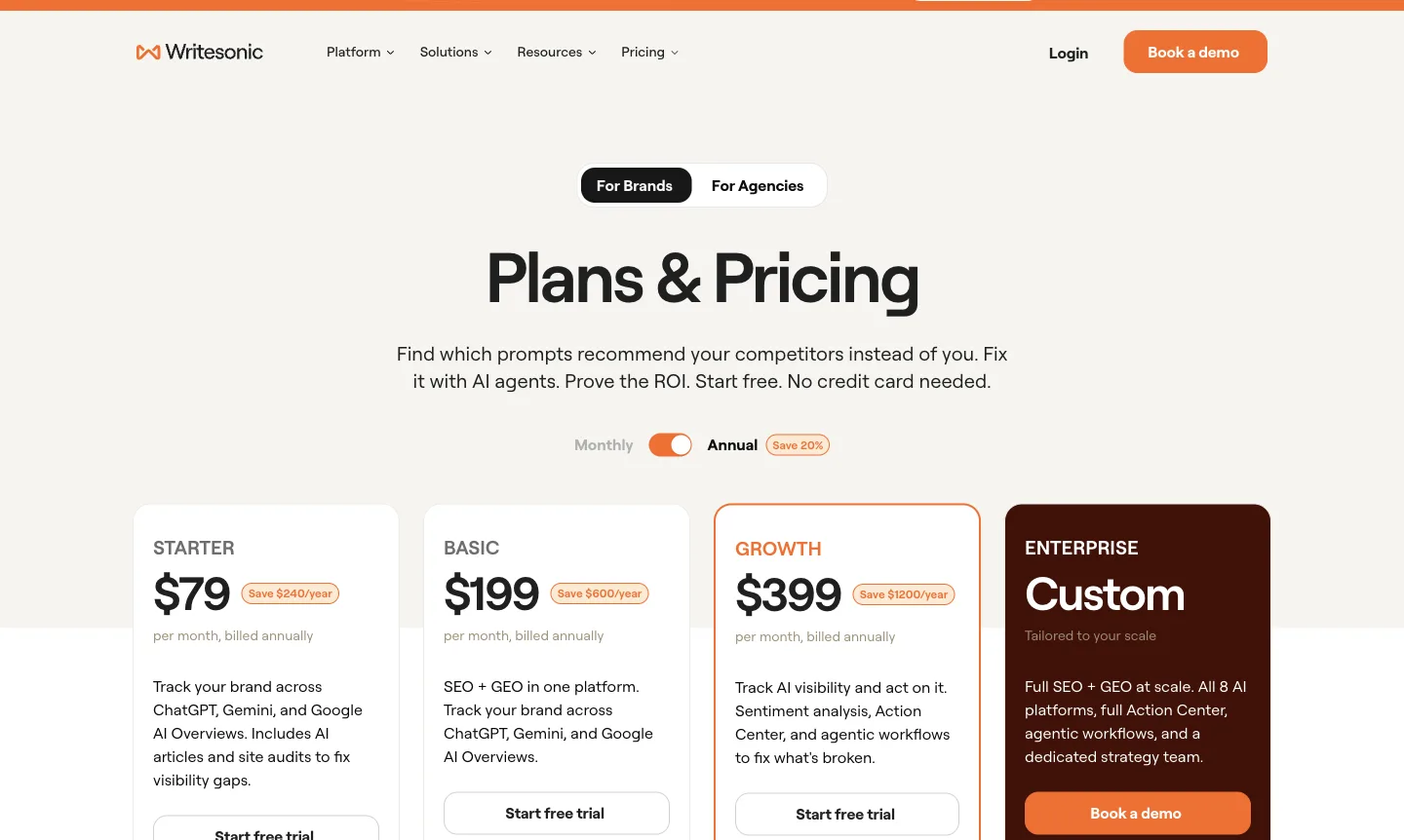
Pricing. Starter $79 a month billed annually: 50 prompts and 150 answers tracked daily on ChatGPT, Gemini and Google AI Overviews, 15 AI articles and 10 site audits. The page says "Start free. No credit card needed." (Writesonic pricing, checked 18 Nov 2026).
Limits. Sentiment analysis starts on Growth ($399). Three engines on Starter.
Verdict. Makes sense if you'd buy an AI writer anyway. If you only need tracking, a dedicated tracker can cost less.
How to choose a GEO tool
Fill in this worksheet before you start a trial. It takes about ten minutes, and it stops you from judging tools on their demo data.
| Question | Your answer | What it rules in or out |
|---|---|---|
| Which assistants do your buyers use? | e.g. ChatGPT, Google AI Overviews | Drop tools that don't cover them on the plan you'd buy |
| How many prompts do you need? Write 10 to 20 real buyer questions first | e.g. 15 | Entry plans with 20 to 50 prompts may be enough; 100+ means higher tiers |
| How many of those prompts name your brand? | e.g. 3 | Track them separately so they don't inflate share of voice |
| Which markets and languages? | e.g. US English | Some entry plans cover one country |
| Do you already pay for Semrush or Ahrefs? | Yes / No | If yes, price their add-on first |
| Do you need raw answers and sources? | Yes | Ask for this in the trial; skip tools that only show scores |
| Budget per month | e.g. $100 | Free checkers plus a sheet, or a $29 to $99 tracker |
Then run the same prompt list in each trial for a week and compare. Our AI visibility checker scorecard has ten yes-or-no questions to score each tool. Before you pay for tracking, check access first: if AI crawlers can't reach your pages, no tracker will find you. Our GEO audit checklist covers that in an afternoon, and our robots.txt examples for AI crawlers show the rules to look for.
Google's own guidance is a useful reality check. It says "The best practices for SEO remain relevant for AI features in Google Search (such as AI Overviews and AI Mode)", and that beyond being indexed and eligible for a snippet, "There are no additional technical requirements" (Google Search Central: AI features and your website). That is Google's documented position. The rest of this section is our own recommendation. A GEO tool helps you measure. It doesn't replace pages that answer the question.
Where PolyDraft fits
We make PolyDraft, so weigh this section accordingly. PolyDraft is an AI website builder, not a GEO tracker. It doesn't give you a visibility score, which is why it isn't in the list above.
What it does cover is the access side that trackers assume is already done. According to our AI visibility page, PolyDraft sites ship a robots.txt that names and allows GPTBot, ClaudeBot and PerplexityBot, along with an llms.txt file and Schema.org structured data. On 18 November 2026, polydraft.ai's own robots.txt named GPTBot, ChatGPT-User, OAI-SearchBot, ClaudeBot, Claude-SearchBot, PerplexityBot and Google-Extended, and its llms.txt returned HTTP 200. Neither file guarantees a citation, and our own result shows it: in AthenaHQ's run, polydraft.ai had no mentions on the seven non-branded prompts.
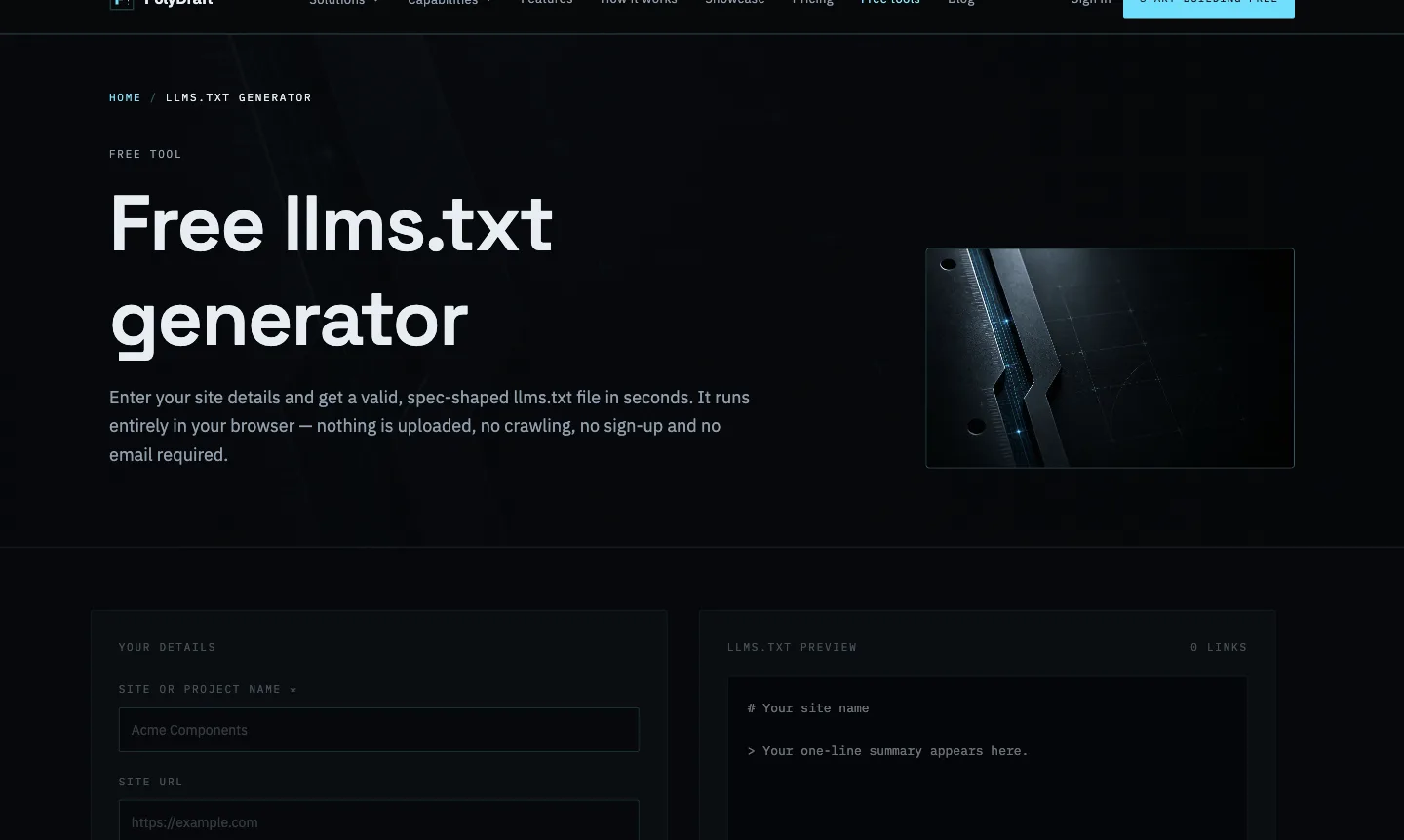
If you don't use PolyDraft, our free llms.txt generator runs in your browser with no sign-up.
If you'd rather have someone run this work, our AI FDE service puts a PolyDraft engineer on your site's SEO and AI visibility. It is a paid service of ours, and it can't guarantee rankings or AI citations either.
How we tested
- Date. 18 November 2026, in one session, in a browser set to US English.
- Subject. PolyDraft and polydraft.ai, our own brand, chosen because we know its true facts and can spot a wrong description.
- Inputs. Brand "PolyDraft", category "AI website builder", industry "Software", location "Global" or "United States", depending on the tool's fields. Tools that take a domain got polydraft.ai.
- Prompts. The free checkers don't accept custom prompts, so each used its own. AthenaHQ generated ten prompts from the site, which we accepted unedited. They are shown in the screenshot in its section. This means the tools were not run on an identical prompt set.
- Accounts. Free only. We signed up with Google where the flow stayed in our tab, entered no card, and accepted no paid upgrade. We created one account (AthenaHQ). The Ahrefs checker ran in a browser that was already signed in to an existing Ahrefs account.
- Criteria. Time to first result, whether raw prompts and answers were visible, whether branded and non-branded prompts were separated, whether the brand description was accurate, and what was locked.
- What we didn't test. Paid tiers of every tool; Otterly.AI, Peec AI, Profound, Scrunch and Writesonic in full (reasons in each entry); repeat runs over several days; locations outside the US. The five untested tools were stopped by our own rules or setup, so read nothing into it about their quality.
- Conflict of interest. We sell an AI website builder, not a GEO tool, and none of these vendors paid for placement. PolyDraft isn't ranked. Order reflects how much we could verify, not commissions.
- Limits. One run per tool on one brand. AI answers change between runs, so treat every number above as a dated sample.
Frequently asked questions
What is a GEO tool?
A GEO tool checks or tracks how often AI assistants such as ChatGPT, Perplexity, Gemini and Google AI Overviews mention or cite your brand. Most work by sending prompts to those assistants and recording the answers. You'll also see them called AI visibility tools or LLM brand monitoring tools.
Are free GEO tools good enough?
For a first look, yes. In our test, the free checkers and graders each returned a result in about a minute or less, though Semrush had no data for our domain. They can't track your own prompts on a schedule, so once you're working on specific questions, you need a tracker with your own prompt list.
Why do GEO tools show different results for the same brand?
They sample different prompts, engines and dates. Some read live search answers, and others test what a model remembers from training. In our test, Semrush showed no data for polydraft.ai, while Ahrefs found two AI Overviews mentions of the name "PolyDraft" on the same day.
Can a GEO tool get my brand cited in ChatGPT?
No. A tool can show where you're missing and which sources assistants use. The assistant decides what to cite. Treat any promise of guaranteed AI placement as a red flag.
How many prompts should I track?
Start with 10 to 20 real buyer questions and keep branded prompts separate. Otterly's own FAQ suggests 50 to 100 prompts per topic or market.
Sources
- AthenaHQ: Plans and pricing
- Ahrefs: Brand Radar, Pricing, Free AI visibility checker
- Semrush: AI Visibility Toolkit knowledge base, SEO and AI search pricing, Free AI visibility checker
- HubSpot: AI Search Grader
- Mangools: AI Search Grader
- Otterly.AI: Pricing
- Peec AI: Pricing
- Profound: Pricing
- Scrunch: Pricing
- Writesonic: Pricing
- Google Search Central: AI features and your website
About this article. Drafted by an AI agent following PolyDraft's editorial policy, with hands-on tests run in a browser on 18 November 2026 and recorded as observed. Reviewed and approved by Vincent Chen. Screenshots were captured on the test date; account names were blurred.