Claude for Marketing: 10 Jobs With the Prompt and the Result
Claude for marketing in practice: ten jobs, each with a prompt, the documented result, the plan it needs and the check a person still does.
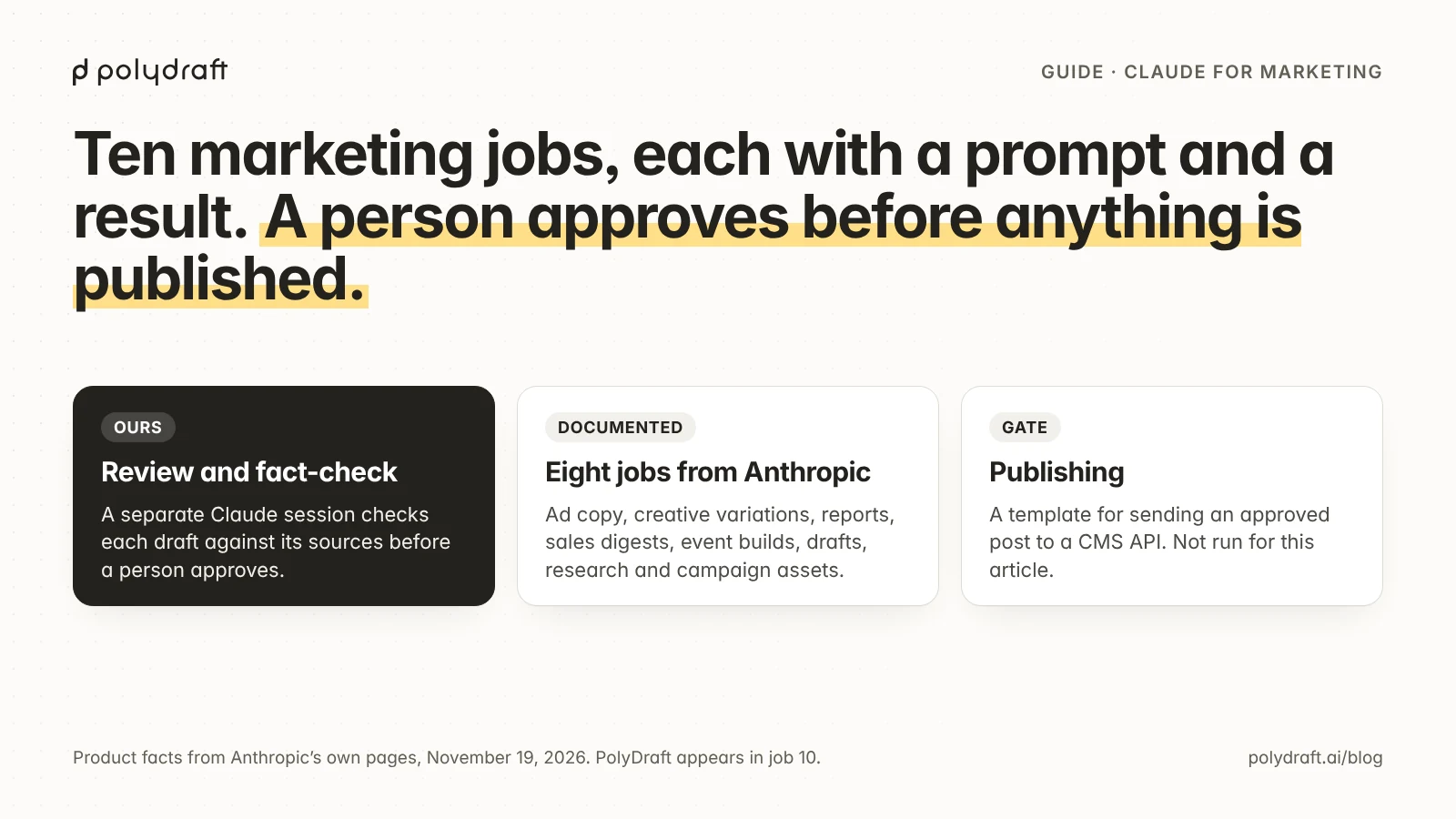
Marketers get the most from Claude on work that repeats and that someone can check: reviewing and fact-checking drafts, ad copy inside character limits, creative variations, weekly reports, sales digests, event builds, first drafts and competitor research. Anthropic's marketing teams have published how they do eight of these jobs. Two more come from our own content program, and the one we have a record of comes first. Each job below has a prompt, the documented result, and the check a person still does.
We didn't run the Anthropic workflows ourselves. Product facts come from Anthropic pages opened on November 19, 2026, and each result is attributed to whoever reported it. We make PolyDraft, which appears in job 10.
Key points
- Our own use is review. A separate Claude session reviewed and fact-checked our drafts before a person saw them. In the first batch of eight drafts it stopped 36 must-fix issues, and our founder spent about two hours on a program of 22 articles.
- Anthropic's documented wins are in rule-bound, repeatable work. It reports ad copy going from 30 minutes to 30 seconds per ad, and a weekly report going from up to two days to up to two hours.
- Chat is enough for drafts. Jobs that write files, run on a schedule or touch several tools need Claude Code or Claude Cowork, which start on the Pro plan.
- Claude fills gaps when data is missing. Anthropic's field marketer found it composing a URL for an event that had none.
- Every workflow here keeps a person on review before anything reaches customers. Six of the ten prompts are our own templates that we haven't run, and each is labeled.
1. Review and fact-check of blog drafts
This one is ours. A Claude session that didn't write the draft is a useful reviewer if it has a checklist and must open the sources. The planning folder for PolyDraft's blog program records keyword research on 261 candidate terms, briefs, then reviews of eight drafts. Each review file names its reviewer as Claude in an independent review session. The evidence rule in the brief reads:
A fact about a product comes from that vendor's own page, opened by
you today, quoted in the claim ledger with URL and UTC time.
Search-engine excerpts are not evidence. If you could not open the
page, the claim is left out or written as "not confirmed on the
vendor's page".
Result (ours, review summary of November 18, 2026): the reviews logged 1 blocking error and 35 must-fix findings, and none of the eight drafts could be published as written. The blocking error was a draft saying a web host had no free option when the host's own page offered a 14-day trial. A fact-check of one draft opened every cited page: 20 claims matched and 4 differed. The check: a person decides what to do with each finding and approves publication.
What it cost us: our founder spent about two hours of his own time on the whole program of 22 articles, from keywords to review and fact-check. It stayed that low because the independent review and a browser fact-check came first, so those 36 issues were stopped before anything reached him for approval. No task is withheld from AI for drafting, but a person approves before anything is published. For comparison, before PolyDraft our weekly marketing work took a team of three people one to two days; now review takes several hours a week.
For the same pattern applied to search work, see how to use AI agents in SEO.
Claude for marketing: ten jobs at a glance
| # | Job | Where it runs | Lowest plan | Reported result | Reported by |
|---|---|---|---|---|---|
| 1 | Review and fact-check of drafts | A separate Claude session that can open files and web pages | Pro, if you use Claude Code | 8 drafts: 1 blocking error and 35 must-fix findings; about two founder hours across 22 articles | PolyDraft (ours) |
| 2 | Search ad copy as a CSV | Claude Code | Pro | 30 minutes to 30 seconds per ad | Anthropic |
| 3 | Ad creative variations | Claude Code | Pro | Nearly 30 minutes saved per large batch | Anthropic |
| 4 | Weekly metrics report | Cowork, scheduled | Pro | Up to two days down to up to two hours | Anthropic |
| 5 | Personalized sales digest | Claude Code plus a data connection | Pro | Hours each Sunday removed | Anthropic |
| 6 | Event and campaign builds | Cowork, scheduled skills | Pro | Days compressed into hours | Anthropic |
| 7 | Drafts and brand review | Chat, Projects, Marketing plugin | Free for chat; Pro for plugins | Case study draft in 30 minutes instead of 2.5 hours | Anthropic |
| 8 | Competitor comparison deck | Claude in Chrome or Research | Pro | No figure published | Anthropic |
| 9 | Campaign plan plus assets | Claude Design with connectors | Free | No figure published | Anthropic |
| 10 | Publishing the approved post | Claude Code plus a CMS API | Pro | Not documented; our template, not run | PolyDraft (ours) |
"Lowest plan" is the cheapest plan that includes the feature, following the feature table on Anthropic's pricing page as of November 19, 2026. Usage limits apply on every plan.
2. Search ad copy as an upload-ready CSV
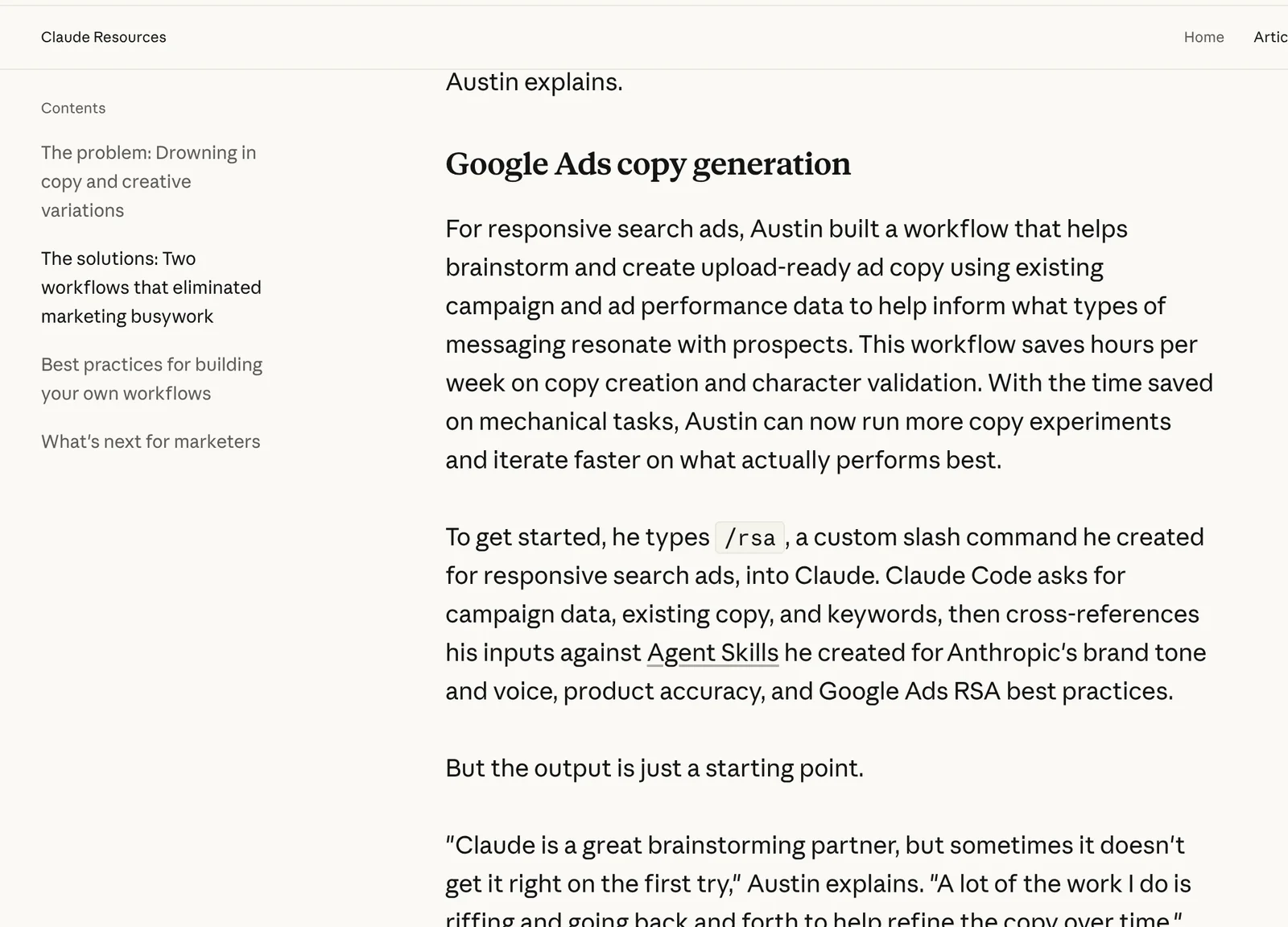
Claude Code can turn campaign data and brand rules into Google Ads responsive search ad copy that already fits the character limits. In Anthropic's account of its growth marketing team, marketer Austin Lau types /rsa, a custom command he made. Claude Code asks for campaign data, existing copy and keywords, checks them against skills for brand voice, product accuracy and Google's ad rules, and exports 15 headlines and 4 descriptions per ad to a CSV.
Anthropic doesn't publish the command. This prompt is our template, built from that description, and we haven't run it:
Help me create a /rsa skill for Google Ads responsive search ads.
Ask me for the campaign, ad group, last month's performance export
and target keywords. Write 15 headlines (30 characters max) and 4
descriptions (90 max), following brand-voice.md and product-facts.md.
Count characters with a script. Save a CSV and list any line you
weren't sure about.
Result (Anthropic's): "What used to take 30 minutes per ad now takes 30 seconds." The check: the CSV is uploaded "after undergoing manual review", and Lau says Claude "sometimes it doesn't get it right on the first try". The 30- and 90-character limits are from Google's help page.
3. Ad creative variations in Figma
A marketer who doesn't code can have Claude Code build a small tool that removes copy-and-paste work. Lau's Figma plugin takes headline copy and generates the variants of an ad frame. Anthropic published the prompt he started with:
Claude, I'm working in Figma. I really want to be able to solve this
challenge of this repetitive copy and pasting. Can you help me build
a Figma plugin to help me solve my challenge?
Result (Anthropic's): the plugin "took about 45 minutes to an hour to build" and "saves him nearly 30 minutes" on each large batch. A second Anthropic article says it generates up to 100 variations. The check: it took "some troubleshooting" before the plugin worked.
4. The weekly metrics report
A scheduled Cowork task can assemble a recurring report before you start work. Anthropic's Cowork page shows this prompt:
Every Monday morning, build last week's marketing readout. Pull web
views and signups from Amplitude, and the newsletter, social, and
webinar numbers from Marketing/Channel-tracker in Drive. Compare
everything to the week before. Slide one: company name and the week.
Slide two: awareness metrics with anything that moved more than 10%
flagged. Slide three: consideration metrics, same flags. Note any
trend worth watching and anything you couldn't pull. Save to
Marketing/Weekly in Drive.
Result (Anthropic's): in its marketing operations write-up, Ian Chan's weekly review "used to take up to two days of work" and now "takes up to two hours". The check: a proofreading skill "checks every number in the draft against a verified source", and Anthropic's advice is to build that skill first. If the weekly report covers search, our SEO report examples show eleven reports and what each one leaves out.
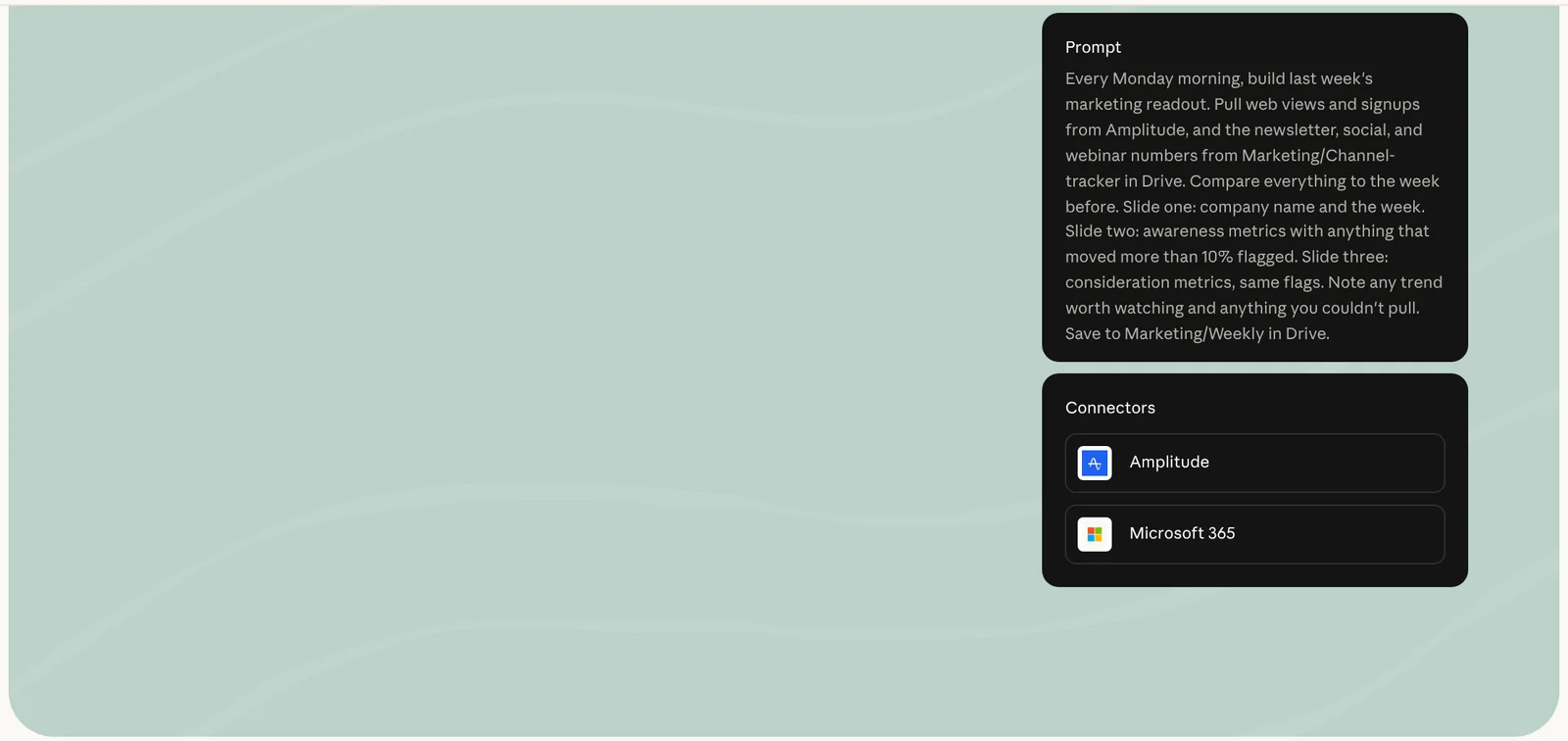
Scheduled tasks are on all paid plans and run remotely, per the Help Center.
5. A personalized weekly digest for sales
Claude Code can turn one source of marketing activity into a different message for each sales rep. Anthropic field marketer Adam Ward describes connecting Claude to the team's BigQuery data through MCP and automating a weekly update he used to assemble by hand. This prompt is our template, based on his steps, and we haven't run it:
I'm not technical. Treat me as a product manager and work step by
step. Goal: a Monday message to each sales rep with the three
marketing actions that fit their accounts. Here is one example I
wrote. Rules: read the events sheet's header row before every run.
Never invent a URL. Skip events with no registration link. Send the
first runs to me only.
Result (Anthropic's): the digest replaced "a manual process that used to take me hours each Sunday", and the team "doubled registrations for an executive dinner in a week". The check: early sends went to a group of 10 people. Where an event had no URL, "Claude composed a plausible-looking one that led nowhere". By the end of week one the prompt held nine rules, each traced to feedback.
For other data connections of this kind, see our list of the best MCP servers.
6. Event and campaign builds
Campaign setup can be split into one skill that routes requests and several that do the work. In the marketing operations write-up, Annabel Custer's dispatcher skill runs once an hour. It reads an intake channel, picks the most urgent request and hands it to one of five specialist skills. This prompt is our template for the routing step, and we haven't run it:
Create a dispatcher skill. Once an hour, read new requests in
#event-requests. Pick the most urgent, mark it as taken, and hand it
to the matching skill: event-build, data-import or approval-support.
Do no setup work yourself. After a build, start a fresh session to
audit it: submit a test registration and confirm the email arrives.
Result (Anthropic's): both operators "compressed days of manual work into hours". Custer's main reason is quality: cloned event pages can produce bugs such as a wrong city name in a confirmation email. The check: an audit agent with no prior context tests each build, and "Annabel reviews each result before it ships."
7. Drafts, launch briefs and brand review
For content, give Claude your brand rules once and ask for a review as well as a draft. Projects hold reference documents and instructions; Anthropic says free accounts can create five. The Marketing plugin in Anthropic's marketplace adds commands such as /draft-content, /campaign-plan and /email-sequence; plugins need a paid plan. This prompt is our template for chat, and we haven't run it:
Using the brand voice guide and the three interview transcripts in
this project, draft a 700-word case study. Use only facts and quotes
from the transcripts, and mark where each quote came from. Then list
every sentence in your draft that breaks the voice guide.
Result (Anthropic's): Customer Marketing "drafts case studies in 30 minutes instead of 2.5 hours", and Product Marketing saves "5-10 hours per launch" on launch briefs. The check: the examples Claude learns from "were written in partnership with the product marketing and copywriting teams". The plugin's /seo-audit command is outside this article; for that side, see our guide to vetting and writing Claude SEO skills.
8. Competitor research into a comparison deck
Claude can collect competitor pricing and positioning from live pages and hand back a deck. Claude in Chrome, on all paid plans, "visits competitor sites and pulls pricing, features, and positioning" and compiles "a formatted PowerPoint". This prompt is our template, and we haven't run it:
Visit the pricing pages of these four competitors: [URLs]. Record
plan names, list prices with the billing period, and the home page's
headline claim. Quote the page and give the URL for every figure. If
a page won't load, write "could not open". Do not fill gaps from
memory. Build a five-slide comparison deck.
Result: Anthropic describes the output and publishes no time or accuracy figure. The check: open every quoted page yourself. Anthropic's own warning: "Pages can hide instructions meant to redirect Claude."
9. A campaign plan plus branded assets
Claude Design can go from a business question to staged campaign assets when connectors are on. Anthropic's Claude Design page shows this prompt:
Find my weakest revenue month from last year and plan a promo to
address it. Draft the strategy, generate the campaign assets in
Canva, segment my list in HubSpot, and stage the send. Show me
everything before anything goes out.
Result: Anthropic describes "branded assets in Canva" and a campaign "staged in HubSpot", with no measured figure. The check is the prompt's last sentence. Anthropic lists Claude Design on every plan; the HubSpot and Canva connectors require signing in to those accounts.
10. Publishing the approved post
Publishing is easy to automate, so gate it. If your CMS has an API, Claude Code can send an approved file to it. PolyDraft is our product, and its integrations page says blog posts "can be created and updated over HTTP with a bearer token you generate". Our rule is the one from job 1: a person approves before anything is published. This prompt is our template, and we haven't run it:
Read the endpoint list in the site's Admin > API docs first. Publish
drafts/post.md as a new blog post through the content API. The token
is in CONTENT_API_TOKEN; never print it. If the docs show a draft
status, use it. If not, stop and ask me. Do not update or delete
existing posts. Return the URL and response status.
Result: not documented. The check: approve the exact revision before the call, and read the live page afterward.
PolyDraft's content API only helps if your site runs on PolyDraft. For other sites, Anthropic's directory lists connectors made by Webflow and by Automattic for WordPress.com. We haven't tested either.
Which Claude plan a marketer needs
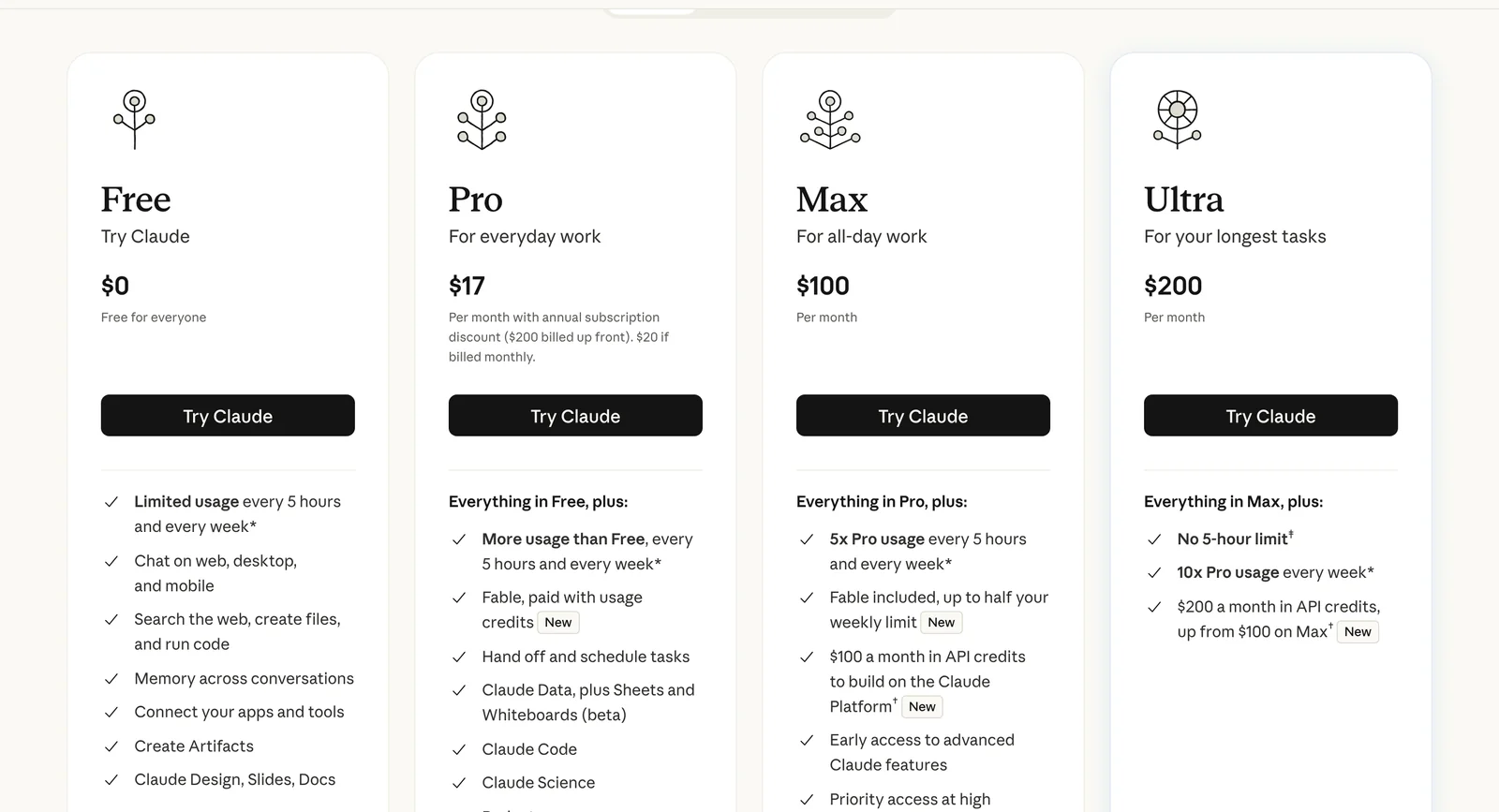
Chat, Projects, Skills, connectors and Claude Design are on the Free plan. Claude Code, scheduled tasks, Research, plugins and Claude in Chrome need a paid plan. These are US list prices from claude.com/pricing on November 19, 2026, before tax.
| Plan | Price | What it adds for marketing work |
|---|---|---|
| Free | $0 | Chat, up to 5 projects, Skills, connectors, Claude Design; limited usage |
| Pro | $20 a month, or $17 a month billed annually ($200 up front) | Claude Code, scheduled tasks, Research, Claude in Chrome |
| Max | $100 a month | 5 times Pro usage |
| Ultra | $200 a month | 10 times Pro usage every week |
| Team, standard seat | $25 per seat a month, or $20 billed annually | 2 to 150 people |
| Team, premium seat | $125 per seat a month, or $100 billed annually | 5 times a standard seat's usage |
Which Claude model each plan includes
People also ask which Claude to use for marketing. The plan decides which models you can pick. This is the "Models and usage" table on claude.com/pricing, opened on November 20, 2026:
| Plan | Models in the Claude apps | Also included |
|---|---|---|
| Free | Sonnet and Haiku | None |
| Pro | Opus, Sonnet and Haiku; Fable paid with usage credits | Usage credits |
| Max | Opus, Sonnet and Haiku; Fable included for up to half the weekly limit | $100 a month in API credits for the Claude Platform |
| Ultra | Same as Max | $200 a month in API credits; no 5-hour limit for verified accounts |
Opus starts on Pro. Anthropic calls Fable "our top model". On Pro you pay for it with usage credits, and Max and Ultra include it for up to half the weekly limit. The same page says how fast you reach a limit depends on the model you use. Anthropic doesn't say which model suits which marketing job, so test your own job on the cheapest model your plan offers before you move up.
How we picked
A job made the list only if a named source describes the workflow and what came out of it. We started from four Anthropic articles about its own marketing teams, then Anthropic's product and Help Center pages, then our own planning files. Each page was opened on November 19, 2026, signed out, and the text and a screenshot were saved.
We left out community skill packs, courses and social posts, which made up most of Google's results for "claude for marketing" that day. Our research environment couldn't open those sites.
The Anthropic results are a vendor describing its own product, and its teams have a data warehouse and engineers nearby. Our results describe one content program over three days.
For tools beyond Claude, see our comparison of AI tools for marketers by task.
Frequently asked questions
Can a marketer use Claude Code without knowing how to code?
Yes, according to Anthropic's own marketers. Austin Lau "had never written a line of code" before building the workflows in jobs 2 and 3. His advice is to "start with a very, very small and easy thing". Claude Code needs a Pro plan or higher.
What are Claude skills for marketing?
Skills are, in Anthropic's words, "folders of instructions, scripts, and resources that Claude loads dynamically". For marketing, that means a brand voice guide, ad platform rules or a report format written once and applied on every run. Anthropic lists Skills on every plan, with code execution turned on.
How much does Claude cost for marketing work?
It depends on the job. Chat, Projects, Skills and Claude Design are on the Free plan. Claude Code, scheduled tasks, Research, plugins and Claude in Chrome start on Pro, which Anthropic lists at $20 a month, or $17 a month billed annually, as of November 19, 2026. Usage limits apply on every plan.
Does a person still need to review what Claude produces?
Yes. Every documented workflow here keeps one: Anthropic's ad copy is uploaded "after undergoing manual review", and in our own program a person approves before anything is published.
Continue with the next task
- Vet or write a skill before you install one: Claude SEO skills
- Connect Claude to your data and tools: Best MCP servers
- Compare tools beyond Claude: AI tools for marketers
- Decide which channels deserve this work first: Marketing strategies for startups, ranked by cost and time
Updated November 20, 2026: Added which Claude models each plan includes, from Anthropic's pricing page, including the monthly API credits on Max and Ultra.
About this article. Drafted by an AI agent following PolyDraft's blog workflow; a person approves before anything is published. Anthropic and Google facts come from their own pages, opened signed out on November 19, 2026, and each quote was checked against the saved text of its page. We didn't run Anthropic's workflows, and the six prompts labeled as our templates haven't been run. The numbers in job 1 come from our own review and fact-check records and from our founder's account of his time. PolyDraft is our product and appears in job 10. The screenshots are real captures taken that day.
Sources
All pages opened November 19, 2026.
- Anthropic: How Anthropic uses Claude in marketing (January 26, 2026); How Anthropic teams use Claude Code (July 24, 2025); field marketer's weekly digest (August 24, 2026); marketing operations and Claude Cowork (July 8, 2026)
- Anthropic product pages: Pricing, Cowork, Design, Artifacts and Claude Design availability, Claude in Chrome, Marketing plugin
- Anthropic connector directory: HubSpot, Canva, Webflow, WordPress.com
- Anthropic Help Center: skills, projects, scheduled tasks, plugins, Research
- Google Ads Help: About responsive search ads
- PolyDraft: Integrations, and our content planning records for November 17 to 19, 2026