In this article
- 01 Key takeaways
- 02 Why a launched site is not a finished site
- 03 The recurring work, step by step
- 04 What to automate, and what to keep human
- 05 Ordering the work when the list is longer than the time
- 06 How to verify the work is actually landing
- 07 What this approach cannot do
- 08 Where this fits
- 09 Continue with the next task
- 10 Sources
Post-launch SEO is the recurring work a website needs after it goes live: refreshing content as facts change, repairing what breaks, adding pages for questions buyers start asking, and telling search engines when something has changed.
Key takeaways
- A launch sets a baseline. Everything that decides whether the site stays findable happens afterwards, on a cadence.
- Most post-launch work is bookkeeping — dates, links, redirects, sitemaps — and bookkeeping is exactly what software should do.
- Two things must stay human: deciding what the business wants to say, and approving anything that changes a factual claim.
- Verify with artifacts you can inspect yourself. A crawlable page, an accurate sitemap date and a clean redirect are checkable in minutes.
- No maintenance routine can promise a position in a result list. It removes the reasons a page gets ignored; it does not decide the ranking.
Why a launched site is not a finished site
On launch day a site is a snapshot of what the business knew that week. Within a quarter the prices have moved, two product pages describe features that changed, an old post links to a page that no longer exists, and the questions buyers ask have shifted. None of this is visible from the homepage, which is why it goes unnoticed for months.
The fundamentals do not change with any of it. Google’s own search engine optimisation starter guide still describes the same basics — crawlable pages, useful content, descriptive titles and links that work. Post-launch work is not a different discipline. It is the same discipline applied on a schedule instead of once.
The recurring work, step by step
The list below is deliberately mundane. Every item is a task with a definite finish, not a strategy.
- Re-read what changed in the business. Prices, plan names, staff, service areas, delivery times. Anything a customer could quote back to you needs to match reality on the page.
- Fix broken internal links and orphaned pages. A page nothing links to is a page crawlers reach late and readers never reach at all.
- Repair redirects. When a URL changes, the old one should send visitors to the closest equivalent, not to the homepage and not to a 404.
- Keep the sitemap honest. The
lastmodvalue should move when a page’s content genuinely changes, and stay still when it does not — the behaviour described in Google’s guide to building and submitting a sitemap. A file that claims every page changed today teaches a crawler to disregard the field. - Announce real changes. Rather than waiting for the next organic crawl, a changed URL can be submitted directly. The IndexNow protocol documentation specifies a simple POST carrying the host, a key, the key file location and the list of changed URLs, and it is explicit that submissions should cover URLs that were added, updated or deleted — not the whole site on a timer.
- Add pages for questions that arrived after launch. Support inboxes and sales calls are where these show up first.
- Re-check the pages that matter most. A handful of pages carry most of a small site’s commercial weight. They deserve a scheduled read-through that the rest of the site does not.
What to automate, and what to keep human
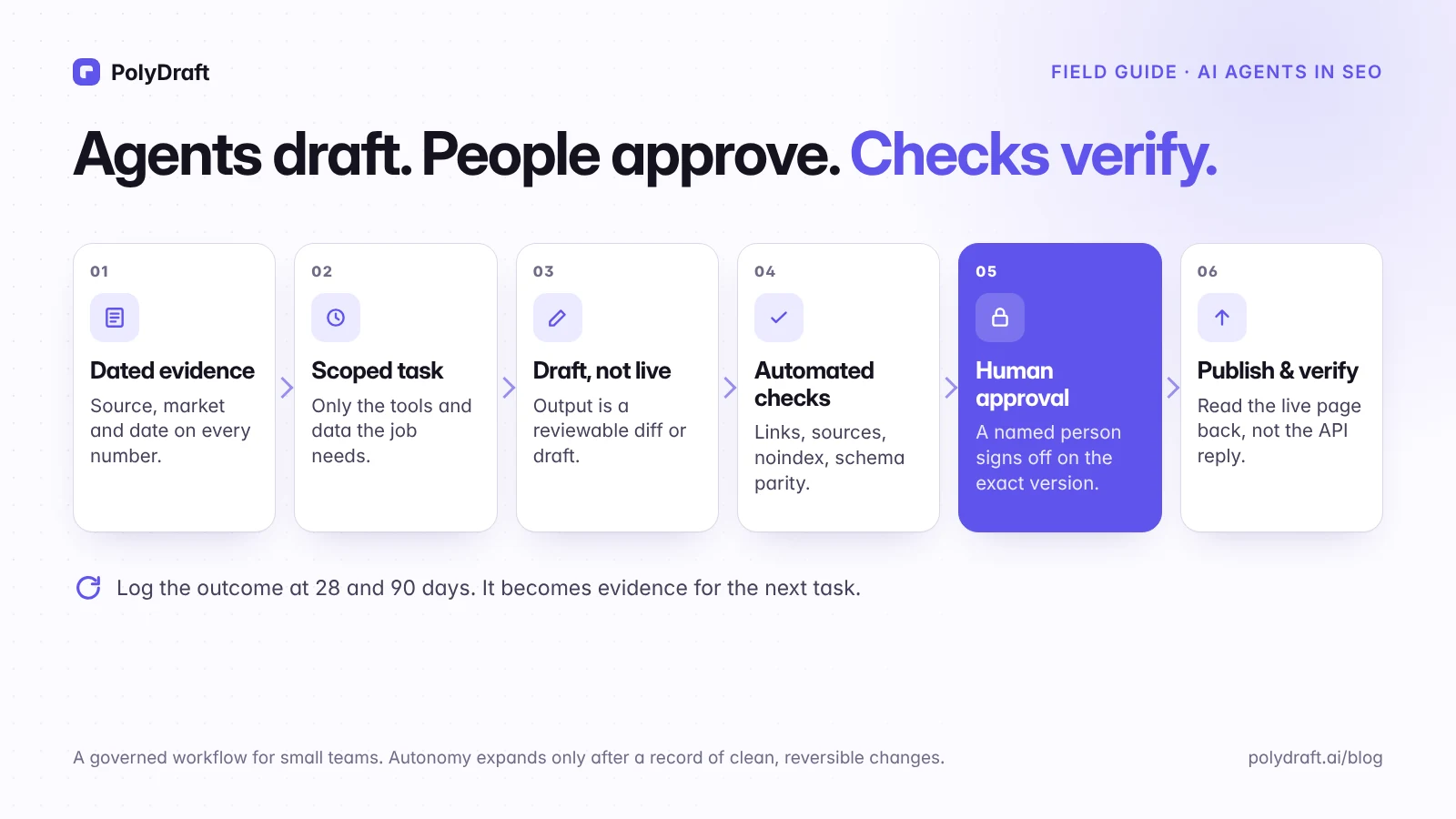
The split is not about capability, it is about consequence. Automate work whose correct answer is determined by the site itself: sitemap dates, redirect maps, internal link suggestions, structured data generated from what a page already says, change notifications. If the software gets one of these wrong the failure is visible and reversible.
Keep a person on anything that changes a claim. Prices, guarantees, availability, credentials, comparisons with named competitors and anything a customer might rely on should be written or approved by someone accountable for it being true. This is the same boundary we apply to our own writing, set out in the editorial policy — and it is the reason automation here proposes changes rather than publishing them.
The middle ground is drafting. A system can propose a rewritten meta description, a new internal link, or an outline for a page answering a question that keeps coming up. Proposing is cheap and reviewable. Publishing without review is where automated maintenance turns into an automated liability. If an AI agent does the drafting, a governed workflow for SEO agents sets out what it may change and who approves.
Ordering the work when the list is longer than the time
Most sites cannot do all of the above every month, so the order matters more than the completeness. Work outward from the reader: first anything that is now false, then anything that blocks access, then anything that merely improves.
- Wrong facts first. A stale price or a discontinued service costs a sale on the visit it happens. Nothing else on the list has that immediacy.
- Access second. Broken links, redirect chains and pages that return the wrong status code stop a page being read at all. A page nobody can reach cannot be improved by editing it.
- Signals third. Titles, descriptions, sitemap dates and structured data help a page be understood once it can be reached. Useful, but only after the first two are clean.
- New pages last. Publishing more while existing pages are wrong or unreachable increases the surface area of the problem.
This ordering also makes the work easier to stop safely. If the month runs out after step two, the site is in a defensible state rather than half-migrated.
How to verify the work is actually landing
Verification should not depend on a dashboard you do not control. Each of these takes minutes and produces an artifact you can look at:
- Fetch the page as a crawler would. Request the URL and read the returned HTML. If the text you care about is not in that response, a crawler did not get it either.
- Open the sitemap and check three dates. Pick a page you edited, one you did not, and one you deleted. The first should have moved, the second should not, and the third should be gone.
- Follow every redirect by hand. One hop, correct destination, correct status code. Chains and loops hide well and cost real crawl budget.
- Check that changed URLs were announced. Whatever mechanism you use, it should log what it submitted and when, so the claim is auditable rather than assumed.
- Re-read the page as a buyer. The most common post-launch defect is not technical. It is a page that is now subtly untrue.
Do this monthly on a small site. The point is not the schedule; it is that the check produces evidence rather than a feeling.
What this approach cannot do
Maintenance removes reasons for a page to be ignored. It does not decide where a page appears, how often it is crawled, or whether a competitor publishes something better next week. Anyone offering a position in exchange for a maintenance retainer is selling something they do not control.
It also cannot rescue a page that has nothing to say. If a topic is covered better elsewhere by people who know more, no amount of technical tidiness closes that gap. The honest sequence is: have something worth reading, then remove every obstacle between it and the reader.
Finally, none of this is instant. Changes are found when they are found. Announcing a change shortens the wait; it does not eliminate it.
Where this fits
If you would rather this ran as a standing process than as a quarterly scramble, that is what SEO automation is for on our side: the recurring work is prepared for you and you approve it. The same discipline applied to AI assistants rather than search engines is covered in the practical guide to checking whether AI assistants can read your site.
Written by Vincent Chen, who is accountable for the claims on this page.
Continue with the next task
Turn a maintenance issue into a scoped change with a baseline and verification record. Read the SEO content refresh workflow.
For multilingual pages, include equivalent URLs in the same release checklist. Read the hreflang release checks.
Sources
- Google Search Central — SEO Starter Guide
- Google Search Central — Build and submit a sitemap
- IndexNow — Protocol documentation
Update note — October 8, 2026: AI-assisted maintenance clarified source boundaries and added related practical guides. This update does not claim a new human expert review or measured search results.
Written by
Founder of PolyDraft and CEO of BlackMonolith, Inc.