What Is a Growth Engineer? The Role, the Work, and What AI Can Take Over in 2027
A growth engineer writes code to move signups, activation and revenue. What the work involves, which parts AI can take over, and when to hire one.
A growth engineer is a software engineer whose job is to move business metrics, such as signups, activation, conversion to paid and revenue, rather than to build one product's features. The work is mostly experiments: forming a hypothesis, shipping the smallest change that tests it, measuring the result, and moving on. Startups usually need one only after they have traction, because growth engineering optimizes something that already works.
AI tools can now do a real share of that work: building funnels and dashboards, setting up an A/B test, summarizing results, drafting pages and writing tracking code. Choosing what to test, deciding whether a result is real, and approving what reaches customers still need a person. This guide covers what the role is, how it compares with neighboring roles, a task-by-task table of what AI can take over today, and how we run our own site, polydraft.ai, with AI agents drafting and checking and one person approving releases.
We make PolyDraft, an AI website builder, and we use "growth engineer" in our own marketing. We've tried to keep that from shaping the definition: the role descriptions below come from PostHog, which publishes how its growth team works, and the AI capabilities come from vendors' own documentation, checked on November 18, 2026. We first read PostHog's pages from the source files PostHog publishes in its public GitHub repository, then a separate fact-check compared every PostHog quote and capability in this article with the rendered pages on November 18, 2026. We didn't test the third-party AI tools hands-on.
Key points
- A growth engineer owns a metric, not a product area. PostHog describes the job as three tasks: create growth ideas, implement them, and measure them.
- Typical work: signup and onboarding flows, pricing and billing pages, landing pages and SEO on the marketing site, A/B tests, event tracking and lifecycle messages.
- AI can already build funnels, create experiments and summarize results inside an analytics tool, and coding agents can write the tracking code. Picking the metric, judging significance against counter-metrics, and shipping to customers remain human decisions.
- Hire one after you have traction and enough traffic for experiments to finish. Before that, a founder can run the same loop at small scale with AI tools.
What a growth engineer is
A growth engineer is an engineer who works on whatever moves the company's growth metrics, wherever in the product or website that work happens. PostHog's definition, from its 2023 explainer on the role, is that growth engineers "focus entirely on projects dedicated to driving as much growth as possible, no matter where they build those projects."
PostHog breaks the job into three responsibilities:
- Creating ideas and strategies for growth.
- Implementing those ideas.
- Measuring and evaluating what was implemented.
That combination is what separates the role. A product engineer also implements; a growth marketer also measures. A growth engineer does all three, so the role needs engineering, product sense, business understanding and enough statistics to read an experiment. PostHog says its own growth team "has always been entirely made up of" former technical founders for exactly that reason.
The title isn't standardized. Some companies use it for a full-stack engineer embedded in marketing; others use it for an engineer on a product-led growth team who works on onboarding and billing. What stays constant is the measure of success: a change in a business metric, not the amount of code shipped.
What the work looks like week to week: experiments, instrumentation, funnels
A growth engineer's week is a loop: find where the funnel leaks, form a hypothesis, ship the smallest test, measure, and decide. PostHog's list of what growth engineers work on gives a concrete picture:
- Strategy: developing a growth strategy, an experiment framework, and measurement for both.
- Funnels: optimizing signup funnels, and running A/B tests on parts of the signup and activation funnel to improve conversion rate and time to value.
- The marketing site: SEO work, building landing pages.
- Messaging: in-app and push notification systems, tools for better product onboarding.
- New markets: localization and support for new payment types.
Describing its own team, PostHog adds billing and pricing: in 2023 its growth engineers were building a billing service so different products could be priced separately.
Three kinds of work carry most weeks.
Experiments. The working unit is a hypothesis, not a feature request. PostHog's growth engineering newsletter gives an example from its own team: pick a target area (onboarding for product analytics and the newly added data warehouse, which "hasn't kept up"), pick a metric (the share of new organizations that activate, without hurting retention), form a hypothesis (adding a dashboard template step will raise activation), and ship the smallest version that tests it. The same piece gives a rule of thumb for test duration: at least one week, to include "the variety of usage across the week," and no more than a month. It also says that at Google, "80-90% of experiments 'fail.'" The research it points to, a 2017 Harvard Business Review article by Ron Kohavi and Stefan Thomke, says that at Google and Bing "only about 10% to 20% of experiments generate positive results." Most tests fail, and the job is to make that cheap.
Instrumentation. None of this works without events tracked correctly. Before running tests, PostHog suggests defining activation (users reaching the product's "aha moment") and retention (users coming back to do it again), then tracking how both move each week and with each change you ship. Instrumentation is unglamorous and easy to get wrong, and a broken event can make a failed test look like a win.
Funnel reviews. PostHog's handbook describes a growth review held every four weeks: attendees write hypotheses beforehand, spend 20 minutes watching session recordings of key flows, then work through each hypothesis with data and assign owners to the resulting experiments. The co-CEOs attend. That detail matters for the AI question later: deciding which hypotheses deserve engineering time is a leadership call, not a mechanical step.
If the experiments touch pages that search engines index, there are extra rules. Google's guidance on A/B testing says not to show Googlebot a different version than people see (cloaking), to use rel="canonical" on alternate test URLs, and to use temporary (302) rather than permanent redirects for test variants.
Growth engineer versus product engineer, growth marketer and growth hacker
A growth engineer differs from neighboring roles mainly in what they're measured on and whether they write production code. The product engineer and growth hacker comparisons below follow PostHog's own definitions. PostHog doesn't define the growth marketer role, so that row is our own description of how the title is commonly used, and it varies by company.
| Role | Measured on | Writes production code? | Typical work | Where it overlaps with a growth engineer |
|---|---|---|---|---|
| Growth engineer | Company-level growth metrics: signups, activation, revenue | Yes, across the product and website | Signup and onboarding experiments, pricing and billing pages, landing pages, tracking, lifecycle messages | — |
| Product engineer | Success of a specific product for its users | Yes, mostly within one product | Features for a defined user group | Both build features, experiment and take ownership; PostHog says the difference is focus, with growth engineers "less constrained to a specific product" |
| Growth marketer | Acquisition and campaign results in their channels | Usually not | Paid ads, email campaigns, content and channel tests | Both run experiments; a growth marketer changes campaigns and copy, a growth engineer changes the product and site code |
| Growth hacker | Growth by any means, often fast | Sometimes | PostHog describes growth hackers as focused on "more non-product, non-technical solutions" | Same goal; a growth engineer's work, in PostHog's framing, is technical work across products |
If you're deciding which to hire: a growth marketer fits when your bottleneck is reaching people (channels, campaigns, content). A growth engineer fits when people arrive but don't sign up, activate or pay, and fixing that means changing code.
Growth engineer and GTM engineer
A GTM (go-to-market) engineer usually builds automated sales and marketing systems, such as lead enrichment, outbound sequences and lead routing, while a growth engineer usually changes the product and website to improve conversion. The two overlap where inbound leads arrive through the website.
We cover the GTM engineer role, its outbound and inbound halves, and its tool stack in What Is a GTM Engineer?.
Which parts AI can take over today, and which it cannot
AI tools can now do most of the mechanical steps of growth engineering: building funnels, creating experiments and feature flags, summarizing results, drafting pages and writing tracking code. They can't yet be trusted to choose what to test, to decide whether a result is real, or to approve changes that reach customers. The table below goes task by task.
How we built this table. We took the tasks from PostHog's description of growth engineering work and matched each to what current tools document they can do. For analytics and experiments we used PostHog AI's documentation, because PostHog publishes both the role definition and a detailed tool list, which makes the comparison checkable. Other analytics vendors have similar assistants; we didn't survey them. For code, we used Claude Code's documentation as an example of a coding agent. For website pages and content, we used our own product pages and build log, which makes those rows a self-assessment. We didn't run these third-party tools ourselves; capabilities are as documented on November 18, 2026, and were checked against the rendered pages as described above.
The middle column uses three levels:
- Most of it: the tool can do the task end to end from a plain-language request; a person reviews.
- Part of it: the tool does a meaningful sub-step; a person does the rest.
- Little: the tool can inform the decision, but the work is human.
| Growth engineering task | How much AI can do today | What the AI can do, per its documentation | What still needs a person |
|---|---|---|---|
| Build funnels, retention charts and dashboards | Most of it | PostHog AI creates insights including trends, funnels and retention, builds dashboards and, per its tools list, can "write and run SQL queries" | Checking that the underlying events are right; PostHog's tools page lists "Guarantee perfect accuracy" under what "PostHog AI can’t (yet)" do |
| Set up an A/B test | Most of it | PostHog AI's experiments doc says it sets split percentages and goal metrics, creates the feature flag with variants and configures targeting | Choosing the goal metric and counter-metrics, and confirming the sample size and duration are enough |
| Read experiment results | Part of it | The same doc says it reports which variant is winning, whether the result is statistically significant, and whether to ship, extend or stop | The ship decision. With most experiments failing, someone has to check counter-metrics, segments and novelty effects before trusting a "win" |
| Write tracking code and the experiment variant | Part of it | Coding agents such as Claude Code read a codebase, edit files across it, run commands and open pull requests | Code review, and verifying in production that events fire correctly |
| Build landing pages and site changes | Most of it (our self-assessment) | AI website builders, including ours, generate and edit pages from a brief or chat request; our build log records PolyDraft's agent building polydraft.ai, and also that people and agents have edited it since | Brand and factual review before anything goes live; deciding which page to test |
| Write SEO content for the marketing site | Part of it | AI agents draft briefs and articles from keyword data. Our SEO automation page describes PolyDraft finding keyword opportunities, writing and refreshing content and linking pages every week; on our own site we run our own workflow (next section) | Fact-checking. Google's guidance says to manually fact-check all AI-generated content, including titles, meta descriptions and alt text, and warns that mass-producing pages without added value can violate its scaled-content spam policy |
| Lifecycle and onboarding messages | Part of it | PostHog AI can create email templates and surveys, and analyze survey responses for themes | Approving what gets sent to customers, and to whom |
| Form hypotheses and choose what to test | Little | Assistants can surface patterns, search session recordings and summarize survey themes to feed the list | Deciding which bets get engineering time. At PostHog this happens in a four-week review attended by the co-CEOs |
| Pricing and billing changes | Little | No vendor documentation cited; our judgment is that AI tools can help analyze usage and billing data | The decision itself. Pricing touches revenue, contracts and customer trust; PostHog's growth team treated multi-product billing as a major engineering project, not an experiment to automate |
The pattern: AI is strongest inside a tool that already holds your data (analytics) or your code (a coding agent), and weakest where the task is a judgment about what matters. In practice the role is shifting from doing every step to directing tools and checking their work. That still needs someone who understands experiments, which is why we wouldn't describe any current tool as a replacement for a growth engineer.
For the SEO side specifically, see how to use AI agents in SEO.
What this looks like on a website: our own setup on polydraft.ai
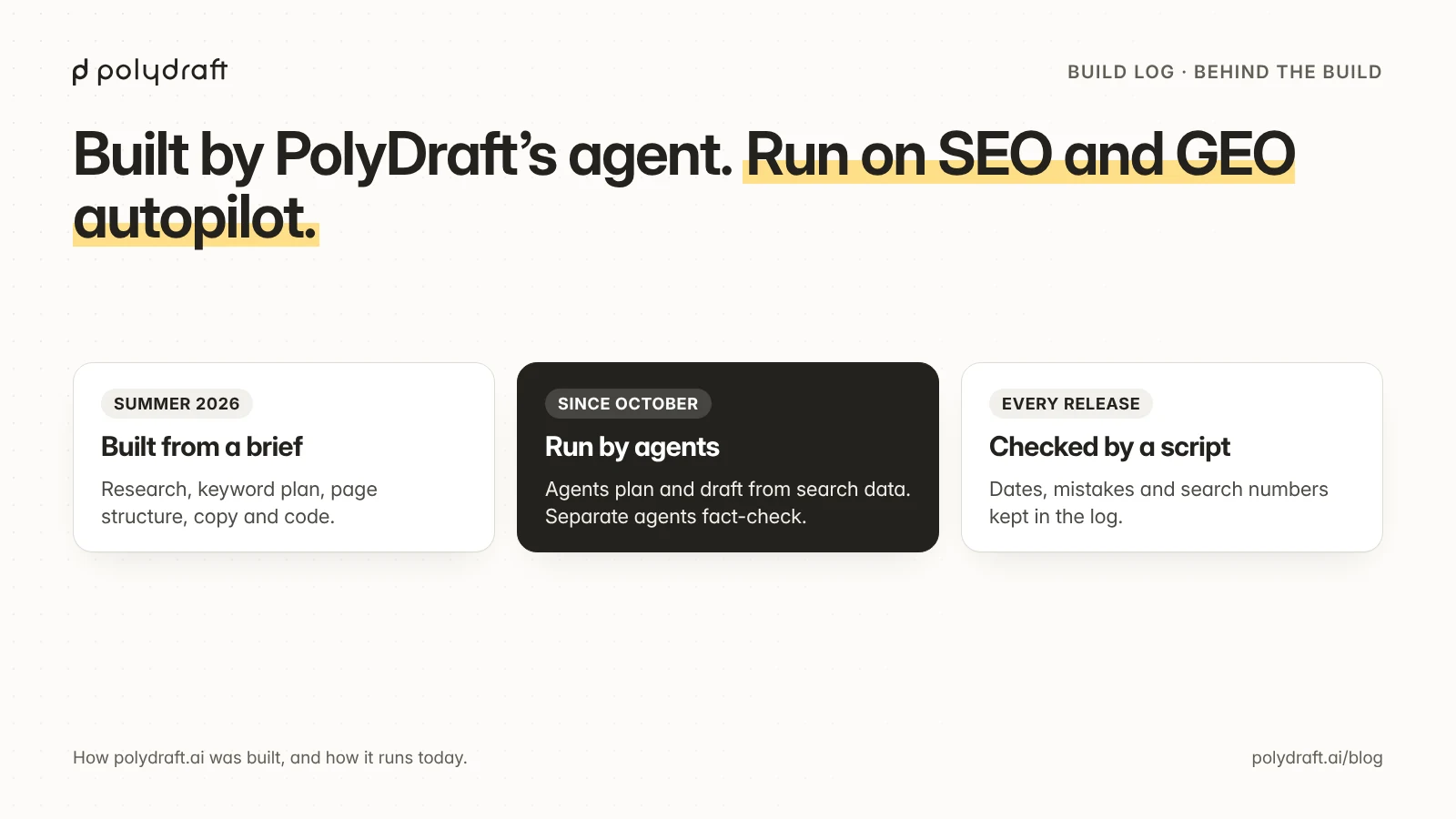
We run polydraft.ai with AI agents doing most of the content and search work, and one person, Vincent Chen, approves releases. The workflow, release log and numbers in this section come from our published build log (last updated November 18, 2026) and from checks we ran on the live site on November 18, 2026 with a desktop browser at 1440 px and command-line requests. This section describes how we run our own site: the build log says polydraft.ai was built before PolyDraft's content calendar existed, so we still run it with our own workflow. We have no customer results to report here, only our own site.
What we hand to AI agents
Every release in our records since October 13, 2026 has followed the same seven steps, as published in the build log:
- Pick the keyword from data. Each post starts from a row in our keyword library with search volume, difficulty and the page that should own it. If another page already owns the keyword, we refresh that page instead.
- Brief and draft. An AI agent writes the brief, then the draft, using only sources it can cite.
- Automated QA. A script checks structure, links, sources, image alt text, metadata and wording, and blocks the release on any error.
- Separate fact-check. Another AI agent, given the draft but not the writer's reasoning, checks every claim against its source and reports problems without fixing them.
- Approval. Vincent Chen reads the result and approves the release.
- Publish and verify. The post goes live through the site's content API, then we check status code, canonical tag, a single H1, structured data, mobile layout and images.
- Link it in. We add links from related posts and queue the URLs for IndexNow, which we currently send by hand (see below).
The build log also lists the exceptions. Eight October posts have no release record (five published on October 8 and three on October 22) and aren't counted. In W42, fact-check corrections landed after approval, and the October 29 refresh has no written approval in its record.
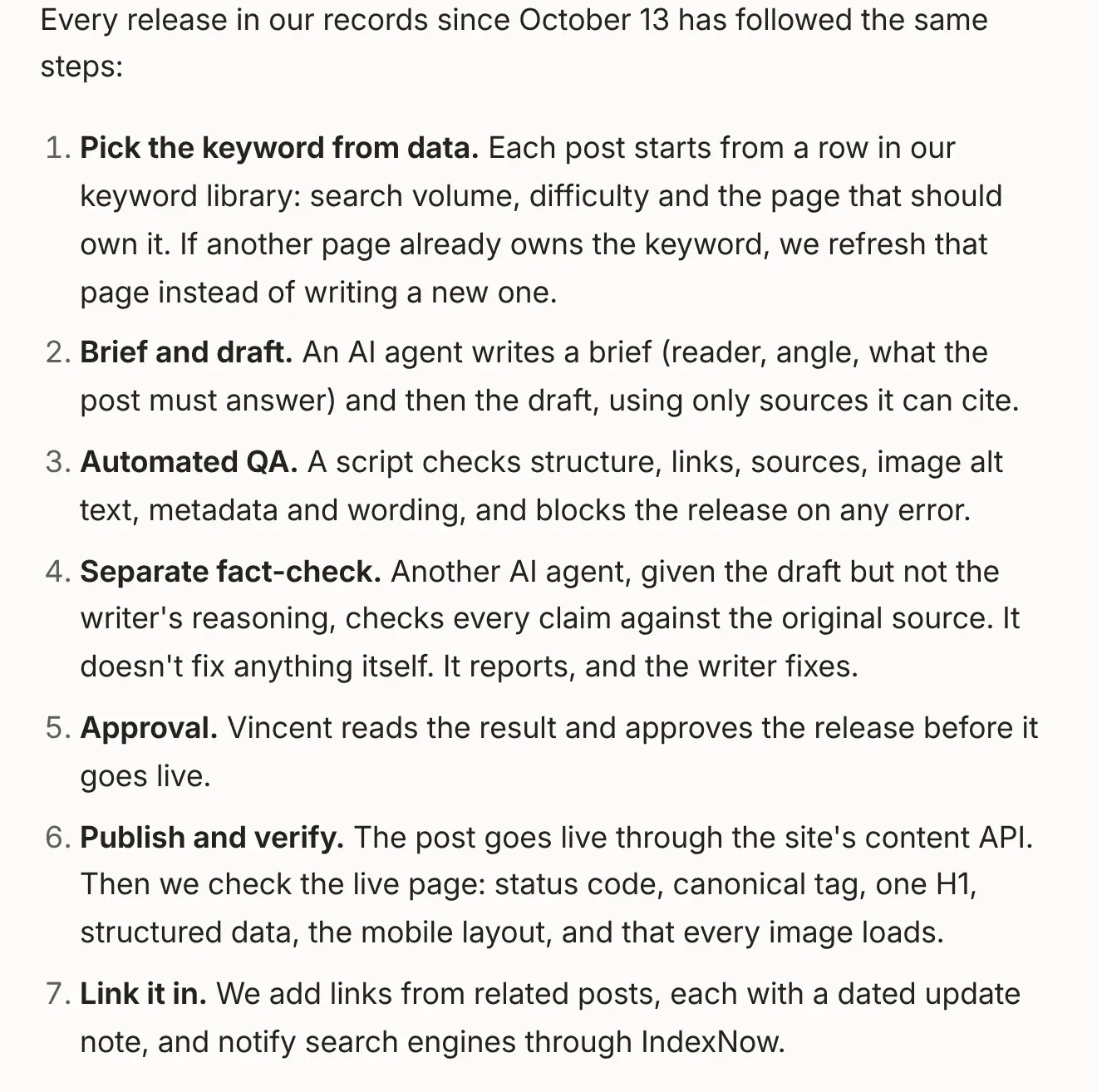
Mapped to the table above, AI agents do the research, drafting and fact-checking in steps 2 and 4, and a script does the QA in step 3. Step 5 is the human checkpoint, and step 1's ownership rule (one primary keyword per page) is a policy we set.
What the checks caught
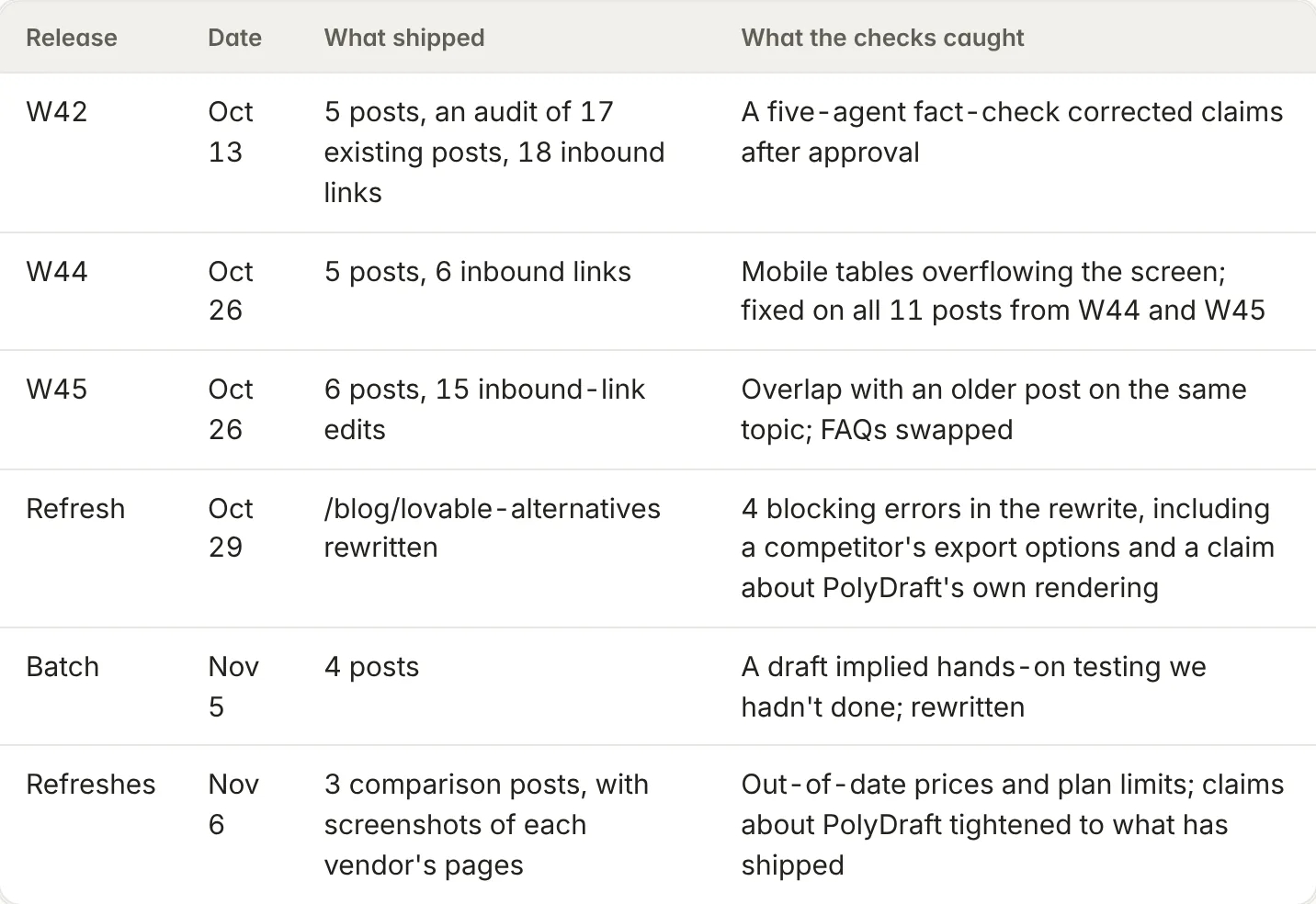
The release log records what each check caught. These are the failures the human and automated checkpoints exist for:
| Release | Date (2026) | What shipped | What the checks caught |
|---|---|---|---|
| W42 | Oct 13 | 5 posts, an audit of 17 existing posts, 18 inbound links | A five-agent fact-check corrected claims after approval |
| W44 | Oct 26 | 5 posts, 6 inbound links | Mobile tables overflowing the screen, fixed on 11 posts |
| W45 | Oct 26 | 6 posts, 15 inbound-link edits | Overlap with an older post on the same topic |
| Refresh | Oct 29 | Lovable alternatives guide rewritten | 4 blocking errors, including a competitor's export options and a claim about PolyDraft's own rendering |
| Batch | Nov 5 | 4 posts | A draft implied hands-on testing we hadn't done |
| Refreshes | Nov 6 | 3 comparison posts | Out-of-date prices and plan limits; claims about PolyDraft tightened to what has shipped |
The build log also lists problems the workflow didn't prevent. An automatic internal linker pointed the word "pricing," in a paragraph about another company, at our own pricing page. IndexNow submissions started failing because of rate limits, so URLs now queue until someone sends them by hand, which means step 7 is partly manual. And a mistyped blog URL redirects to the blog index instead of returning a 404. We checked that on November 18, 2026: three randomly named /blog/ addresses that don't exist each returned a 302 redirect to /blog, so that fix is still pending.
What we haven’t done
Our public record covers the content-and-search part of growth engineering, not the experimentation part. There is no A/B test and no signup-funnel analysis in the build log. If you're judging whether AI can run growth for a site, we can show you evidence for AI-assisted publishing with human approval, not evidence for AI-run experiments.
The results so far are small. The build log reports 49 clicks and about 5,700 Google impressions in the three months to November 5, 2026, at an average position of 52.8. We don't claim the workflow caused any ranking or traffic outcome; the site is new and most posts are weeks old.
Where PolyDraft fits, and where it doesn’t
The site itself was built with PolyDraft. Our build log describes it as Astro pages rendered on the server and deployed to our own Cloudflare account; the server: cloudflare response header shows the site is served through Cloudflare. That covers the "build landing pages and site changes" row of the table. For any customer, PolyDraft deploys to their own Cloudflare account, and cancelling the subscription doesn't take the site offline. Each site has a blog admin, and PolyDraft's plans include 10, 30 or 100 languages (Starter, Pro and Agency). Pro and above allow project transfer, and Agency allows source export. Access is invite-based, and building and previewing are free. Every paid plan includes what PolyDraft calls its SEO and GEO autopilot: weekly keyword opportunities, new articles, refreshes of pages that slip, internal links, technical checks and a weekly report (pricing, checked November 18, 2026). It makes no promise of rankings, traffic or AI citations, and the SEO automation page says so too.
PolyDraft is the wrong tool if you need:
- Experiments on your app's signup flow. PolyDraft builds and edits websites. Product analytics and A/B testing on your app belong in an analytics tool.
- An online store. PolyDraft has no ecommerce.
- A data migration. PolyDraft can rebuild an existing site from its current public URL, but it reads only what visitors can see. It doesn't copy your old CMS database, theme or plugins, and you plan and confirm redirects yourself; our WordPress-to-Astro page calls redirects "the gap you have to close." A site with years of search history needs that redirect work done carefully.
- One place for hosting and domains. The site runs in your own Cloudflare account under your own domain, and our integrations page notes that those cloud and domain accounts still need their own maintenance and payment.
We also offer a done-for-you service, AI FDE, in which a PolyDraft engineer builds or migrates your site and runs its SEO, content and AI-visibility work with PolyDraft's agents. Scope and pricing are agreed per engagement after a free website review. It's our own service, and we haven't listed prices or terms here.
When a startup should hire a growth engineer, and what to do before that
Hire a growth engineer once you have traction: steady signups, enough traffic for an experiment to finish in weeks rather than months, and more growth hypotheses than anyone has time to test. PostHog says growth engineers "likely won't help you find traction," and its handbook says growth reviews are only worth running after product-market fit. Before that point, the bottleneck is building something people need, and optimizing a funnel nobody enters doesn't fix that.
Signs it's time:
- People reach your site or product but drop off at signup, activation or payment, and fixing it means changing code.
- Your weekly traffic is high enough that a one-to-four-week test can reach a conclusion (see the quick check below).
- Cross-product work such as billing and the pricing page belongs to no product team, so it doesn't get done. PostHog says features like billing "don't fit into a specific product team's responsibility" and would be missed without growth engineers.
- You have a backlog of growth ideas with no owner.
A quick traffic check. A common rule of thumb for an A/B test at the usual settings (5 percent significance, 80 percent power) is that each variant needs about 16 × p × (1 − p) ÷ d² visitors, where p is your current conversion rate and d is the absolute change you want to detect. Example: if 4 percent of visitors to your signup page sign up and you want to detect a lift to 4.8 percent, each variant needs about 16 × 0.04 × 0.96 ÷ 0.008², or roughly 9,600 visitors, so about 19,200 in total. Run over four weeks, that's about 4,800 visitors a week to that page. If you're far below that, test bigger changes or wait for more traffic. This is an approximation; use your experiment tool's own calculator before you start.
Who to look for: someone who has shipped code across a full stack and has also made business decisions. PostHog recommends former technical founders. We haven't included a salary figure because we couldn't verify one from primary data; check current postings in your market before setting a budget.
What to do before you hire one. A founder can run a small version of the loop now, using AI tools for the mechanical steps in the table above:
- Define two numbers. Write down what counts as activation for your product and how you'll measure retention. Track both weekly.
- Instrument the funnel. Make sure signup, activation and payment events fire correctly. A coding agent can write the tracking code; you check that the events arrive.
- Hold a monthly review. Borrow PostHog's format: list hypotheses beforehand, watch a few session recordings of key flows, decide which one or two to test, and give each an owner.
- Run small tests. Test the smallest version of each idea, for at least a week. Let an analytics assistant set up the flag and summarize results, but make the ship decision yourself and check a counter-metric.
- Keep a log. Record each test, its result and what you decided. When you do hire a growth engineer, that log is their starting point.
If your bottleneck is the website itself, meaning no site, or a site that search engines and AI assistants can't read well, fix that first. That's the part PolyDraft covers.
Frequently asked questions
What does a growth engineer do?
A growth engineer finds where users drop out of signup, onboarding or payment, forms a hypothesis about why, ships the smallest code change that tests it, and measures the result. PostHog lists their work as growth strategy and experiment frameworks, signup funnels, A/B tests, landing pages and SEO on the marketing site, in-app messaging, onboarding tools, and localization. Its own growth team also works on billing and pricing.
Do growth engineers need to code?
Yes. Writing production code is what separates a growth engineer from a growth marketer. PostHog says growth engineers must be comfortable across the stack, work with external APIs and pick up unfamiliar technology when an experiment needs it.
What is the difference between a growth engineer and a growth hacker?
Both aim at growth, but PostHog describes growth hackers as focusing on "more non-product, non-technical solutions," while growth engineers do technical work across the product. In practice, a growth hacker might find a new acquisition channel; a growth engineer changes the signup flow so more of that traffic converts.
Can AI replace a growth engineer?
Not today. AI tools can build funnels, create A/B tests and feature flags, summarize experiment results, write tracking code and draft pages. They don't reliably choose which hypotheses are worth testing, judge whether a result is real, or carry accountability for changes that reach customers. A founder with AI tools can run a small version of the growth loop before hiring.
When should a startup hire its first growth engineer?
After it has traction: steady signups and enough traffic for experiments to finish within a few weeks. PostHog advises against hiring one to find traction, because growth engineers optimize products that already work.
How is a growth engineer different from a GTM engineer?
A GTM engineer usually builds automated sales and marketing systems such as lead enrichment, outbound sequences and routing. A growth engineer usually changes the product and website to improve conversion. Our GTM engineer guide covers that role in full.
Is PolyDraft an AI growth engineer?
No. We use "growth engineer" on our homepage to describe what we're building toward, but PolyDraft covers only part of the role. According to our product pages, it builds and edits your website, deploys it to your own Cloudflare account, and each week finds keyword opportunities, writes and refreshes articles, links pages, runs technical checks and sends a report. It doesn't run product experiments, analyze your app's signup funnel or make pricing decisions.
Continue with the next task
- See how we build and run this site, release by release: How this website was built with PolyDraft
- Put AI agents to work on the search side: How to use AI agents in SEO
- Compare the sales-automation role: What Is a GTM Engineer?
About this article. Drafted by an AI agent following PolyDraft's blog workflow, checked by an automated QA script, fact-checked by separate AI agents against its sources and our product pages, and approved by Vincent Chen. The drafting agent is Claude, made by Anthropic, which also makes Claude Code, the coding agent used as an example in the AI table. Role definitions come from PostHog's published blog post, newsletter and handbook, read in full on November 18, 2026 from the source files PostHog publishes in its public GitHub repository, then checked against the rendered posthog.com pages in a browser by a separate fact-check the same day. AI tool capabilities come from PostHog's documentation (read and checked the same way), Claude Code's documentation and Google Search Central, checked the same day; we didn't test the third-party tools hands-on. The polydraft.ai section uses our published build log, our pricing, SEO automation, AI FDE, WordPress-to-Astro and integrations pages, and live checks on November 18, 2026, repeated on November 19, 2026. The traffic check in the hiring section is a standard statistical approximation, not a vendor figure. PolyDraft and AI FDE are our own product and service.
Sources
- PostHog: What is a growth engineer? (And why they're awesome) (Ian Vanagas, April 26, 2023), How to think like a growth engineer (2024), Growth reviews, Analyze data with PostHog AI, PostHog AI tools and capabilities, Analyze Experiments with PostHog AI
- Google Search Central: Minimize A/B testing impact in Google Search, Guidance on using generative AI content
- Harvard Business Review: The Surprising Power of Online Experiments (Ron Kohavi and Stefan Thomke, September–October 2017)
- Anthropic: Claude Code overview
- polydraft.ai: Build log, Pricing, SEO automation, AI FDE, WordPress to Astro, Integrations