What Is a GTM Engineer? Outbound, Inbound, and the Stack Behind Both (2027)
What a GTM engineer builds, the outbound and inbound halves, the tool stack, live US salary ranges, and when a small team actually needs one.
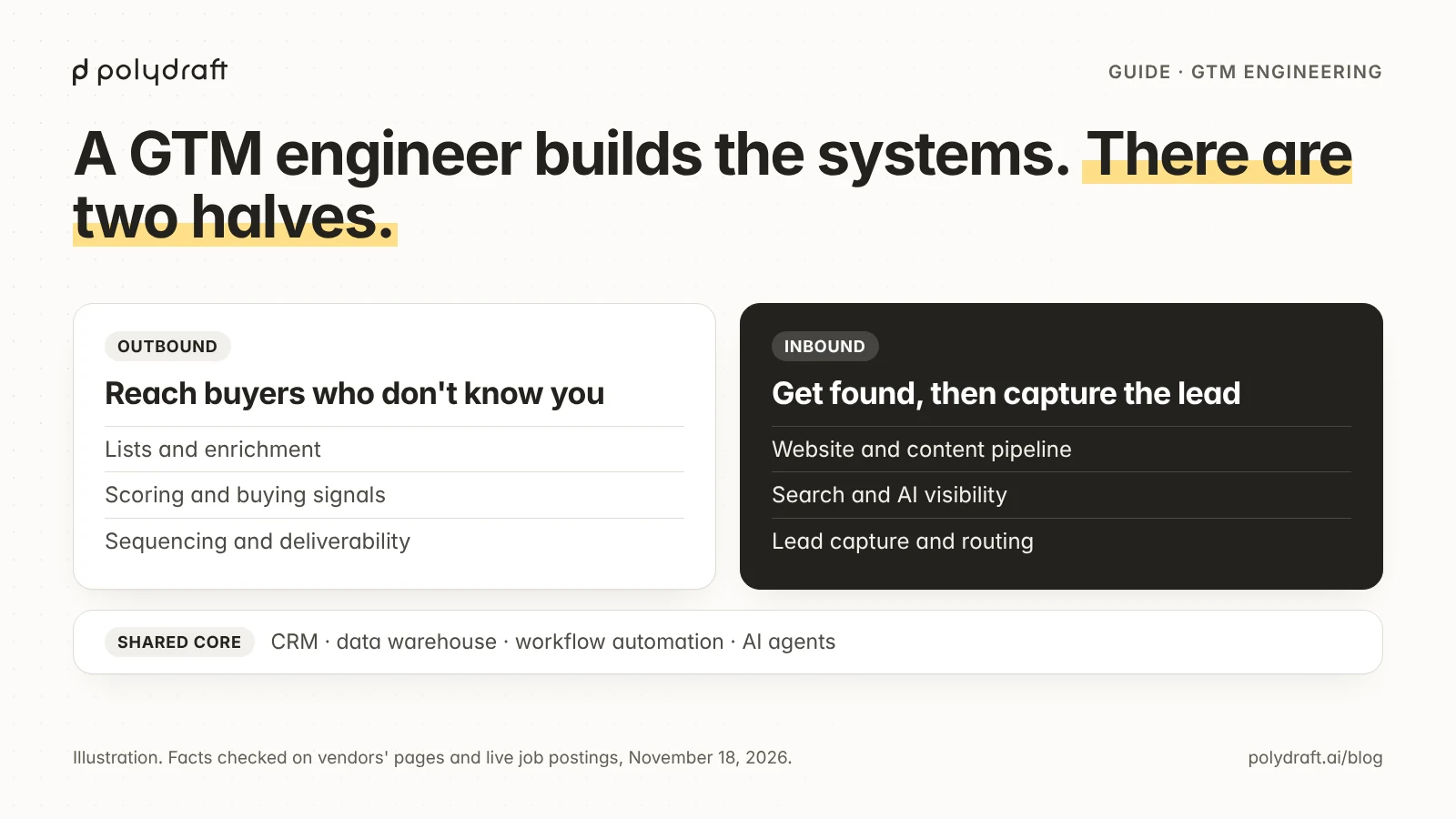
A GTM engineer builds the systems that run a company's go-to-market: the data, automations and AI workflows that find buyers, reach them and turn their interest into pipeline, instead of doing that work by hand. Clay, which says it coined the role in 2023, defines GTM engineering as "the practice of building automated revenue systems with AI, data, and workflow automation, instead of running go-to-market by hand." Most of what's written about the role covers only outbound: enrichment, sequencing, signals and Clay. This guide splits the job into an outbound half and an inbound half (website, content, search and AI visibility, lead capture), so you can tell which half your company needs first, and whether you need a hire at all.
We make PolyDraft, an AI website builder that covers part of the inbound half. It doesn't do outbound, data enrichment or CRM integration, and we say exactly where it stops below. We didn't test the outbound tools hands-on. Definitions, tool facts and pay figures come from vendors' own pages, job postings and a practitioner salary survey; search volumes come from DataForSEO. We read all of them on November 18, 2026.
Key points
- The title is new and loosely defined. Two US postings titled "GTM Engineer" that we read on November 18, 2026 describe different jobs: a full-stack engineer building internal AI apps (Vercel, which closed later that day) and a Salesforce and quote-to-cash systems owner (Together AI, still open). A third, Apollo's "Senior GTM Systems Engineer," is a Salesforce architect role.
- Most people mean the outbound half: building target lists, enriching and scoring them, watching for buying signals, and running email sequences.
- The inbound half is the system that produces the form fill: the website, the content pipeline, search and AI visibility, and lead capture. Outbound tools mostly pick up after that point.
- Pay is high and varies widely. The three postings state $138,000 to $295,000, depending on location, seniority and whether bonus is included. The 2026 State of GTM Engineering survey puts the US in-house median base at $135,000 (61 respondents).
- A small company may not need a hire. It needs one bottleneck automated. The decision table shows when a full-time GTM engineer makes sense.
What a GTM engineer is
A GTM engineer turns go-to-market work into systems that run without someone doing each step. Clay puts the difference in one line: "The unit of work is a system, not a task." Clay's guide illustrates it this way: "A traditional ops hire researches an account, updates the record, drafts the follow-up. A GTM engineer builds the workflow that researches every account, updates every record, and drafts every follow-up," and then measures the output in meetings booked and hours saved.
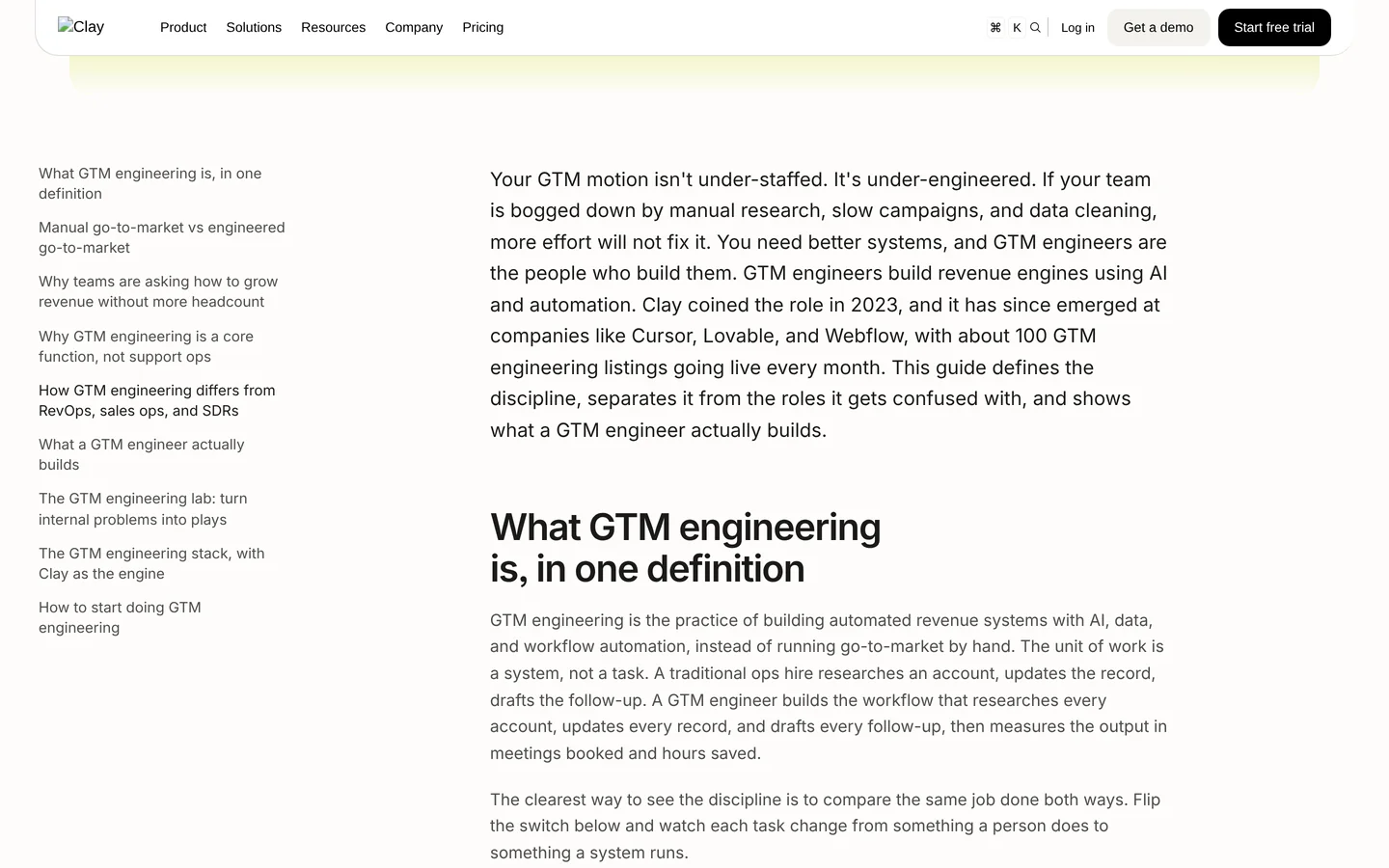
Clay's guide at clay.com/guides/gtm-engineering, captured November 18, 2026 at 18:09 UTC (1440 px desktop viewport, not signed in).
The homepage of the State of GTM Engineering report, an annual practitioner survey by Garrett Wolfe (founder of the GTM engineering agency OneGTM), Alex Lindahl (Claymation) and Maja Voje, adds where the role sits. It describes a GTM engineer as "a technical go-to-market operator who builds the data, automation, and AI workflows behind pipeline and revenue," working between sales, marketing, RevOps and data systems with tools like Clay, CRMs, warehouses and AI coding agents.
How technical the job is depends on the company. Clay's guide says a GTM engineer "does not need to write production code." Vercel's posting asked for 4+ years of full-stack development and a Next.js app shipped to production. Read the posting, not the title:
| Posting (checked Nov 18, 2026) | What the job actually is | Tools and skills named |
|---|---|---|
| Vercel: GTM Engineer (closed Nov 18, 2026) | Build and ship AI apps and workflows that Sales, Marketing, Customer Success and Data teams use; turn top performers' workflows into systems | Next.js, AI model APIs (OpenAI, Anthropic, v0), Vercel; 4+ years full-stack |
| Together AI: GTM Engineer | Architect the GTM tech stack, own data integrity and enrichment logic, lead Salesforce CPQ and quote-to-contract design | Salesforce, HubSpot, Snowflake, Clay, Gong, Apollo, APIs and webhooks; 3 to 5+ years in growth, GTM engineering or RevOps |
| Apollo: Senior GTM Systems Engineer | Own Salesforce architecture and automation for one funnel domain, including marketing and partnerships; build AI-assisted CRM workflows | Salesforce Flow, Apex, LWC, Chili Piper, Ironclad, Gong; AI coding tools such as Claude, Cursor or Codex |
A GTM engineer is not a sales engineer, who runs technical demos for prospects. Nor is the role a product software engineer. And it isn't the same as RevOps, though it often starts there. The comparison table covers the differences.
Why the role appeared: tools like Clay made go-to-market programmable
The GTM engineer exists because almost every go-to-market step now has an API, and AI made the steps between them cheap to automate. Finding companies, buying contact data, researching an account, scoring it, writing to it and logging the result used to take a person and several tabs. Now each step is a call to a data provider, a language model or a CRM, and one person can wire them together.
Clay's own account of the shift has two parts. The old model, where more reps meant more pipeline, stopped working once identical cold emails flooded every inbox. And AI "collapsed the cost of the research and engineering" that better plays required: in Clay's words, work that needed a developer or a week of manual research two years ago "is now a no-code workflow that runs in an afternoon." That is a vendor's framing of its own category, so weigh it accordingly. The plumbing it describes is real, though. Clay's pricing page says it buys data from 150+ partners on a customer's behalf (its homepage says 200+ vendors), and its guide describes AI research columns that run the same prompt across every account and syncs that carry results back to Salesforce or HubSpot.
Demand for the term is recent and still rising. In DataForSEO's US data pulled on November 18, 2026, "gtm engineering" and "gtm engineer" each average 4,400 searches a month, with a last-three-month average of 6,300; DataForSEO shows no year-ago figure for either term. Clay's guide claims about 100 GTM engineering listings go live every month. Skepticism is part of the picture too: one of the top Google results for "gtm engineer" that day was a Reddit thread asking whether the role is real or hype.
The outbound half: data enrichment, sequencing, signals
The outbound half finds companies you don't talk to yet, learns enough to judge them, and contacts the right ones at the right moment. This is what most job postings, courses and tool vendors mean by GTM engineering. It covers six jobs:
- List building: define the ideal customer profile and pull every matching account (Clay calls this TAM sourcing).
- Enrichment: fill in contacts, emails, phone numbers and company facts, often by querying several providers in sequence ("waterfall enrichment") until one returns a result.
- Scoring: rank accounts and leads by fit and timing, increasingly with an AI model that writes down its reasoning.
- Signals: watch for events that make an account worth contacting now, such as a funding round, a job change, a hiring spree or a visit to your pricing page.
- Sequencing and deliverability: send multi-step email campaigns from warmed-up mailboxes without landing in spam.
- CRM sync: write everything back to the system of record so sales sees it.
Three tools come up in nearly every outbound stack. Facts below are from each vendor's site on November 18, 2026:
- Clay is the orchestration layer. Its tagline is "Build systems to grow revenue." It combines a data marketplace, AI research agents (Claygent) and workflow automation in what its guide calls "a no-code table." Plans: Free (100 data credits and 500 actions a month, up to 200 rows per table), Launch, Growth (adds CRM auto-sync, webhooks and web intent signals) and custom Enterprise. On the pricing page, the FAQ gives "starting at" prices of $185 a month for Launch and $495 for Growth with monthly allowances, while the plan cards, shown with annual billing and yearly allowances, list $167 and $446 a month. Clay is the most common answer to "what is Clay in GTM engineering?": it's the workbench most GTM engineers build on.
- Apollo is a contact database and outreach platform in one. It says it holds over 240 million contacts and 30 million accounts and that over 600,000 companies use it. Its pricing page lists a free plan with no time limit. Email campaigns are included on every account, though free plans can connect Gmail only.
- Instantly focuses on cold email sending and deliverability. Its pricing page lists a 450M+ B2B lead database, waterfall email enrichment from 5+ providers, an AI Reply Agent, and private sending infrastructure. Instantly sells several separately priced products, so check the page for current totals. The page also lists a "Dedicated GTM Engineer" in its VIP plan, which is custom-priced and sold through a sales call: the title is now also sold as a service.
Outbound fits when you sell B2B to a definable list of companies, a deal is worth enough to justify paying per contact, and buyers aren't yet searching for your category. It fits poorly when you sell to consumers or local customers, deal sizes are small, or you can't meet email consent rules in the markets you target. Apollo, for one, advertises tooling for GDPR, CAN-SPAM and do-not-call compliance.
The inbound half: website, content, search and AI visibility, lead capture
The inbound half builds the systems that make buyers find you, and then catches them when they arrive. Most GTM engineering content stops at the form fill. Clay's inbound enrichment use case (linked as "Automated inbound" in the footer of Clay's guide), for example, describes connecting "forms, webinars, events, paid ads" and then automatically enriching, scoring and routing the leads they produce, so the work starts once a lead already exists. The work before that point is usually left to a marketer or an agency, and nobody calls it engineering. Calling it the inbound half is our framing, not an industry standard. We use it because it's the same kind of work as outbound: build a system once and let it run.
The inbound half has five parts:
- The website as a system. Pages built from structured content and templates, so adding a page, a language or a comparison is a data change rather than a design project. Deploys are routine, and nothing breaks when marketing edits copy.
- A content pipeline. Keyword research, then briefs, drafts, fact-checking, publishing and refreshing pages that lose traffic. The engineering part is making that a repeatable loop with review gates, not a burst of posts every quarter.
- Search and AI visibility. Technical SEO (sitemaps, canonical URLs, structured data, crawlable server-rendered HTML), monitoring in Google Search Console, letting AI crawlers in, and tracking whether ChatGPT, Perplexity or Google's AI answers mention you. Ahrefs and Semrush now market AI visibility alongside search, and Profound and Peec AI were built for it.
- Lead capture and routing. Forms, chat and scheduling that get a visitor to the right person fast. Chili Piper, for example, says its agents recognize which accounts are on your site, answer their questions, route them and book the meeting. This is where the inbound half hands off to the outbound stack's enrichment and CRM.
- Measurement. Knowing which pages and queries produce leads, so the content pipeline works on what converts.
Inbound fits first when buyers already search for the problem you solve, your sales cycle is long enough that they research before talking to anyone, or a small team can't staff outbound. It fits poorly when nobody searches for your category yet. In that case content takes months to find an audience, and outbound or partnerships reach buyers sooner.
The GTM stack, layer by layer
A GTM stack has a shared core (the CRM, the warehouse and a workflow layer) and separate tools for each half. The table names representative tools as each vendor describes itself. It isn't a ranking or an endorsement, and PolyDraft is ours.
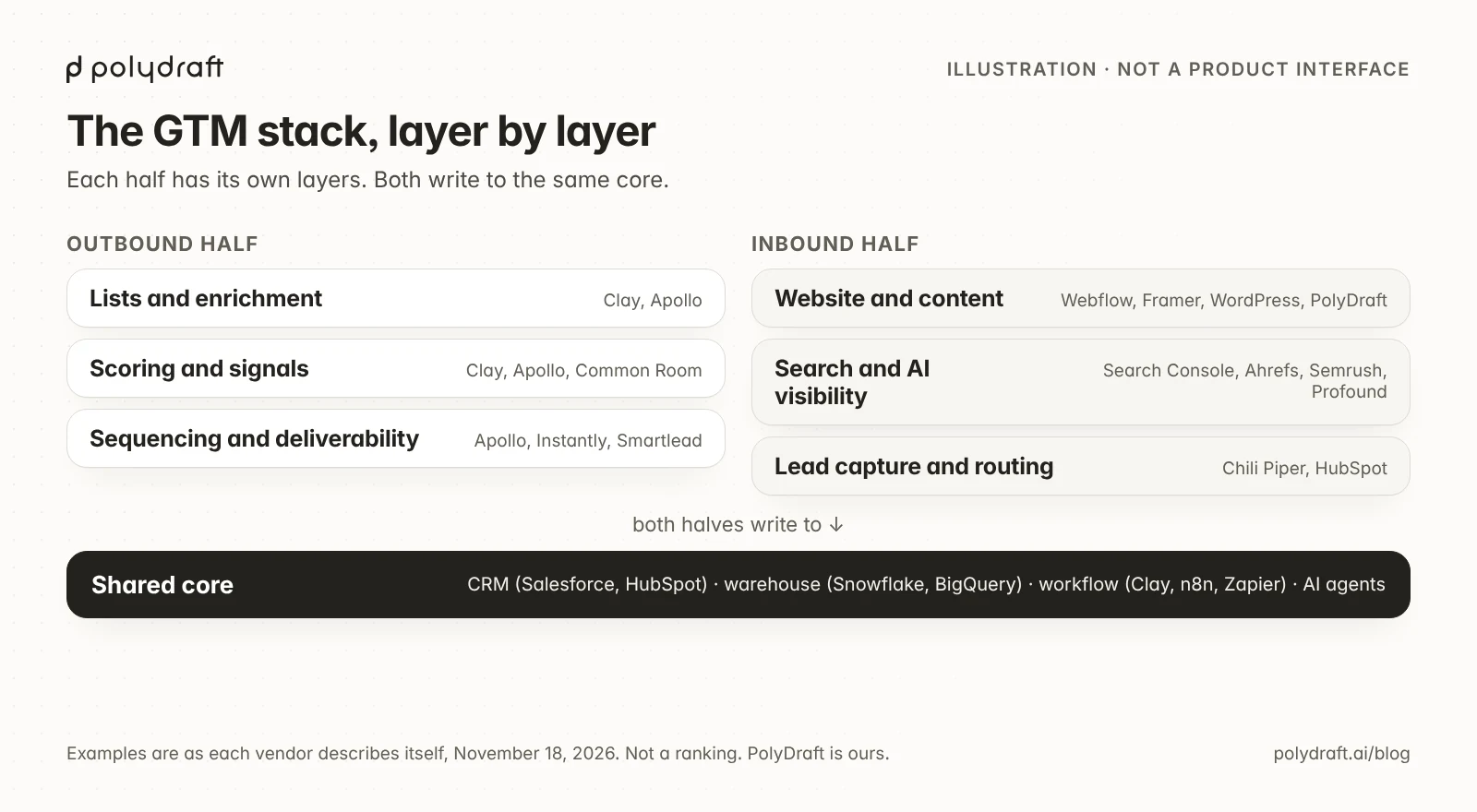
| Layer | Half | What the layer does | Representative tools (self-described, Nov 18, 2026) |
|---|---|---|---|
| CRM (system of record) | Both | Stores accounts, contacts, deals and activity | Salesforce, HubSpot |
| Data warehouse | Both | Holds product usage and other first-party data | Snowflake, BigQuery (named in Clay's guide) |
| Workflow and orchestration | Both | Connects tools, runs logic on triggers and schedules | Clay, n8n, Zapier |
| AI agents and coding tools | Both | Builds and runs custom automations | Claude, Cursor, Codex (named in Apollo's posting) |
| Lists and enrichment | Outbound | Finds accounts and contacts and fills in their data | Clay, Apollo, Instantly lead database |
| Signals and intent | Outbound | Flags accounts worth contacting now | Clay signals, Apollo buying signals, Common Room |
| Sequencing and deliverability | Outbound | Sends campaigns and keeps mail out of spam | Apollo, Instantly, Smartlead |
| Website and CMS | Inbound | Publishes and maintains the site and blog | Webflow, Framer, WordPress, PolyDraft (ours) |
| Search and content research | Inbound | Shows demand, rankings and technical issues | Google Search Console, Ahrefs, Semrush |
| AI visibility | Inbound | Tracks mentions and citations in AI answers | Profound, Peec AI, Ahrefs, Semrush |
| Lead capture and routing | Inbound | Turns visits into booked meetings and routed leads | Chili Piper, HubSpot marketing tools, Clay inbound enrichment |
A small team doesn't need every layer. A sensible minimum is a CRM, one workflow tool, and the tools for whichever half you're starting with.
Skills and a typical week
A GTM engineer combines systems skills with commercial judgment. Clay describes the role as "half commercial thinker, half builder," and the postings above add the specifics:
- CRM data modeling: objects, fields, ownership and sync rules. Together AI and Apollo both list Salesforce depth as a requirement.
- APIs, webhooks and a workflow tool: Clay, n8n or plain code.
- SQL and data hygiene: deduping, merging and keeping records trustworthy.
- Working with AI models: writing prompts for research and scoring, and checking their output. Apollo's posting asks candidates to understand "where AI-generated configuration or code can introduce errors, regressions, or false confidence."
- Commercial sense: knowing whether a workflow helps close deals, not just whether it runs.
- Working with non-technical teams: Vercel's posting asked for experience scoping internal tools with business teams.
- For the inbound half: technical SEO, content operations and web analytics, skills that rarely appear in current GTM engineering postings.
The week below is illustrative. It's assembled from the duties in the three postings and Clay's guide, not from one person's diary:
| Day | Outbound-leaning work | Inbound-leaning work |
|---|---|---|
| Monday | Review last week's meetings booked by play; retire the weakest sequence | Check Search Console for pages that lost clicks; queue them for a refresh |
| Tuesday | Build an account-research workflow for a new segment and test it on 50 rows | Turn a high-intent query into a page brief with sources |
| Wednesday | Fix a CRM sync that created duplicate contacts | Review the routing for demo-request forms; shorten time to first reply |
| Thursday | Add a job-change signal that triggers a sequence | Check whether AI answers mention the company for its main category prompts |
| Friday | Document the week's workflows; hand a stable one to RevOps | Publish the refreshed pages; note what to measure next week |
Salary and hiring
US GTM engineer pay is in the range of many software roles, but stated ranges vary with location, seniority and what's included. Here is what live sources said on November 18, 2026:
| Source (checked Nov 18, 2026) | Stated pay | What the number covers |
|---|---|---|
| Vercel: GTM Engineer (closed Nov 18, 2026) | $180,000 to $295,000 | Base pay, San Francisco, as last shown; other locations may be adjusted; equity and bonus possible on top |
| Together AI: GTM Engineer | $160,000 to $190,000 | US base salary, plus equity and benefits |
| Apollo: Senior GTM Systems Engineer (adjacent title) | $159,000 to $198,000 (San Francisco, New York City, Seattle); $138,000 to $172,000 (other US locations) | Total cash: base plus annual bonus; ranges may span several levels |
| State of GTM Engineering 2026: salary | US in-house median $135,000 (25th to 75th percentile $105,000 to $165,000); all regions $105,000 | Base salary only; self-reported by 61 US and 107 total in-house respondents who disclosed pay; surveyed Q4 2025 to Q1 2026 |
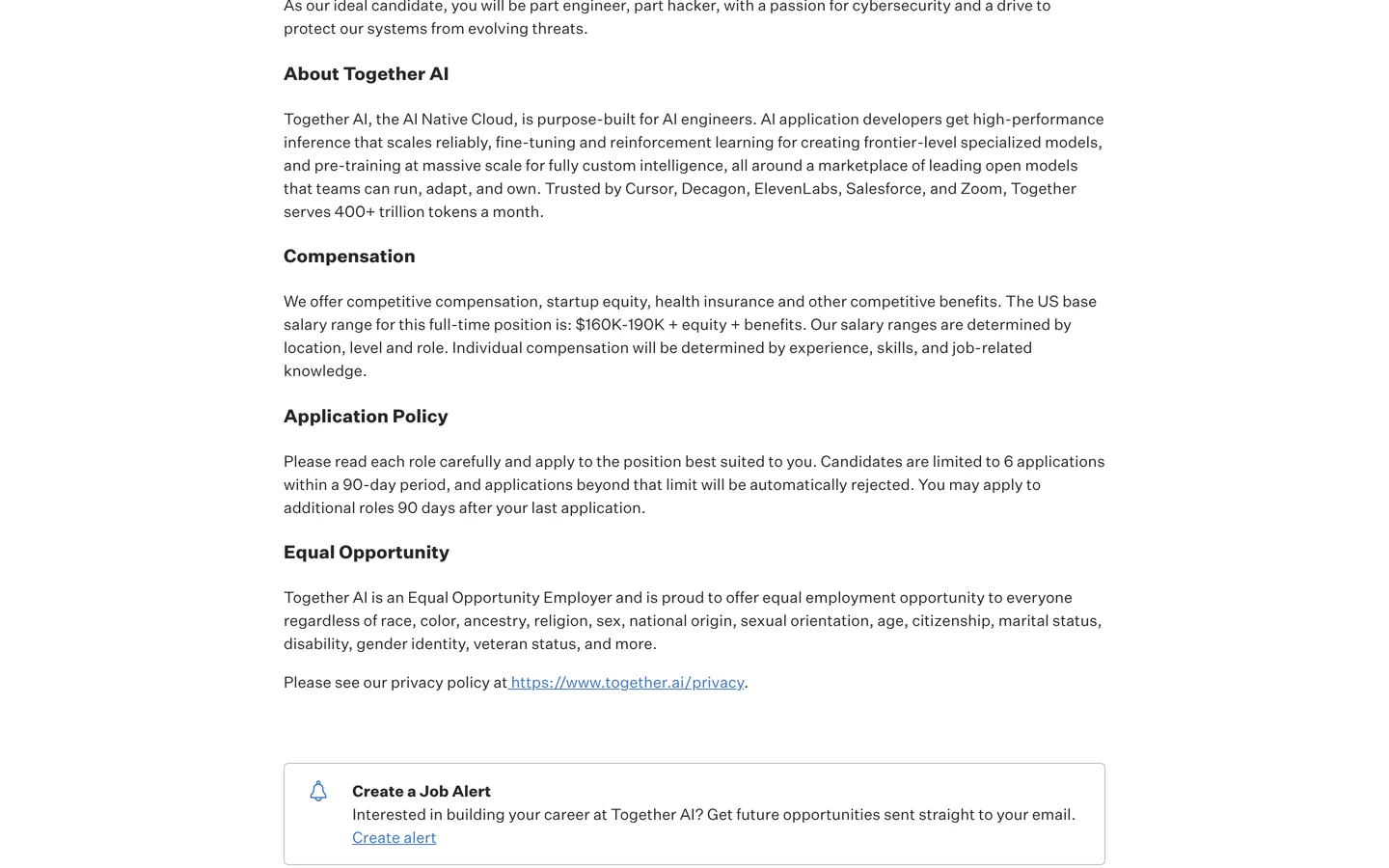
Together AI's GTM Engineer posting at job-boards.greenhouse.io, captured November 19, 2026 at 02:01 UTC (1440 px desktop viewport, not signed in). The posting was still open at that time.
Three cautions apply. First, postings turn over fast. Of ten Greenhouse postings with pay ranges that a web search returned that morning, nine had already closed and one (Together AI) was still open. Vercel's posting closed later the same day. If a link in the tables above stops working, the posting has closed; the figures are what it stated on November 18, 2026. Second, ranges as wide as Vercel's span several levels, so don't read the top as typical. Third, the State of GTM Engineering survey's full 2026 report sits behind a work-email form, but its salary medians are on an open page, which is what the table quotes; they're self-reported by a self-selected group, so treat them as indicative. Its homepage says the 2027 edition is being fielded in October and November 2026 and will publish once the survey closes, so a fresher benchmark is due.
Is GTM engineer a good job? On the evidence, it pays well, demand for the term is still growing, and the underlying skills (CRM architecture, data, automation, AI workflows) transfer to RevOps, growth and software roles if the title fades. The risk is that definitions vary so much that two "GTM engineer" jobs can share almost nothing. Judge an offer by its duties and tools, not by the title.
Does your company need one? For founders and small teams, the decision is usually about which bottleneck to automate first, not about a hire:
| Your situation | Sensible first move |
|---|---|
| Under about 10 people, no repeatable sales motion yet | Don't hire. A founder or ops generalist learns one workflow tool and automates one bottleneck. |
| Outbound works by hand but doesn't scale | A contractor or agency builds the first Clay or Apollo workflows. Vendors such as Default now sell "deployed GTM engineers," and Instantly includes one in its custom-priced VIP plan. |
| Buyers search for your category, but the site and content don't keep up | Fix the inbound half first: the site, a content pipeline and search basics. An AI SEO agency or a site builder that handles the technical layer may be enough. |
| Several workflows in production, a CRM that needs an owner, budget for a senior hire | Hire a full-time GTM engineer, and write the posting around the half and the tools you actually use. |
GTM engineer versus RevOps, growth engineer and marketing ops
The roles overlap. The useful difference is what each one delivers. Clay draws the RevOps line clearly: "RevOps keeps the existing motion running. GTM engineering changes what the motion is." The other rows are our working definitions:
| Role | Main output | Typical tools | Where it overlaps with a GTM engineer |
|---|---|---|---|
| GTM engineer | New automated revenue systems: research, scoring, routing, outreach and, in our framing, inbound systems | Clay, CRM, warehouse, workflow tools, AI agents | — |
| RevOps | A reliable existing motion: clean CRM, working routing, forecasts and reporting | Salesforce or HubSpot admin, BI, CPQ | Clay says most companies place their first GTM engineer inside RevOps |
| Growth engineer | Engineering for growth experiments in the product and on the website, measured by activation, conversion or retention. For the full definition, see what a growth engineer is. | Product code, analytics, experimentation tools | Shares the build-measure-iterate habit and also works on the website, but mainly on conversion experiments; the inbound half is about the systems that bring visitors and leads in |
| Marketing ops | The marketing machine: automation platform, campaign operations, lead lifecycle, attribution | HubSpot, Marketo, analytics | Owns parts of the inbound half: forms, nurture and lead handoff |
| Sales engineer | Technical demos and evaluations for prospects | Product, demo environments | Customer-facing; doesn't build internal systems |
What AI already automates on each half
On both halves, AI now does much of the repetitive research and drafting. People still decide what to target, what to say and what to trust. The table records what vendors say their AI does today (their claims, as of November 18, 2026, not our tests) and what still needs a person:
| Task | Half | What vendors say AI does now | What still needs a person |
|---|---|---|---|
| Account research | Outbound | Clay runs a research prompt across every account with Claygent | Choosing the questions; spot-checking accuracy |
| Lead scoring | Outbound | A Claygent scoring agent outputs a score and its reasoning (Clay) | Deciding which signals matter; auditing drift |
| Building workflows | Both | Clay's Sculptor co-pilot turns a plain-English request into a live workflow | Architecture calls. Apollo's posting lists "the architecture calls that do not get faster with AI." |
| Writing outreach | Outbound | Clay's "Use AI" columns draft outreach; Instantly lists an "AI Email Writer Agent" | The offer, the claims and compliance |
| Handling replies | Outbound | Instantly's AI Reply Agent answers replies | When to hand off to a human |
| Routing website visitors | Inbound | Chili Piper's agents recognize accounts, answer questions, route and book meetings | Routing rules, privacy and consent |
| Tracking AI visibility | Inbound | Profound and Peec AI track brand performance across AI answer engines | Deciding what to publish in response |
| Building pages and content | Inbound | AI site builders, including Framer's design agent and PolyDraft, generate pages from a brief | Facts, positioning and editorial review |
On the outbound half, AI has taken over most of the per-row work: research, scoring, first drafts and first replies. What's left is the judgment that makes a play worth running at all, plus keeping AI-generated data and copy accurate at scale. On the inbound half, AI can now build a site, draft articles and report where a brand shows up in AI answers. Deciding which pages deserve to exist, checking every fact before it ships, and connecting leads back to the pages that produced them remain human work.
Where PolyDraft fits (and where it doesn’t)
PolyDraft covers part of the inbound half: building and running the marketing website. It doesn't cover outbound, and it isn't a GTM engineer. As of November 19, 2026, according to PolyDraft's pricing, features, integrations and WordPress to Astro pages:
- What it does: builds a marketing site from a brief or an existing public URL and deploys it to your own Cloudflare account. The site keeps running if you cancel. It includes a blog CMS, an inquiry inbox, and support for up to 10, 30 or 100 languages depending on plan. Building and previewing are free; access is invite-based. Agency plans can export the full source code, and Pro and above can transfer projects.
- What it doesn't do: no outbound email, no data enrichment, no lead scoring and no CRM integration. It has no ecommerce. Moving from WordPress or another builder is a rebuild from your public site, not a backend import: PolyDraft's own WordPress page says plugins, private records and commerce functions don't carry over, and redirects are a gap you have to close.
- Who should use something else: outbound-led teams should start with Clay, Apollo or Instantly. Stores need an ecommerce platform. If your site depends on a membership system, booking engine, forum or course platform, PolyDraft's WordPress page says that dependency doesn't move.
We make no promises about rankings, traffic or AI citations, for PolyDraft or anyone else. If you're a startup weighing the inbound half, our startups page explains how we approach it.
Frequently asked questions
What does a GTM engineer do?
A GTM engineer builds and maintains automated systems for go-to-market work. On the outbound half, that means target lists, enrichment, scoring, buying signals, email sequences and CRM sync. On the inbound half, it means the website, content pipeline, search and AI visibility, and lead routing. The common thread is building a workflow once so it runs on every account or lead, rather than doing each task by hand.
What is a GTM engineer’s salary?
Two US "GTM Engineer" postings checked on November 18, 2026 stated $160,000 to $190,000 base at Together AI and $180,000 to $295,000 base in San Francisco at Vercel (that posting closed the same day). Apollo's adjacent "Senior GTM Systems Engineer" posting stated $159,000 to $198,000 total cash in San Francisco, New York City and Seattle and $138,000 to $172,000 elsewhere in the US. The 2026 State of GTM Engineering survey reports a US in-house median base of $135,000. Ranges move quickly, so check current postings.
Is GTM engineer a good job?
GTM engineering pays well and demand for the term is still rising, and the skills (CRM architecture, data, automation and AI workflows) carry over to RevOps, growth and engineering roles. The main risk is that the title means different things at different companies, so evaluate each role by its listed duties and tools.
What is Clay in GTM engineering?
Clay is the workflow and data platform most GTM engineers build on. It combines data from many providers, AI research agents and automation in a no-code table, then syncs results to a CRM. Clay also says it coined the GTM engineer role in 2023. It's an outbound-first tool, though it also enriches, scores and routes inbound leads.
What are the top GTM tools?
The GTM engineering toolset breaks into layers, not a single top-10 list. Most stacks pair a CRM (Salesforce or HubSpot) with a workflow layer (Clay, n8n or Zapier), outbound tools for data and sending (Apollo, Instantly), and inbound tools for the site, search, AI visibility and lead routing (Webflow or Framer, Search Console, Ahrefs or Semrush, Chili Piper). See the stack table.
Do GTM engineers need to code?
It depends on the employer. Clay says a GTM engineer doesn't need to write production code, and many build in no-code tools. Vercel's GTM engineer posting (closed November 18, 2026) required 4+ years of full-stack development. SQL, APIs and comfort with AI coding tools help in almost every version of the job.
What does GTM stand for in GTM engineer?
GTM stands for go-to-market: how a company finds, reaches, sells to and keeps customers. A GTM engineer is sometimes called a go-to-market engineer. It has nothing to do with Google Tag Manager, which is also abbreviated GTM.
Does a startup need a GTM engineer?
Most early startups don't need a full-time GTM engineer. They need one bottleneck automated, such as account research, lead routing or a site that can't keep up with content. Hire full-time once several workflows are in production and someone has to own the CRM and the systems around it.
How we researched this
About this article. This article was drafted by an AI agent working for PolyDraft on November 18, 2026. The agent read Clay's GTM engineering guide, pricing page and homepage; Apollo's and Instantly's homepages and pricing pages; the State of GTM Engineering homepage; the homepages of the tools in the stack table; and three job postings. Because the agent's network couldn't open those sites directly, it first read their server-rendered text through a page-parsing service. A separate review pass then reopened every cited page in an automated browser on November 18, 2026 (18:08 to 18:30 UTC), without signing in, added the survey's open salary page, and the draft was corrected where pages differed; a person has not yet re-checked the figures. Search volumes come from DataForSEO (US, English, pulled November 18, 2026), and the search-results observations come from a live US desktop Google sample on the same day. We didn't test Clay, Apollo, Instantly or the other third-party tools hands-on. Prices and pay ranges change often, so treat every figure as dated. PolyDraft is our product. Vincent Chen approved the article for publication on November 19, 2026.
Update note — November 19, 2026: Added a link to our guide to what a growth engineer is. This update does not claim a new human expert review or measured search results.
Continue with the next task
- Compare agencies before hiring for the inbound half: Best AI SEO agencies
- Decide what an AI agent may change on your site: How to use AI agents in SEO
- Plan the recurring search work after launch: Post-launch SEO checklist
- Check whether AI crawlers can read your site: AI crawler access check
Sources
Read November 18, 2026; the Together AI posting and Clay's pricing page were reopened November 19, 2026.
- Clay: GTM engineering guide, Pricing, Homepage, Inbound enrichment use case
- State of GTM Engineering: Homepage, Salary
- Job postings on Greenhouse: Vercel, GTM Engineer (closed November 18, 2026), Together AI, GTM Engineer, Apollo, Senior GTM Systems Engineer
- Apollo: Homepage, Pricing
- Instantly: Homepage, Pricing
- Other tools, as each describes itself: Default, Chili Piper, Salesforce CRM, HubSpot CRM, HubSpot marketing, n8n, Zapier, Common Room, Smartlead, Webflow, Framer, WordPress, Google Search Console, Ahrefs, Semrush, Profound, Peec AI
- PolyDraft: Pricing, Features, Integrations, WordPress to Astro