GEO Audit: A 10-Check Checklist You Can Run in an Afternoon
A GEO audit checks whether AI answer engines can reach, read, trust and cite your site: 10 ordered checks, run on our own site on November 14, 2026.
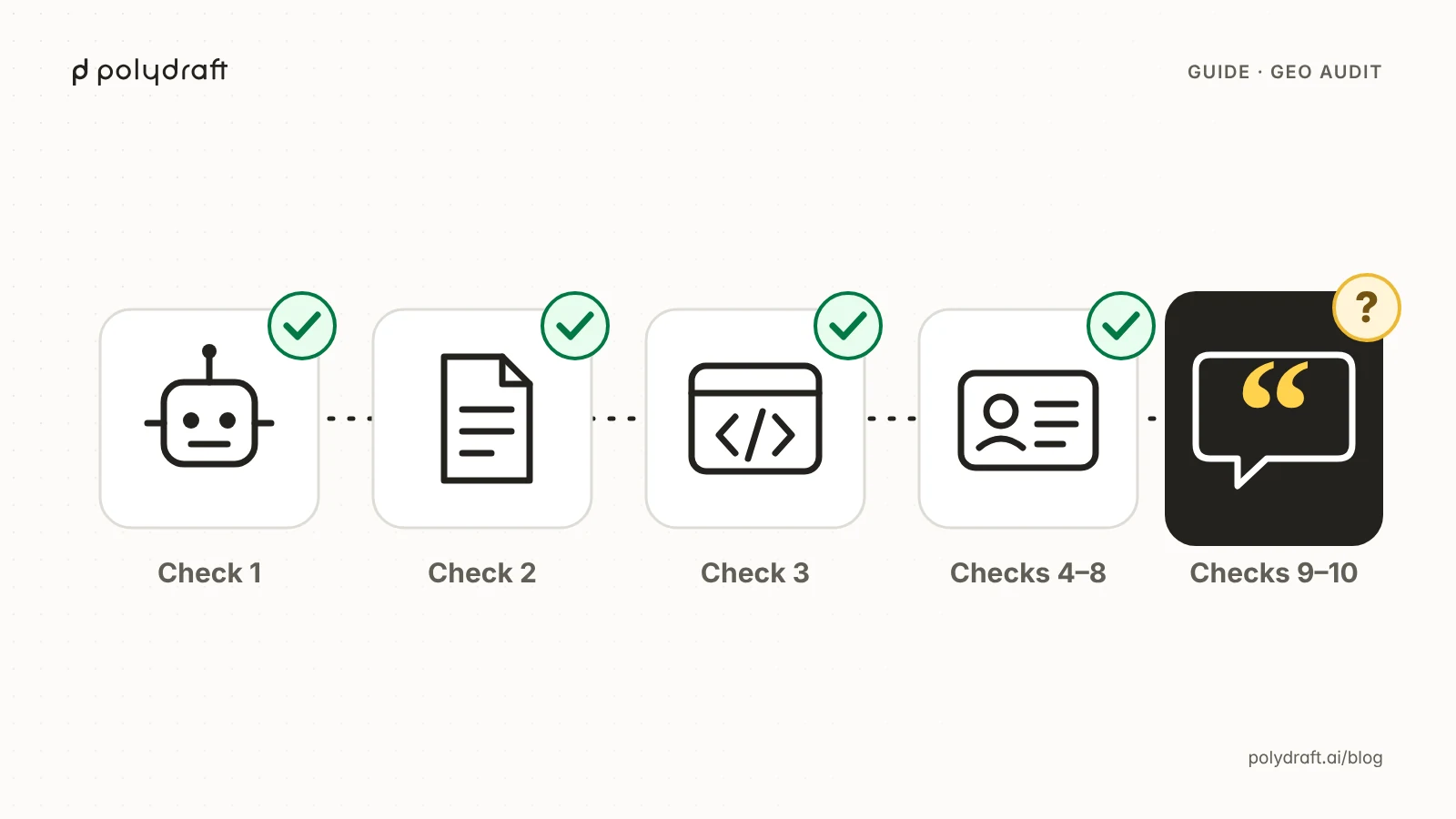
A GEO audit tests whether AI answer engines can reach, read, trust and cite your website. Run ten checks in order: crawler access, indexing in Google and Bing, rendering without JavaScript, answer-first pages, consistent business facts, structured data, llms.txt, third-party mentions, a manual prompt panel, and a measurement baseline. Each check below names its evidence and tool. We ran them on polydraft.ai on November 14, 2026: eight in full, indexing in part, and measurement not at all.
We make PolyDraft, an AI website builder, so the worked example is our own site, gaps included. If you call it an AEO checklist (answer engine optimization), the checks are the same.
Key points
- Most of a GEO audit is ordinary technical SEO, checked with AI crawlers and AI answers in mind. Google says optimizing for its AI features "is optimizing for the search experience, and thus still SEO."
- Only the last two checks look at AI answers themselves. Treat them as a dated sample, not a score.
What is a GEO audit?
A GEO audit (generative engine optimization audit) is a structured check of the conditions that let AI systems use your pages as sources. It looks at your site, the facts others publish about you, and a dated sample of AI answers. It ends with a list of fixes in priority order.
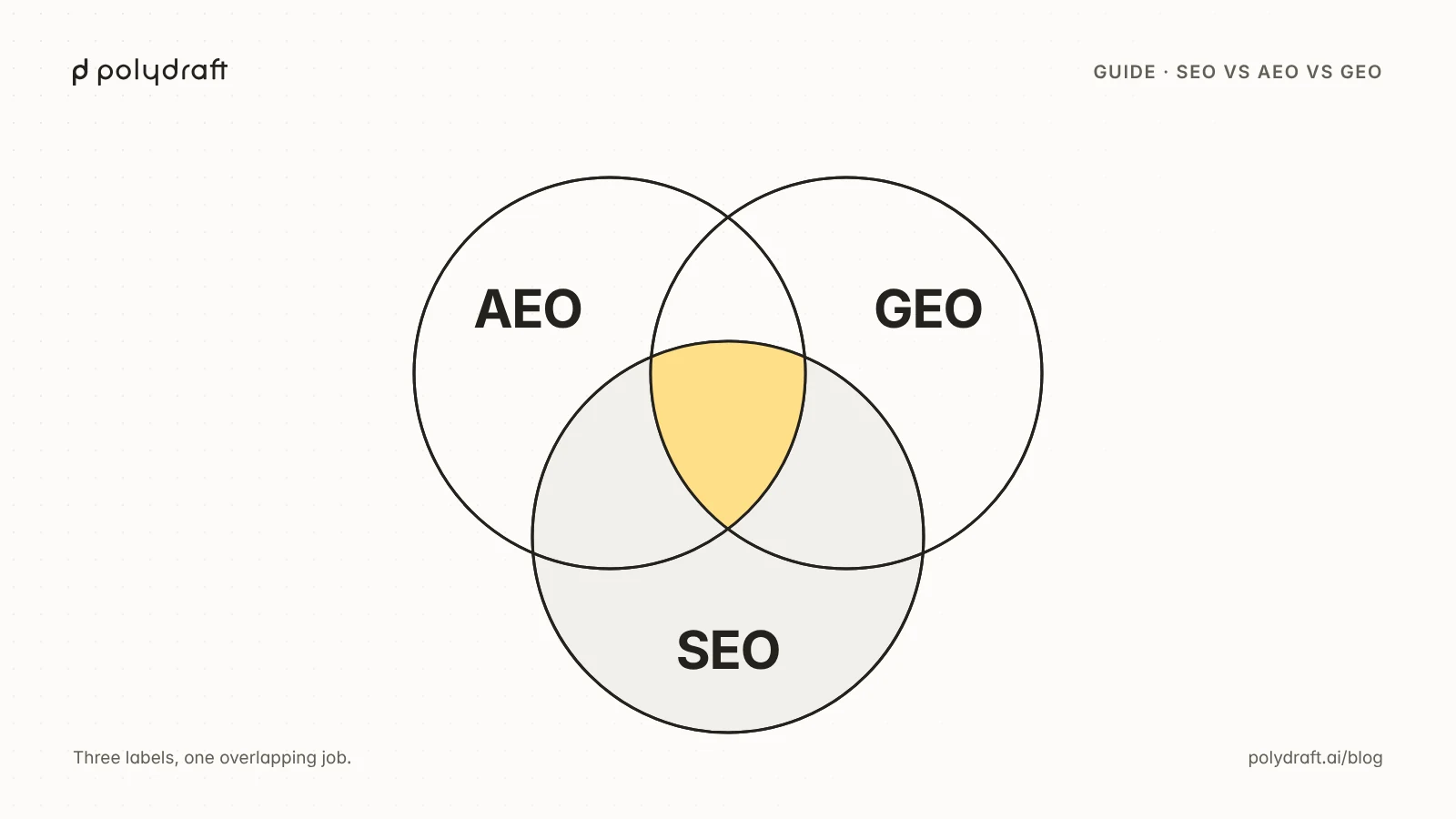
You'll see other names for the same job. An AEO audit or AEO checklist uses the older "answer engine optimization" label. An "AI visibility audit" usually leans toward measuring how often assistants mention you; checks 9 and 10 below cover that side, and our AI visibility checker guide compares tools that measure it. The label matters less than the order: access first, then content, then evidence from AI answers.
The search results for "geo audit" and "aeo audit" on November 14, 2026 were mostly free scoring tools, agency offers, a Reddit thread and Medium posts. One "GEO checklist" lists 449 checks; a small business needs the ten that would change what it does next, plus a record of what it found. If you're unsure how the three acronyms relate, our AEO vs SEO (and GEO) comparison explains it.
What answer engines say a GEO audit includes
We asked them. On November 14, 2026, we ran three prompts, including "what is a GEO audit", through ChatGPT via DataForSEO's ChatGPT scraper, US English, logged out. Two went to Perplexity's API (model sonar, web search on) through DataForSEO. We also captured Google's AI Overviews for four queries via DataForSEO's Google SERP API, desktop, US English. That makes nine answers, one run each: a very small sample, and answers vary by run, account, location and time. Domain counts use the links each answer showed directly; we left out Google's redirect links, as in our other panels.
| Engine | Queries | How the answers framed a GEO audit | Who they cited |
|---|---|---|---|
| Google AI Overviews | geo audit; what is a geo audit; aeo checklist; aeo strategy | Measurement first: how often AI answers mention or cite you. Then crawler access, schema, entity facts and third-party sources | 16 domains, mostly marketing-software vendors and agencies, plus Reddit and YouTube. No platform documentation |
| ChatGPT | what is a GEO audit; how do I do a GEO audit of my website; what should an AEO strategy include | Visibility, mentions, citations, content, authority and competitors. The "how do I" answer also covered crawlability and structured data | Only the "how do I" answer searched the web. It cited Google and Bing documentation, Google's test tools and SEO tools |
| Perplexity | what is a GEO audit; what should an AEO strategy include | AI visibility, accuracy, citations, technical access, content, authority and competitors | 20 domains, mostly agencies, software vendors and industry blogs. No platform documentation. None of the nine answers, from any engine, named or cited PolyDraft |
Two things stood out. First, most of the nine answers treat a GEO audit mainly as measurement. Google's AI Overview for "what is a geo audit" called it an evaluation of "how often and how well your brand, product, or website appears inside answers". Our checklist puts measurement last, because a low score tells you little until access and facts are right.
Second, Google's own AI Overview for "aeo checklist" told readers to add an llms.txt file and FAQPage schema. Google's guide says Search ignores llms.txt, and FAQ rich results stopped appearing in May 2026 (checks 6 and 7 below).
The GEO audit checklist: 10 checks in order
Here is the full AEO and GEO checklist. Each row names the evidence to save, so next month's audit can compare like with like.
| # | Check | Evidence it produces | Tool or manual method | Rough time |
|---|---|---|---|---|
| 1 | Crawler access | robots.txt rules per AI agent; HTTP status per user agent | Browser, curl, your CDN's bot settings | 20 min |
| 2 | Indexing in Google and Bing | Index status of key URLs; noindex and canonical tags; sitemap | Google Search Console, Bing Webmaster Tools | 30 min |
| 3 | Rendering without JavaScript | Key sentences present in raw HTML | curl, or a browser with JavaScript off | 15 min |
| 4 | Answer-first pages | First paragraph of each key page answers its question | Manual read of 5 to 10 pages | 30 min |
| 5 | Consistent business facts | Name, offer, address, prices match everywhere | Site, profiles, structured data, a brand search | 30 min |
| 6 | Structured data | Valid markup that matches the page, of types Google documents | Rich Results Test, Schema Markup Validator | 20 min |
| 7 | llms.txt (optional) | File exists, parses, links work | Browser, a link checker | 10 min |
| 8 | Third-party mentions | List of other sites that describe you | Search results, AI answer sources | 20 min |
| 9 | Prompt panel | Dated answers, cited URLs, brand named or not | ChatGPT, Perplexity, Google AI Overviews | 45 min |
| 10 | Measurement baseline | Starting numbers you can compare next month | Search Console, Bing Webmaster Tools, analytics | 20 min |
The times are our estimates for a site of 10 to 100 pages, not measurements. Together they fit in about four hours.
Checks 1 to 3: can AI systems reach and read your pages?
The first three checks decide whether an AI system can fetch your text at all. They are pass-or-fail, and each produces a record you can date. Fix any failure here before you touch content.
1. Crawler access: robots.txt and your CDN
Crawler access passes when your robots.txt and your CDN both let in the agents you've chosen to allow. Open yoursite.com/robots.txt and look for groups that name these agents, with links to each operator's documentation:
| Agent | Operator | What its robots.txt rule controls (as of November 14, 2026) |
|---|---|---|
| OAI-SearchBot | OpenAI | Appearing in ChatGPT search answers. OpenAI says opted-out sites "will not be shown in ChatGPT search answers" (OpenAI crawlers) |
| GPTBot | OpenAI | Use of your content to train OpenAI's foundation models; separate from search |
| ChatGPT-User | OpenAI | Pages fetched when a user asks; OpenAI says robots.txt rules "may not apply" |
| PerplexityBot | Perplexity | Being surfaced in Perplexity's answers (Perplexity crawlers) |
| ClaudeBot | Anthropic | Use of your content for Anthropic's model training (Anthropic's crawler page) |
| Claude-SearchBot | Anthropic | Indexing that improves Claude's search results |
| Google-Extended | A token, not a crawler: Gemini training and grounding. Google says it "does not impact a site's inclusion in Google Search" (Google's common crawlers) |
Search agents and training agents are separate decisions. You can allow OAI-SearchBot and block GPTBot, for example. Our robots.txt examples for AI crawlers give copyable files for each choice. You can also draft the rules with our robots.txt generator and then check them by hand.
robots.txt is only half the check. A CDN or firewall can block a crawler that robots.txt allows. Request one key page with each agent's user-agent string and record the status code. A 403 or a challenge page fails the check. Our manual AI crawler access check has the curl commands and explains how to verify a real crawler by IP address.
Evidence to save: the robots.txt text, and one status code per agent, with the date.
2. Indexing in Google and Bing
Indexing passes when your key pages return 200, aren't marked noindex, point their canonical tag at themselves, and are known to Google and Bing. AI features grounded in a search index can only use pages in that index.
Google is explicit. To be eligible for its AI features, "a page must be indexed and eligible to be shown in Google Search with a snippet" (Google's guide to generative AI features). The same guide adds that a site must be included under the Search generative AI setting in Search Console. That setting lives under Settings > Search generative AI, and its "Exclude" option removes your site from Google's Search generative AI features, including AI Overviews and AI Mode (Search generative AI control). Check it once; someone may have changed it.
For each key page, use the URL Inspection tool in Search Console. In Bing, add your site to Bing Webmaster Tools and check the same URLs. Our post-launch SEO checklist covers Bing setup and IndexNow. Microsoft says Copilot is grounded in Bing search (Copilot privacy and protections). Also look for nosnippet or a small max-snippet value in your robots meta tags, since those limit how Google can show your text.
Evidence to save: an index status per key URL from each tool, and the generative AI setting's value.
3. Rendering without JavaScript
Rendering passes when your main text, headings, tables and links are in the HTML your server sends, before any JavaScript runs. Google can process JavaScript, but many AI crawlers are reported not to run JavaScript, so test the raw HTML.
Test it two ways. Run curl -s https://yoursite.com/page | grep "a sentence from the page", or turn JavaScript off in your browser and reload. If the sentence is missing, or the page is blank, an AI crawler probably sees the same thing. Google's JavaScript SEO basics cover the fixes, such as server-side rendering.
Most builders pass this check. In our separate November 14, 2026 field test of 46 live sites on 10 website builders, the server HTML held at least 60% as many words as the rendered page on 40 of the 44 sites we could compare, and three were below 50% (best website builder for SEO). So test your own pages rather than assuming from the builder.
Evidence to save: the URL, the sentence you searched for, and whether it was found.
Checks 4 to 6: can an answer engine quote you correctly?
Checks 4 to 6 ask whether a system that reads your page gets the right answer from it. They need judgment, not just a tool. Score them on your five to ten most important pages.
4. Answer-first page structure
A page passes when its first paragraph answers the question the page exists for, in plain words, and each section opens with its own answer. AI answers often quote a passage on its own. A passage that only makes sense after three paragraphs of context is hard to quote.
Read the first 100 words of each key page. Ask: if this paragraph were the only thing someone saw, would they know what we do, for whom, where, and at what price or next step? Then check that headings say what each section answers.
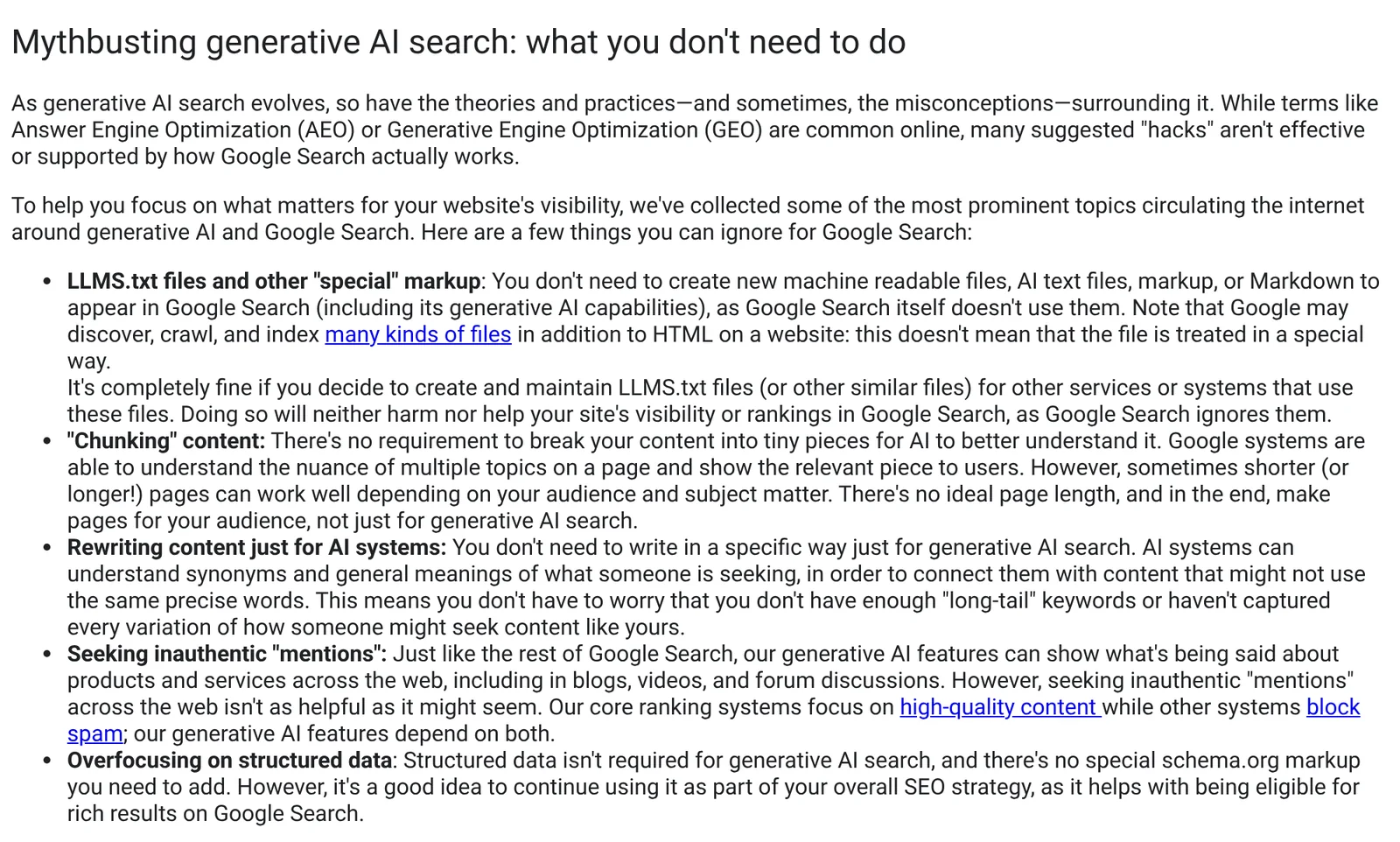
Google's guide says you don't need to break content into "tiny pieces" or rewrite it "just for AI systems". So this check is about clarity for people, which also helps machines. It is not about chunking.
Evidence to save: a table of pages with "answers first: yes or no" and the fix for each no.
5. Consistent business and brand facts
Facts pass when your business name, what you sell, your location, contact details and prices read the same everywhere. That means every page, your structured data, your llms.txt, your Google Business Profile and your social profiles. Answer engines combine sources. Conflicting facts give them a reason to describe you wrongly, or to skip you.
Make a short fact sheet first: legal name, brand name, one-sentence description, address, phone, email, prices, founding facts. Then compare each place against it. Our business website examples show where small sites usually put these details.
Also search your brand name on its own. If another company, product or game uses a similar name, write down how search results and AI answers tell you apart. That ambiguity is a fact problem too.
Evidence to save: the fact sheet, with every mismatch and where it appears.
6. Structured data Google documents
Structured data passes when it is valid, describes what the page visibly shows, and uses types Google documents. Structured data is optional for AI features. Google's guide says it "isn't required for generative AI search," and there's "no special schema.org markup you need to add".
Markup still helps Google understand pages and qualify for rich results. Check the types most small sites use:
- Organization or LocalBusiness: name, URL, logo, address as a PostalAddress, contact details. Google's Organization structured data page lists the recommended properties.
- Article or BlogPosting for posts: headline, image, dates, author (Article structured data).
- BreadcrumbList, and Product if you sell online.
Run key pages through Google's Rich Results Test and the Schema Markup Validator. Then compare the markup with the visible page, as Google's structured data guidelines require.
One change matters in 2026. Google stopped showing FAQ rich results on May 7, 2026, and removed their documentation in June (Search Central updates). FAQPage markup does no harm, but don't expect a Google feature from it.
Evidence to save: the validator result per page, and each mismatch between markup and page.
Checks 7 and 8: optional files and the web beyond your site
Check 7 is cheap and optional. Check 8 is where many AI answers actually get their facts about a business. Neither replaces checks 1 to 6.
7. llms.txt: optional, so check it is accurate
llms.txt passes if you don't have one, or if yours is accurate. It is a community proposal, a Markdown file at /llms.txt that lists your important pages. As of November 14, 2026, no major answer engine has documented using it for ranking or citations. Google says Search ignores these files, and that having one "will neither harm nor help" your visibility there.
If you keep one, check four things. It returns 200 as text, starts with an H1, links only to live pages, and states facts that match your fact sheet. Our llms.txt example and validation checklist walks through the format. To start a file, use our free llms.txt generator. Our other free website tools cover robots.txt rules and website costs.
Evidence to save: the HTTP status, the content type, and any dead links.
8. Third-party mentions
This check passes when independent sites describe your business accurately and you know which ones they are. AI answers often cite directories, reviews, forums and news, not only your own site.
Collect them two ways. Search your brand name and note every result that isn't yours. Then look at the sources AI answers cite in check 9. For each mention, record the site, what it says and whether it's right. Correct what you can, through the site's own process. Don't write fake reviews or seed forum posts. Google's guide warns that "seeking inauthentic mentions" isn't as helpful as it seems, and Google's spam systems apply to its AI features too.
Evidence to save: a list of third-party pages, each marked accurate, outdated or wrong.
Checks 9 and 10: do AI answers cite you, and how will you know next month?
The last two checks look at outcomes. Neither proves cause and effect. They give you a dated baseline to compare against after you fix the earlier checks.
9. A manual prompt panel
A prompt panel is a fixed list of questions you ask AI assistants, recording the answer, the cited sources and whether your business appears. Write 10 to 20 prompts before you look at any answers, so the list isn't chosen to flatter you. Mix three kinds:
- Brand prompts: "What is [your business]?", "Is [your business] any good?", "[your business] vs [competitor]".
- Category prompts: "best [service] in [city]", "best [product type] for [use]".
- Question prompts: the questions your best pages answer.
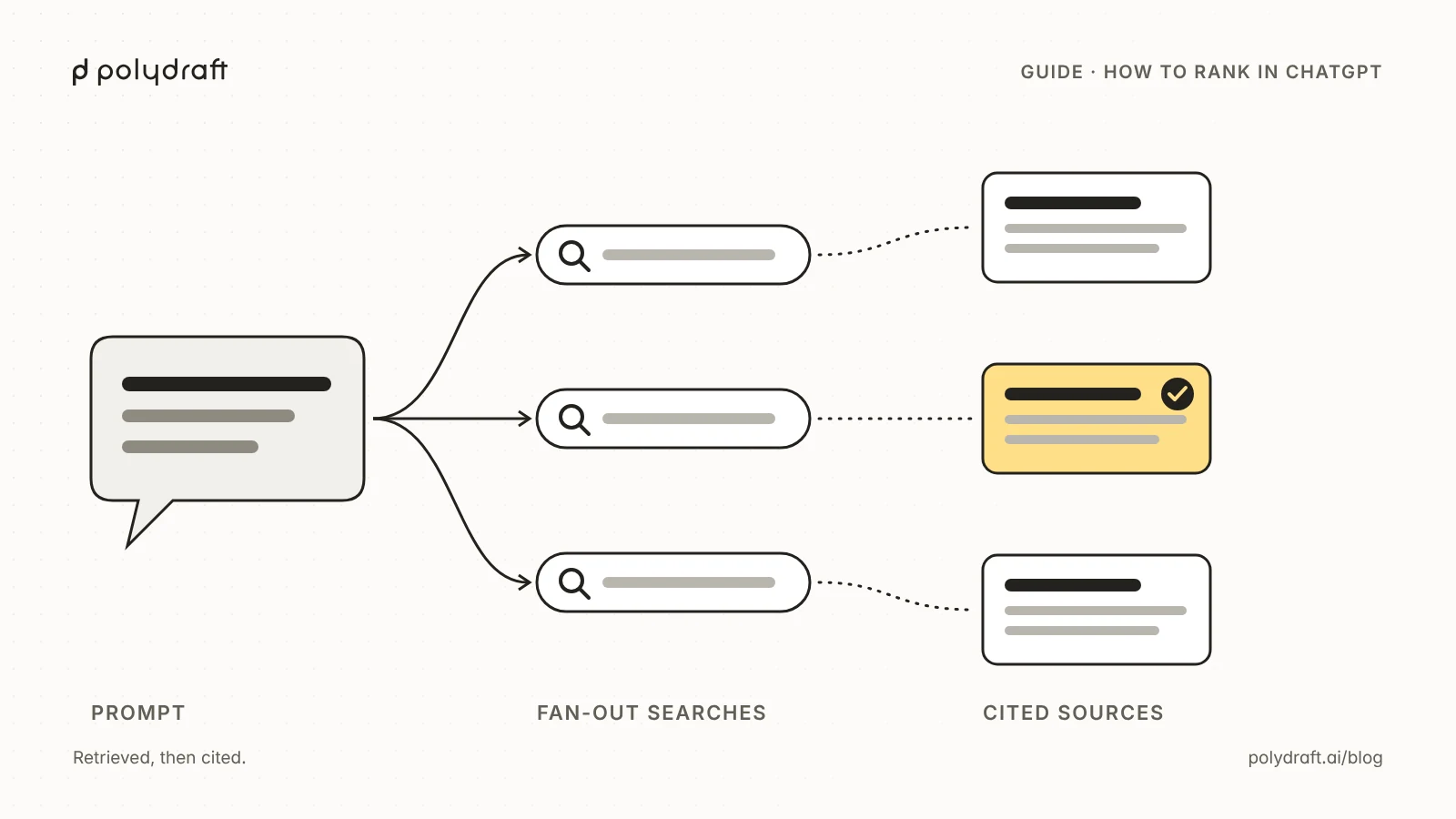
Run them in the assistants your customers use, such as ChatGPT, Perplexity and Google with AI Overviews. Record the date, the assistant, whether you were logged in, your location, every cited URL and whether your business was named. Answers change between runs, accounts and days, so report counts like "3 of 15", never a rank. For ChatGPT specifically, our guide on how to rank in ChatGPT explains how its search picks sources. An AI visibility tracker can repeat the panel for you.
Evidence to save: a spreadsheet with one row per prompt and assistant.
10. A measurement baseline
The baseline passes when you've written down today's numbers from sources you'll check again in four weeks. Use what the platforms provide:
- Google Search Console's Generative AI performance report shows impressions from Google's generative AI features, where your site has enough of them.
- Bing Webmaster Tools has an AI Performance report that counts citations in Copilot, Bing's AI summaries and some partner integrations. Microsoft launched it as a public preview in February 2026, and as of October 12, 2026 its data was sampled.
- Your analytics can show visits referred by chatgpt.com, perplexity.ai and similar sites. Many assistant visits arrive with no referrer, so treat the count as a floor.
Evidence to save: each number, its date range and where it came from.
Worked example: our GEO audit of polydraft.ai on November 14, 2026
We ran the checks on polydraft.ai on November 14, 2026, between 02:29 and 02:40 UTC, read-only; check 10 couldn't be run from our sandbox. We fetched the live robots.txt, sitemap and llms.txt, requested 83 sitemap URLs, rendered three pages with JavaScript on and off, and read the structured data. For the prompt panel we used our batch's dated panels, described below. The summary:
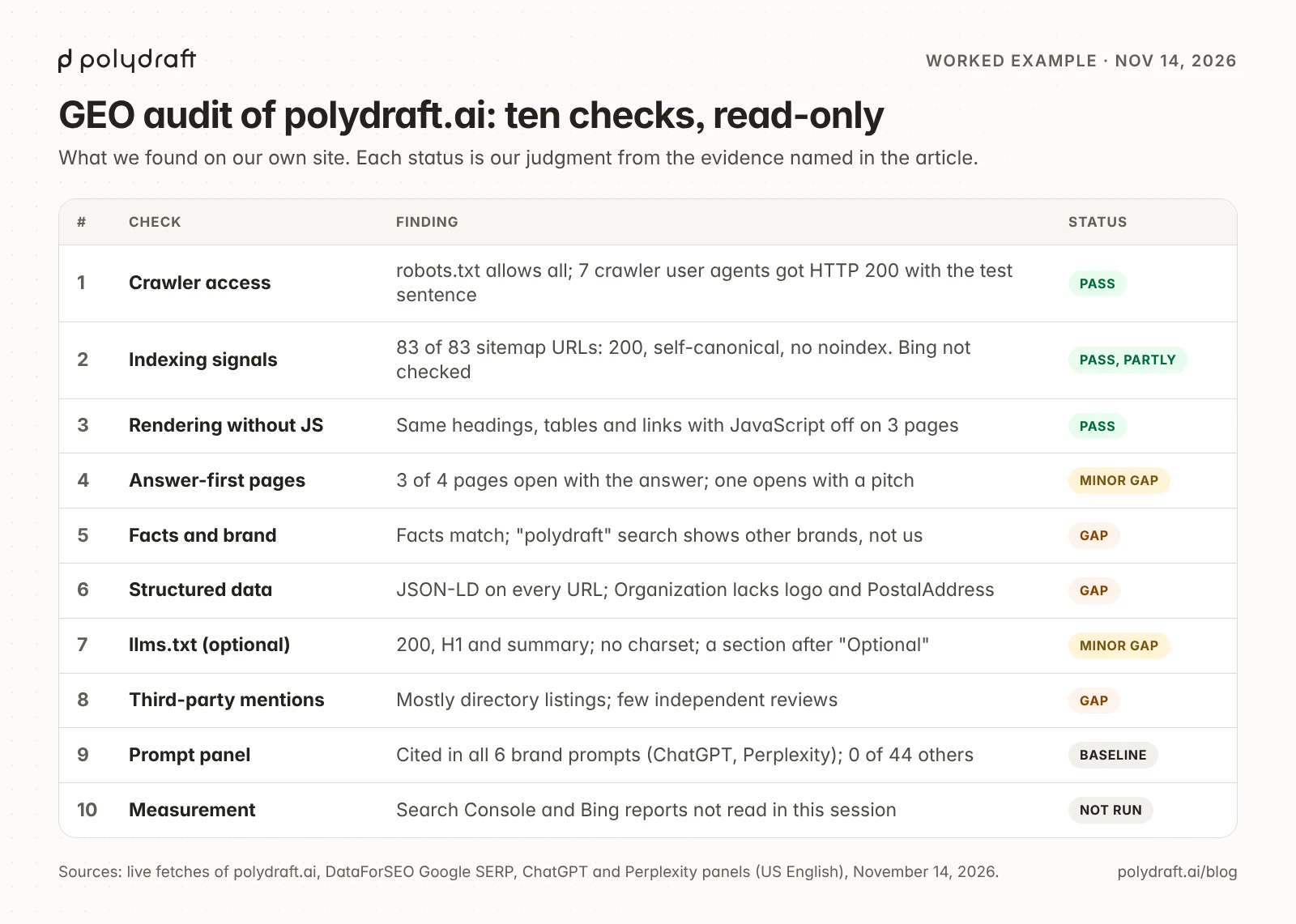
| # | Check | Result on polydraft.ai | Status |
|---|---|---|---|
| 1 | Crawler access | robots.txt allows all agents and names seven, including OAI-SearchBot, GPTBot and PerplexityBot. A blog post returned 200, with its test sentence, to seven crawler user agents (terminal output below). | Pass |
| 2 | Indexing signals | All 83 sitemap URLs returned 200 and self-canonical, with no noindex. A Google site: query returned an estimated 191 results. Bing and the Search Console setting were not checked from our sandbox. |
Pass, partly checked |
| 3 | Rendering | Three pages kept the same headings, tables and links with JavaScript off. | Pass |
| 4 | Answer-first | The blog post, homepage and pricing page open with a direct answer. The AI visibility page opens with a pitch and defines the term in its second section. | Minor gap |
| 5 | Facts and brand | Company name, address and email match across footer, structured data, llms.txt and ChatGPT's answers. A Google search for "polydraft" (US, desktop) showed none of our pages in the top 18 organic results. Its AI Overview noted a game studio with the same name. | Gap |
| 6 | Structured data | Every sitemap URL has JSON-LD. Posts carry BlogPosting, BreadcrumbList, Organization and Person. The Organization node has no logo, and its address is a plain string, not a PostalAddress. Posts still emit FAQPage markup. | Gap |
| 7 | llms.txt | Returns 200 as text/plain with an H1 and summary. It still has no charset in its content type, which we first noted on November 6. One section sits after the "Optional" section. Perplexity listed the file among its sources for "What is PolyDraft?", a single observation. | Minor gap |
| 8 | Third-party mentions | ChatGPT's brand answers cited directory and review pages such as TechYorker, iTechGuides and Legit.Show. One answer said there "aren't many independently verified customer reviews". | Gap |
| 9 | Prompt panel | ChatGPT named PolyDraft and cited polydraft.ai in 5 of 5 brand prompts, and in none of the other 35, which asked about local businesses, software and SEO topics. Perplexity did the same for its 1 brand prompt and cited us in none of its other 9. | Baseline recorded |
| 10 | Measurement | Search Console and Bing reports were not read in this session. PolyDraft doesn't measure AI referrals or track AI citations. | Not run |
The recheck: same checks, real terminal output
We re-ran the mechanical part of checks 1, 2, 6 and 7 at 03:48 UTC the same day, about 70 minutes after the first run ended. One read-only shell script fetched robots.txt, llms.txt and the sitemap. It then requested the same blog post with seven crawler user-agent strings, looking for the test sentence in the raw HTML. Last, it listed the JSON-LD types on three pages.
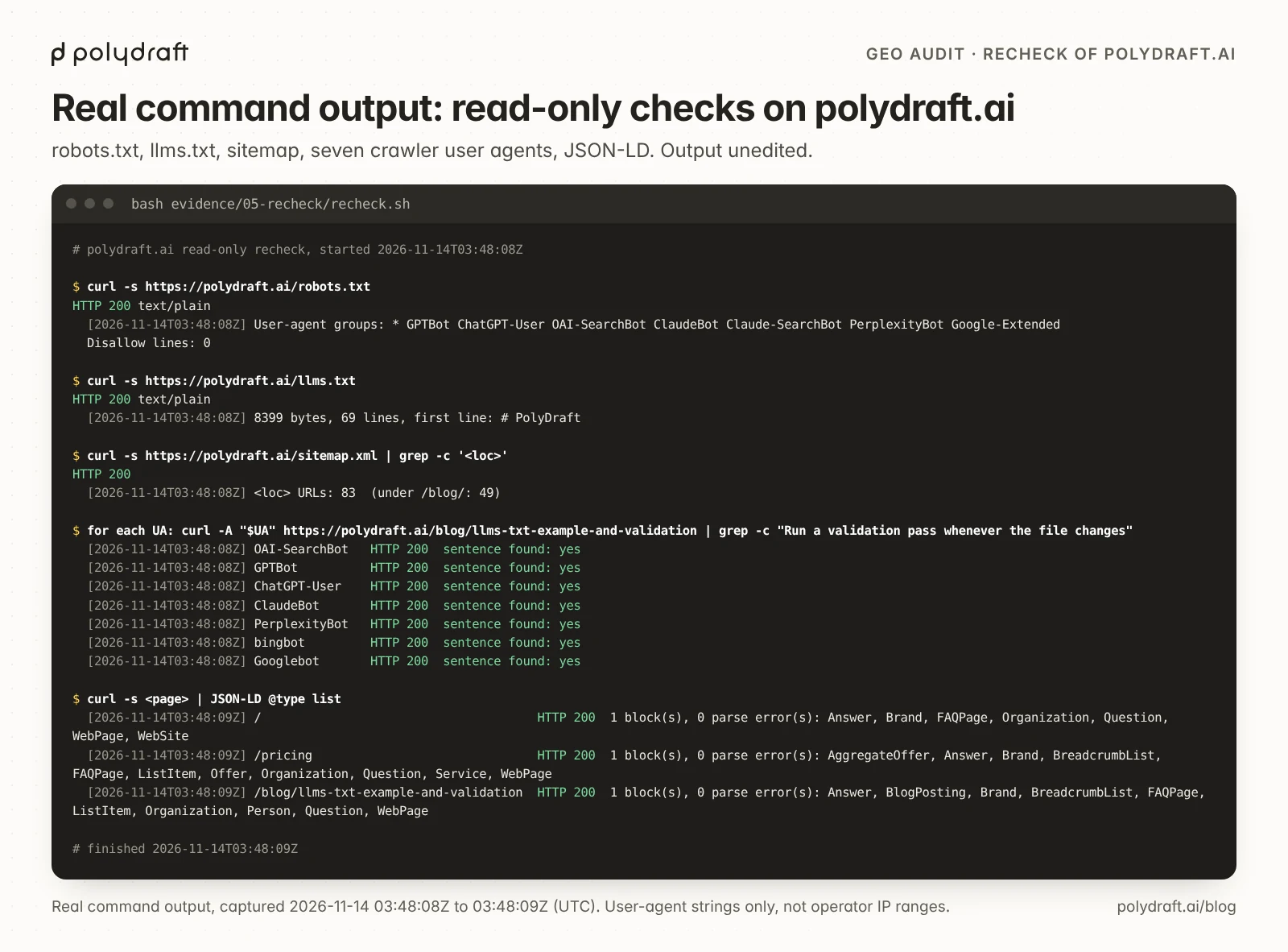
Every result matched the first run. robots.txt, llms.txt and the sitemap were byte-for-byte identical, all seven user agents got the test sentence, and the Organization markup still had no logo and a plain-string address.
A user-agent test only shows that nothing blocks by name. It doesn't prove a real crawler from the operator's IP range gets the same response.
What the results mean, in the order we'd tackle them:
- Brand ambiguity is the biggest gap. ChatGPT knows PolyDraft when asked by name. Google's organic results for the bare word "polydraft" were about drafting film and games, not us. The fix is more consistent mentions on independent sites, not more markup.
- Independent reviews are thin. The third-party pages ChatGPT cited were mostly directory listings. We can't fix that by writing on our own site, and we won't seed reviews.
- Structured data needs two small fixes. Add a logo and a PostalAddress to the Organization node. The FAQPage markup can stay, but it no longer earns a Google rich result.
- robots.txt mislabels three tokens. Our file groups GPTBot, ClaudeBot and Google-Extended under a comment that reads "AI Search Engine Crawlers". All three control model training (Google-Extended also covers Gemini grounding), not search, so the comment is wrong even though the rules work as intended.
The prompt panel data come from DataForSEO. We ran 40 prompts through its ChatGPT scraper on November 14, 2026, in US English, logged out; five were brand checks. We also ran 10 prompts through DataForSEO's Perplexity endpoint (the sonar model, web search on), one of them a brand check. All prompts were fixed before any results were seen. Different runs, accounts and locations will give different answers.
From GEO audit to AEO strategy
An AEO strategy is what you do with the audit results: a short, ordered plan, not a new set of tactics. Three steps turn the audit into one.
- Fix in checklist order. A failure in checks 1 to 3 blocks everything after it, so fix access, indexing and rendering first. Then correct facts (check 5), because conflicting facts can lead answers to describe you wrongly. Structured data and llms.txt fixes are cheap, so batch them.
- Write the pages the panel says are missing. Look at the prompts in check 9 where an assistant cited other sites and not yours. If you have no page that answers that question directly, that's your next page. If you have one, compare its first paragraph with the cited pages. Write it answer-first, as check 4 describes.
- Re-run the panel monthly. Keep the same prompts, assistants and settings, and record counts. Change one thing at a time where you can, and write down what you changed and when.
For polydraft.ai, the audit put off-site work first: brand ambiguity and thin independent reviews. Markup and llms.txt fixes came after. Your order will differ; let your own evidence set it.
What a GEO audit can’t tell you
A GEO audit tells you whether the conditions for being cited are in place. It can't tell you that an assistant will cite you, or why it chose another source. No vendor sees inside these systems; Google notes that "no third-party tool has access to our internal ranking or AI systems".
One limit is worth stating plainly: a crawler fetch isn't a citation, and a citation isn't a click. Record each separately.
If an audit shows your pages have nothing worth quoting, that's a content task. Our guide to what makes a site quotable covers it. If you'd rather hire someone, our guide to GEO services lists the deliverables to ask for. For Google specifically, see how to show up in AI Overviews.
Where PolyDraft fits
PolyDraft builds websites whose pages are server-rendered, with a sitemap, a robots.txt and structured data input in the generated code. That covers the raw material for checks 1, 3 and 6. We make it, so weigh this section accordingly.
Know the limits. As of November 14, 2026, the robots.txt in PolyDraft-built sites uses a fixed allow-all preset. Because the site runs on your own Cloudflare account, you can block individual AI crawlers in Cloudflare's AI Crawl Control; PolyDraft's own admin panel doesn't edit robots.txt. Sites built since November 2026 also serve an llms.txt file. PolyDraft's autopilot checks crawlability, structured data and llms.txt every week, and its weekly report samples which pages AI assistants cite; it doesn't measure AI referral traffic. Building and previewing are free; publishing needs a plan, as our pricing page explains.
Frequently asked questions
How is a GEO audit different from an SEO audit?
Most of it overlaps. Crawler access, indexing, rendering and structured data are technical SEO checks; a GEO audit runs them with AI crawlers such as OAI-SearchBot and PerplexityBot in mind. It adds what an SEO audit usually skips: consistent business facts on other sites, third-party mentions and a dated sample of AI answers. Google calls optimizing for its AI features "still SEO".
How long does a GEO audit take?
For a small site of 10 to 100 pages, the ten checks in this article take about four hours, by our estimate. The prompt panel takes longest. A large site takes longer because checks 4 to 6 need a person to read pages, not just a tool.
Do I need llms.txt to pass a GEO audit?
No. llms.txt is an optional community proposal. Google says Search ignores it, and no major answer engine has documented using it for ranking or citations as of November 14, 2026. If you keep one, make sure it returns 200, links to live pages and matches your other business facts.
Can a free GEO audit tool replace a manual audit?
A free tool is a good start for checks 1, 3 and 6, because those are mechanical. It can't judge whether your first paragraph answers the question, whether your facts match your Business Profile, or what AI answers say today. Its score is that tool's own measure, not a platform metric.
How often should I run a GEO audit?
Run the full checklist once, then repeat checks 9 and 10 monthly with the same prompts and settings. Rerun checks 1 to 3 after any change to your hosting, CDN, robots.txt or site template. Rerun check 5 whenever your prices, address or offer change.
Continue with the next task
- Write the robots.txt rules for each AI crawler: robots.txt examples for AI crawlers
- Test crawler access with curl: Manual AI crawler access check
- Get your pages into ChatGPT answers: How to rank in ChatGPT
- Choose a tool to repeat your prompt panel: AI visibility checker guide
- Fix the pages your audit flagged: SEO content audit
About this article. Drafted by an AI agent following PolyDraft's blog workflow, checked by an automated QA script, and approved by Vincent Chen. The worked example was run read-only on polydraft.ai on November 14, 2026, between 02:29 and 02:40 UTC, and its mechanical checks were re-run at 03:48 UTC. The terminal image is that re-run's saved output, rendered unedited as an image. Lines starting with $ are the script's own labels for each step; the full script, with its exact curl options, is kept with our evidence files. We fetched public files and pages with curl and a headless Chromium browser, and made no changes to the site. Google site: and brand results come from DataForSEO's Google SERP API, US English, on the same day. The ChatGPT answers come from DataForSEO's ChatGPT scraper, logged out, US English; the Perplexity answers come from Perplexity's sonar model through DataForSEO. The time estimates in the checklist are ours, not measurements. The answer-engine table comes from a second DataForSEO panel run between 03:46 and 03:52 UTC the same day, one run per prompt, with prompts fixed before results were seen. Search volumes come from Ahrefs (US) and DataForSEO (US, English), retrieved November 14, 2026. The Google screenshot shows its page with a substitute font, because its stylesheet didn't load in our headless browser; the text is unchanged. The hero is an original diagram.
Sources
- Google Search Central: Optimizing your website for generative AI features on Google Search, last updated July 10, 2026; Google's common crawlers, last updated October 30, 2026; JavaScript SEO basics; General structured data guidelines; Organization structured data; Article structured data; Latest Search Central documentation updates
- Search Console Help: Search generative AI control, Generative AI performance report, URL Inspection tool
- Google: Rich Results Test; Schema.org: Schema Markup Validator
- OpenAI: Overview of OpenAI crawlers, checked November 14, 2026
- Anthropic: Does Anthropic crawl data from the web, and how can site owners block the crawler?, checked November 14, 2026
- Perplexity: Perplexity crawlers, checked October 12, 2026
- Microsoft: Bing Webmaster Guidelines, Introducing AI Performance in Bing Webmaster Tools, Copilot privacy and protections, checked October 12, 2026
- Cloudflare: Manage AI crawlers, last updated July 28, 2026, checked November 14, 2026
- llms.txt: The /llms.txt proposal
- PolyDraft: polydraft.ai/robots.txt, /llms.txt and /sitemap.xml, fetched November 14, 2026; raw results in our evidence file