Lovable vs Claude Code 2027: Price, Hosting, Code and Limits
Lovable vs Claude Code on November 2026 prices, credits and usage limits, hosting, GitHub, security checks, and when to use both.
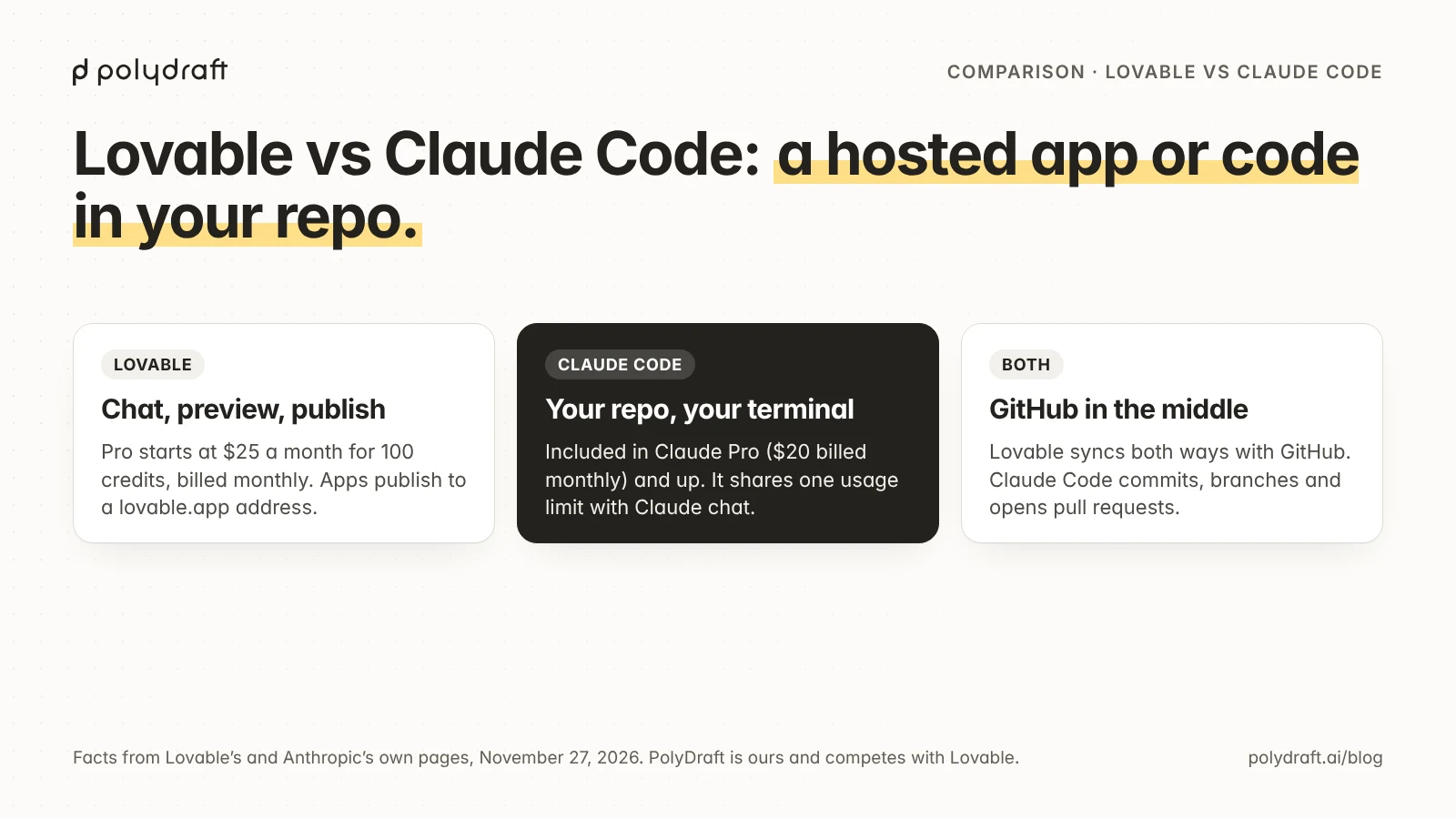
Lovable vs Claude Code is a choice between two kinds of tool. Lovable is a browser app builder: you chat, watch a preview, and publish to a lovable.app address with a built-in backend. Claude Code is Anthropic's coding agent: it works in your terminal, editor, desktop app or browser, on a code repository you control. Pick Lovable if you don't write code and want a hosted app. Pick Claude Code if you or your team can run, review and deploy code.
We make PolyDraft, an AI website builder. PolyDraft competes with Lovable for marketing sites, though not with Claude Code; it has its own short, labeled section near the end. Every price, limit and policy below comes from Lovable's and Anthropic's own pages, read on November 27, 2026. We have no account on either product, so this is a documentation comparison, not a hands-on test. Nothing here describes building an app in either tool.
Key points
- Who it's for: Lovable says anyone can build "with no technical knowledge needed" (Lovable pricing). Claude Code's docs assume you install a command-line tool or an editor extension and work in a project folder (Claude Code overview).
- Entry price: Lovable Pro starts at $25 a month for 100 credits, billed monthly, or $250 a year (Lovable subscription plans). Claude Code comes with Claude Pro at $20 billed monthly, or $200 billed up front for a year, which Anthropic shows as $17 a month (Claude pricing).
- Free use: Lovable's Free plan includes a daily chat allowance and 5 build credits a day, up to 30 a month. Claude's Free plan does not include Claude Code.
- Metering: Lovable charges credits per message, with a cost that depends on the work. Claude Code on a subscription draws from the same usage limits as Claude chat (five-hour and weekly on Pro and Max).
- Hosting: Lovable publishes and hosts your app and offers a built-in database. Claude Code writes code; none of the Claude Code pages we read offer to host your app.
- Code: Lovable syncs your project both ways with GitHub on every plan. Claude Code edits files in your repository and can commit, branch and open pull requests.
- Both: Lovable documents two routes: GitHub sync, with Claude Code working in the same repository, and Lovable's MCP server, which lets Claude Code send work to Lovable projects.
Lovable vs Claude Code at a glance
The table sums up the evidence in the sections below. Prices are as of November 27, 2026; Lovable's come from a "$" table, and checkout may vary by region.
| Lovable | Claude Code | |
|---|---|---|
| What it is | Browser app and website builder you talk to | Coding agent for terminal, IDE, desktop app and web |
| Who the vendor writes for | People with "no technical knowledge" | Developers working in a codebase |
| How you work | Chat, preview, publish | Prompt in a repository; review diffs; commit |
| Free plan | A daily chat allowance, 5 build credits a day (up to 30 a month), plus 20 Cloud credits a month | Not included on Claude Free |
| Entry paid plan | Pro, 100 credits: $25 a month billed monthly; $250 a year billed annually | Claude Pro: $20 billed monthly; $200 a year billed up front (shown as $17 a month) |
| How usage is metered | Credits per message; Cloud, AI and connector use also draw credits | Shared five-hour and weekly limits on subscriptions; API tokens on Console |
| Past the limit | Top-ups: $15 per 50 credits on Pro | Usage credits at API rates, a bigger plan, or pay-as-you-go on Console |
| Hosting | Publishes to your-app.lovable.app; custom domains on paid plans | Not offered on the pages we read; you deploy elsewhere |
| Database | Built-in backend (Cloud) with database, auth and storage | Whatever your project already uses |
| Code ownership | "You own your code"; two-way GitHub sync on all plans | Code lives in your own repository |
| Security review | Automatic checks when you publish, advanced checks on demand | Permission modes (Auto by default, or Manual prompts), sandbox, /security-review, security plugins |
| Team pricing | Priced by credits; unlimited members on all plans | Team plan from $20 per standard seat a month, billed annually |
Who each tool is for
Lovable is built for people who would rather describe an app than code it. Claude Code is built for people who already work with code, or will learn to.
Lovable's pricing page calls the product "an AI software engineer" that lets "anyone" build websites and web apps by chatting, "with no technical knowledge needed" (Lovable pricing). That is the vendor's claim, not something we checked. Its GitHub docs make the same point from the other side: "You don't need GitHub to use Lovable" (Lovable Git sync).
Anthropic describes Claude Code as "an agentic coding tool that reads your codebase, edits files, runs commands, and integrates with your development tools" (Claude Code overview). The overview's examples are developer jobs: write tests, fix lint errors, resolve merge conflicts, write commit messages and open pull requests. If the words in that list are unfamiliar, Lovable is the closer fit today.
If you want to stay inside Claude without code, Anthropic's pricing page lists Artifacts and Claude Design on every plan, Free included. Lovable can import a Claude Design into a new project through its MCP server (Lovable MCP server). We did not compare those products here.
For other builders aimed at non-developers, see our list of the best AI app builders.
How you work: chat and preview, or repo and terminal
In Lovable you stay in one browser tab. In Claude Code you start in a project folder, and the agent works on your files.
Lovable. You send messages in a project chat. Plan mode thinks through an idea and "never modifies your code"; Build mode makes the changes (Lovable credits and usage). When the app is ready, a Publish button in the top-right corner puts it on a live URL (Lovable publish).
Claude Code. You install it with one command on macOS, Linux or Windows, then run claude inside a project folder. It also comes as a VS Code extension, a JetBrains plugin, a desktop app and a web version at claude.ai/code (Claude Code overview). The desktop app can start a dev server and open it in a Browser pane, so you can see your running app while Claude checks its changes (Claude Code desktop). The web version clones a GitHub repository into an isolated virtual machine, makes changes and pushes a branch for you to review (Claude Code web quickstart).
Claude Code starts in Auto mode in the terminal and VS Code: a separate classifier model reviews its actions instead of you and blocks the ones it judges unsafe. You can switch to Manual mode, where it starts with read-only permissions and asks before it edits files or runs commands (Claude Code security).
Lovable vs Claude Code pricing: credits against usage limits
The entry prices are close: $25 against $20 a month on monthly billing. What you get for that money is measured in different units, so a direct comparison only goes so far.
Lovable: plans priced by credits
Lovable sells Pro and Business plans in credit tiers. Pro starts at 100 credits for $25 a month on monthly billing or $250 a year (Lovable lists this as $21 a month). Business starts at 100 credits for $50 a month or $500 a year. Both run up to 10,000 credits a month (Lovable subscription plans). The Lovable pricing page showed euro prices to our capture tool (€25 and €50, the same numbers), so Lovable appears to price by region. The dollar figures here come from the "$" price table on Lovable's subscription plans page. What you pay at checkout may depend on where you are.
On top of plan credits, Free, Pro and Business include grants: 5 daily build credits, 20 monthly Cloud credits, 4 monthly AI credits and 1 connector credit. On Free, daily build credits stop after 30 in a calendar month (Lovable subscription plans).
A message costs what the work costs. Plan mode is 1 credit per message, plus any research it runs. Build mode "depends on the complexity of the request and the work completed" (Lovable credits and usage). Messages in Chat mode are priced separately and draw first on a daily chat allowance included on Free, Pro and Business.
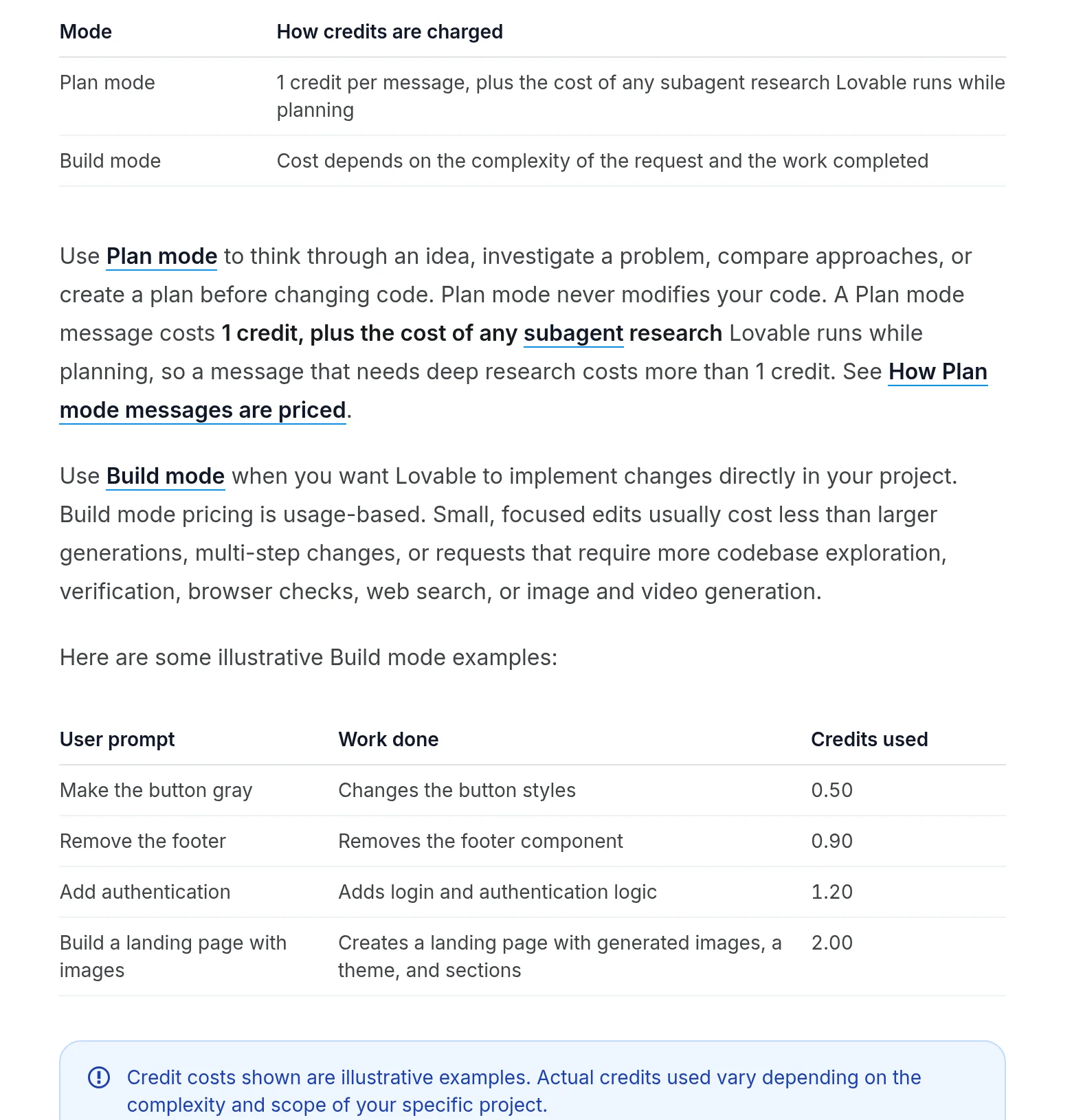
Lovable's Credits and usage page, captured November 27, 2026. Lovable calls these costs "illustrative examples".
The two official pages disagree on one example. The docs list a landing page with images at 2.00 credits. The pricing page lists "Build me a landing page, use images" at 1.70 credits. Treat both as rough guides. The pages also differ on caps: the pricing page says some regional Pro and Business plans cap daily build credits at 30 a month, while the plans docs say only Free is capped.
Credits expire. Monthly plan credits last two months from issue; on annual plans they last until one month after the year ends. Top-up credits last 12 months. Credits "aren't refundable" (Lovable pricing). Our Lovable pricing guide works through what a project costs in credits. Base44 meters credits differently; see our Base44 pricing guide.
Claude Code: included in Claude plans, or billed by the token
Claude Code is "included in all paid plans", and "it shares the same usage limits as the rest of your plan" (Claude pricing). The plans on that page:
| Claude plan | Price | Usage, as Anthropic states it |
|---|---|---|
| Free | $0 | Claude Code not included |
| Pro | $20 billed monthly; $200 a year billed up front (shown as $17 a month) | Limits every 5 hours and every week; at least 5 times Free's usage per 5-hour session |
| Max | $100 a month, billed monthly | 5 times Pro usage, every 5 hours and every week |
| Ultra | $200 a month, billed monthly | 10 times Pro weekly usage; no 5-hour limit for verified accounts |
| Team, standard seat | $20 per seat a month billed annually; $25 billed monthly | "More usage than Pro"; for 2 to 150 people |
| Team, premium seat | $100 per seat a month billed annually; $125 billed monthly | 5 times more usage than standard seats |
| Enterprise | $20 per seat a month, billed annually, 20-seat minimum, plus usage at API rates | Admins set spend limits |
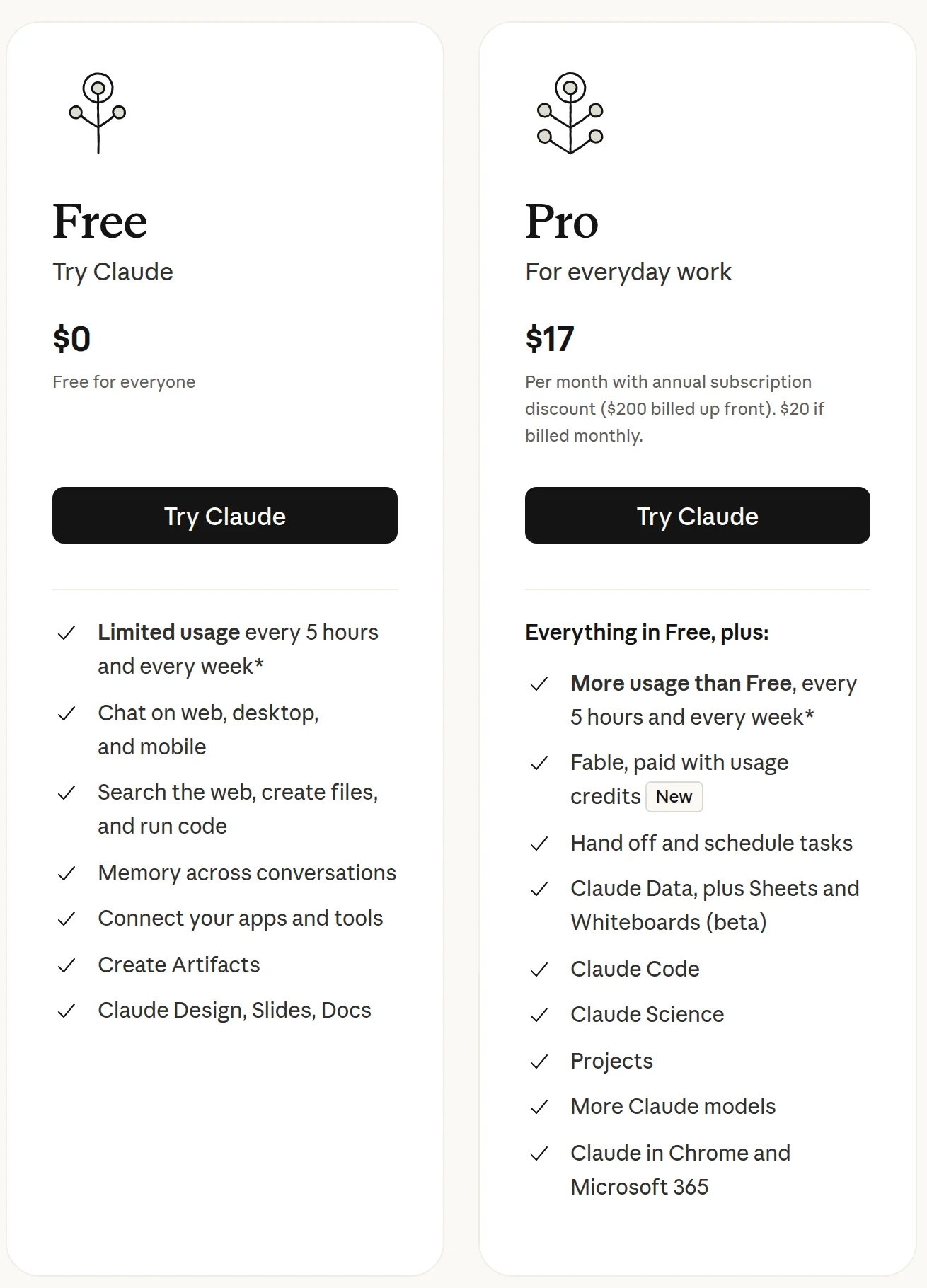
Claude's pricing page, captured November 27, 2026 (US). Claude Code appears on the Pro card, not on Free.
Anthropic gives no fixed message count. "How much you can do depends on the length and complexity of your conversations, the model you choose, and the features you use" (Claude pricing).
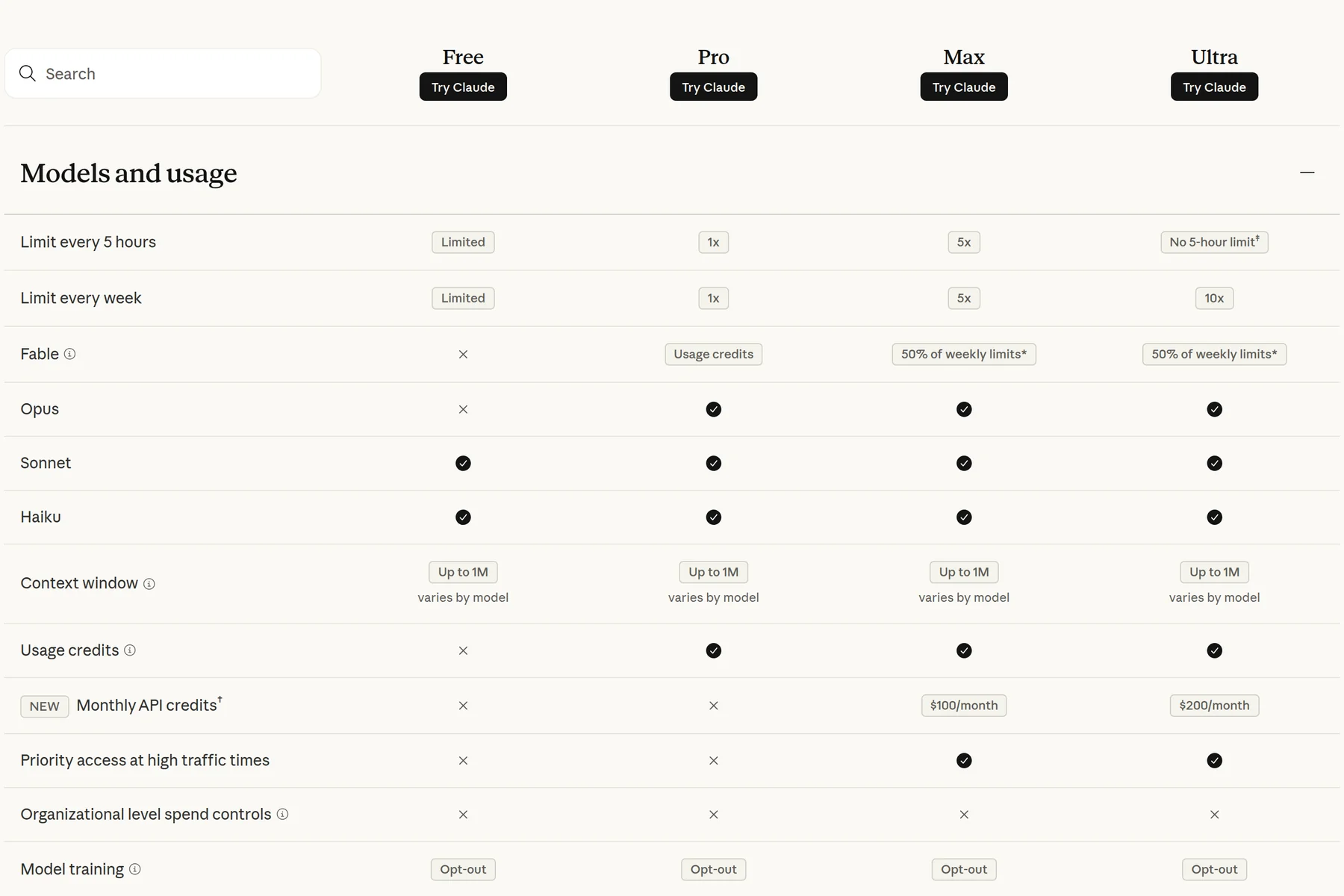
Claude's pricing page, captured November 27, 2026. Two parts of the same table are shown: the plan header row, and the Models and usage rows further down. The rows between them were cut.
Max and Ultra also include monthly API credits ($100 and $200) for building on Anthropic's API. Anthropic says these can't be used in Claude Code or for usage credits (Claude Help Center).
The other route is the API. You sign in to Claude Code with a Claude Console account and pay per token (Claude Code authentication). On the pricing page's API tab, Sonnet 5.5 costs $2 per million input tokens and $10 per million output tokens; Opus 5.5 costs $4 and $20 (Claude pricing). Anthropic's cost guide says enterprise deployments average "around $13 per developer per active day and $150-250 per developer per month" (Claude Code costs). One trap: if an ANTHROPIC_API_KEY variable is set on your computer, Claude Code uses it and bills API rates instead of your subscription (Claude Help Center).
What a year costs at the entry level
List prices before tax, from the pages above. This is our arithmetic, not a vendor quote.
| Setup | Lovable | Claude Code |
|---|---|---|
| Entry plan, billed monthly | Pro 100 credits: $25 × 12 = $300 | Pro: $20 × 12 = $240 |
| Entry plan, billed yearly | Pro 100 credits: $250 | Pro: $200 |
| Next step up | Pro 200 credits: $50 a month, $600 a year on monthly billing | Max: $100 × 12 = $1,200, billed monthly only |
| Hosting included | Yes, on lovable.app; heavy traffic draws credits | No; add your own hosting bill |
The rows are not equal value. Lovable's price includes hosting and a backend allowance. Claude Code's price covers the agent only, plus Claude chat on the same plan. To price the rest of a project, try our website cost calculator.
Hosting, deployment and databases
Lovable runs your app for you. Claude Code leaves hosting to you.
Lovable. The Publish dialog puts your app at your-app.lovable.app by default. Custom domains need a paid plan. "Publishing from the publish dialog costs nothing and works even when your credit balance is zero" (Lovable publish). The same FAQ says "Hosting the published app is free", while the built-in backend "consumes run credits as your app is used". The pricing page adds that apps with "significant visitor traffic and/or size may start incurring cost" beyond the included grant (Lovable pricing).
The built-in backend, which Lovable calls Cloud, includes a database, sign-in, file storage, edge functions and AI features (Lovable built-in backend). Two limits are worth knowing first. You can't change a project's data region after the backend is on. Moving from the built-in backend to your own Supabase project is a manual job: export the database, restore it, then move files, code, sign-in and secrets.
You can also host a Lovable app elsewhere. Lovable's portability guide describes deploying from the synced repository to platforms such as Netlify, Vercel or Cloudflare Pages, or to your own server (Lovable external hosting).
Claude Code. None of the Claude Code pages we read offer hosting or a database. It works with whatever your project uses: it can run commands, and it connects to outside tools through MCP servers (Claude Code overview). Deployment is a step in your own workflow, such as a host that builds on every push. That is more setup, and more choice.
Code ownership, export and GitHub
Both vendors leave the code with you. They differ in where the code lives day to day.
Lovable's pricing FAQ is direct: "You own your code", including apps, customer data stored in Lovable and AI output, "subject to any third-party rights in the underlying AI models" (Lovable pricing). Git sync to GitHub, GitLab or Bitbucket is on every plan. Downloading the codebase as a .zip needs a paid plan (Lovable subscription plans).
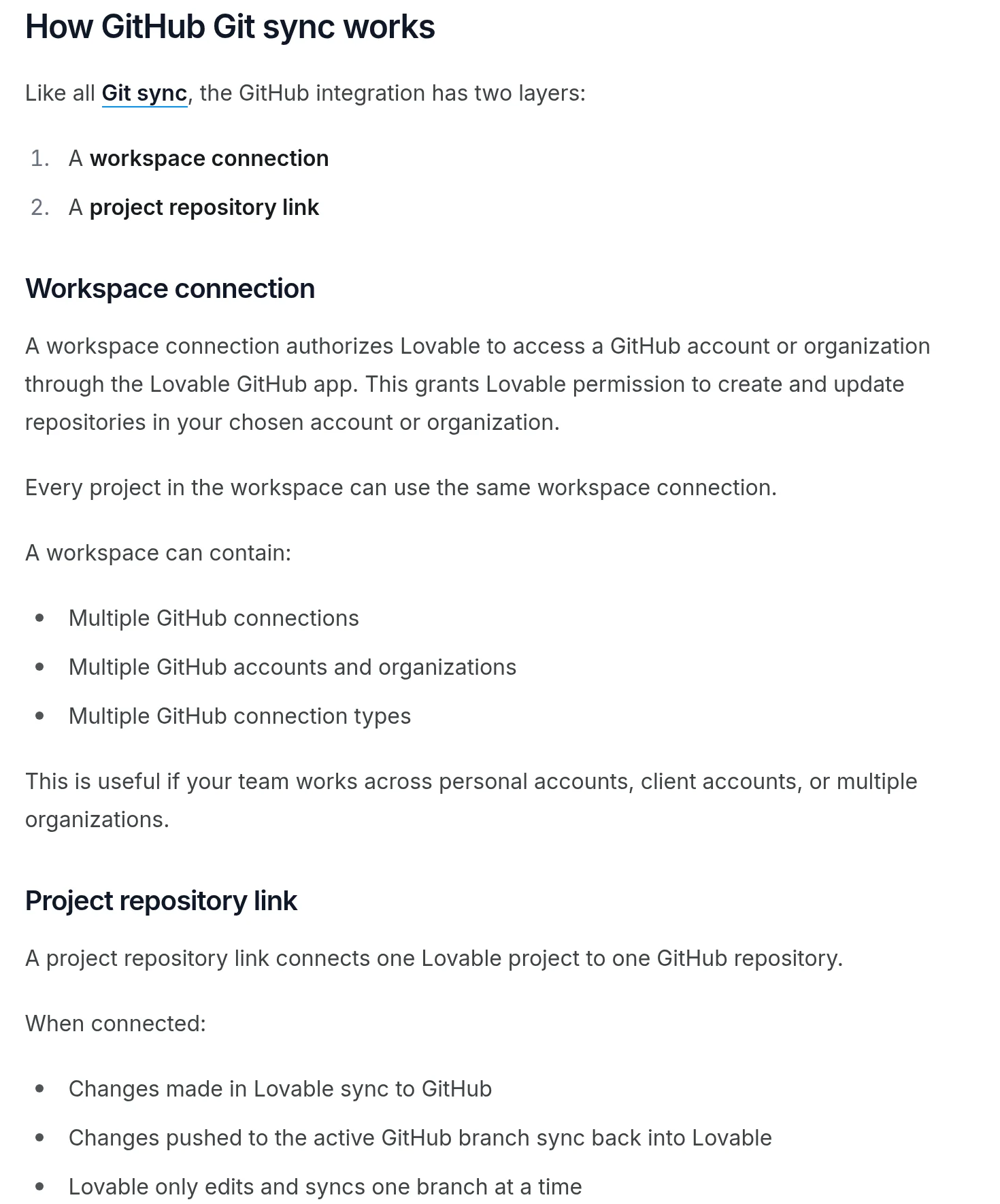
Lovable's Git sync page, captured November 27, 2026.
The details matter if a developer joins later. Connecting a project creates a new repository, private by default; Git sync can't link to a repository that already exists. To start from existing code, you upload the repository as a ZIP, which copies it into a new project. Lovable edits and syncs one branch at a time. Its commits are signed by lovable-dev[bot] (Lovable Git sync).
Claude Code works on the code where it already lives. It "works directly with git", staging changes, writing commit messages, creating branches and opening pull requests (Claude Code overview). Cloud sessions work on GitHub repositories; private repositories need the Claude GitHub App (Claude Code web quickstart).
Security review features
Both run security checks, and both say the checks are not a full audit. Lovable checks the app at publish time. Claude Code reviews the code as it changes.
Lovable. When you open the Publish dialog, automatic checks look at your database access rules, including row-level security policies, and your packages. Findings "don't block publishing by default" (Lovable publish). Advanced checks add code scanning for issues such as cross-site scripting and unsafe API calls. Running checks is free; fixes draw on 10 free fixes, then credits (Lovable security). Lovable's own warning: its checks "can't guarantee that your app is secure or replace a full security review."
Claude Code. The safeguards start with a permission mode: Auto mode, the default in the terminal and VS Code, has a classifier review actions, and Manual mode asks you before edits and commands. There is also an optional sandbox for shell commands and a /security-review command for the current branch (Claude Code security). A security guidance plugin has Claude review its own changes for issues such as injection while it works (security guidance plugin). The Claude Security plugin runs a multi-agent scan of a whole repository or a diff; it needs a paid plan, API access or a cloud provider (Claude Security plugin). /code-review checks a branch for bugs on any plan (local code review). Automatic Code Review on GitHub pull requests is for Team and Enterprise plans (Claude Security plugin).
Collaboration and learning curve
Lovable prices a team by credits, and asks you to describe what you want. Claude prices by seats, and asks you to judge what it did.
Lovable workspaces "support unlimited members on all plans", and members share the workspace's credits. Owners and admins can set a monthly credit limit per member (Lovable pricing). Business adds role-based access, a security center and publishing to logged-in workspace members only.
Claude for Teams covers 2 to 150 people, with standard and premium seats (Claude pricing). Anthropic calls it the recommended setup for most teams using Claude Code, with admin tools, SSO and organization-wide settings (Claude Code authentication). Day-to-day collaboration runs through your repository: branches, pull requests and a shared CLAUDE.md file of project instructions.
When credits or usage run out
Both let you keep working for more money. The rules differ.
Lovable. On Pro and Business you can buy a one-time top-up or turn on auto top-up. Pro top-ups cost $15 per 50 credits and Business $30 per 50 (Lovable top-ups). Free plans can't top up; you wait for the daily credits or upgrade. A published app that uses the built-in backend or AI features "still need[s] available credits to serve requests" (Lovable publish). Watch the balance if real users depend on the app.
Claude Code. Pro and Max have a five-hour session limit and a weekly limit, shared across Claude and Claude Code (Claude Help Center). If you hit the five-hour limit mid-response, Claude Code may finish the step in progress: on Pro up to once a week, on Max each time. Anthropic says this is still rolling out. After that, you wait, upgrade, or switch on usage credits.
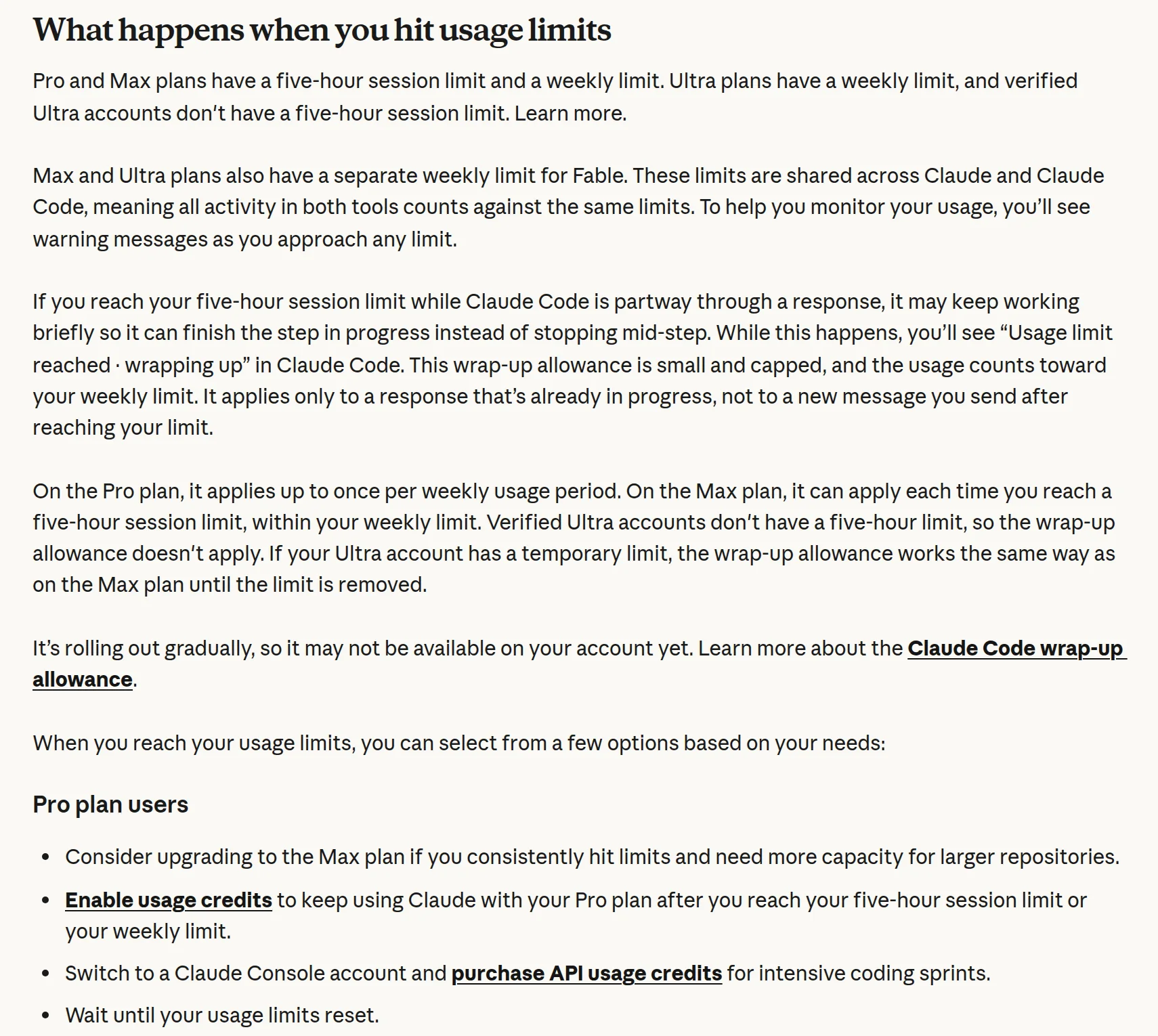
Claude Help Center, captured November 27, 2026.
Usage credits bill "at standard API rates" and appear as separate charges; you can set a monthly spend cap. Credits bought on or after December 7, 2026 generally expire 12 months after purchase, and purchases are non-refundable (manage usage credits).
With Lovable you don't need a terminal, Git or a hosting account to publish. Its Git docs say you only need GitHub's features "if you want to do more advanced things such as branching, pull requests, or CI/CD" (Lovable Git sync).
Claude Code's overview links a terminal guide for people who "haven't used a terminal before" (Claude Code overview). The desktop app and the web version remove most of the setup. You still review diffs, choose how much it may do without asking, and decide what ships. That review is the skill to budget time for.
When to use both
Start in Lovable, then bring in Claude Code through GitHub, or connect Claude Code to Lovable's MCP server. Each vendor documents its half; we have not run either workflow.
- Connect the Lovable project to GitHub. Lovable creates a new repository, private by default, and syncs both ways (Lovable Git sync).
- Open the repository in Claude Code. Clone it and run
claudein the folder, or start a cloud session on it at claude.ai/code (Claude Code web quickstart). - Work on a branch. Claude Code creates branches, commits and opens pull requests (Claude Code overview).
- Merge into the branch Lovable syncs. Lovable picks up commits on its active branch. Commits on other branches don't sync until merged.
Expect friction. If Lovable and GitHub diverge, a push to the synced branch replaces Lovable's version of that branch; Lovable saves a backup first. Protected branches can push Lovable's changes to a separate "lovable-sync" branch instead (Lovable Git sync). Agree who edits where before two tools edit one branch. Our Lovable alternatives guide covers moving off Lovable entirely.
The other route: Lovable's MCP server. Lovable also documents an MCP server that lets AI clients, Claude Code among them, create, change and publish Lovable projects. It works on any Lovable plan. A connected client acts as you across all your workspaces, so what it does can spend your credits and publish apps (Lovable MCP server). In this route the code stays in Lovable, and Claude Code directs the work rather than editing files.
Cursor vs Lovable
Going by its docs, Cursor sits on Claude Code's side of this comparison: a tool for people who work in code. Its docs describe "a coding agent for building ambitious software" that helps you "understand your codebase, plan and build features, fix bugs, review changes" (Cursor docs).
The pricing page at cursor.com/pricing, checked twice on November 27, 2026, sells Cursor bundled with Grok and X subscription features. Its FAQ says subscriptions are "only sold directly through X Subscription Corp." This is unusual, so check the page before you buy. Plans are listed at $0, $8 (Plus, Grok models only), $30 (Premium), $100 (Super) and $200 (Ultra) a month, with Teams from $30 per user a month. On Premium and above, third-party models are "available in Cursor at API list price", billed separately; Plus includes Grok models only (Cursor pricing). The pricing page also lists "Code hosting via Origin" and "Grok Build"; we did not read what those include, so we don't compare hosting or export here.
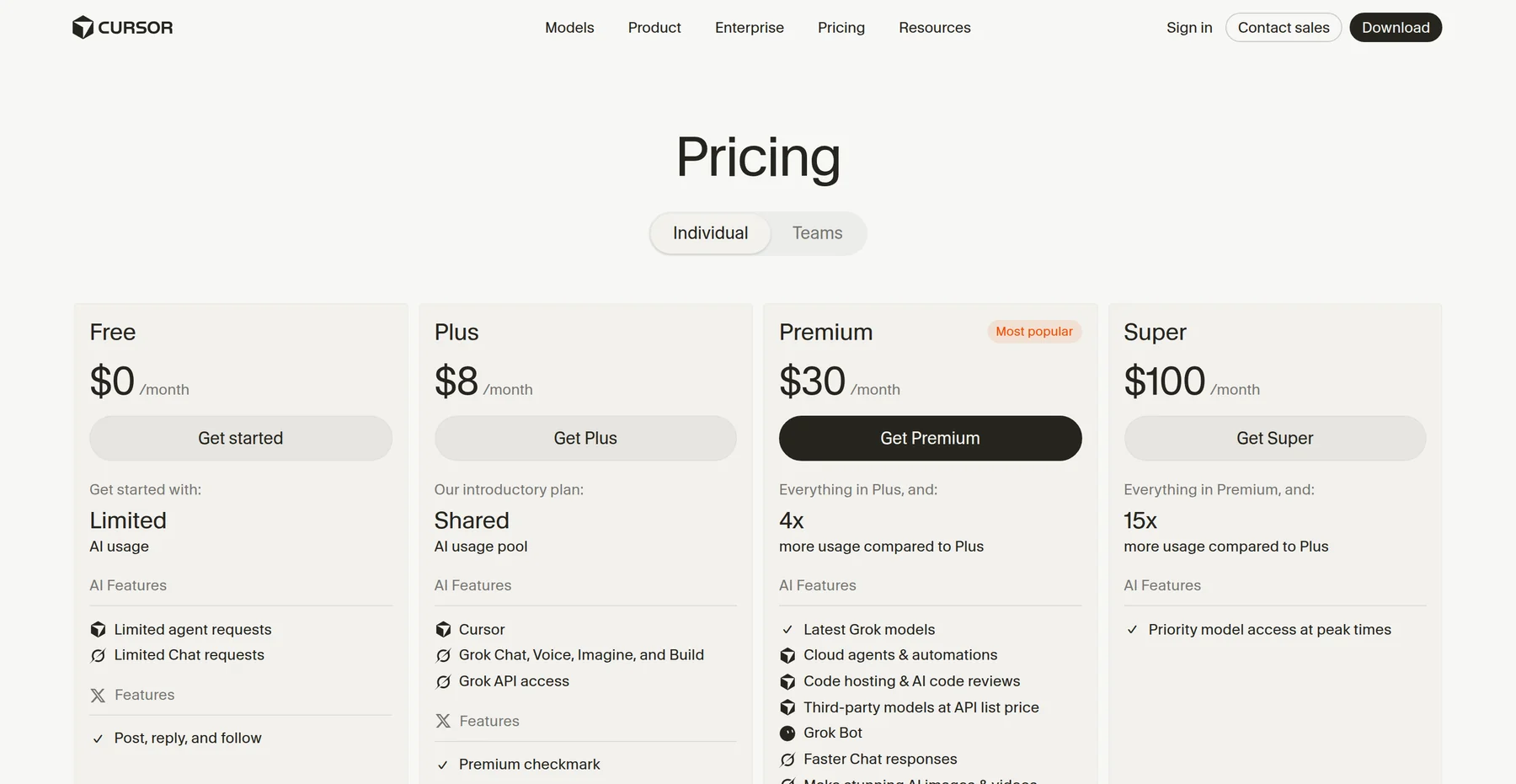
Cursor's pricing page, captured November 27, 2026 through DataForSEO. The Ultra card is not in the first screen, and a cookie banner covered the lower right, so the image was cropped above it.
For a non-developer, the Lovable-or-Cursor question has the same answer as Lovable or Claude Code. If you code, Claude Code also runs inside Cursor: Anthropic's VS Code extension installs there (Claude Code overview). For another builder in the same category as Lovable, see Replit vs Lovable.
Lovable vs Claude Code: a decision table
Neither is better overall. Each fits a different owner. For complex projects, note Lovable's documented limits: it edits one branch at a time, can't save files over 10 MB into a project (Lovable Git sync), and locks the backend's data region once it's on (Lovable built-in backend). Claude Code works in any repository you control.
| Your situation | Pick | Why, from the evidence above |
|---|---|---|
| You don't write code and want a working app online | Lovable | Chat, preview and a Publish button; hosting included |
| You want to try before paying | Lovable | Free plan with daily build credits; Claude Free has no Claude Code |
| You have a codebase already | Claude Code | It works in your existing repository; Lovable can only import a copy of it (a ZIP upload) as a new project |
| You need a database without setup | Lovable | Built-in backend with database, sign-in and storage |
| You want hosting and data under your own accounts | Claude Code | Code stays in your repo; you pick the host |
| You also use Claude for writing and research | Claude Code | One subscription and one usage pool |
| A team of non-developers shares one budget | Lovable | Unlimited members on shared credits |
| A dev team wants review on every pull request | Claude Code | Code Review on Team and Enterprise |
| You start without code and hire a developer later | Both | Lovable GitHub sync, then Claude Code in the same repo |
For how Claude can help with marketing work beyond code, see Claude for marketing and our list of Claude SEO skills.
Where PolyDraft fits
We make PolyDraft, an AI website builder that competes with Lovable for marketing sites, so weigh this section accordingly. It fits a business that wants a marketing website built from a brief, deployed to its own Cloudflare account, with ongoing search work done on it. Our pricing page lists Starter at $39 a month, or $390 a year, with up to 10 languages. It says the site keeps running if you cancel. Building and previewing are free, and access is currently invite-based.
PolyDraft is the wrong choice in several cases. It builds websites, not web apps with user accounts and app logic, so pick Lovable or Claude Code for an app. It does not sell online stores. Full source-code export is only on the Agency plan; a developer who wants the code in a repo from day one is better served by Claude Code. Our PolyDraft vs Lovable comparison has the detail. We make no promise about rankings or traffic.
Frequently asked questions
Is Claude Code better than Lovable?
Neither is better for everyone. Lovable suits people who don't code and want a hosted app with a built-in backend. Claude Code suits people who work in a code repository and handle their own hosting. On November 27, 2026, Lovable Pro started at $25 a month and Claude Pro, which includes Claude Code, at $20 a month, both billed monthly.
Can I use Claude Code on a Lovable project?
Yes, in two documented ways. Through GitHub: Lovable's Git sync creates a repository for your project and syncs it both ways, and Claude Code can work in that repository. Or through Lovable's MCP server, which lets Claude Code create and change Lovable projects. Lovable edits one branch at a time, so agree who edits where.
Is Claude Code free?
No. Claude's Free plan does not include Claude Code. It comes with Pro at $20 billed monthly, or $200 billed up front for a year, and with Max, Ultra, Team and Enterprise. You can also pay per token through a Claude Console account. Prices as of November 27, 2026 (Claude pricing).
Does Lovable host my app for free?
Mostly. Lovable's docs say publishing from the dialog costs nothing and hosting the published app is free. Its built-in backend uses credits as people use the app. The pricing page warns that apps with significant traffic or size may cost more than the included grant. Custom domains need a paid plan.
Cursor vs Lovable: which should I pick?
Pick Lovable if you don't code and want a hosted app. Cursor, like Claude Code, is a coding agent for people who work in a codebase. On November 27, 2026, Cursor's pricing page bundled it with Grok and X features, from $0 to $200 a month. Third-party models cost extra at API list price and aren't available on the Free or $8 Plus plans (Cursor pricing).
Who owns the code in Lovable and Claude Code?
You do in both. Lovable's pricing FAQ says "You own your code", subject to third-party rights in the AI models. Git sync works on every plan, and code download needs a paid plan. Claude Code writes to files in your own project and commits to your repository.
Continue with the next task
- Work out what a Lovable project costs in credits: Lovable pricing
- Compare Lovable with another app builder: Replit vs Lovable
- Check what another builder charges for credits: Base44 pricing
- Leaving Lovable or still shopping: Lovable alternatives
About this article. Drafted by an AI agent following PolyDraft's blog workflow, checked by an automated QA script, reviewed independently and approved by Vincent Chen. Every vendor fact was read on the vendor's own page on November 27, 2026 and is logged with its capture file. Anthropic's pages were downloaded directly; Lovable's and Cursor's pages were captured through DataForSEO's page tools. Nothing here comes from a search excerpt. We have no Lovable, Claude or Cursor account, so we did not build, run or deploy anything in any of them; this is a documentation and pricing comparison. Lovable's pricing page showed euros in our capture, so its dollar prices come from the "$" table on Lovable's subscription plans page; checkout prices may vary by region. The cost and decision tables are our own work. Screenshots are captures of the vendor pages, cropped and resized but otherwise unchanged. PolyDraft is our product and competes with Lovable. If something here is out of date, tell us through our contact page (https://polydraft.ai/contact) and we'll update it.
Sources
Pages were opened on November 27, 2026 (UTC).
- Lovable: pricing, subscription plans, credits and usage, credit top-ups, publish, Git sync with GitHub, security, built-in backend (Cloud), external hosting, MCP server
- Anthropic, Claude Code docs: overview, authentication, costs, security, security guidance plugin, Claude Security plugin, local code review, web quickstart, desktop app
- Anthropic: Claude pricing, use Claude Code with Pro, Max or Ultra, manage usage credits
- Cursor: docs, pricing
- PolyDraft: pricing