Replit vs Lovable: Which AI App Builder Fits Your Project?
Replit vs Lovable, compared from official docs: who each fits, pricing and credits, hosting, databases, GitHub export, and where Bolt, v0 and Cursor fit.
Which is better, Replit or Lovable? Neither wins outright. Lovable is better if you want to describe an app, shape it visually and rarely open the code, while keeping it synced to GitHub. Replit is better if you want an AI agent inside a full coding workspace, where you or a developer will keep editing files, managing the database and choosing how the app runs. Both build full-stack web apps with a database, sign-in and hosting, and both charge for AI work by usage.
Updated November 16, 2026: added a which-is-better table for common needs and answers on which to choose and on mobile apps. Plan and price facts are unchanged from the November 13 check.
We make PolyDraft, an AI builder for marketing and business websites rather than apps, so it isn't part of this comparison; we say where it fits only after the decision. This guide is based on each vendor's public plans pages and official documentation, read and captured on November 13, 2026. We didn't sign in to or build anything in Replit, Lovable, Bolt, v0 or Cursor, so nothing here is a test result.
Replit vs Lovable: the short answer
Replit and Lovable both turn a prompt into a full-stack web app, but they put different things in front of you. Lovable puts the running app first: you chat, see the preview and adjust it visually. Replit puts the project first: Agent works inside a workspace with files, a shell, a Git pane and a database tool you can open at any time.
This table summarizes what each vendor documents as of November 13, 2026. The sections below explain each row and link to the official page.
| Replit (Agent) | Lovable | |
|---|---|---|
| What you work in | A cloud coding workspace with an AI agent | A chat and visual editor with a live preview |
| What it builds | Web apps and native iOS and Android apps, with App Store submission documented; slides and other types on Core and Pro | Web apps in React; new apps since May 13, 2026 use TanStack Start |
| Typical user | Builders who will touch code, or work with a developer | Non-developers and teams who want to stay out of the code |
| Entry paid plan | Core: $20/month, or $18/month billed annually | Pro: $25/month for 100 monthly credits, or $250/year |
| How AI work is billed | Effort-based: one checkpoint per request, priced by complexity; a Free Mode allowance on Core and Pro | Credits per message, scaled by complexity; 5 free build credits a day |
| Hosting | Replit publishing: Autoscale by default, or Reserved VM | Lovable hosting with HTTPS; custom domains on paid plans |
| Database | Built-in PostgreSQL in every app, with separate development and production databases | Built-in backend (database, auth, storage, functions), or your own Supabase |
| Code and data export | Download as ZIP; GitHub through the Git pane; production database export | Git sync with GitHub, GitLab or Bitbucket on every plan; full database export |
| Team size | 5 builders on Core, 15 on Pro | Unlimited workspace members on every plan |
Replit or Lovable: which is better for what?
Lovable is better for non-developers who want to build a web app through chat, for large teams of non-developers, and for a documented exit to their own hosting. Replit is better for builders who will work with code, for native mobile apps, for separate development and production databases, and for the lowest entry paid plan. The table gives our verdict for each need, based on the vendors' documentation as of November 13, 2026, which the rest of this guide cites.
| If this matters most | Better fit | Why |
|---|---|---|
| Building without touching code | Lovable | Chat and a visual editor with a live preview; code is optional. |
| Editing code, running commands, working with a developer | Replit | Agent works in a full workspace with files, a shell, a Git pane and database tools. |
| A native iOS or Android app | Replit | Replit documents native apps built with Expo and App Store submission; Lovable builds web apps. |
| A large team of non-developers | Lovable | Unlimited workspace members on every plan, sharing one credit balance; Replit includes 5 collaborators on Core and 15 on Pro. |
| GitHub from day one on a free plan | Lovable | Git sync with GitHub, GitLab or Bitbucket on every plan, including Free. Replit's Git pane connects to GitHub; we didn't find it documented by plan. |
| A documented move to your own hosting | Lovable | A step-by-step guide to hosting the frontend elsewhere and moving the backend to Supabase. |
| Separate development and production databases with point-in-time recovery | Replit | Every Replit app gets both, and production databases can be recovered to a point in time over 7 days, or 28 on Pro. |
| Lowest entry paid plan | Replit | As of November 13, 2026, Core costs $20 a month ($18 billed annually); Lovable Pro costs $25 a month for 100 credits ($250 a year). |
| When credits run out | Depends | Lovable keeps published pages up but pauses the built-in backend; Replit keeps the app running and bills usage until a spending limit you set, then blocks usage-based services. |
Who each tool is for, and what you end up with
Lovable is built for people who want a working web app without managing a development environment. Its plans page describes Pro as "Designed for fast-moving teams building together in real time", and its docs describe a full-stack platform where you build, iterate and deploy "using natural language". You can open the code on paid plans, but you don't have to.
Replit is built around a cloud development workspace. Its plans page describes Core as "For personal projects and simple apps" and Pro as "For commercial and professional builds". Agent builds the app, but the project editor, shell, Git pane and database tools stay one click away. Replit's mobile guides cover native iOS and Android apps tested on your phone with Expo Go, and a follow-on series covers App Store submission. On Core and Pro, Agent also builds slide decks and other "artifact types". Lovable's docs describe a platform for web applications; its iOS and Android app is for building from your phone, not for shipping a native app.
What you end up with is similar on paper: a web app with a front end, a backend, a database and a live URL. The difference shows up in month three. With Lovable, most changes still go through the chat. With Replit, it's normal to open a file, run a command or hand the project to a developer in the same workspace.
Neither tool is designed first as a marketing-website builder. If what you need is a company site with service pages and a blog, see our examples of business websites for what that usually contains, and our guide on whether ChatGPT alone can build a website for the lightest option.
Plans, credits and costs, as of November 13, 2026
Both tools are metered: the plan buys an allowance, and AI work, hosting and database use draw it down. Monthly and annual prices differ, so check which one a quote uses.
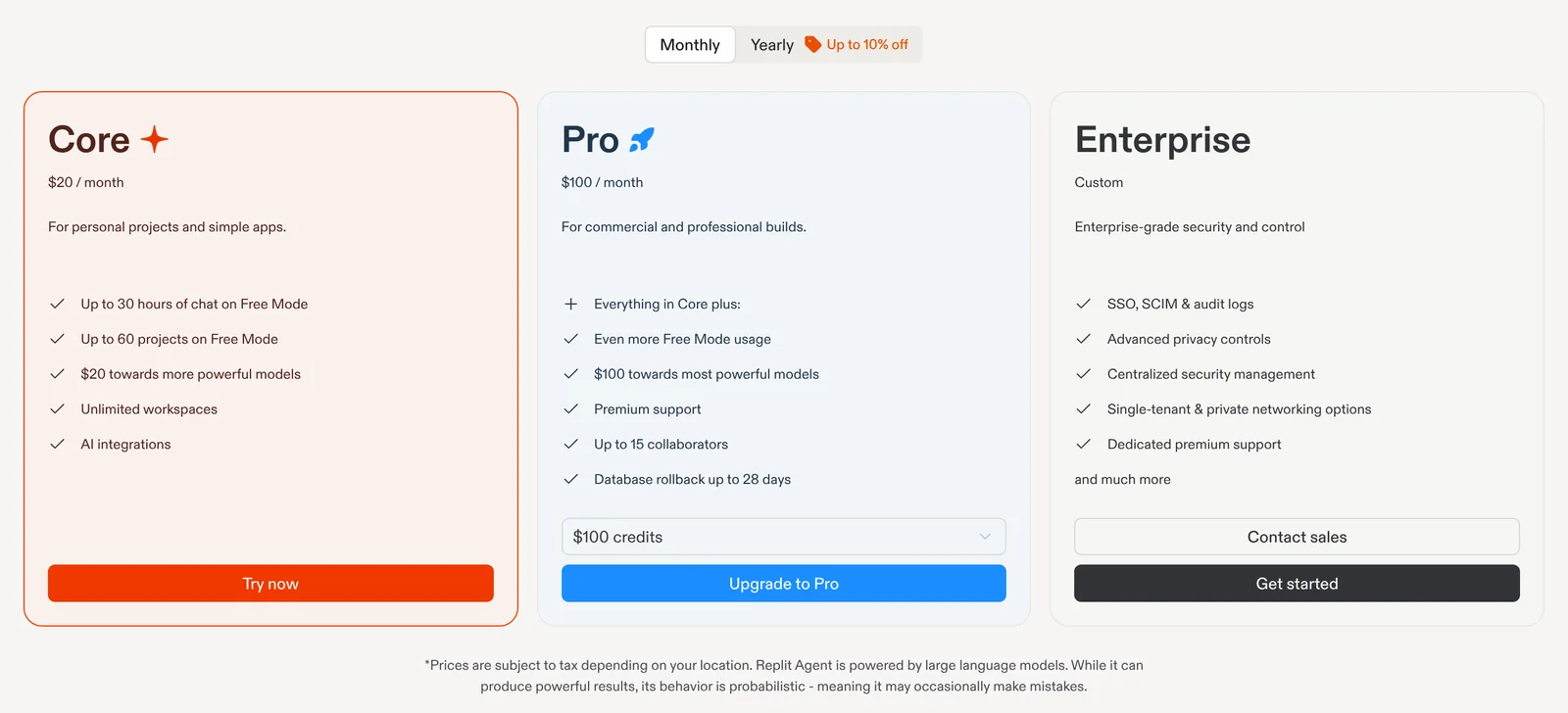
Replit (pricing page). Core includes up to 30 hours of chat on Free Mode, up to 60 projects on Free Mode and "$20 towards more powerful models". Pro costs $100 a month ($90 billed annually) and adds more Free Mode usage, $100 of credits, up to 15 collaborators and database rollback up to 28 days. Replit's AI billing docs say paid Agent work is billed by effort. Agent creates one checkpoint per request, and a complex build costs more than a small fix. Replit asks for confirmation before a paid action starts.
The free Starter plan gives daily Agent credits up to a monthly cap and Lite build only, according to Replit's Starter plan page. Its one free published app "will automatically go down after 30 days", though it can be republished. Free Mode on Core and Pro has an allowance that refreshes every five hours, according to the Agent modes page.
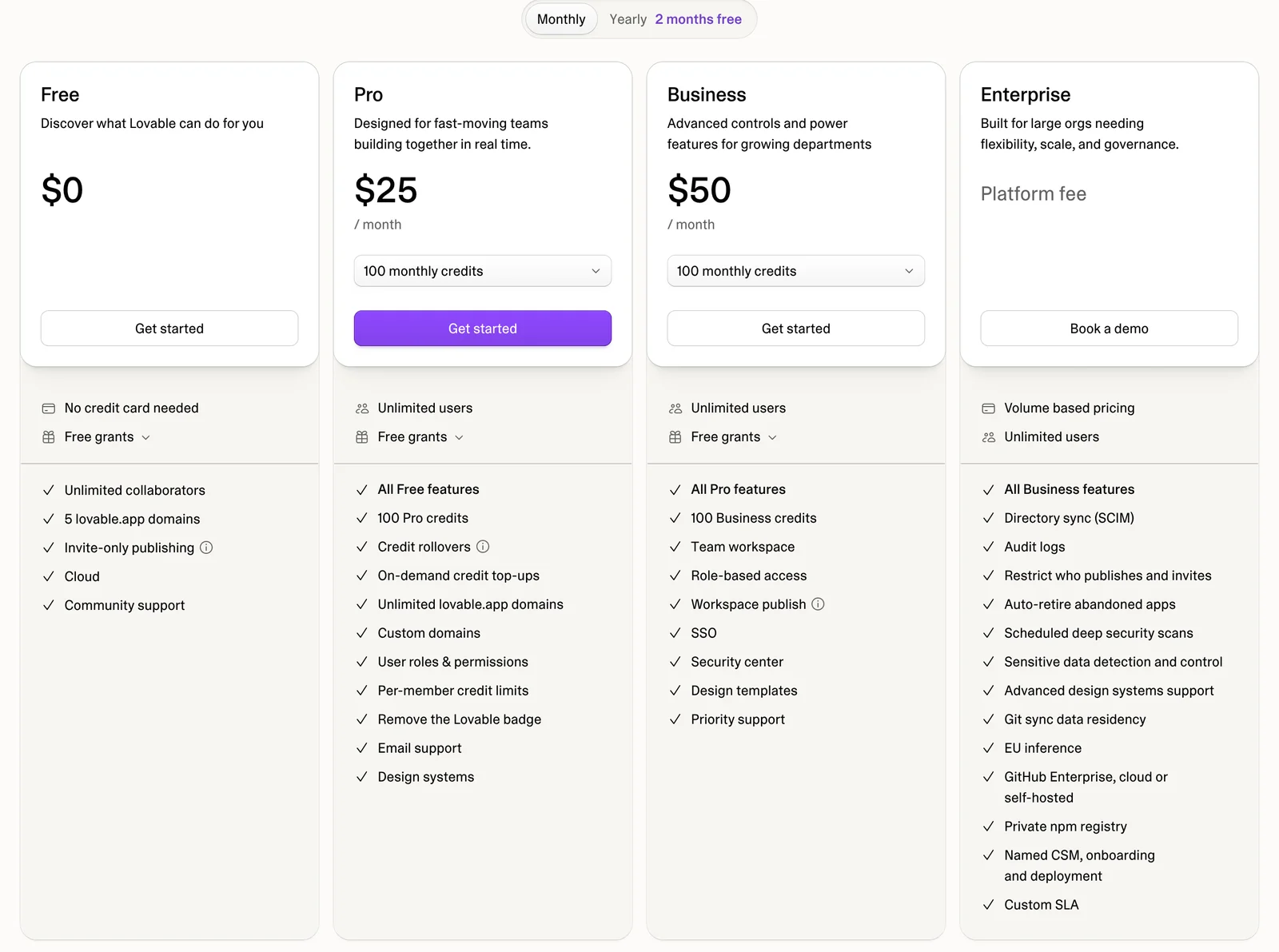
Lovable (pricing page). Free costs $0. Pro costs $25 a month and Business $50 a month, each starting at 100 monthly credits, with tiers up to 10,000 credits. Yearly billing gives two months free. Lovable's subscription plans page adds 5 daily build credits on every plan, capped at 30 a month on Free. Free, Pro and Business also get monthly grants of 20 Cloud credits and 4 AI credits for running apps, which Lovable calls "a temporary offering and subject to change".
Lovable's credits documentation prices Build-mode messages by complexity. Its examples are 0.50 credits to make a button gray, 1.20 to add authentication and 2.00 to build a landing page with images. Plan mode costs 1 credit per message. Our Lovable pricing guide covers every tier, top-up and expiry rule in detail.
| Credit rule (as of Nov 13, 2026) | Replit | Lovable |
|---|---|---|
| What the plan allowance pays for | Agent, publishing, network transfer, database storage, AI integrations | Building and chat, plus hosting, the built-in backend and AI in your app after the monthly grants |
| Free allowance | Starter: daily Agent credits up to a monthly cap | 5 build credits a day, up to 30 a month |
| Unused monthly credits | Core: don't roll over, per the publishing costs page. Pro: roll over for two months | Roll over while subscribed, but expire 2 months after issue on monthly billing |
| Buying more | Credit packs from $100; packs expire six months after purchase | Top-ups on Pro and Business; they last 12 months |
| When the allowance runs out | Usage-based charges continue after credits, with alerts and budget limits you set | Published pages keep serving, but the built-in backend pauses until credits are added |
The last row is the one to plan for. Replit keeps your app running and bills the overage, which protects uptime but not your budget. If you set a usage limit, Replit's spend controls page says usage-based services are blocked once you reach it, until the next billing cycle or until you raise it. Lovable's out-of-credits page says the database, storage and sign-in pause when the Cloud grant and general credits are gone, which protects your budget but not uptime.
Deployment and hosting
Both host the app for you, inside the same account and on the same meter as building.
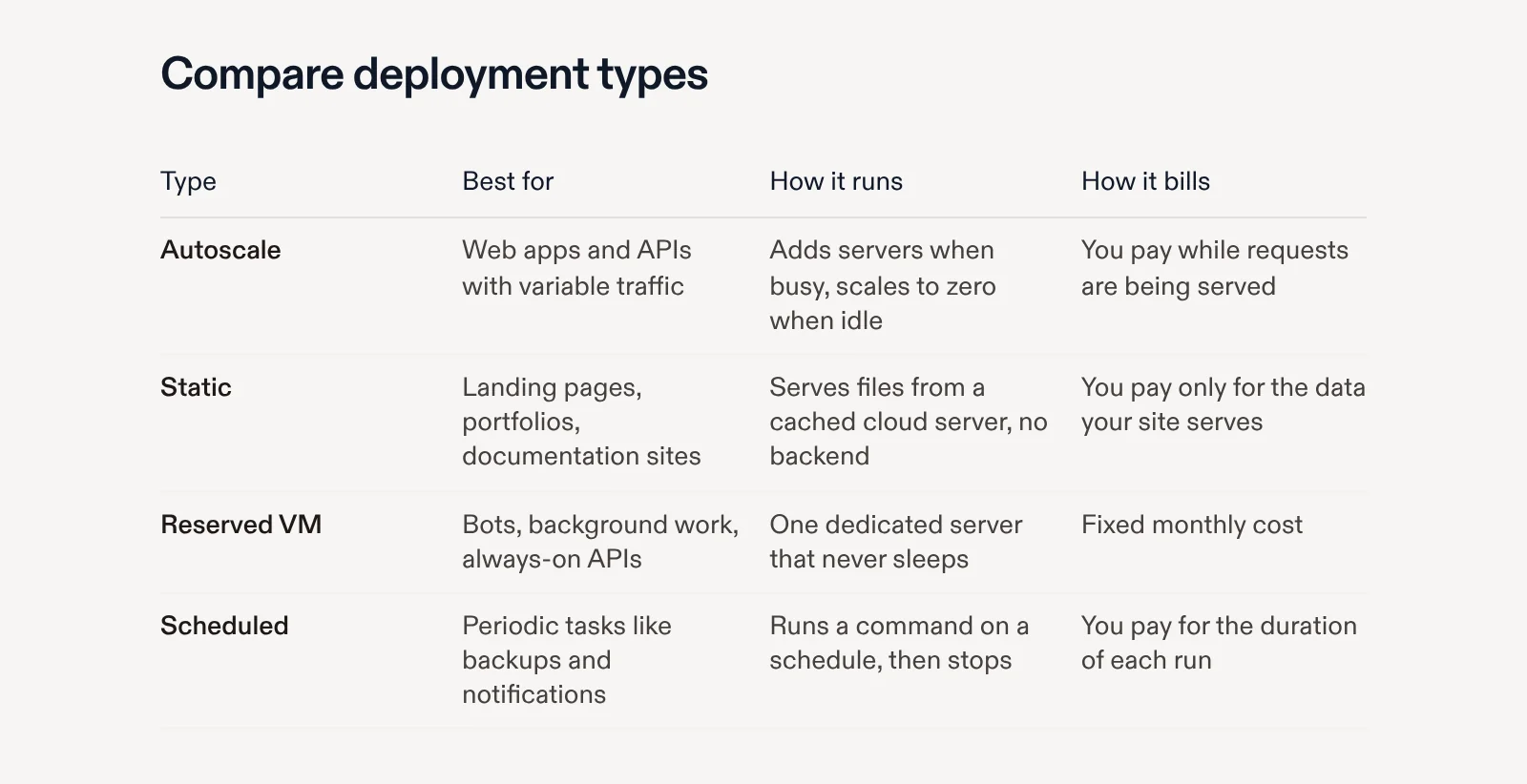
Replit offers four deployment types. Autoscale is the default: it adds servers when busy, scales to zero when idle, and bills while requests are served. Reserved VM runs one server that never sleeps, for a fixed monthly cost. Replit's docs add a limit worth knowing early: Static deployments "are not compatible with Replit Apps created using Agent", because Agent builds full-stack apps that need a server.
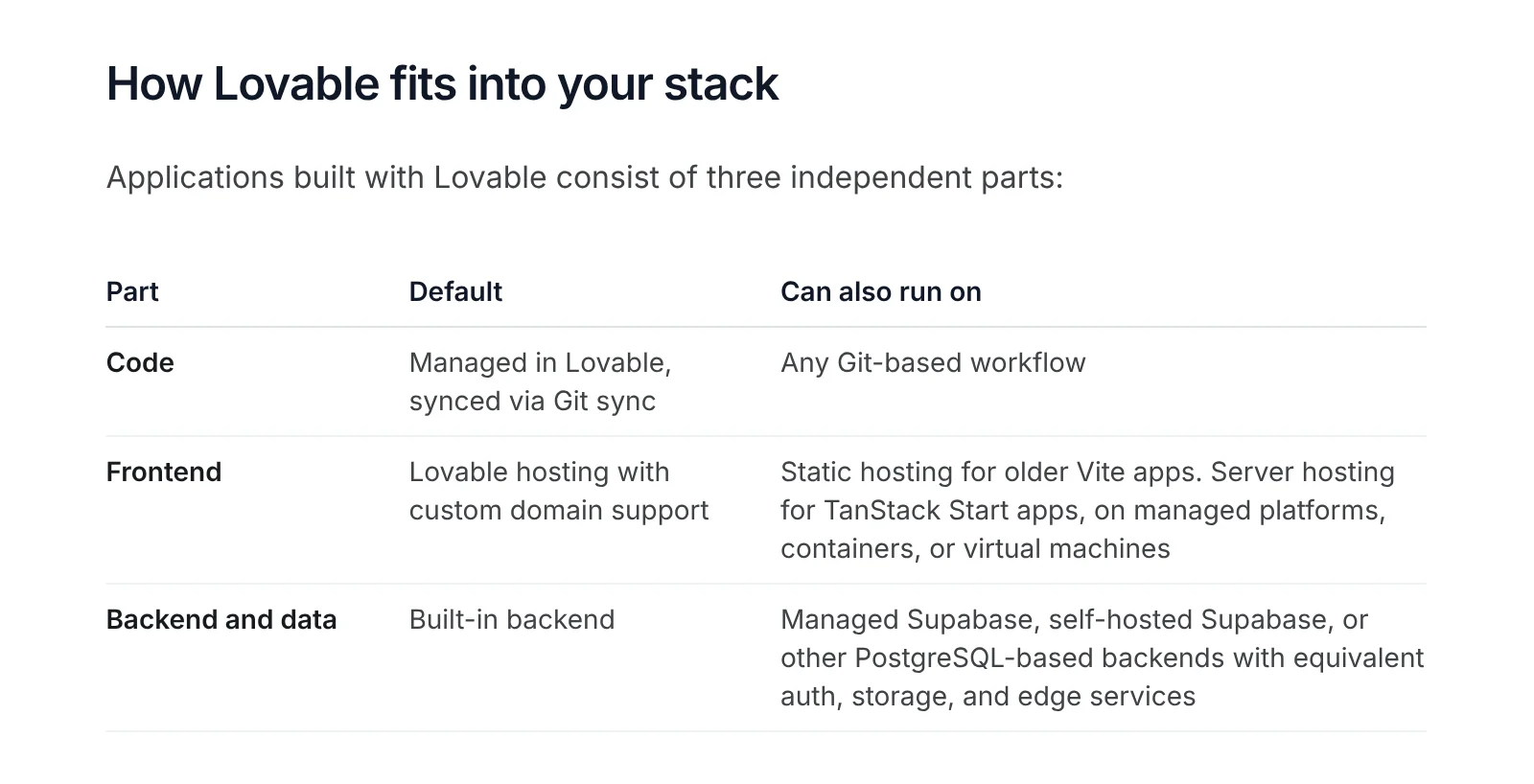
Lovable's hosting and ownership guide splits an app into three parts: code, frontend and backend. By default all three stay on Lovable. The guide documents moving the frontend to another host and the backend to managed or self-hosted Supabase. New Lovable apps created since May 13, 2026 use TanStack Start, which renders pages on the server; our Lovable SEO guide explains what that changes for search.
| Hosting question (as of Nov 13, 2026) | Replit | Lovable |
|---|---|---|
| Free-plan publishing | One app; the link goes down after 30 days unless republished | Publish to a lovable.app address; a Free project can be unpublished after about a year with no visits, logins or edits |
| Custom domain | Buy or connect one in Replit's custom domains settings | Paid plans only, per the publish docs |
| How hosting is billed | From monthly credits, then usage; Autoscale bills while serving requests | From monthly Cloud and AI grants, then general credits |
| Documented path to other hosting | Code by ZIP or GitHub and a production database export; Bring Your Own Cloud is an Enterprise option | A step-by-step guide to hosting the frontend elsewhere and moving the backend to Supabase |
| SEO tooling | SEO Agent audits a published app, on paid plans | An SEO and AI search review in the Analytics view, on all plans |
Code ownership, GitHub and export
Lovable syncs your code to GitHub, GitLab or Bitbucket on every plan, but editing and downloading code inside Lovable needs a paid plan. Replit gives you the project files from the start, with a ZIP download and a Git pane that connects to GitHub. Both also document a database export. The bigger difference is how much of the rest Lovable's docs walk you through.
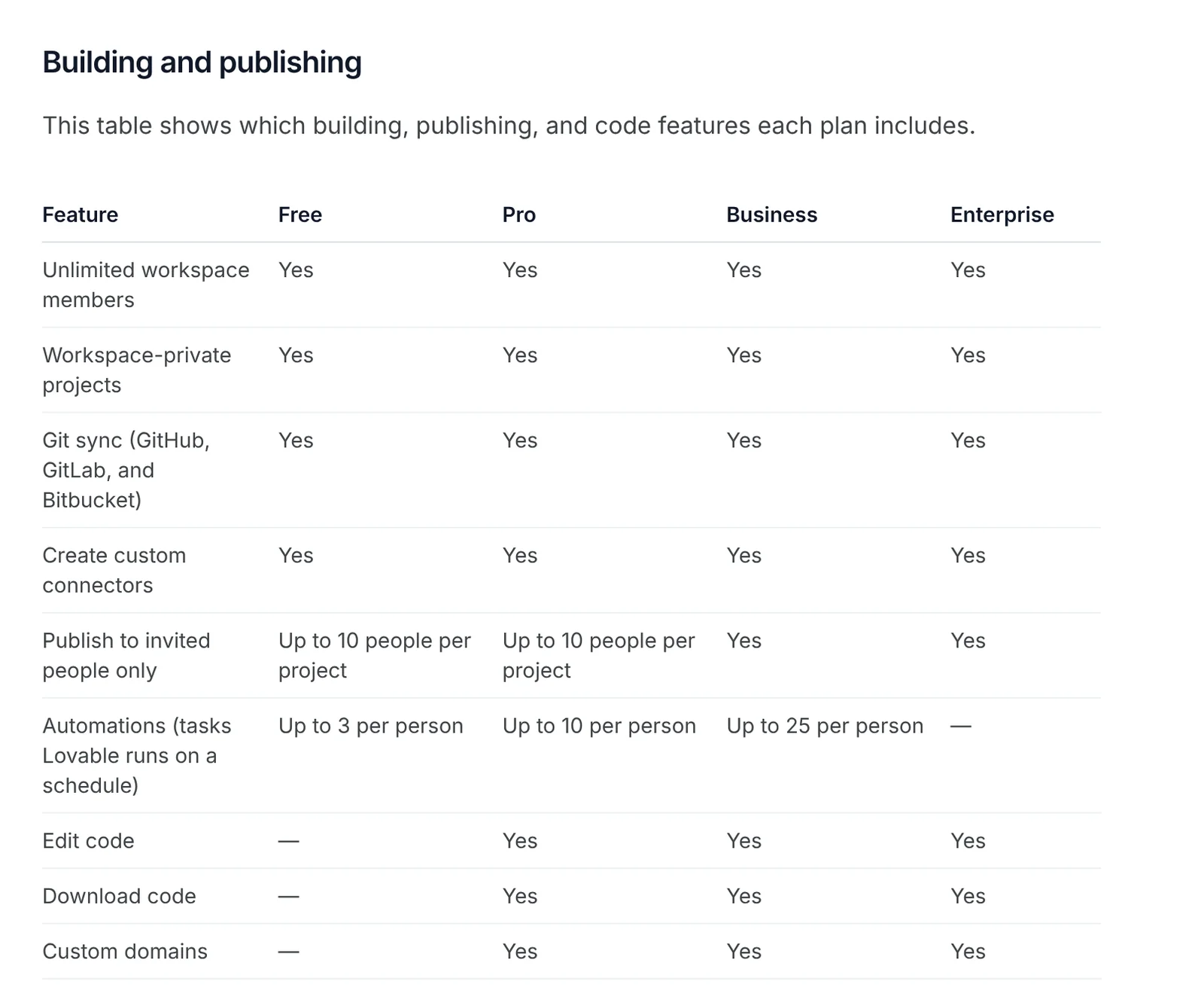
Lovable. Lovable says it is "intentionally built so that you are never locked in". Its database backup page describes a full PostgreSQL export, including user accounts and password hashes. Storage files, edge function code, secrets and sign-in settings have to be moved separately.
Replit. Replit's help page on projects and files says to choose "Download as zip" from the file tree, and to turn on auto-sync in the Git pane for two-way syncing with GitHub. Because Agent works in ordinary project files, a developer can clone the repository and keep going elsewhere. For the data, Replit's data docs describe exporting the production database "to keep your own copy" or "move your data to another service". We didn't find a Replit guide for running an Agent app outside Replit on Starter, Core or Pro. That doesn't mean it can't be done, but you would plan the hosting move yourself.
Switching between them. Each documents importing from the other, by different routes. Replit's import page takes the GitHub repository Lovable syncs to; it brings the code and database schema, but not existing database records or secrets. Lovable's import page takes a ZIP downloaded from Replit (or Bolt, v0, Base44 or Manus) and moves the database and users to its built-in backend, using a database export you supply. Our Lovable vs Base44 comparison shows the same export questions for another pair.
Databases and backend
Every Replit app comes with a managed PostgreSQL database, and Agent can create the schema and the code that uses it. Lovable includes a built-in backend, Lovable Cloud, with a database, authentication, storage and edge functions, or you can connect your own Supabase project. Both handle the basics without setup.
Replit's database docs say each app gets 20GB of free development database storage, or 50GB on Pro and Enterprise. Replit keeps separate development and production databases, and publishing applies schema changes to production. Its data recovery page offers point-in-time recovery for production databases over 7 days on every plan, and up to 28 days on Pro.
If you move Lovable's backend, Lovable's guide names managed and self-hosted Supabase as the supported destinations. Moving to plain PostgreSQL or another provider means rebuilding sign-in, storage and functions yourself.
Collaboration and teams
Lovable allows unlimited workspace members on every plan and pools one credit balance across them. Replit includes 5 collaborators on Core and 15 on Pro, and its help pages say collaborators don't need a paid plan to edit your project. For a team of ten non-developers, Lovable's model is simpler; for a small team that wants separate Agent settings and background tasks, Replit's is more granular.
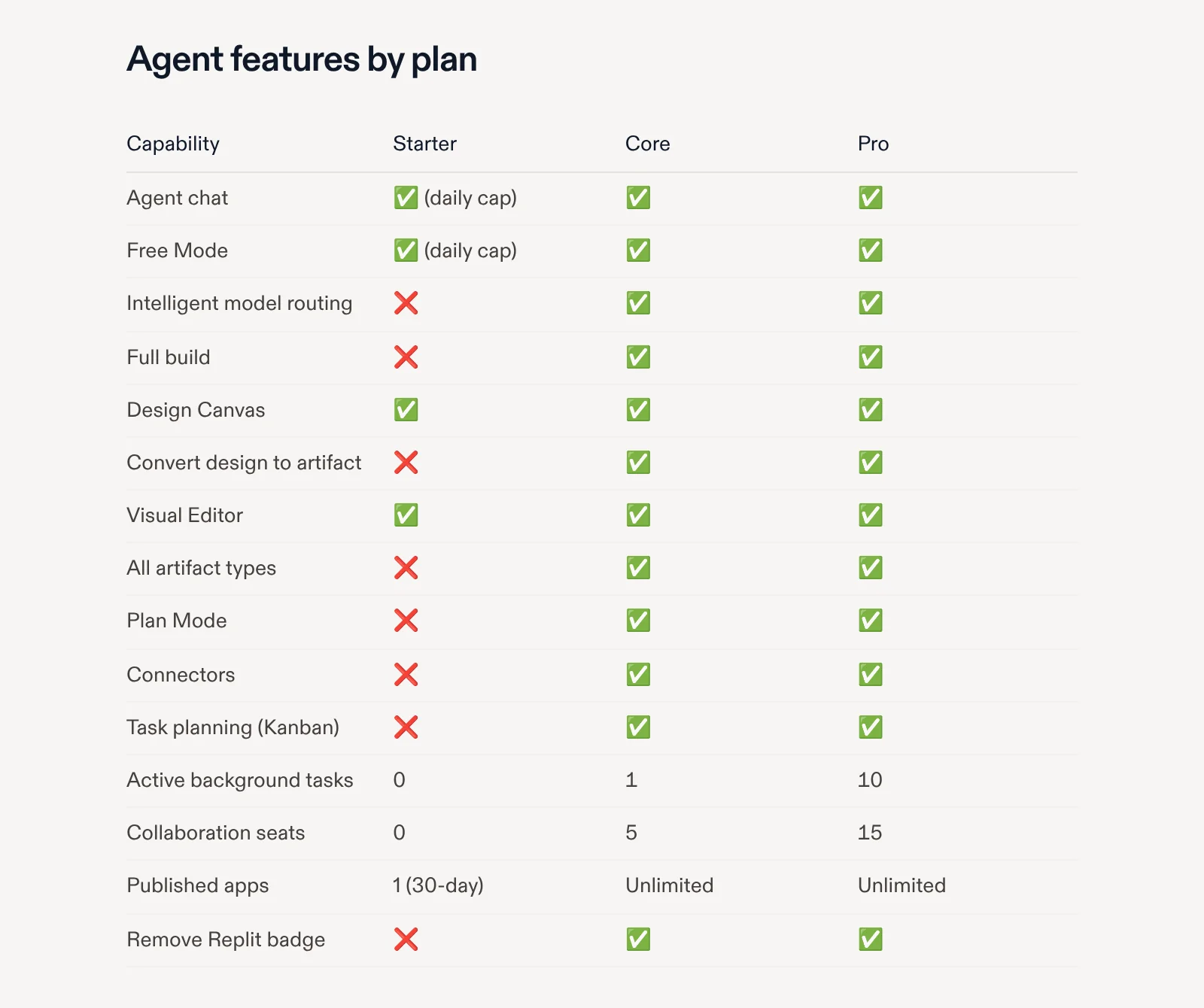
Replit's plan table also shows background tasks: 1 active task on Core and 10 on Pro. Each person's Agent mode and model settings stay their own in shared projects, according to the Agent modes page. Lovable's collaboration docs describe roles, permissions and real-time changes, with admin roles on paid plans only.
Limits that bite later
These documented limits tend to show up after the first week, as of November 13, 2026:
- Replit's free app expires. A Starter deployment goes down after 30 days unless you republish it.
- Replit Agent apps need a server. Static deployments don't work for them, so even a simple site bills from credits.
- Replit Core credits don't carry over. Pro credits roll over for two months.
- Lovable Free has no code editor. Git sync works, but editing or downloading code and custom domains need a paid plan.
- Lovable credits expire. Monthly credits expire two months after issue; daily build credits reset at 00:00 UTC.
- Your users spend your credits. On both, hosting and backend usage draw on the same balance as building.
- Running out behaves differently. Lovable pauses the backend; Replit bills overage until a limit you set. Set that limit, or Lovable's usage alerts, before launch.
- AI output still needs checking. Replit's plans page notes that Agent "may occasionally make mistakes". Test sign-in, data permissions and payments yourself, whichever tool you use.
Before you commit to either, run the same short brief through both and check the output with our guide to evaluating an AI website builder. Its tests apply to app builders as well.
Where Bolt, v0 and Cursor fit
Bolt and v0 are the closest alternatives to Lovable: both build full-stack apps from prompts and host them for you. Cursor is different: it's an AI coding agent and editor for code you already have, closer to Replit's workspace than to Lovable's builder. Our list of Lovable alternatives covers ten tools; this table covers the three most often compared with Replit and Lovable.
| Tool (as of Nov 13, 2026) | Entry paid plan | Usage model | Hosting | Code |
|---|---|---|---|---|
| Bolt | Pro $25/month, from 10M tokens | Tokens; unused paid tokens roll over and stay valid two months | Bolt hosting (Pro: 30 GB, 1M requests a month) or Netlify | GitHub sync; ZIP download |
| v0 | Plus $30/user/month, $30 of credits per user | Credits by model token rates; unused monthly credits expire after 65 days | Deploys to Vercel | GitHub sync through branches and pull requests |
| Cursor | Plus $8/month (Grok models only); Premium $30/month | Shared usage pool; third-party models billed separately at API list price | None for your app; you deploy the code where you choose | Your own repository |
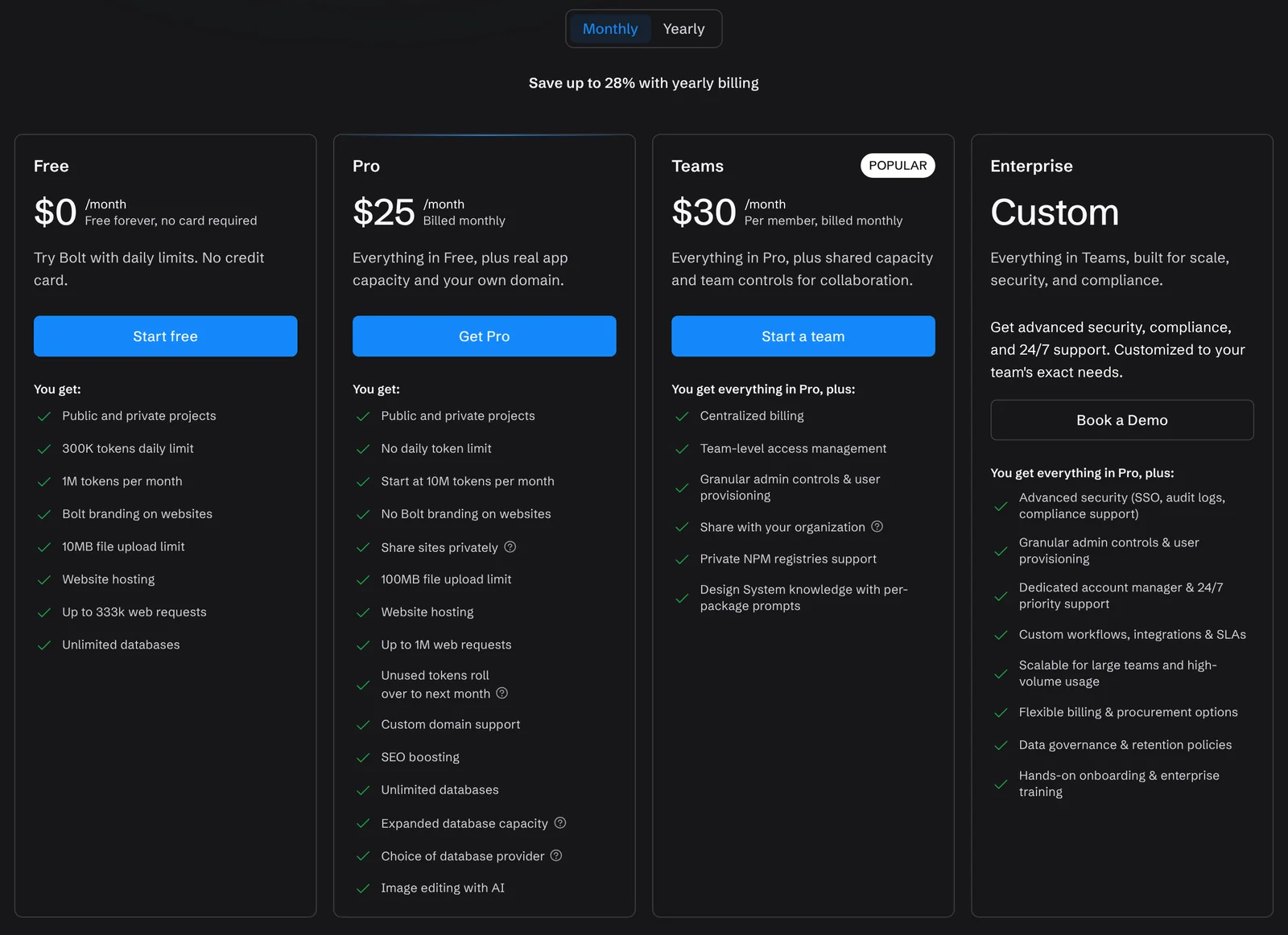
Bolt vs Lovable. Both start at $25 a month and both host the app and a database. Bolt meters tokens rather than credits; its token docs say unused paid tokens stay valid for two months, and its Free plan has a 300K daily limit. Bolt's hosting plans note that Free sites stop serving once they hit 10 GB or 333,333 requests in a month. Bolt can use its own database or, on Pro and Teams, Supabase.
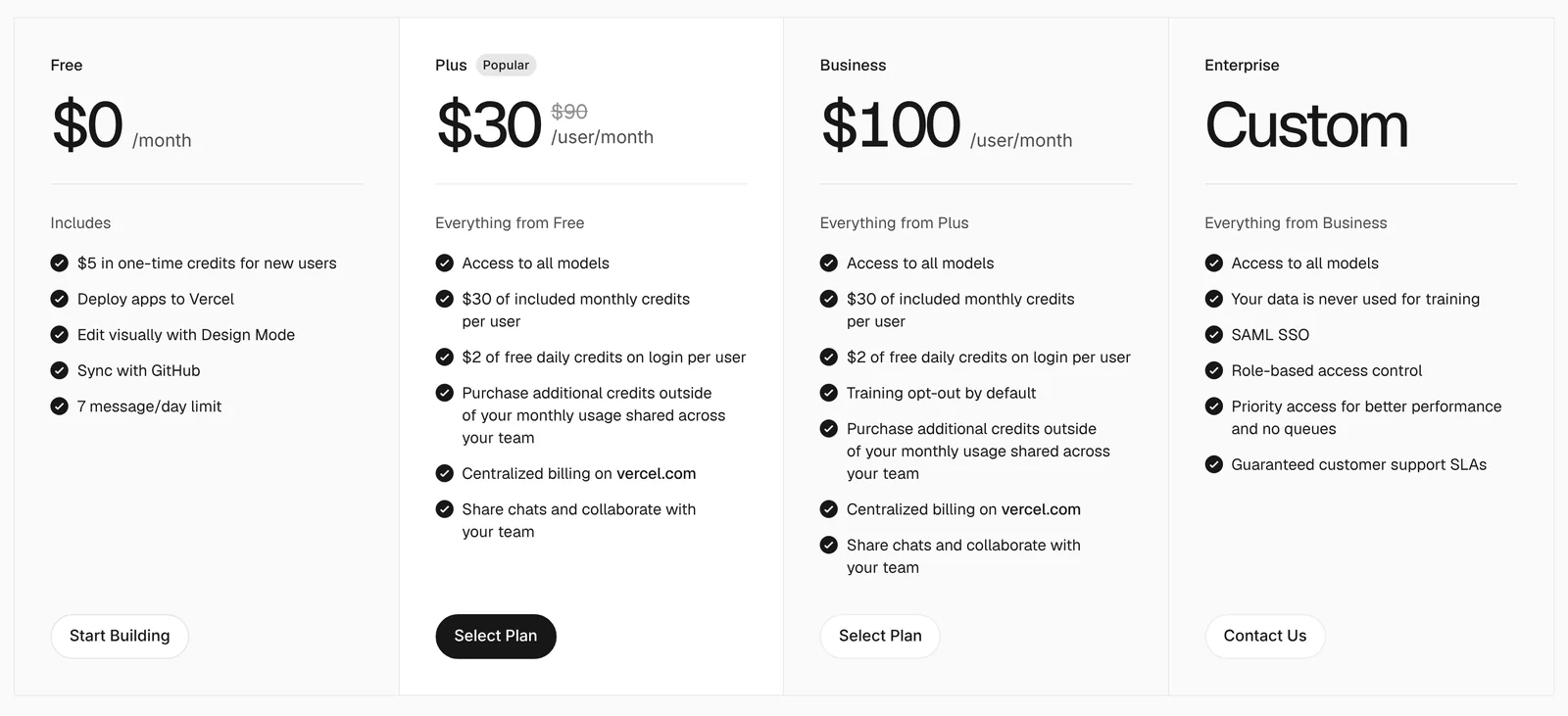
Replit vs v0. v0 generates React and Next.js apps and, according to its deployment docs, deploys them to Vercel with preview deployments for each working branch. Its GitHub docs say a connected repository becomes the source of truth, and changes ship through pull requests. Databases come from Vercel Marketplace integrations such as Neon, Supabase and Upstash. Choose v0 over Replit if your team already deploys on Vercel and reviews code in GitHub; choose Replit if you want the database and hosting in one workspace.
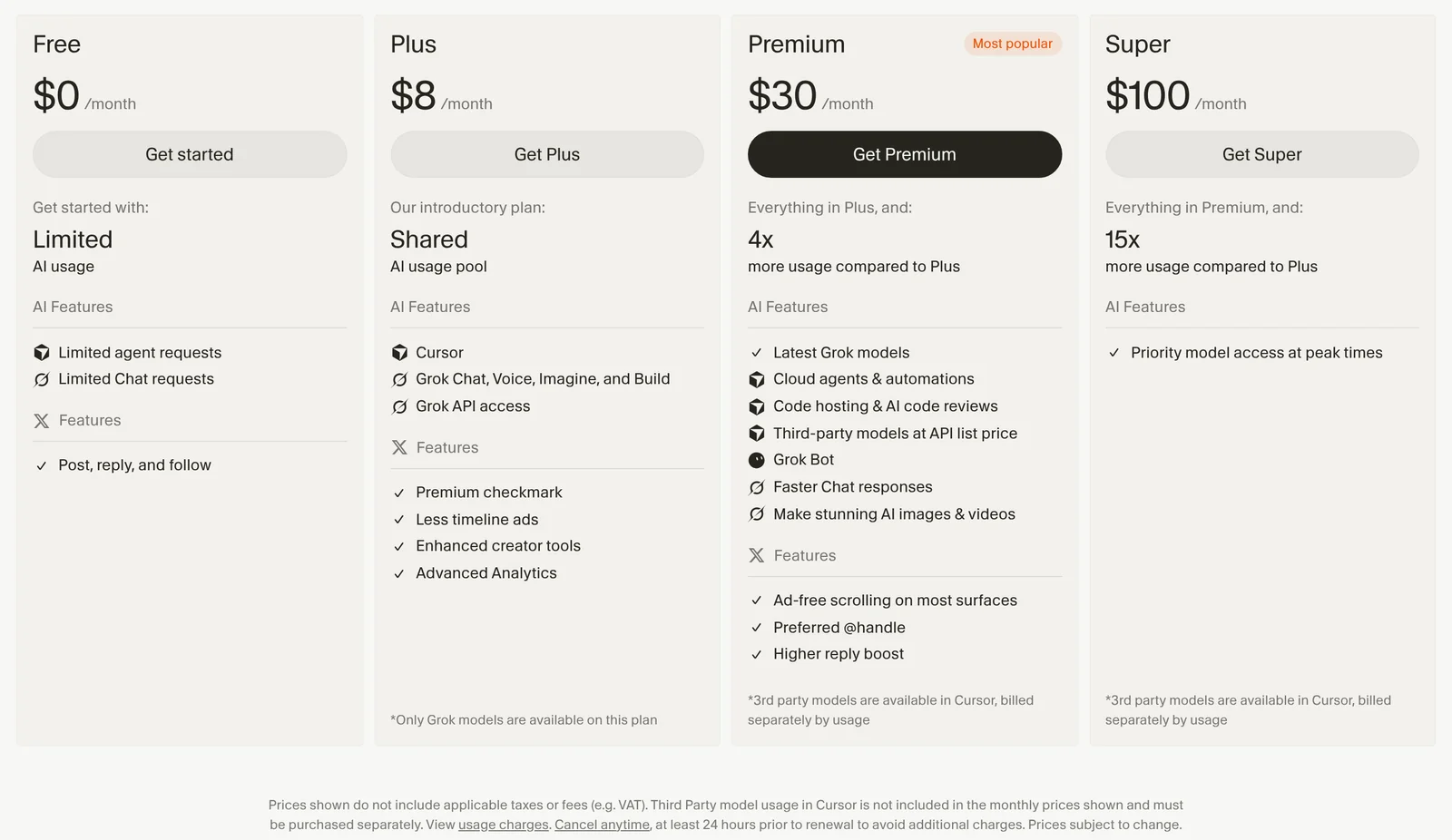
Cursor vs Lovable, and Replit vs Cursor. Cursor's documentation describes "a coding agent for building ambitious software" that you download and point at a folder. It doesn't host your app, so you choose the framework, hosting and database yourself. That makes "cursor vs lovable" a choice between writing code with help and not writing code at all. "Replit vs Cursor" is a developer-tool question: Replit runs the workspace and hosting in the cloud, while Cursor works on a repository you control.
Choose Replit or Lovable: a decision you can make today
Use these conditions to decide. Read each line and note which tool it points to; the side with more lines that describe your project is the better starting point.
Choose Lovable if:
- nobody on the team wants to open the code, and changes will go through chat and the visual editor;
- several non-developers need access, and you'd rather not count seats;
- you want GitHub sync from day one, even on the free plan;
- you want a documented exit to your own hosting and Supabase;
- you'd rather the backend pause than run up an overage bill.
Choose Replit if:
- you, or a developer you work with, will edit files, run commands and review changes;
- you want the database, hosting and code editor in one workspace;
- you may need a native iOS or Android app, not only a web app;
- you need separate development and production databases with point-in-time recovery;
- you'd rather the app keep running on pay-as-you-go billing, capped by a usage limit you choose.
Look past both if: your team already ships React on Vercel (consider v0); you want token-based billing and Netlify as an option (consider Bolt); or you write code and want no platform at all (consider Cursor). If the project is really a marketing website, a website builder will usually fit better than an app builder.
Where PolyDraft fits
PolyDraft is not an app builder, so it isn't an alternative to Replit or Lovable for apps with user accounts and a database. We make it, so weigh this section accordingly.
PolyDraft builds multi-page marketing and business websites: it generates a server-rendered Astro site from a conversation and deploys it to your own Cloudflare account. Each site has an admin with a blog editor. You build the primary language first, then add languages up to 10, 30 or 100 by plan. As of November 13, 2026, our pricing page says building and previewing are free and you subscribe to publish, from $39 a month on Starter; purchased credits never expire; and access is currently invite-based. Source-code export is included on the Agency plan.
For anything with user accounts, app logic or a native mobile app, Replit or Lovable is the better fit.
How we compared
We compared Replit and Lovable on the questions the people searching for this comparison ask: who each is for, plans and credits, hosting, code export, databases, collaboration and later limits. We added Bolt, v0 and Cursor because they appear in the same searches and the same ranking articles.
- Sources. Every vendor fact comes from that vendor's own plans page or official documentation, read on November 13, 2026, and rechecked the same day by a separate reviewer. No third-party reviews were used.
- Screenshots. Each plans page and the key documentation tables were captured that day without signing in, cropped and otherwise unedited. They show what each vendor publishes, not results from our use.
- No hands-on tests. We didn't build the same app in each tool, so this guide can't tell you whose output is better.
- Prices change. Treat every figure as a dated checkpoint and check the linked page before you buy.
Frequently asked questions
What's better, Replit or Lovable?
It depends on who builds the app. Lovable is better for people who don't want to touch code: you build through chat and a visual editor, with GitHub sync on every plan. Replit is better if you or a developer will edit code, if you need a native iOS or Android app, or if you want separate development and production databases. As of November 13, 2026, Replit Core costs $20 a month and Lovable Pro $25.
Can Replit or Lovable build a mobile app?
Replit can: its documentation covers native iOS and Android apps built with Expo, tested on your phone with Expo Go, and submitted to the App Store. Lovable builds web apps, which work in a phone's browser; its own iOS and Android app is for building from your phone, not for shipping a native app.
Is Lovable or Replit better for beginners?
For someone who doesn't code, Lovable is designed to keep you in chat and a visual editor, with code optional. Replit can also be used without coding, but its workspace exposes files, a shell and Git from the start. Beginners who want to learn code may prefer Replit; those who want to avoid it may prefer Lovable.
How much do Replit and Lovable cost per month?
As of November 13, 2026, Replit Core costs $20 a month, or $18 a month billed annually, and Replit Pro $100. Lovable Pro costs $25 a month for 100 credits and Business $50, with yearly billing giving two months free. Both have free plans, and both charge for AI work and hosting by usage.
Can I export my code from Replit and Lovable?
Yes. Lovable syncs code to GitHub, GitLab or Bitbucket on every plan, and paid plans can also download it. Replit lets you download a project as a ZIP or connect it to GitHub through the Git pane. Both document a database export. Lovable also documents moving its backend to Supabase; we found no Replit guide to hosting an Agent app elsewhere on standard plans.
Do Replit and Lovable include a database?
Yes. Every Replit app comes with a managed PostgreSQL database, with separate development and production databases. Lovable includes a built-in backend with a database, authentication, storage and functions, or you can connect your own Supabase project. Replit's development database is free up to its storage cap; production database use on Replit and backend use on Lovable draw on plan credits.
Can I move a project from Lovable to Replit, or back?
Yes, by different routes. Replit imports a Lovable project from the GitHub repository Lovable syncs to, bringing code and schema but not existing records or secrets. Lovable imports a Replit project from a ZIP and moves the database and users to its built-in backend from an export you supply. Check sign-in, data and secrets after any move.
Where do Bolt and v0 fit compared with Lovable?
Bolt and v0 are the closest alternatives to Lovable. As of November 13, 2026, Bolt Pro costs $25 a month with token-based usage and Bolt hosting or Netlify. v0 Plus costs $30 per user a month, generates React and Next.js code and deploys to Vercel. Both sync with GitHub.
Is Cursor an alternative to Replit or Lovable?
Cursor is an AI coding agent and editor that works on a repository you control, so it suits people who write code. It doesn't host your app. Compared with Lovable it's a different job; compared with Replit, it trades the cloud workspace and built-in hosting for full control of your own setup.
Continue with the next task
- Budgeting for Lovable's credits and tiers: Lovable pricing explained
- Comparing more app and website builders: Lovable alternatives compared
- Testing any builder's output before you commit: How to evaluate an AI website builder
- Checking whether a Lovable app can rank: Lovable SEO audit
About this article. Drafted by an AI agent following PolyDraft's blog workflow, checked by an automated QA script, and approved by Vincent Chen. Every vendor fact comes from the official plans pages and documentation of Replit, Lovable, Bolt, v0 and Cursor, read on November 13, 2026, and the screenshots were captured from those public pages the same day without signing in. A separate AI review pass rechecked the facts, screenshots and links against the live pages the same day. We didn't build test projects in any of these tools. Search demand for this topic comes from Ahrefs (US, November 1, 2026) and DataForSEO (US, English, retrieved November 13, 2026). We make PolyDraft, which is not part of the comparison.
Sources
All vendor pages checked November 13, 2026.
- Replit: Pricing, AI billing, Starter plan, Agent modes, Publishing costs, Deployment types, Custom domains, Database, Data recovery, Work with your data, Git pane, Projects and files, Import from other tools, Managing spend, Mobile apps, Submit to the App Store
- Lovable: Pricing, Subscription plans, Credits and usage, Out of credits, Deployment, hosting and ownership, Publish, Database backups and export, Collaboration, SEO and AEO, Import a project
- Bolt: Pricing, Tokens, Hosting plans
- v0: Pricing, Deployments, GitHub
- Cursor: Pricing, Documentation
- PolyDraft: Pricing