In this article
- 01 How to find low competition keywords: the six checks
- 02 Start from what your site can deliver
- 03 Keep provider, market and date on every number
- 04 Why one KD number is not enough
- 05 Check what the SERP actually wants
- 06 Merge variants instead of adding volume
- 07 Our 12 decisions: kept, merged or rejected
- 08 From keyword to brief
- 09 Find low-competition opportunities in your own Search Console
- 10 Where PolyDraft fits
- 11 Frequently asked questions
- 12 Continue with the next task
- 13 Sources
Here is how to find low competition keywords you can realistically win: filter by difficulty to get leads, then check each one. Record each number with its provider, market and date. Compare the average with the latest month. Read the live results for meaning, page type and big brands. Merge variants into one page. Keep only searches your site can answer better and connect to something you offer. Keyword difficulty (KD) is a model of links, not of intent or of your site.
This guide shows that process on 12 real candidates from PolyDraft's keyword research between November 5 and November 8, 2026, with the provider, market and date for every number. We make PolyDraft, an AI website builder, so these are our own keywords and decisions, including the ones we got wrong at first. None of the kept keywords has produced rankings yet. This is a record of method, not a success story.
Key points
- A KD filter finds candidates. It doesn't pick them. Both DataForSEO and Ahrefs build KD from links to the current top 10 results.
- The same keyword can look very different across tools and dates. "international seo agency" showed 2,900 searches in an Ahrefs row from October 5, 2026 and 590 in DataForSEO on November 8, and its latest month was 140.
- A KD of 0 can sit on a results page full of strong agency sites, or on a word that means something else.
- Variants such as "seo vs aeo" (KD 9) and "aeo vs seo" (KD 17) belong to one page. Don't add their volumes or borrow the lower KD.
- A kept keyword becomes a brief with one reader task, one asset only you can make, and one next step.
How to find low competition keywords: the six checks
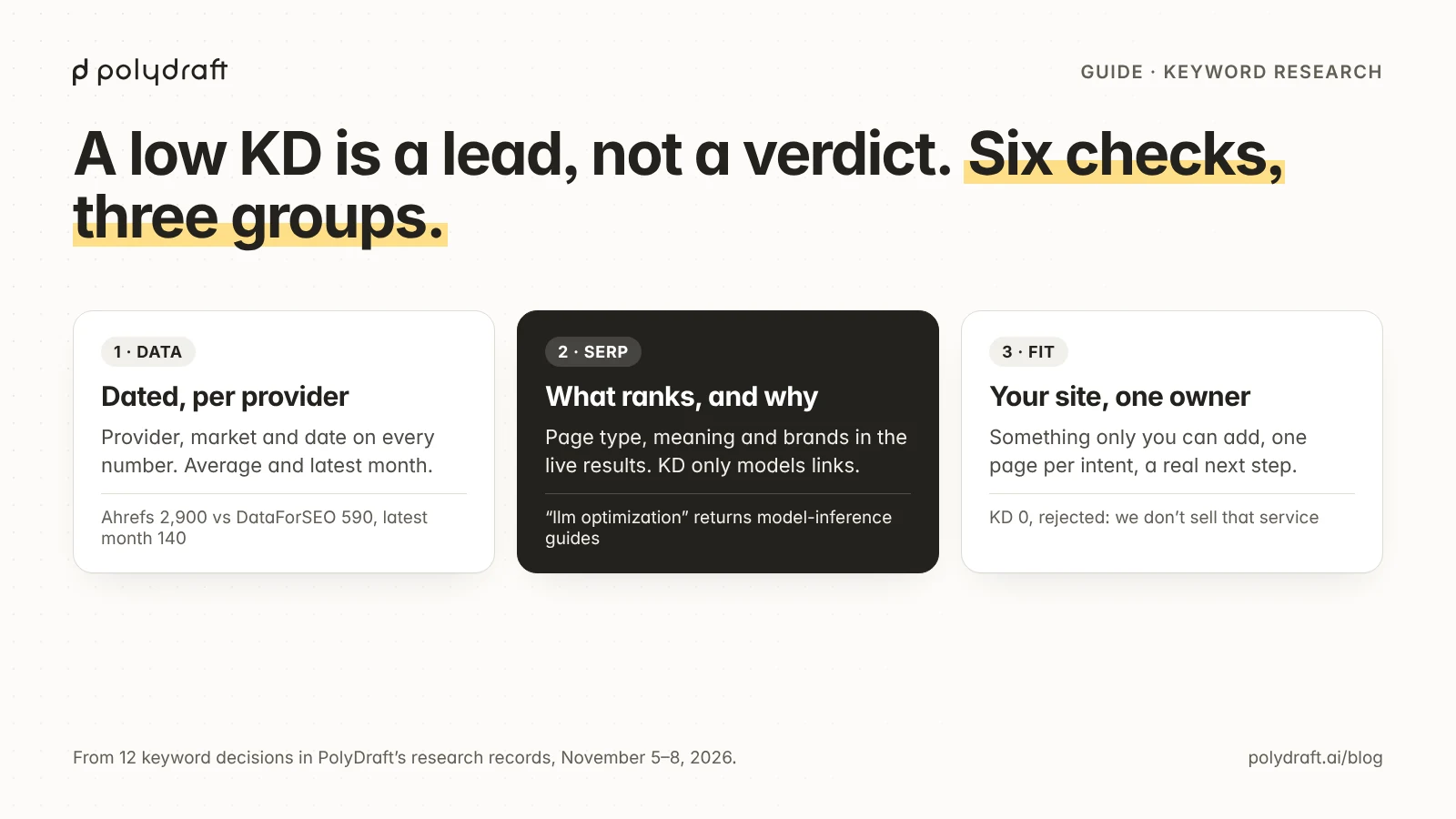
Finding low-competition keywords is a filter followed by six checks. The filter, such as KD 20 or less, gives you a list. The checks remove words where the data is stale, the demand is shrinking, the results want another kind of page, or the searcher wants something you don't offer. What survives becomes a brief. The figure pairs each check with the real decision behind it.
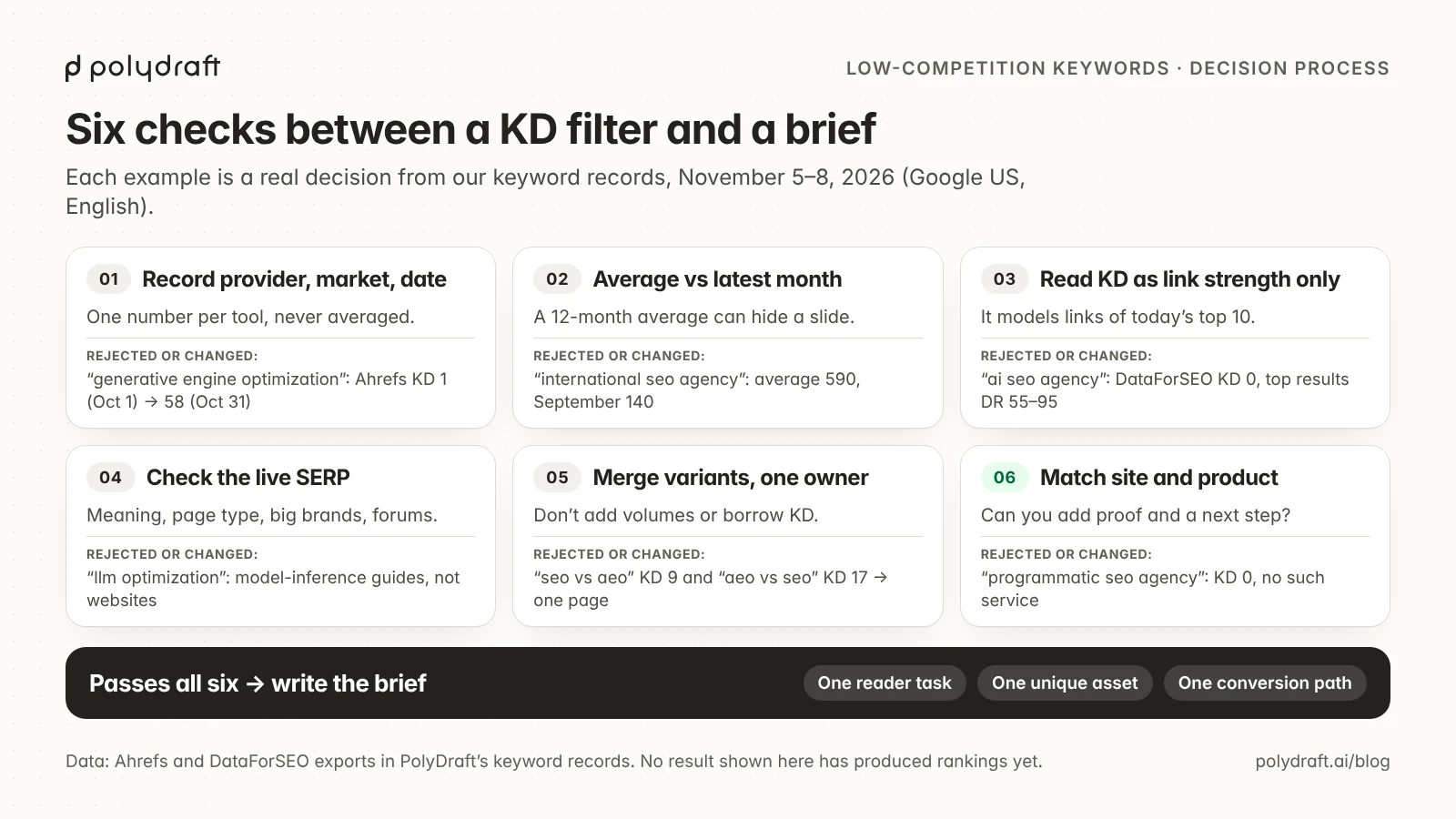
- Record provider, market and date. Keep one column per tool. Never average two tools.
- Compare the average with the latest month. A 12-month average can hide a decline.
- Read KD as link strength only. It doesn't tell you what kind of page wins.
- Check the live results. Look at meaning, page type, brands and forums.
- Merge variants and give the intent one owner page. Don't add volumes or borrow KD.
- Match your site and product. Ask what you can add that others can't, and what the reader does next.
If you're new to the terms, our guide to what SEO keywords are explains volume, difficulty and intent first. This article goes one step further: how to judge competitiveness yourself.
Start from what your site can deliver
Start a low-competition keyword search from the tasks your site can genuinely help with, not from a tool's "easy keywords" list. A low KD on a word you can't serve is wasted work. Write down your offers, the questions customers already ask you, and the evidence only you have: data, tests, screenshots, case files. Then look for searches that match those.
For us, that list included keyword research records, a website builder, and a done-for-you SEO service. So "programmatic seo agency" (Ahrefs: 200 searches, KD 2) was out at once, even though DataForSEO gave it KD 0 on November 5, 2026. We don't offer that service. Our own content plan recorded the reason next to the keyword so nobody would revisit it.
A new site has a second limit: authority. A domain with few links and little history can't win searches where every result is a strong brand. Our launch plan for a new website shows how we filtered for results pages that already include small sites. The checks in this article sit on top of that filter.
Keep provider, market and date on every number
Every keyword number needs three labels: which tool produced it, for which market, and when. Tools estimate search volume and difficulty differently, and both move over time. Keep each provider in its own column. Note whether a volume is an average or a single month. Without those labels, two numbers that look contradictory can't be compared at all.
Our clearest case was "international seo agency". In our Ahrefs export, in a row Ahrefs last updated on October 5, 2026, it showed 2,900 US searches a month and KD 5. On November 8, 2026, DataForSEO's keyword overview for Google US in English returned 590 searches and KD 0. Its latest reported month, September 2026, had 140 searches.
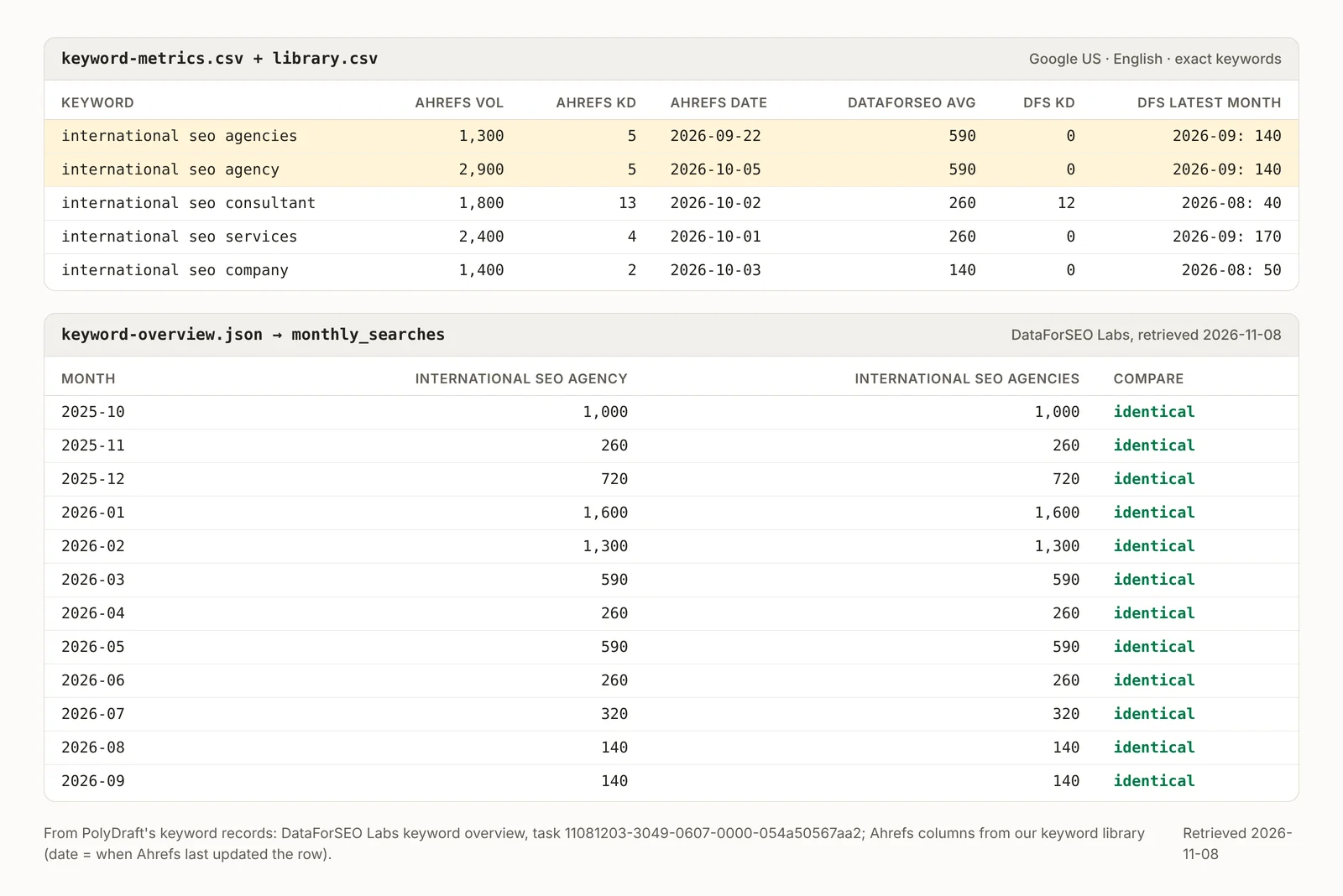
The monthly history mattered more than the average. DataForSEO's 12 months, October 2025 to September 2026, peaked at 1,600 searches in January and fell to 140 in August and September. Whatever the true level is, recent demand was far below the 2,900 in the older row. The live results on November 8 also showed lists, agency pages and directories rather than guides. So the keyword didn't make our writing list, while landing page vs website held up better (390 average, 320 in September).
Two rules from that case:
- Don't read a provider gap as a trend. Ahrefs 2,900 and DataForSEO 590 come from different models. The gap doesn't prove that searches fell. Only one provider's own monthly series can show a trend.
- Look at the latest month before you commit. Ahrefs explains that its volume can be shown as an average or a single month. DataForSEO's search volume is an average with a monthly history attached. Read the history.
Dates also expire within one tool. Our Ahrefs data for "generative engine optimization" had KD 1 in a row dated October 1, 2026. A newer Ahrefs row, dated October 31, showed KD 58. DataForSEO said 44 on November 8. Setting the KD 1 against the 44 would have compared an old row from one tool with a new row from another. Ahrefs' own newer row sat much closer to DataForSEO. Our files don't say why Ahrefs moved 57 points in a month, so we treat the KD 1 as superseded, not as a second opinion.
Why one KD number is not enough
Keyword difficulty estimates how hard it is to reach the top 10, based on links to the pages ranking now. DataForSEO computes its keyword difficulty from the link-based strength of the top 10 domains and pages, on a 0–100 scale. Ahrefs bases its KD on the referring domains of the top 10 pages. Neither score measures intent, content quality, or your own site.
That has three practical consequences.
KD can be low while the results are strong. "ai seo agency" had DataForSEO KD 0 on November 5, 2026 and Ahrefs KD 19 (row dated October 29). Yet Ahrefs' cached top 10 from the same day showed agency service pages and best-agency lists on sites with Ahrefs Domain Ratings from 55 to 80, plus a Reddit thread (DR 95). The score was low, but those sites aren't weak. People searching it want to hire an agency, not read an article, so it isn't a blog topic for us.
Two providers can disagree by a lot. "seo monitoring software" showed 2,900 searches and KD 3 in Ahrefs (October 30, 2026). DataForSEO showed 720 searches, KD 66, and only 50 searches in September. Ahrefs' cached results were tool roundups, most on sites rated DR 58 or higher. We took it out of our plan. When two providers disagree this much, treat the higher difficulty as the working assumption until the live results say otherwise.
When both providers are high, believe them. "answer engine optimization" had Ahrefs KD 40 (October 2) and 48 (October 31), and DataForSEO KD 43. No reading of the results would turn that into an easy target for a new site.
Unknown is not zero, and some dates are placeholders
Two data problems look like low competition and aren't:
- Missing KD. Our November 5 DataForSEO difficulty refresh covered 135 keywords. Only 16 came back with a number; the rest are stored as
unknown. A blank KD is not KD 0. Don't fill it from a plural or a neighbouring word. - Placeholder dates. DataForSEO returned "aeo tool" with KD 7 and a related results date of
0001-01-01. That date is a placeholder, not a real snapshot. We keep the raw value but treat its freshness as unknown.
Check what the SERP actually wants
The search results page (SERP) shows what Google thinks the searcher wants. Search the exact phrase in your target market and note what ranks: page types (guides, tools, service pages, lists, forums), whose sites they are, and whether the word means what you think. Google's search quality rater guidelines ask raters to judge results by how well they meet the searcher's intent. Your page faces the same question.
The numbers passed and the meaning failed on four of our candidates:
- "llm optimization" (DataForSEO 720, KD 15). Most of the live results on November 8, 2026 were about making language models run faster and cheaper: PyTorch, Humanloop, inference guides. We wanted searches about websites being found in AI answers. Rejected.
- "aeo" (DataForSEO 27,100, KD 16). The same research turned up "aeo jeans" at 246,000 and "aeo credit card" at 40,500. Most of this demand is for the American Eagle clothing brand, not answer engine optimization. Rejected.
- "geo marketing" (880, KD 12). The results mixed generative engine optimization with location-based marketing. We used the clearer "what is geo in marketing" (720, KD 16) instead.
- "seo roadmap" (140, KD 4). Two of the top three results were learning paths for people studying SEO. "seo roadmap template" (90, KD 0) matched our task better.
Check the provider's flags too. DataForSEO's record for "seo agent" showed 22,200 average searches and KD 19, which looked like a large opportunity. The same record marks the keyword as possibly another language and lists a local map pack among its results features.
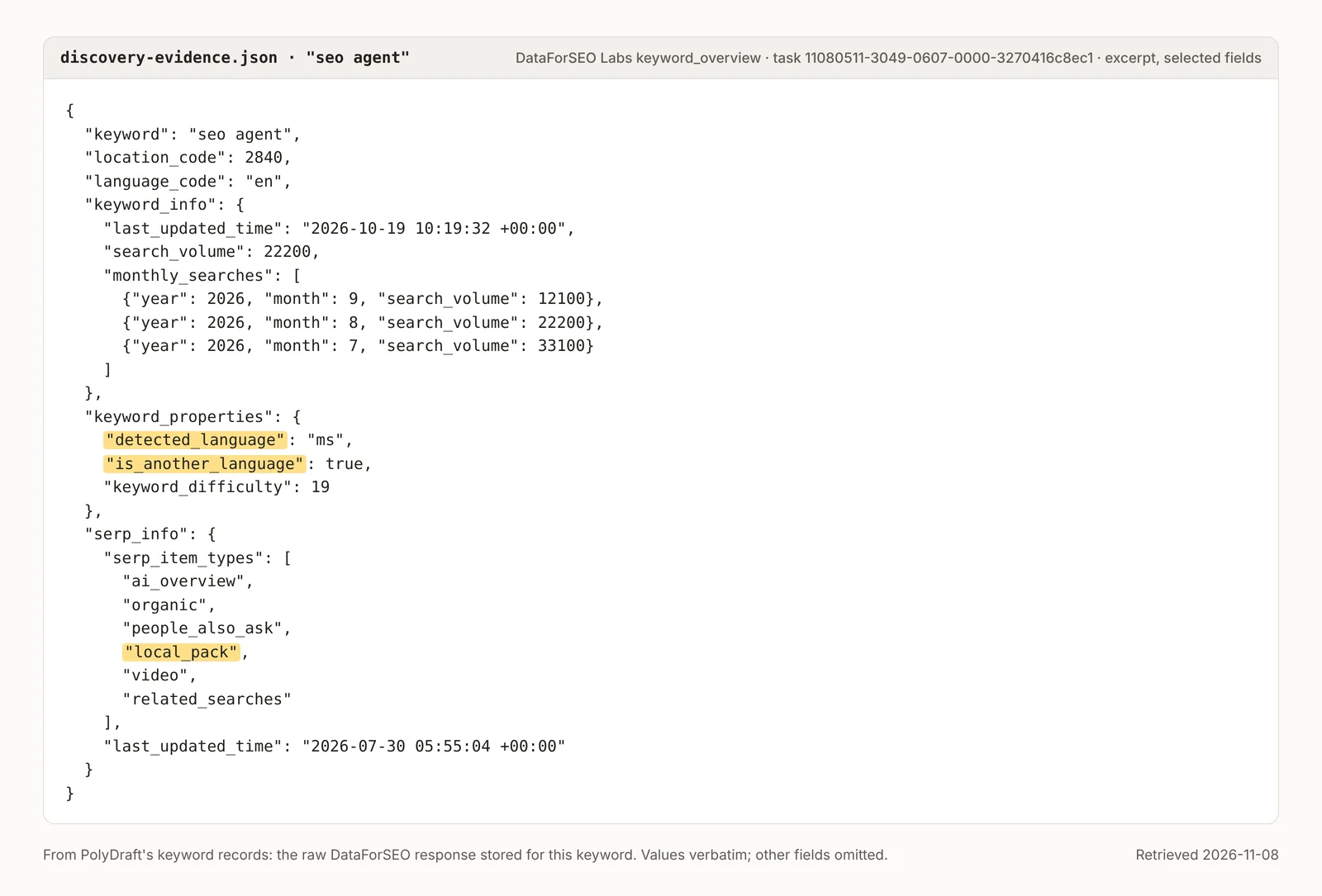
The language flag (ms) needn't mean the searches are in Malay. It does mean the volume can't be read as English software demand without more checks. Ahrefs showed 800 searches for the same word on October 26. We put "seo agent" on hold. The same flags appear on plainly English phrases, such as it on ai visibility and es on "aeo vs seo". So a flag is a reason to check, not a verdict: read the flag, then read the page.
As of November 8, 2026, the results for "how to find low competition keywords" itself showed an AI Overview, a LinkedIn post, a Reddit thread, Quora, method guides from Productive Blogging, Exploding Topics and Zapier, a keyword tool, and YouTube videos. That told us a method article fits, and that readers trust first-hand experience. Hence the real table below.
Merge variants instead of adding volume
Variants of one search, such as reordered words, singular and plural, or small wording changes, usually share one intent and should share one page. Merge them in your plan, but keep each variant's numbers separate. Don't add their volumes into a total, and don't let the easiest variant's KD stand for the group.
Two cases from our records:
- "international seo agency" and "international seo agencies" each showed 590 average searches in DataForSEO. Their monthly values were identical for all 12 months. That points to one shared pool of demand, not 1,180 separate searches.
- "seo vs aeo" had KD 9 and 1,000 searches. "aeo vs seo" had KD 17 and 1,900 searches. They ask the same question. Writing for "aeo vs seo" on the strength of a KD 9 would mean betting on a number from a different keyword.
Then give each intent one owner page. If you already have a page that answers the question, improve it instead of writing a second one that competes with it. Both comparison variants went to our existing guide to what makes a site quotable, which already compares GEO, AEO and SEO. Our website architecture guide covers how to keep an owner register so these decisions stick.
Our 12 decisions: kept, merged or rejected
These are 12 real keyword decisions from PolyDraft's research records between November 5 and November 8, 2026. All figures are for Google US. Ahrefs dates are the date Ahrefs last updated that row; Ahrefs values come from Keywords Explorer exports, except row 9 (a Site Explorer export). DataForSEO figures were retrieved on November 5 or 8, 2026. "Avg" is the provider's average monthly volume. None of the kept keywords has produced rankings yet.
| # | Keyword | Ahrefs (vol / KD, date) | DataForSEO (avg / KD, latest month) | What we saw | Decision |
|---|---|---|---|---|---|
| 1 | how to find low competition keywords | 600 / 0 (Oct 23) | 140 / 13; Sep 140 | Forums and posts, method guides, one tool, videos | Kept: this article |
| 2 | ai seo agency | 3,800 / 12 (Oct 5); 3,800 / 19 (Oct 29) | 1,600 / 0; no monthly data stored | Agency pages and best-agency lists, DR 55–95 | Not a post: hiring intent, strong results |
| 3 | answer engine optimization | 5,000 / 40 (Oct 2); 7,300 / 48 (Oct 31) | 2,400 / 43; Sep 4,400 | High in both tools | Rejected as a new target; existing GEO guide owns it |
| 4 | generative engine optimization | 7,200 / 1 (Oct 1); 7,800 / 58 (Oct 31) | 4,400 / 44; Sep 4,400 | KD 1 was an old Ahrefs row | Rejected as a new target; existing GEO guide owns it |
| 5 | ai visibility | 4,400 / 0 (Oct 1); 4,200 / 31 (Oct 31) | 880 / 26; Aug 1,000 | Old Ahrefs KD 0; volume about 5× apart | Kept on our product page only |
| 6 | seo monitoring software | 2,900 / 3 (Oct 30) | 720 / 66; Sep 50 | Tool roundups on strong sites | Rejected; removed from our plan |
| 7 | international seo agency | 2,900 / 5 (Oct 5) | 590 / 0; Sep 140 | 4 lists, 3 agency pages, 2 directories | Not pursued: recent demand too low |
| 8 | llm optimization | 2,200 / 15 (Oct 29) | 720 / 15; Sep 480 | Model inference and cost | Rejected: wrong meaning |
| 9 | aeo | 17,000 / 32 (Nov 2) | 27,100 / 16; Sep 33,100 | Clothing brand searches | Rejected: wrong meaning |
| 10 | seo agent | 800 / 12 (Oct 26) | 22,200 / 19; Sep 12,100 | Language flag, local pack | On hold |
| 11 | seo vs aeo / aeo vs seo | Not in our library | 1,000 / 9 and 1,900 / 17 | Same question, two orders | Merged into the existing GEO guide |
| 12 | programmatic seo agency | 200 / 2 (Oct 15) | KD 0 (volume not pulled) | Not a service we offer | Rejected: business fit |
Three patterns stand out. Only one of the 12 became a new post (this one); two more went to pages we already have (rows 5 and 11). The biggest numbers (rows 9 and 10) were the least reliable. And in four rows (4, 5, 6 and 7), a second provider or a newer date reversed what the first number suggested.
From keyword to brief
A kept keyword becomes a brief, not a title. The brief names one reader task, one asset that only you can make, and one conversion path, so the page has a reason to exist beyond the keyword. If you can't fill all three, the keyword isn't ready, however low its KD. Google's guidance on helpful, people-first content asks whether a page adds original information or analysis. The unique asset is how you answer that.
Here are the three keywords we kept for posts in the week of November 9, 2026, with DataForSEO figures retrieved November 8, 2026:
| Keyword | Avg / KD (Sep) | Reader task | Unique asset | Next step |
|---|---|---|---|---|
| how to do a content audit | 70 / 10 (110) | Decide what to keep, fix, merge or retire across a blog | A completed audit of our own 40-post blog | Our refresh workflow, then contact |
| how to find low competition keywords | 140 / 13 (140) | Judge which candidates a small site can win | This table of 12 real decisions | Our keyword and architecture guides |
| landing page vs website | 390 / 5 (320) | Choose what to build first | A decision table and a plan for growing one page into a site | Start building |
The content audit brief became our guide on how to do a content audit. Each brief also lists the page that owns the topic today and the pages it must not repeat. For this article, that meant not repeating the 370-keyword example in our keywords guide.
A short brief template you can copy:
- Keyword and variants, each with provider, market, date, average and latest month.
- Live results summary: page types, brands, forums, AI Overview, date checked.
- Owner page: new URL or the existing page to improve; pages it must not overlap.
- Reader task in one sentence.
- Unique asset: your data, test, template or worked example.
- Conversion path: the one next step that fits the reader.
- What we won't claim: results or features you can't support.
Find low-competition opportunities in your own Search Console
Once your site has impressions, Google Search Console is the best source of low-competition keywords, because it shows real searches where Google already shows your pages. Open the Performance report, choose Search results, and look at queries with impressions but few clicks. Those are searches you can partly win already.
A method that works for small sites:
- Sort queries by impressions and note which page each one reaches. A query with impressions but no page written for it is a candidate that already passed Google's first test.
- Look at average position. Google defines it as the topmost position of your result, averaged. Queries sitting just off page one are the usual first targets; this is our working rule, not Google's.
- Group the queries by intent and run the checks above on each group. A query in Search Console can still be the wrong intent.
- Remember the limits. Search Console omits some rare queries and shows the most important rows, so the list is incomplete. Google documents this under data limits.
We don't show Search Console data in this article. Our figures above come from keyword tools. Search Console examples would need a separate, dated export.
Where PolyDraft fits
We make PolyDraft, an AI website builder that deploys sites to your own Cloudflare account. Sites built on PolyDraft since November 2026 (scaffold v2.28 or later) get a content calendar with topic clusters, a dated publishing queue, and keyword and question data. The questions answer engines might ask are AI-predicted. The judgement in this article still needs a person: which intents fit your business, and what proof you can add.
If you'd rather have someone run this for you, PolyDraft AI FDE is our AI SEO and GEO service: a PolyDraft engineer runs PolyDraft for you, doing your site's technical SEO, content and AI-visibility work with PolyDraft's agents. Nothing goes live without your approval. Contact us to ask about it. For how agents can prepare this evidence, see our guide to using AI agents in SEO.
Frequently asked questions
What are low competition keywords?
Low competition keywords are searches where the pages ranking now are relatively weak, so a smaller site has a realistic chance. Tools estimate this with keyword difficulty, which is based on links to the top 10 results. A keyword is only a good target if its intent also matches what your site offers.
Is a keyword with KD 0 easy to rank for?
Not necessarily. KD 0 means the tool's link model sees weak competition. In our records, "ai seo agency" had DataForSEO KD 0 on November 5, 2026, while the cached top 10 included sites rated DR 55 to 95. Check the live results and the meaning before you trust a low score.
Why do Ahrefs and DataForSEO show different numbers?
They use different data and models for volume and difficulty, and their rows have different update dates. For "international seo agency", an Ahrefs row from October 5, 2026 showed 2,900 searches; DataForSEO showed 590 on November 8. Keep each tool's numbers separate and dated, and never average them into one figure.
What KD should a new website target?
There is no safe number. Our own research used KD 20 or less as a working filter, but a filter only finds candidates. A new site should also look for results pages that include small sites or forums, intents it can fully serve, and evidence only it can add. A low KD on the wrong intent doesn't help.
How do I check keyword difficulty for free?
Search the exact phrase in your target market and read the top results. Note the page types, whether big brands or forums rank, and whether the word means what you think. Free keyword checkers give a rough KD. Once your site is live, Search Console's Performance report shows the searches where Google already shows your pages.
Should I add up the volume of keyword variants?
No. Variants like "seo vs aeo" and "aeo vs seo" usually share one searcher need and belong on one page. Their volumes can overlap; in our data, two international SEO keywords had identical monthly values for 12 months. Plan them as one page and keep each variant's numbers separate.
Continue with the next task
- Learn the terms behind these checks: What SEO keywords are and how to choose them
- Give each kept keyword one owner page: Website architecture for SEO
- Check which pages you already have before writing more: How to do a content audit
About this article. Drafted by an AI agent following PolyDraft's blog workflow, checked by an automated QA script and an on-page audit, and approved by Vincent Chen. The 12 decisions come from PolyDraft's keyword research records in our internal knowledge base: Ahrefs exports captured October 5 and November 5, 2026 (rows last updated by Ahrefs between September 22 and November 2), and DataForSEO Labs and live results pulls on November 5 and November 8, 2026, all for Google US in English. Every number was re-read from those files on November 8, 2026. The two record images are renders of those files, not screenshots of a tool's interface. Results summaries come from titles and snippets; we didn't open every ranking page. Provider definitions were checked against DataForSEO's and Ahrefs' help pages through search excerpts on November 8, 2026. No Search Console data is used. The decision diagram is an original illustration.
Sources
- DataForSEO Help Center: What is keyword difficulty and how is it calculated, What is search volume
- Ahrefs Help Center: What does KD stand for in Keywords Explorer, Monthly vs average search volume
- Ahrefs Academy: Keyword and search traffic metrics
- Google Search Central: Creating helpful, reliable, people-first content
- Google: Search quality rater guidelines
- Search Console Help: How are you performing on Google?, What are impressions, position, and clicks?, Performance report: about the data
- PolyDraft: Features
Written by
Founder of PolyDraft and CEO of BlackMonolith, Inc.