In this article
- 01 What SEO keywords are, with examples
- 02 The metrics, in plain words
- 03 How we turned 370 keywords into 5 pages
- 04 Keyword examples for a business outside SEO
- 05 Choosing keywords for a new or low-authority site
- 06 Where to use a keyword on the page
- 07 Checking whether your keywords work
- 08 Where PolyDraft fits
- 09 Frequently asked questions
- 10 Continue with the next task
- 11 Sources
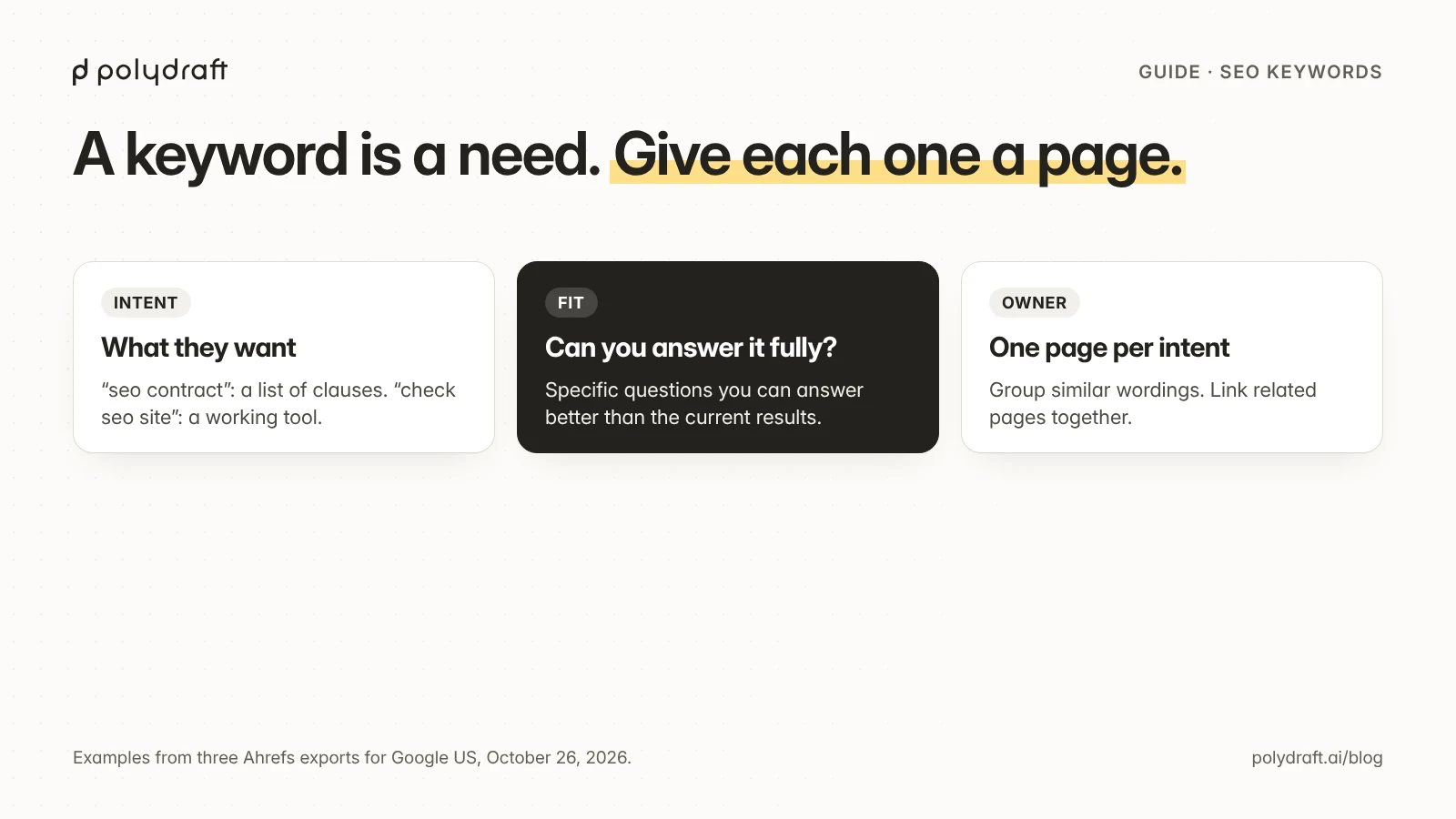
SEO keywords are the words and phrases people type into a search engine, or ask an AI assistant, when they need something. To choose them for your site, pick the queries where you can fully answer the searcher's question and add something others can't. Give each one its own page. Volume and difficulty scores help you sort the list, but they don't make the decision. For a new or small site, the best keywords are usually specific, lower-volume questions your customers already ask, grouped so the pages can link to each other.
This guide is for founders and small teams doing their own keyword research. It explains the terms tools use, shows real examples from three keyword exports we worked through on October 26, 2026, and ends with a checklist you can use on your own list.
Key points
- A keyword stands for a need. Judge a keyword by what the searcher wants (intent), not just by how often it's searched.
- Tool metrics are estimates. A difficulty of 0 doesn't mean a page will rank easily.
- Each search intent gets one owner page. Several pages chasing the same intent compete with each other.
- New sites do better with specific queries they can answer completely, grouped into a small cluster of linked pages.
- Write for the reader and use the words they use. Repeating a keyword doesn't help, and keyword stuffing is against Google's spam policies.
What SEO keywords are, with examples
A keyword is the text of a search. People also use the word for the topic behind a group of similar searches. Search tools group similar wordings together, so "what is seo keywords", "what are seo keywords", and "seo keywords meaning" usually point to the same need and should be answered by one page.
Here are real examples from the exports we used for this article: Ahrefs data for Google US, exported on October 26, 2026. Ahrefs last updated the rows between September 20 and October 25, and some rows have no update date. Volumes are Ahrefs' average monthly searches. The last two columns are our reading of the search results, not only the tool's labels.
| Keyword | Monthly US searches | What the searcher wants | Type of intent |
|---|---|---|---|
| how seo works | 1,900 | Understand the basics | Informational |
| what is seo keywords | 1,800 | A definition and examples | Informational |
| seo contract | 1,900 | A template or a list of clauses | Commercial and informational |
| auto seo software | 500 | Compare tools | Commercial investigation |
| claude code seo skills | 70 | Find or build an AI agent Skill | Informational and commercial |
| healthcare seo agency | 3,800 | Hire a specialist agency | Commercial and local |
| check seo site | 1,100 | Run a free checker tool now | Commercial, answered by tools |
Two keywords with similar words can want completely different things. "seo skills" (1,600 searches) looked like a fit for us. When we read the results, about nine in ten of those searches came from people researching SEO careers. "claude code seo skills" has 70 searches, and the person searching wants AI agent Skills, which matches what we write about.
The metrics, in plain words
Every keyword tool shows similar columns. In the tool we used (Ahrefs), they mean roughly this:
| Metric | What it estimates | How to use it |
|---|---|---|
| Volume | Average monthly searches for this exact wording in one country | Compare keywords; don't treat it as a traffic forecast |
| Keyword difficulty (KD) | How hard it is to reach the top 10, on a 0 to 100 scale, based mainly on links pointing at the pages that already rank | A rough signal. It ignores intent, local results, and SERP features |
| Traffic potential | Estimated traffic to the top-ranking page for the parent keyword, across all the queries that page ranks for | Shows whether a topic is bigger than one wording |
| Parent keyword | The query that sends the most traffic to the top-ranking page | Hints whether one page can cover several wordings |
| Intent labels | The tool's guess at informational, commercial, local, or branded | A starting point. Read the actual results to confirm |
Why KD 0 isn't "easy". All 14 keywords in one of our exports had a difficulty of 0. They included "healthcare seo agency", where the results are specialist agencies and Ahrefs labels the intent as local, and "check seo site", where people want a working tool. A blog post can't win either search, whatever the score says. Difficulty measures links. It doesn't measure whether your page is the right kind of answer.
Why traffic potential matters. "check seo site" has 1,100 searches but a traffic potential of 187,000, because the top page for its parent keyword, "seo checker", is a checker tool that ranks for thousands of related searches. Matching that needs a free tool, not an article.
How we turned 370 keywords into 5 pages
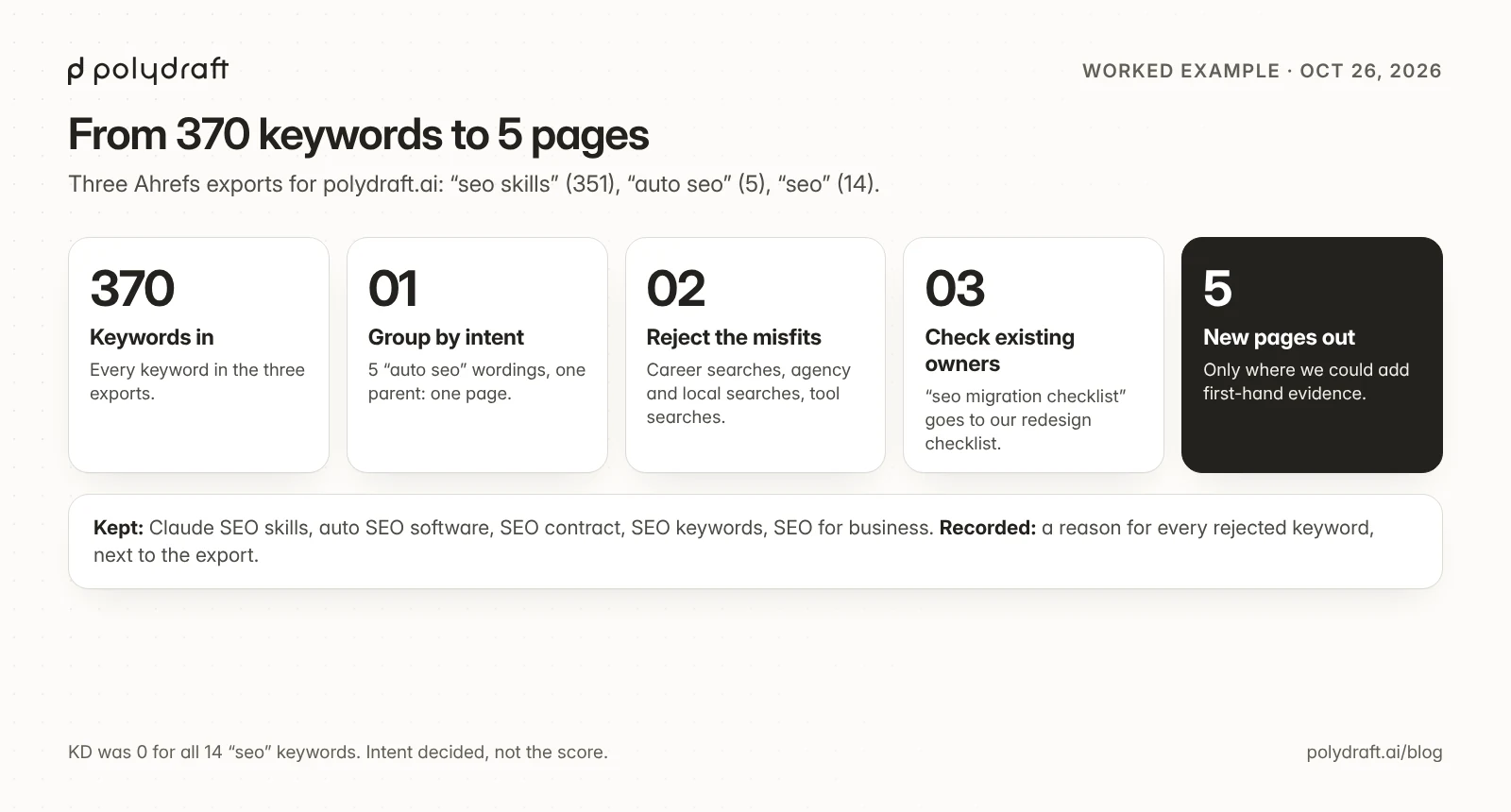
On October 26, 2026, we worked through three Ahrefs exports for polydraft.ai: "seo skills" (351 keywords), "auto seo" (5), and "seo" (14). This is the process, with the real decisions.
1. Group by intent, not by wording. Four of the 5 "auto seo" keywords shared one parent keyword, and the fifth, "auto seo software", had the same intent, so they became one page: our guide to auto SEO software. Splitting them across several pages would have made them compete.
2. Reject intents you can't serve. About nine in ten "seo skills" searches were career searches. Six of the 14 "seo" keywords were agency or local searches, such as "online seo services" and "website design and seo company". We're not an agency, so we rejected them and recorded the reason.
3. Check whether a page you already have owns the intent. "seo migration checklist" (1,100 searches) is a real need, but our website redesign SEO checklist already covers platform and domain migrations. We'll extend that page instead of creating a second one that competes with it.
4. Keep only topics where you can add something. We wrote about Claude SEO skills because we could test a Skill and read real packs. We wrote this article because we had our own keyword data to show. Topics where we'd only be summarizing other people's pages were left out.
5. Map what's left to pages that link to each other. The result was 5 new pages from 370 keywords. Four of them form one small cluster: SEO for business as the overview, with this guide, our SEO contract checklist, and our auto SEO software guide as supporting pages.
The decisions, with a reason for every rejected keyword, are kept in a mapping file next to each export. When the same keywords come up again, we don't have to decide twice.
Keyword examples for a business outside SEO
Our own examples all come from SEO, because that's what we sell. Here's the same thinking applied to a local plumber. These keywords are illustrative, not data from a tool:
| Type | Example | What it tells you |
|---|---|---|
| Head term | plumber | Broad and competitive. Local map results and directories usually win it |
| Long-tail | emergency plumber open sunday [city] | Specific and urgent. A clear service page with opening hours can win it |
| Question | why is my water heater making noise | Informational. A helpful guide can earn trust before the customer needs you |
| Local | water heater repair near me | Answered by map results. Your Google Business Profile matters most |
| Commercial | tankless water heater vs tank cost | Comparison. A page with your own prices and experience stands out |
| Branded | [your business name] reviews | People already know you. Make sure your own pages answer it |
The long-tail and question rows are where a small site usually starts. They have less competition, clearer intent, and room for the first-hand detail a directory can't give.
Choosing keywords for a new or low-authority site
A new site has few links and little history with search engines. That changes which keywords are realistic:
- Prefer specific questions to broad topics. "What to include in an SEO contract" is more realistic than "SEO". Specific questions usually have clearer intent, and a thorough answer stands out.
- Pick questions you can answer completely. If a searcher still needs another page after yours, yours probably won't hold its position.
- Bring something first-hand. Your own data, a test you ran, a worked example, or a template. Google's guidance on helpful content asks whether a page shows first-hand expertise and provides original information.
- Build small clusters. Three to six linked pages on one theme help readers and search engines see what your site is about, more than scattered single posts.
- Read the results before you write. If the first page is all tools, local map results, or big brands' product pages, an article is the wrong format.
- Skip what you can't support. If you can't offer a free tool, don't chase "checker" keywords.
Where to use a keyword on the page
Use the words your readers use, where they'd expect them:
- Title and heading. Make the page's promise clear, using the searcher's own words.
- The first paragraph. Answer the question directly, early.
- Subheadings. Use the related questions people ask.
- The URL. Short and readable, such as
/blog/seo-contract. - Links from other pages. Use descriptive anchor text, not "click here".
Don't repeat a keyword to hit a count. Google's spam policies list keyword stuffing as a spam practice, and its SEO starter guide says the keywords meta tag isn't used by Google Search.
AI search changes the input, not the job. People ask AI assistants longer, conversational questions. Collect the exact questions your customers ask in emails, calls, and sales conversations, and answer them on the page that owns the topic. Our guide to what makes a site quotable covers the page structure that helps.
Checking whether your keywords work
After a page has been live for a few weeks, open Search Console's Performance report and filter by the page:
- Queries. Are the searches you planned for appearing? Are there others you didn't expect? Unexpected queries are often your next section or page.
- Impressions before clicks. On a new site, impressions usually come first. Rising impressions with few clicks often means the title or description doesn't match what searchers want.
- Two pages for one query. If two of your pages appear for the same searches, decide which one owns the topic.
Our content refresh workflow turns these signals into updates.
Where PolyDraft fits
When keyword research data is configured, PolyDraft's builder agent uses search demand data to plan each page. In the builder chat, the /onpageseo command can research keywords, map them to pages, and edit those pages in the builder for you to review. Metadata edits don't yet reach a site that's already published, so check the live page after you publish. The choices in this guide still need a person: which intents fit your business, and what you can add that others can't. See what PolyDraft automates for SEO.
Frequently asked questions
What are SEO keywords?
They are the words and phrases people type into a search engine, or ask an AI assistant, when they need something. A page targets the keywords whose intent it answers.
What is an example of an SEO keyword?
"seo contract" is one: about 1,900 US searches a month (Ahrefs, October 2026), mostly from people looking for a template or a list of clauses. A page that provides both can target it.
How many keywords should one page target?
One main search intent, plus the different wordings and related questions people use for it. Several unrelated keywords on one page usually means the page should be split.
Is a keyword with difficulty 0 easy to rank for?
Not necessarily. Difficulty scores are mostly based on links to the current results. They don't account for local map results, tool results, or whether a blog post is the right format.
Should a new website target high-volume keywords?
Usually not at first. Start with specific questions you can answer better than the current results, build a small cluster of linked pages, and widen as the site earns trust.
Do keywords still matter with AI search?
Yes, but think in questions. AI assistants work from what people ask, so use the language your customers use and answer each question clearly on the page that owns it.
Continue with the next task
- See where keywords fit into the bigger plan: SEO for business
- Give each keyword one owner page: Website architecture for SEO
- Get the basics in place on a new site: SEO for a new website
About this article. Drafted by an AI agent following PolyDraft's blog workflow, checked by an automated QA script, reviewed by separate AI agents, and approved by Vincent Chen. The keyword figures come from three Ahrefs exports for Google US, dated October 26, 2026, and the decisions come from our own mapping files. Metric definitions describe how we use the tool, in plain words, not Ahrefs' own wording. We paraphrase Google's guidance rather than quote it. The diagrams are original illustrations made for this article.
Sources
- Google Search Central: SEO starter guide
- Google Search Central: Spam policies for Google web search
- Google Search Central: Creating helpful, reliable, people-first content
- Google Search Central: In-depth guide to how Google Search works
- Search Console Help: Performance report
Written by
Founder of PolyDraft and CEO of BlackMonolith, Inc.