About Us Page Examples: 15 Real Pages, Annotated, Plus a Fill-In Template
15 real About Us page examples from startups, agencies, local shops, a manufacturer and nonprofits, annotated from dated screenshots, plus a fill-in template.
The best about us page examples answer three questions: who runs this, how the work gets done, and why anyone should believe it. An About Us page is the page that tells visitors who is behind a business, how it works and why it exists. We captured 15 live pages on 18 November 2026 (13 About pages and two company history pages) and annotated what each one does well and where it slips.
In brief, by situation:
- Startup or bootstrapped software: copy Plausible (dated story, funding model, "when we're not a fit"), Basecamp (a signed founder letter) and Buffer (numbers linked to their source).
- B2B SaaS with scale: Ahrefs and Stripe.
- Agency or consultancy: Pentagram, Siege Media and IDEO.
- Local business: Zingerman's Deli and Russ & Daughters.
- Manufacturer: Lodge Cast Iron.
- Founder-led brand: Patagonia.
- Nonprofit: charity: water and Khan Academy.
This guide is for anyone writing or rebuilding an About page, and it ends with an about us page template you can fill in. It does not cover legal pages such as imprints or privacy policies, which have their own rules. We make PolyDraft, an AI website builder, and our own About page is one of the 15. It is labeled and judged by the same rules.
At a glance: 15 about us page examples compared
We evaluated every page the same way: we opened the live page in a desktop browser at 1440 pixels wide on 18 November 2026 and read the full text. The examples are grouped by business type, not ranked.
| Example | Type | Best idea to copy | Weak spot we saw |
|---|---|---|---|
| Plausible | Bootstrapped startup | Dated story, funding model and a "not a fit" link | The team is only a link to another page |
| Basecamp | Founder-led software | Signed founder letter with a direct email address | Durations ("27 years") with no start year |
| Buffer | Remote startup | Company metrics next to a link to the public dashboard | Very long roster before the values |
| Ahrefs | B2B SaaS | Concrete data numbers and a media contact | A product promo sits above the About content |
| Stripe | B2B infrastructure | Mission essay where claims link to evidence | No people, founding year or address on the page |
| Pentagram | Design agency | Explains how the firm is owned, then shows the owners | Meta description says 24 partners, body says 23 |
| IDEO | Design consultancy | Named history plus staff profiles | "Nearly 50 years" next to "founded in 1991" |
| Siege Media | Marketing agency | Every staff member and four street addresses | A traffic-value figure with no method shown |
| Zingerman's Deli | Local deli | Founders, opening date, address, phone and hours | Page title shows a template placeholder |
| Russ & Daughters | Family food shop | Names, dates and the street address in the story | "For 111 years" is a count that has gone stale |
| Lodge Cast Iron | Manufacturer | Town, founding year and a dated timeline | Sale banners stack above the story |
| Patagonia | Founder-led brand | Archive photos credited by photographer | Very long, with no quick facts box |
| charity: water | Nonprofit | "We prove every project" with links to proof | A lead-capture popup covered the page |
| Khan Academy | Nonprofit | Dated usage numbers plus research and watchdog links | Testimonials are anonymous |
| PolyDraft (ours) | Small B2B software | Named founder, legal entity and a corrections route | Hero text fades in, and there is no founding year |
What the best About pages have in common
Across the 15 pages, the strong ones do five things. None of them needs a big budget.
- One plain sentence first. Khan Academy opens with its mission in one line. Plausible opens with what it is, where it is based and why it exists.
- Facts a reader can check. Dates, places, names and numbers, with a link when the number comes from somewhere. Buffer puts an "Open dashboard" button beside its metrics. charity: water links "see proof" and "view all financials".
- Real, named people. Siege Media and Buffer list staff by name and role. Pentagram shows each partner with a portrait, name and city. Basecamp goes further: the CEO signs the page and gives a direct email address.
- How the business works. Pentagram explains that its owners do the work. Plausible explains who pays for it. charity: water explains where donations go. This is the easiest part to skip.
- A way to reach someone. An address, a phone number, a support email or a named contact for the press.
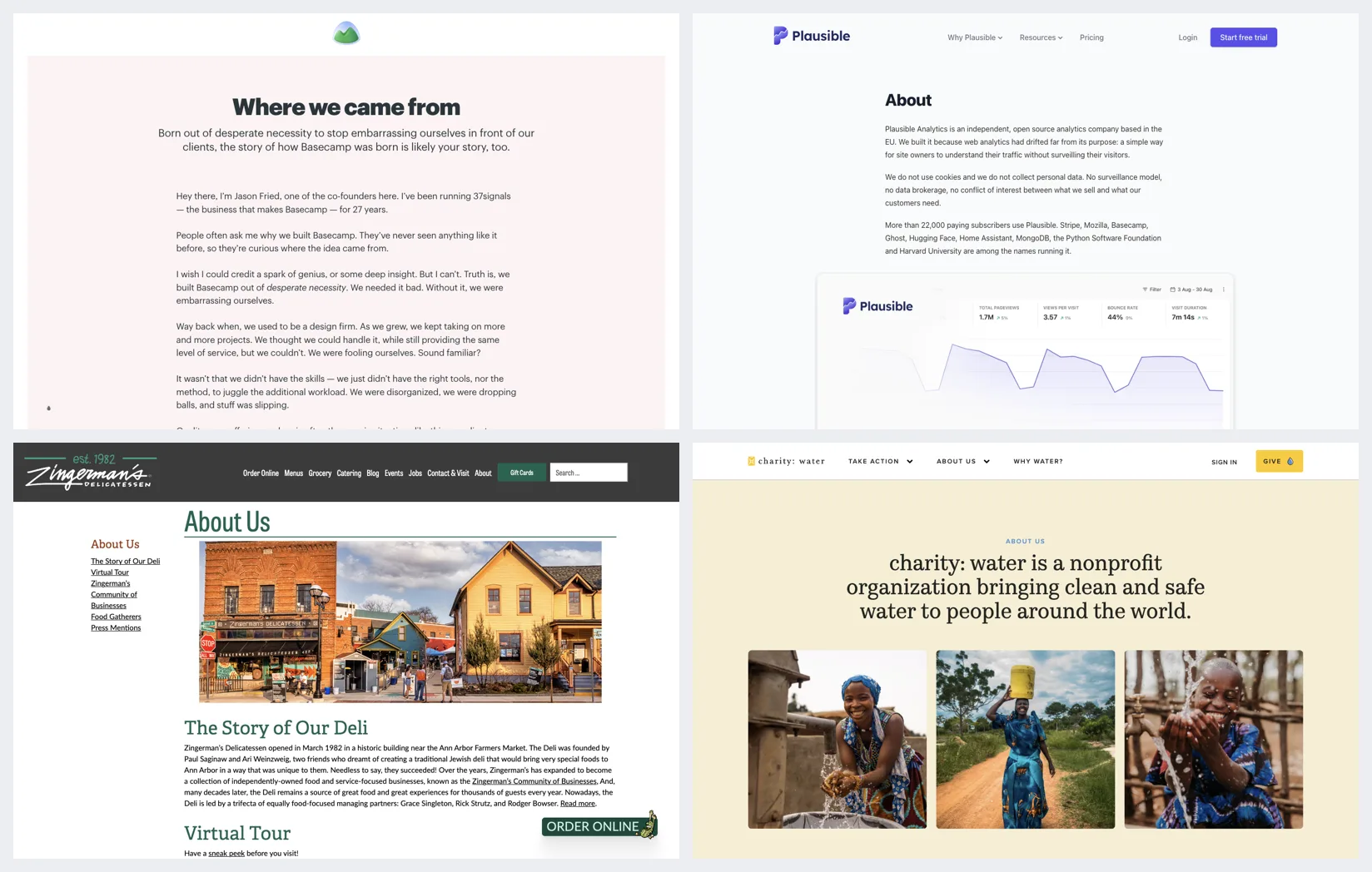
If you are planning a whole site rather than one page, our business website examples cover homepages, calls to action and local contact details. This article stays on the About page.
Startups and SaaS companies
Plausible Analytics: a bootstrapped startup
What it is: the About page of Plausible, an open source web analytics company based in the EU.
Who it suits as a model: small software companies, especially self-funded ones, whose buyers worry about lock-in or data use.
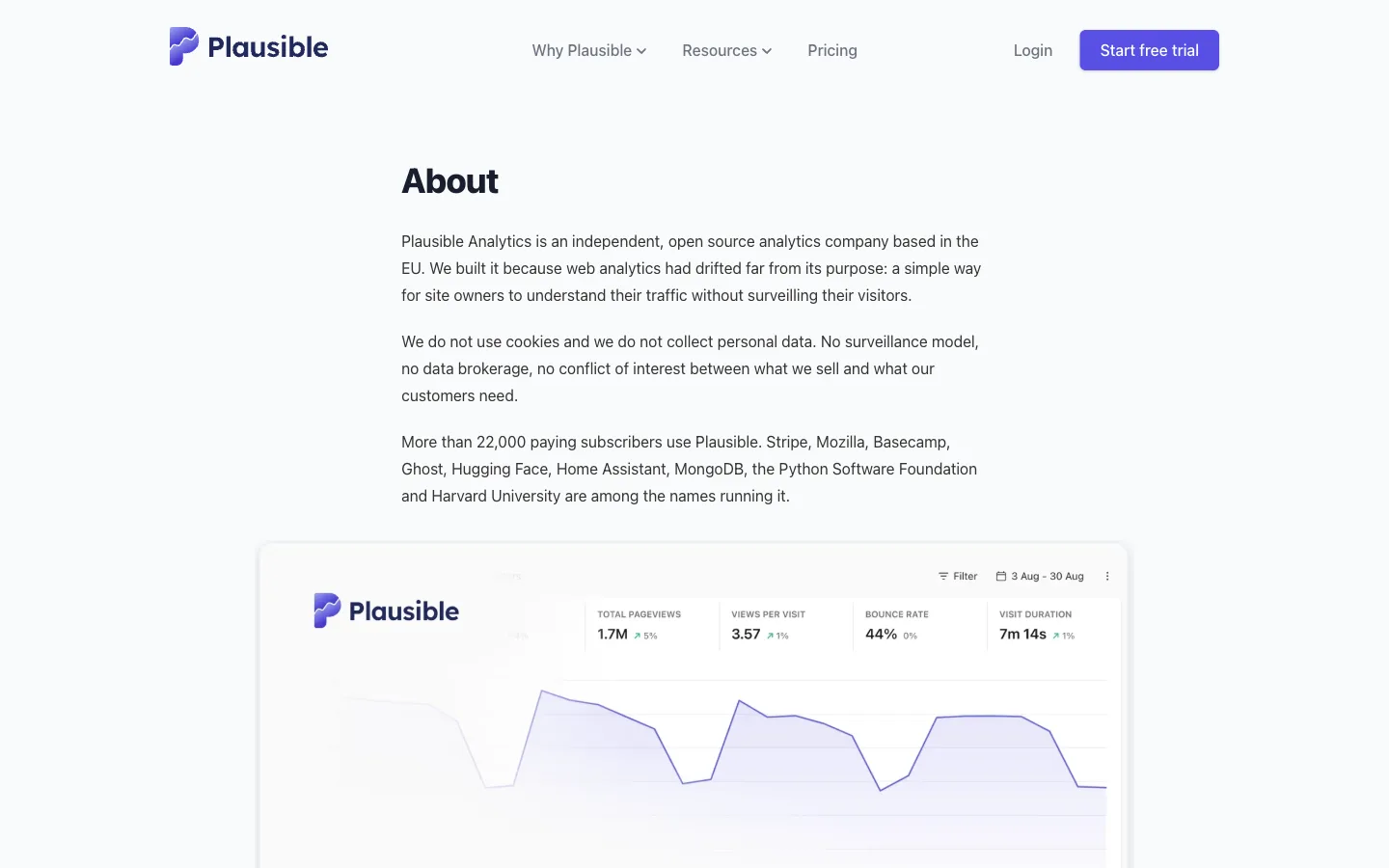
What we saw: the first paragraph says what the company is and where it is based. The second says what it does not do: "We do not use cookies and we do not collect personal data." Then comes a dated story: Uku Taht "started Plausible in December 2018", Marko Saric joined in 2020, and the company "crossed $1 million in annual recurring revenue in 2022". A "How we're funded" section says the company is "self-funded and profitable, with no outside investors and no plans to sell".
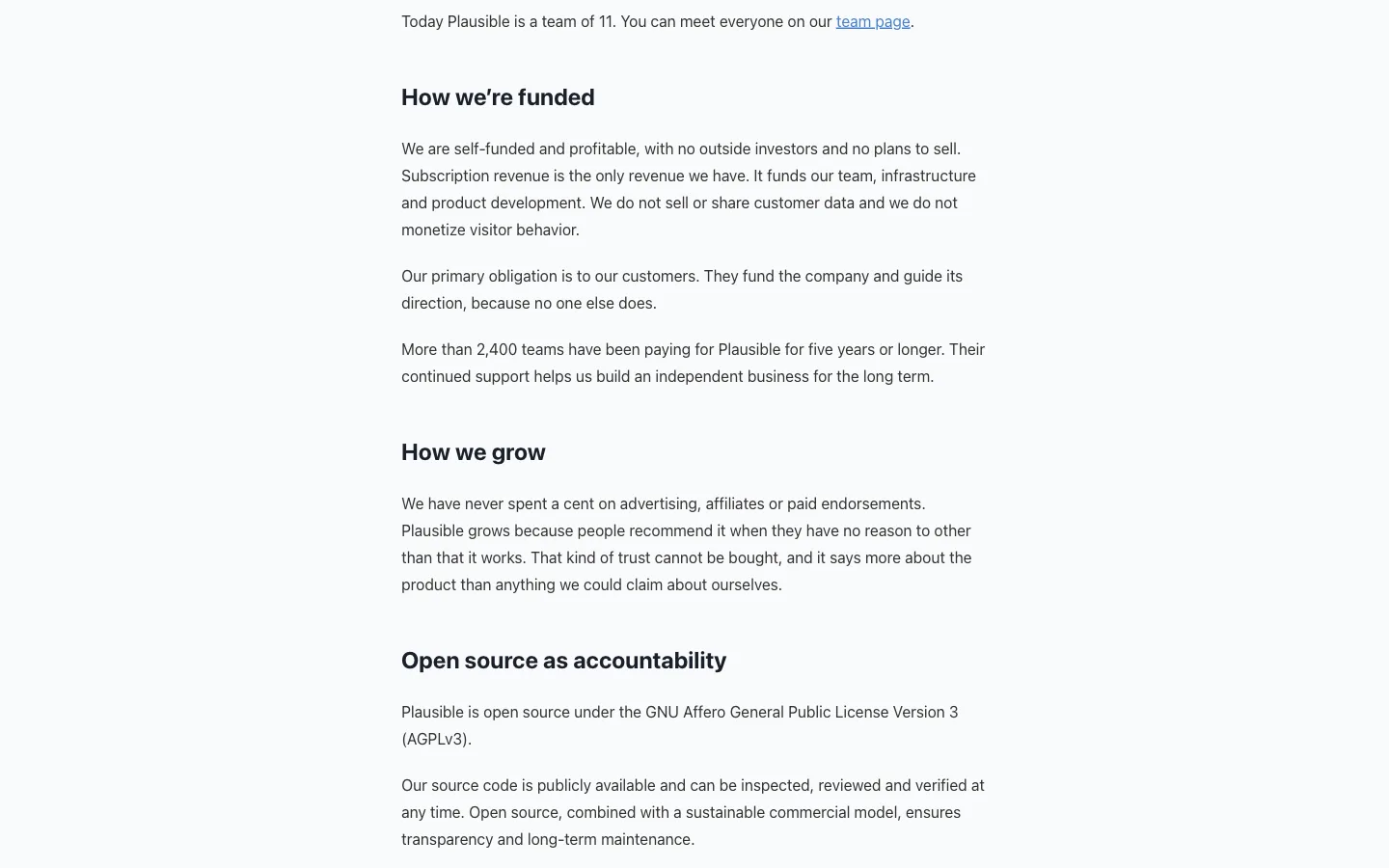
The detail most of the other pages lack: a link that says "Read when Plausible is not a fit before you decide." Telling readers when not to buy builds trust, because it costs the company something.
Limits: the page mentions a team of 11, but the team appears only as a link to a separate page. A small team photo would make those people visible.
What to copy: a "How we're funded" section and a link to "when we're not a fit".
Basecamp: a founder letter with a real email address
What it is: Basecamp's "Where we came from" page, written in the first person by co-founder Jason Fried.
Who it suits as a model: founder-led companies whose origin story explains the product.
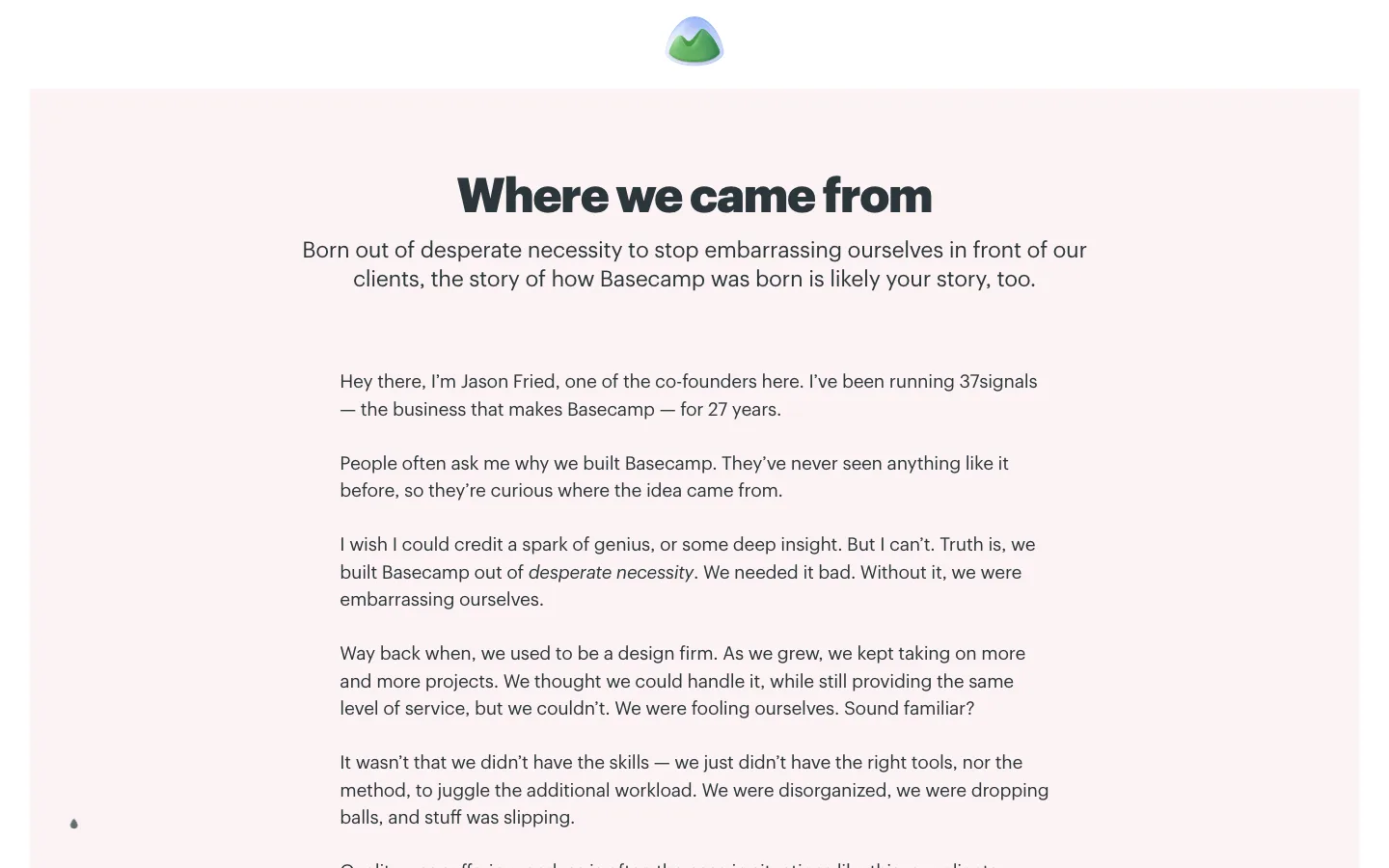
What we saw: the letter explains that the company was a design firm that built a project tool for itself because "we were embarrassing ourselves" in front of clients. Clients asked to use it, and about a year after release "it was generating more revenue for us than our web design business." The page ends with a signature, a photo and "You can always contact me directly if you have any questions at jason@basecamp.com."
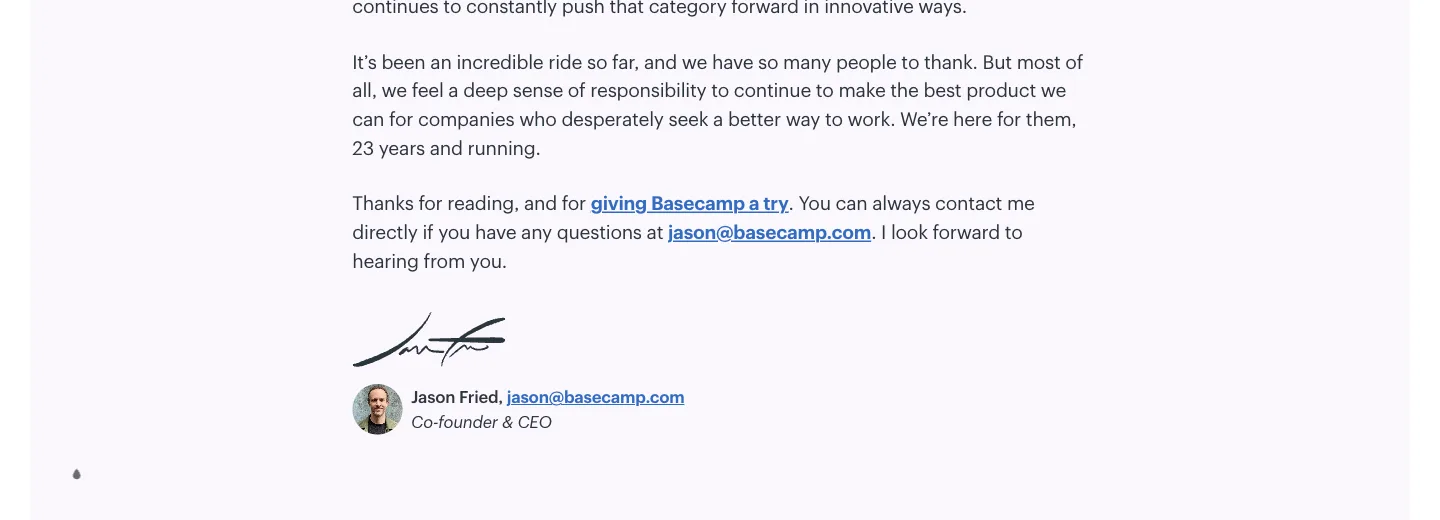
Limits: the letter uses durations, not years. It says Fried has run 37signals "for 27 years" and that the company is "23 years and running" for customers. A reader can't tell when the text was written, and the counts go stale every year.
What to copy: a signed letter with a real way to reply. Write the founding year instead of a count of years.
Buffer: company numbers with a link to the source
What it is: the About page of Buffer, a social media tool run by a fully remote team.
Who it suits as a model: startups that compete on openness, or distributed teams that want to show where people are.
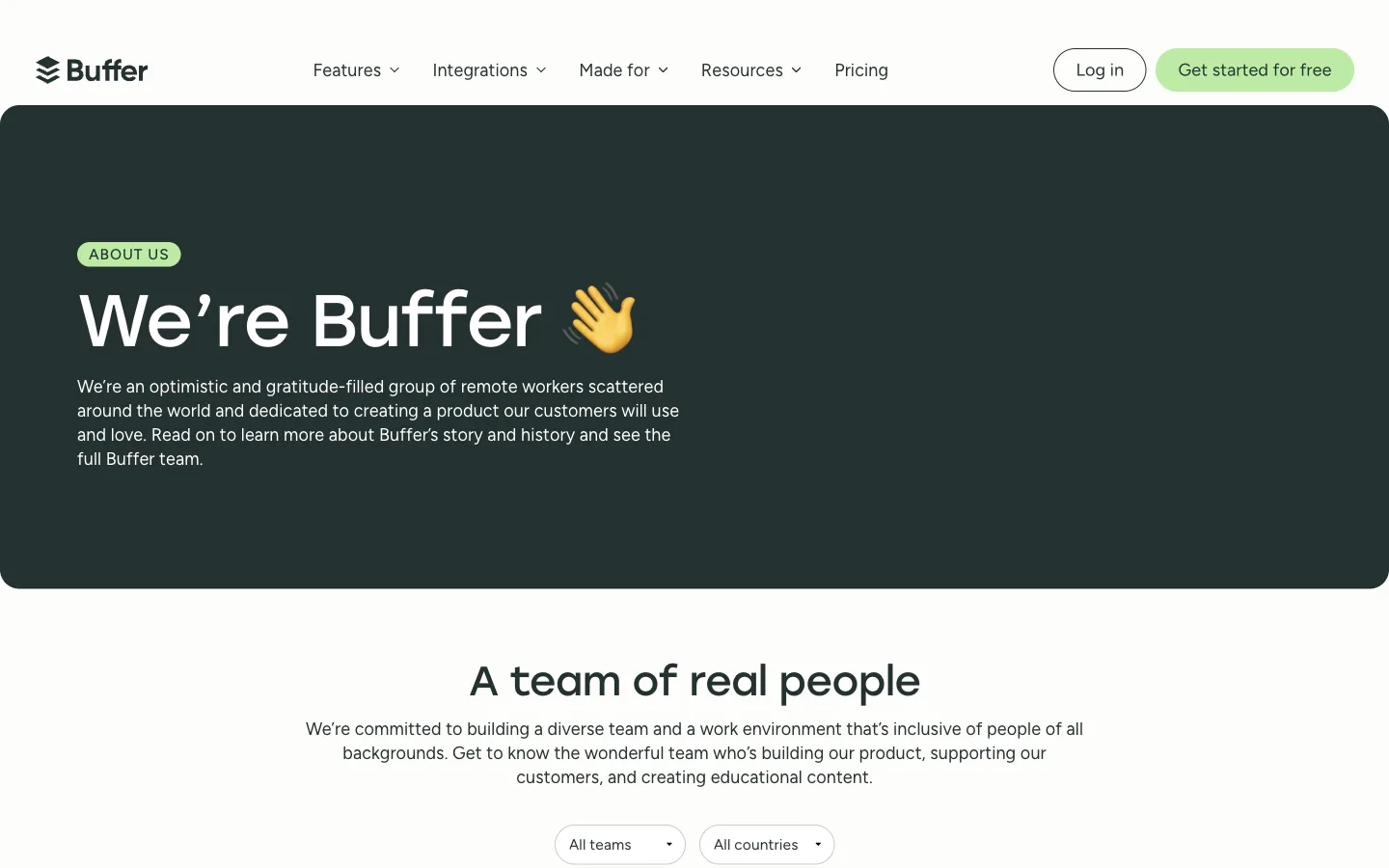
What we saw: a section headed "We are an open company" says that "Since 2013, we've shared Buffer's finances, team salaries, and other key metrics openly." Four figures follow: monthly active users, total customers, teammates "across 15 countries" and annual recurring revenue. An "Open dashboard" button beside them points readers to Buffer's public dashboard. Further down, every team member is listed with role and city, and the hiring section warns that scammers have used Buffer's name for fake job offers.
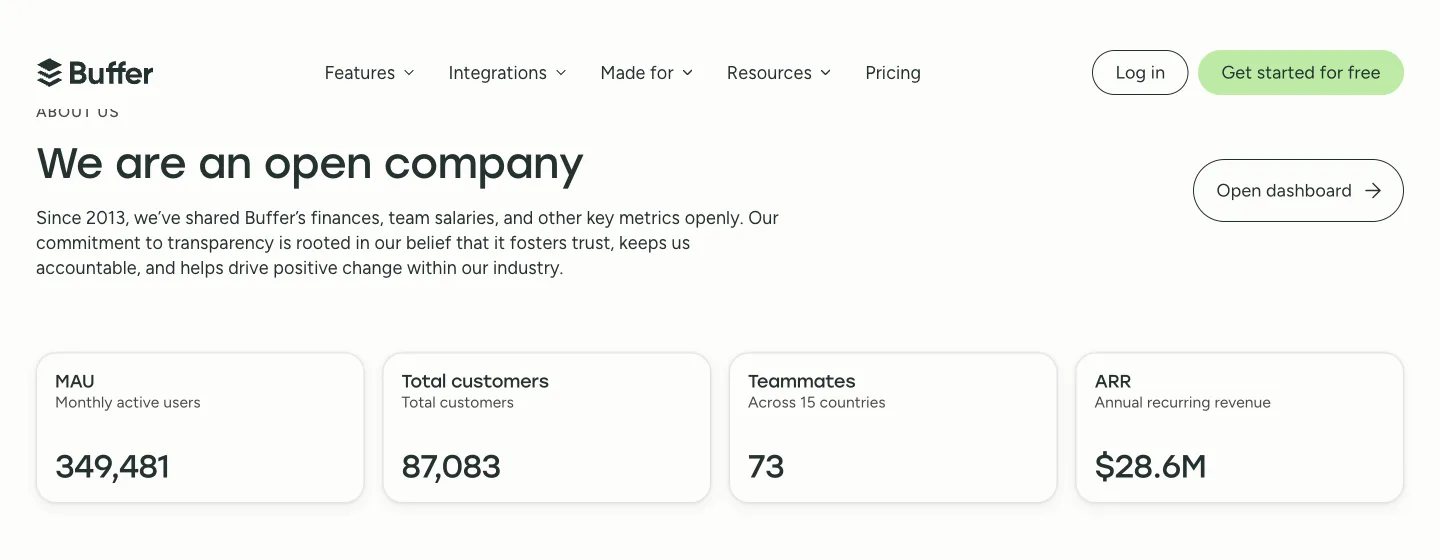
Limits: the roster of more than 70 people comes before the values and the open-company metrics, so a reader scrolls a long way to reach the "why".
What to copy: any number you show should link to where it comes from.
Ahrefs: numbers a reader can check
What it is: the About page of Ahrefs, an SEO and marketing software company.
Who it suits as a model: B2B SaaS companies whose product is built on data.
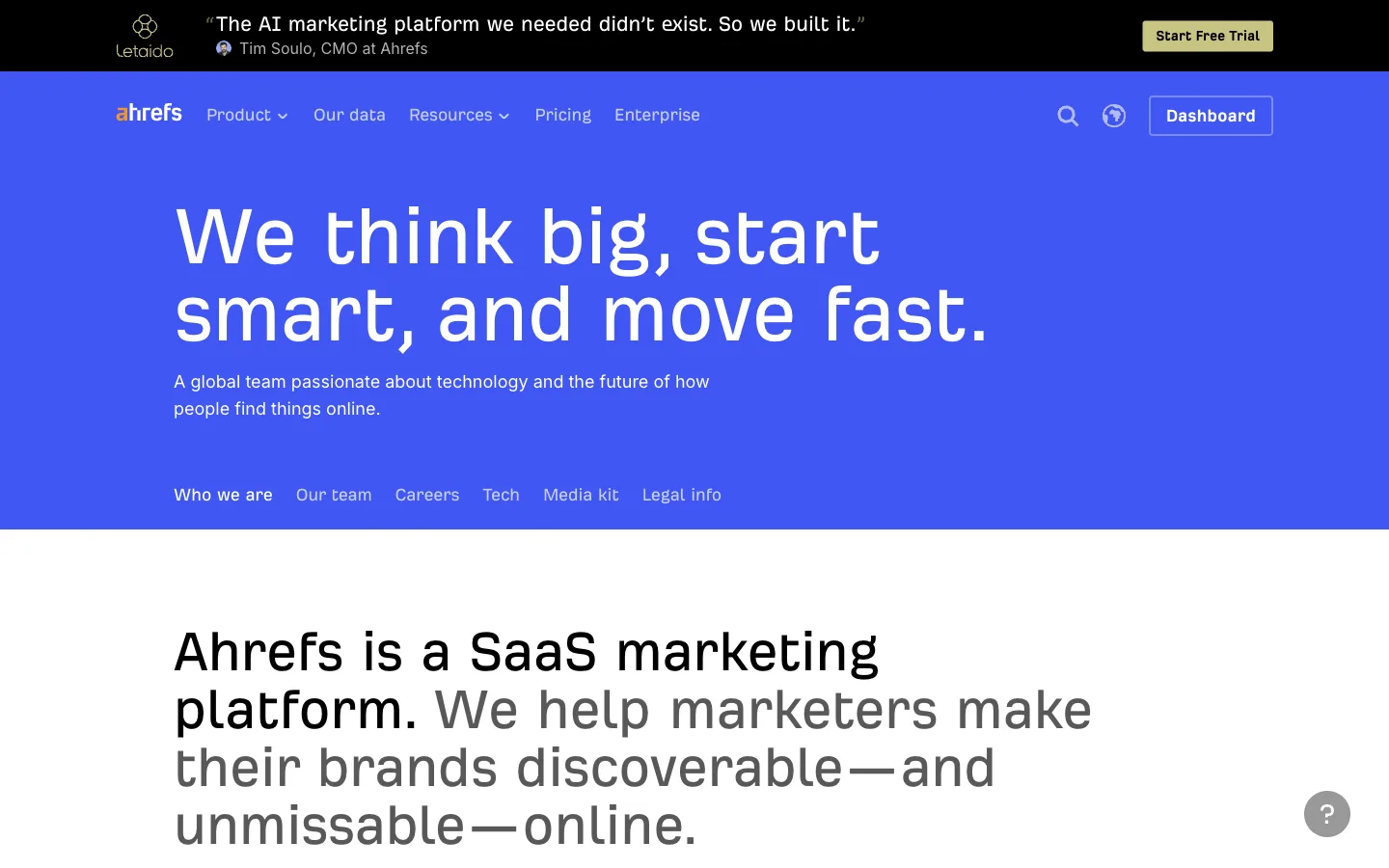
What we saw: under the hero, a sub-menu links to the team, careers, tech, media kit and legal info, so each audience gets its own path. The page says Ahrefs is "proudly bootstrapped", gives a headcount of 148 teammates in 27 locations and names its headquarters in Singapore. An "Our data" section gives index sizes such as 28 billion filtered keywords and 23 billion pages in the content index, with a link to "Ahrefs by the numbers". A "For media" box gives a press email and a logo kit.
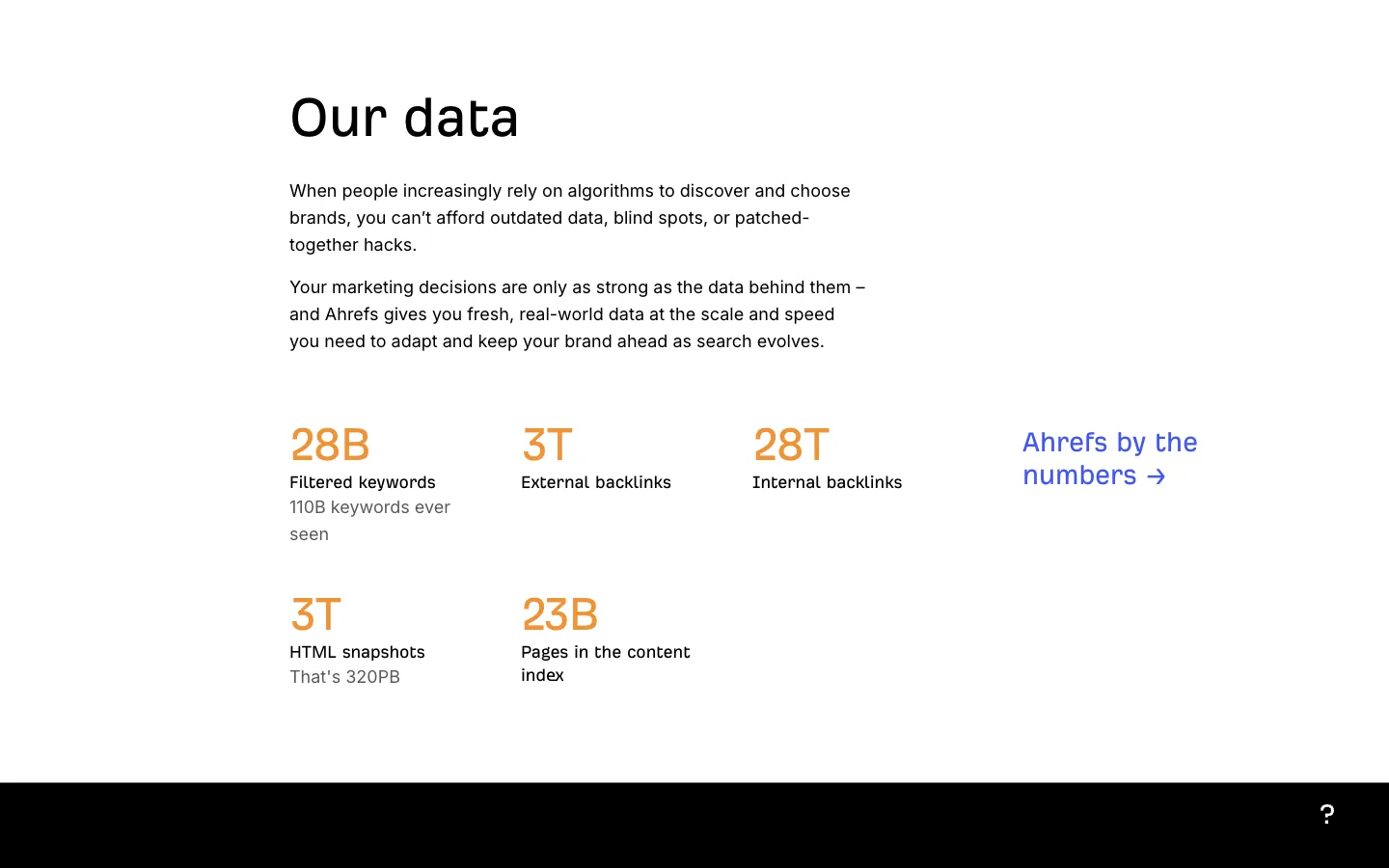
Limits: above the hero, a promotion for a new product competes with the About message. A visitor who came to learn about the company sees an ad first.
What to copy: a media box with a press contact and brand assets, and the numbers that matter for your product.
Stripe: a mission essay with linked claims
What it is: Stripe's About page, a short essay on why the company exists.
Who it suits as a model: larger B2B companies that need to explain a purpose more than a story. For how Stripe's homepage and pricing score with buyers, see our review of the best B2B websites.
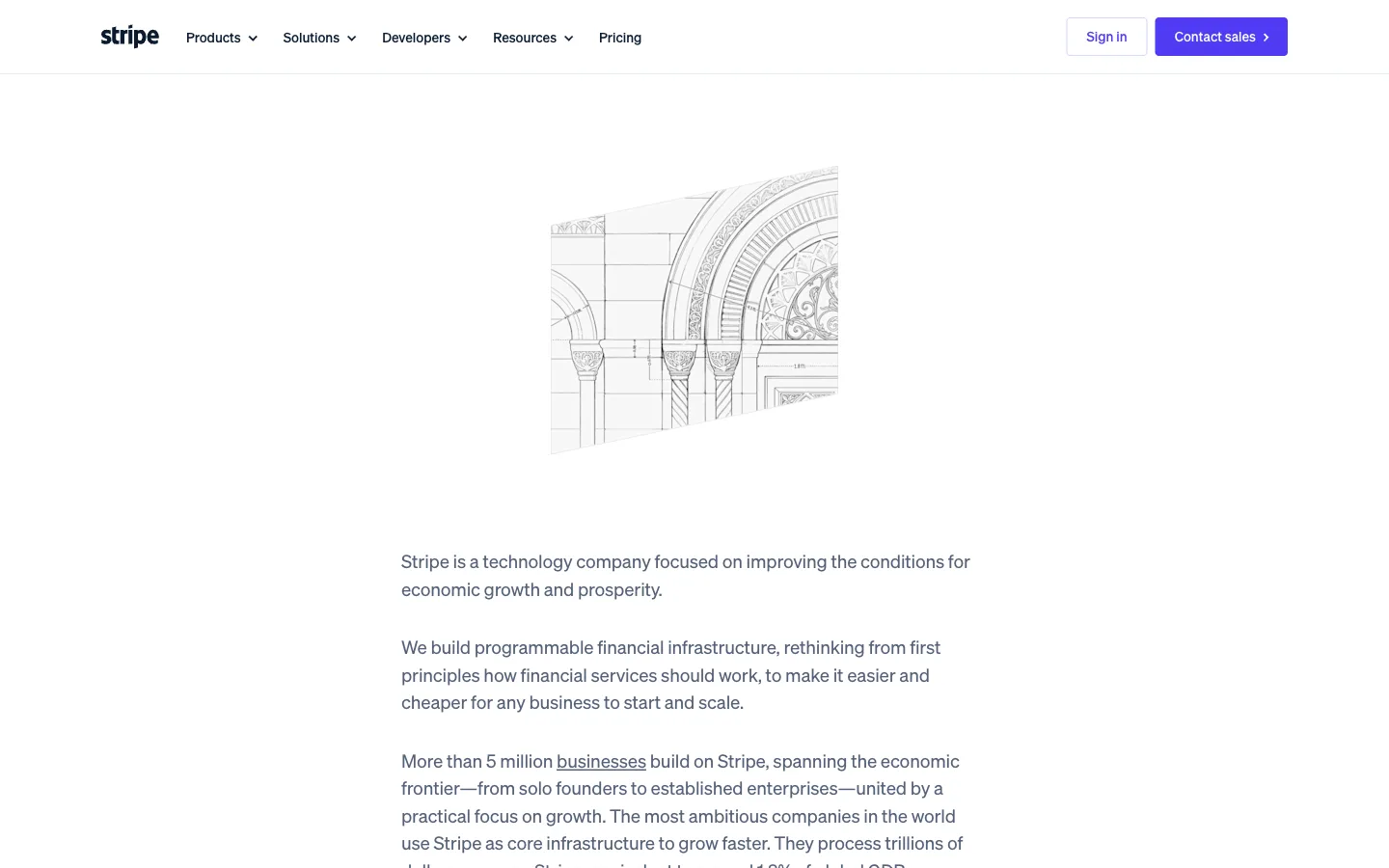
What we saw: it opens with one sentence of purpose, then gives scale: "More than 5 million businesses build on Stripe," processing volume "equivalent to around 1.8% of global GDP." Many claims link out. "Businesses" links to its customer stories, "upgrades to our products" to its roadmap, "reliable APIs" to its public status page, and "publish" to Stripe Press. The page ends with three routes: get in touch, read the docs, view open roles.
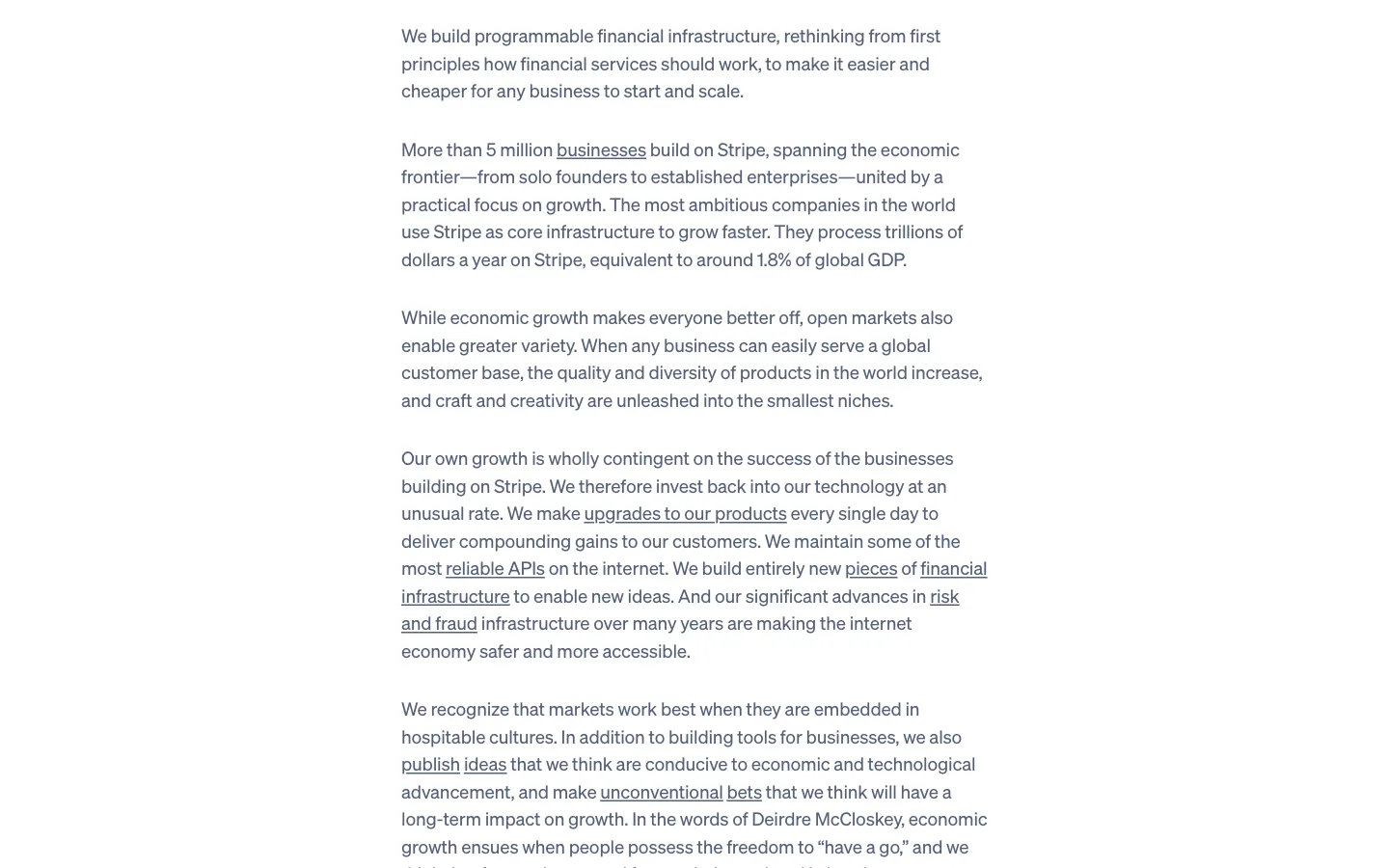
Limits: no founders, team, founding year or address appear on the page. That may suit a company many readers already know. A smaller company copying the format would leave readers asking who is behind it.
What to copy: link each claim to the page that proves it.
Agencies and studios
Pentagram explains its structure, then shows the partners
What it is: the About page of Pentagram, an independently owned design studio.
Who it suits as a model: agencies, studios and professional firms, where buyers want to know who will do the work.
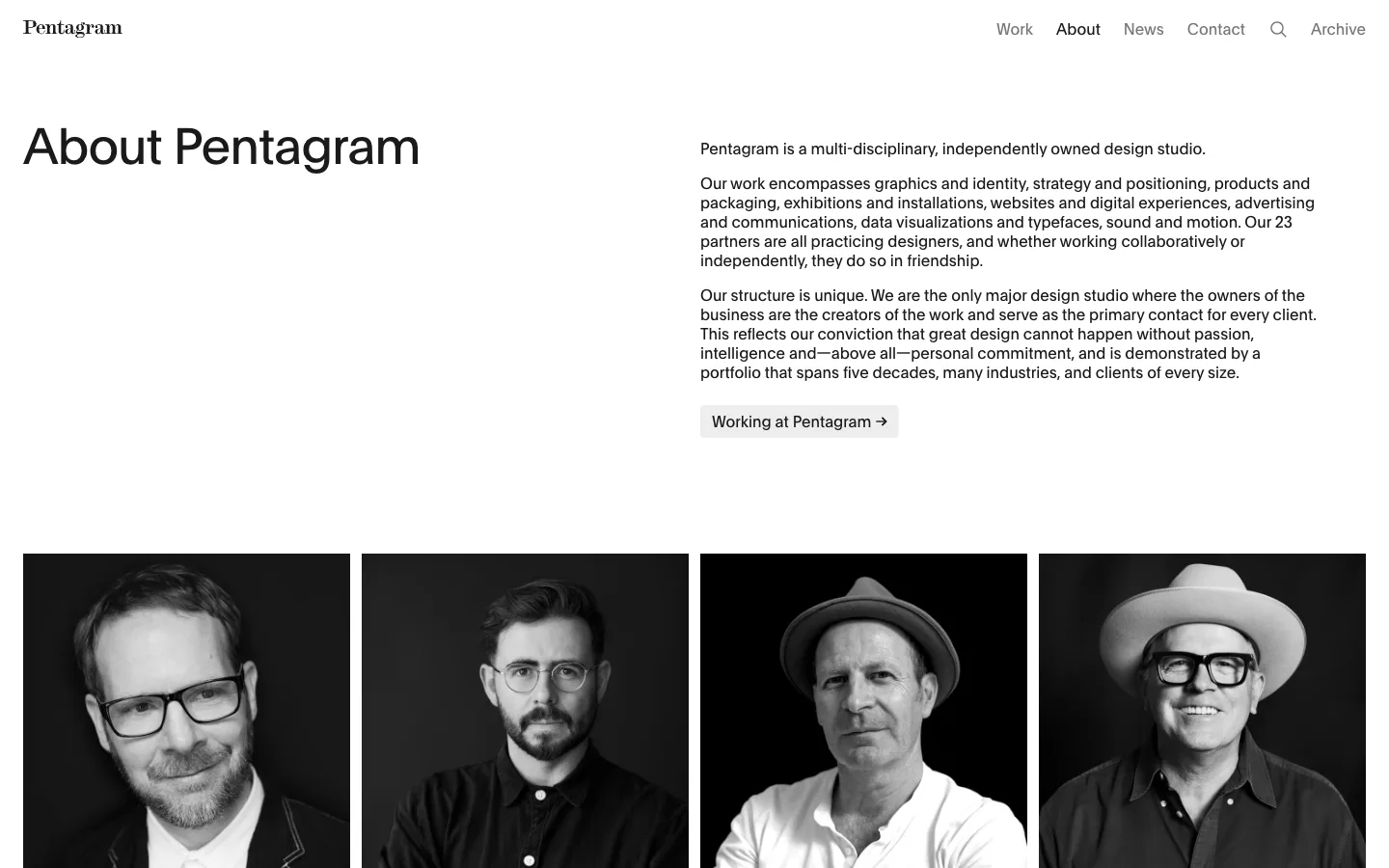
What we saw: three short paragraphs. The key one: "We are the only major design studio where the owners of the business are the creators of the work and serve as the primary contact for every client." Then a grid of partners, each with a portrait, name and city.
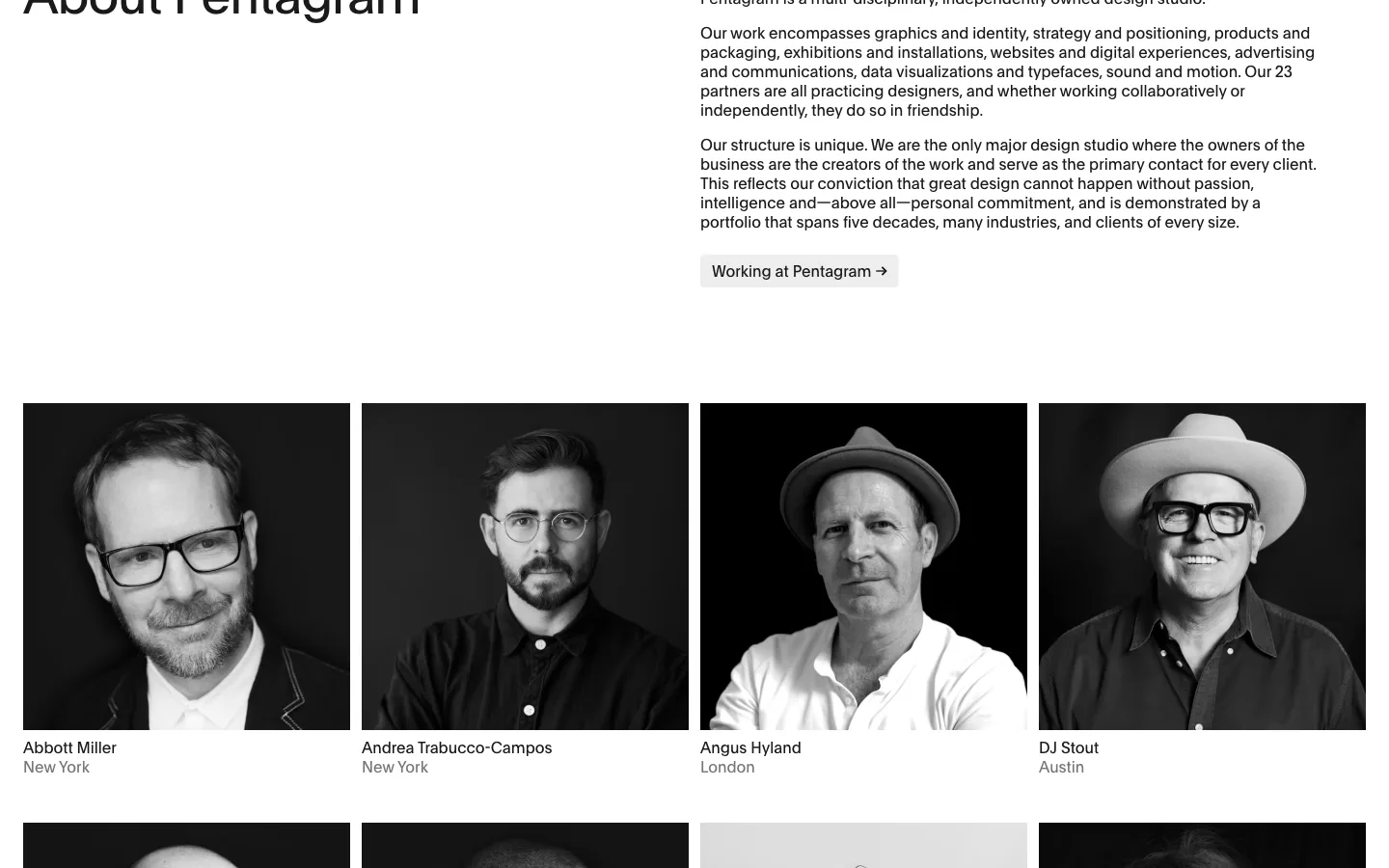
Limits: on 18 November 2026 the page body said "Our 23 partners", but the page's meta description, which can appear in search results, said "Learn about the 24 partners". Small mismatches like this can make readers doubt the rest.
What to copy: one paragraph on how your firm is set up and who the client deals with.
IDEO: a dated history and real staff profiles
What it is: IDEO's About page, covering its history, methods and people.
Who it suits as a model: consultancies whose method is part of what they sell.
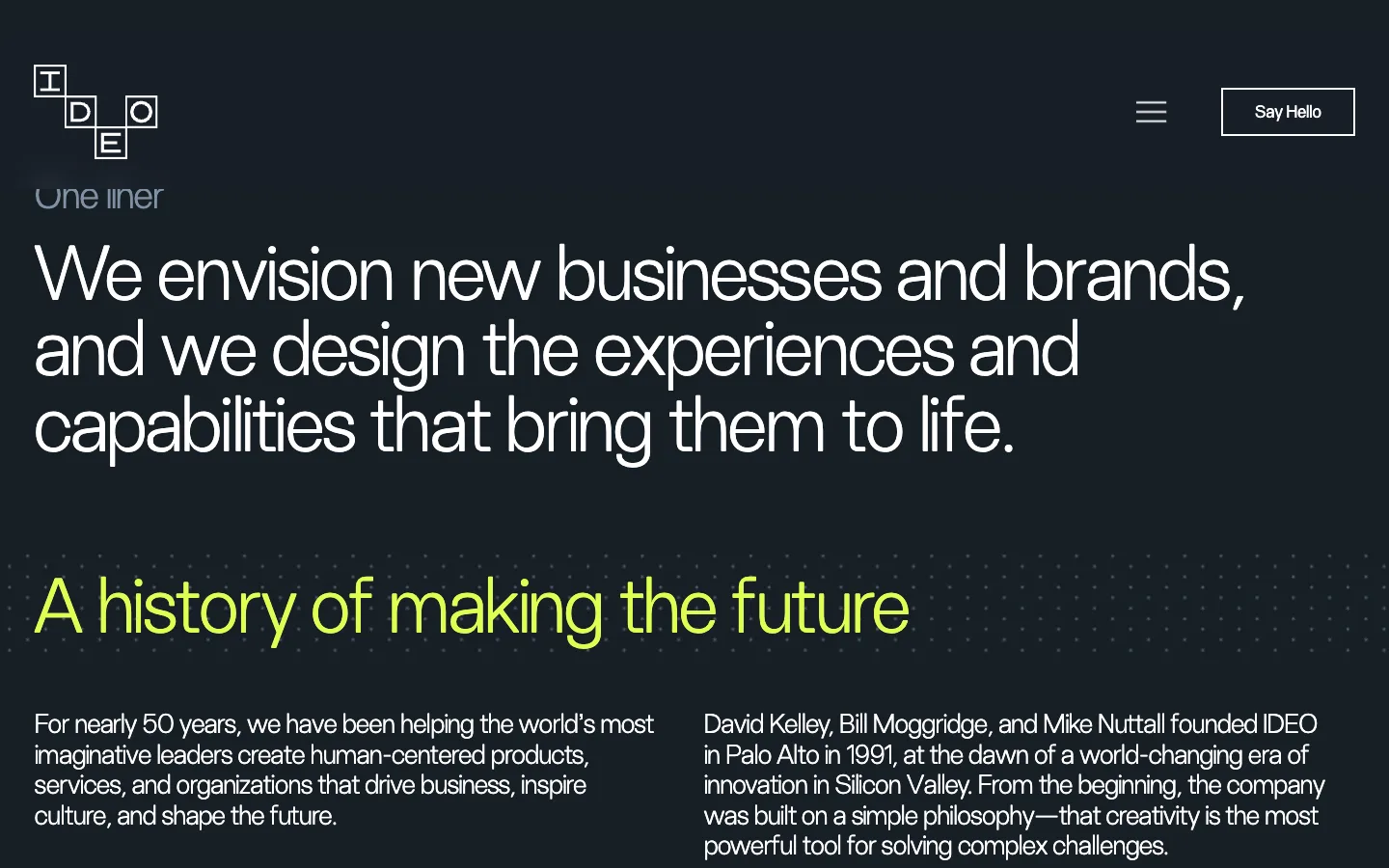
What we saw: the page names founders David Kelley, Bill Moggridge and Mike Nuttall, shows a carousel of dated client projects (Apple's first mouse, PillPack, Ford), and has a section on design thinking that credits Tim Brown's 2009 book. Further down, staff profiles give names, titles and backgrounds.
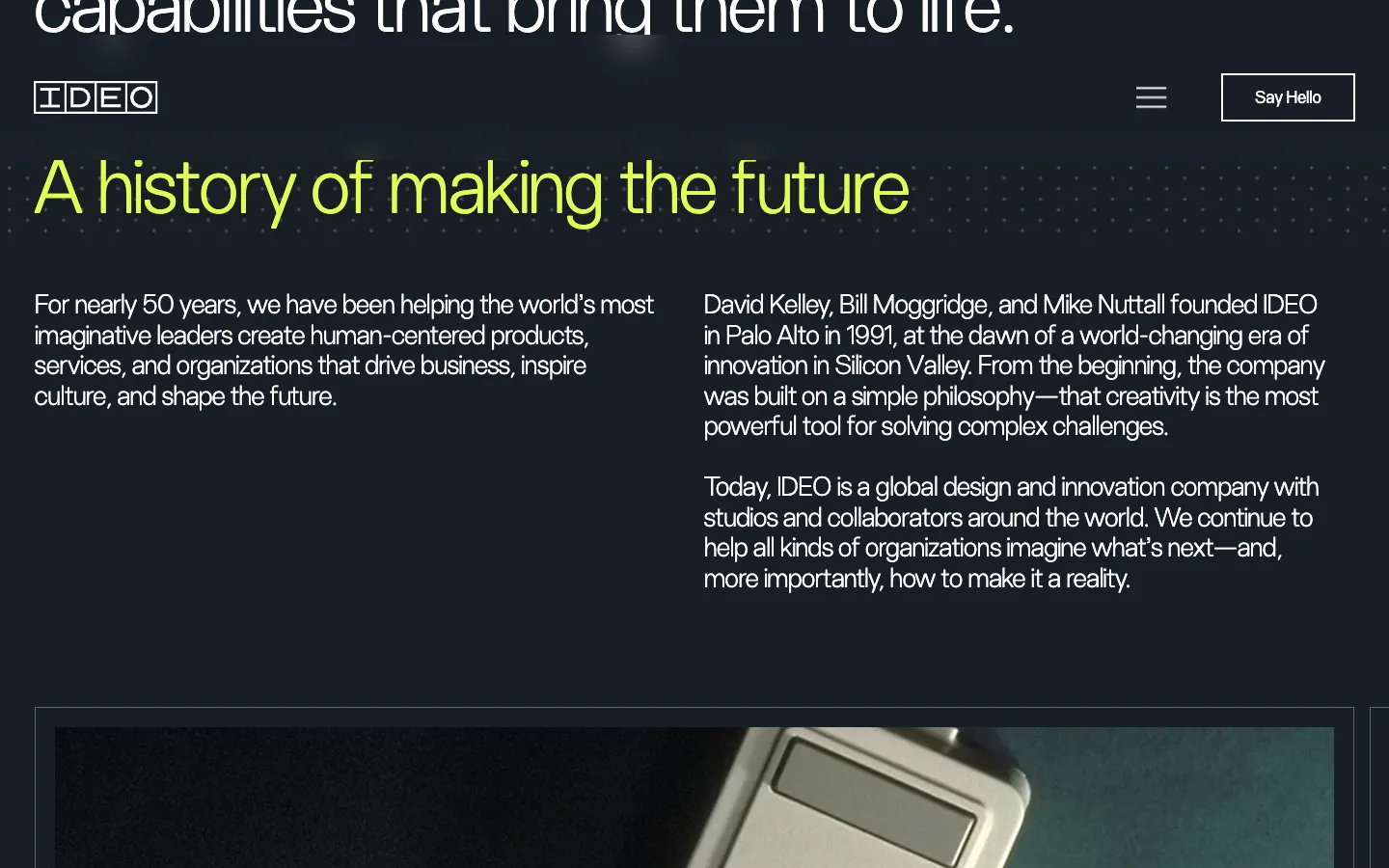
Limits: the section starts "For nearly 50 years" and the next paragraph says the founders started IDEO "in 1991". Our guess is that the longer count includes earlier firms that merged into IDEO, but the page doesn't say so, and a reader sees two dates that don't add up.
What to copy: dated project examples that show the method in action.
Siege Media: every person and every office
What it is: the About page of Siege Media, a content and SEO agency.
Who it suits as a model: service firms where buyers want to see the size and location of the team.
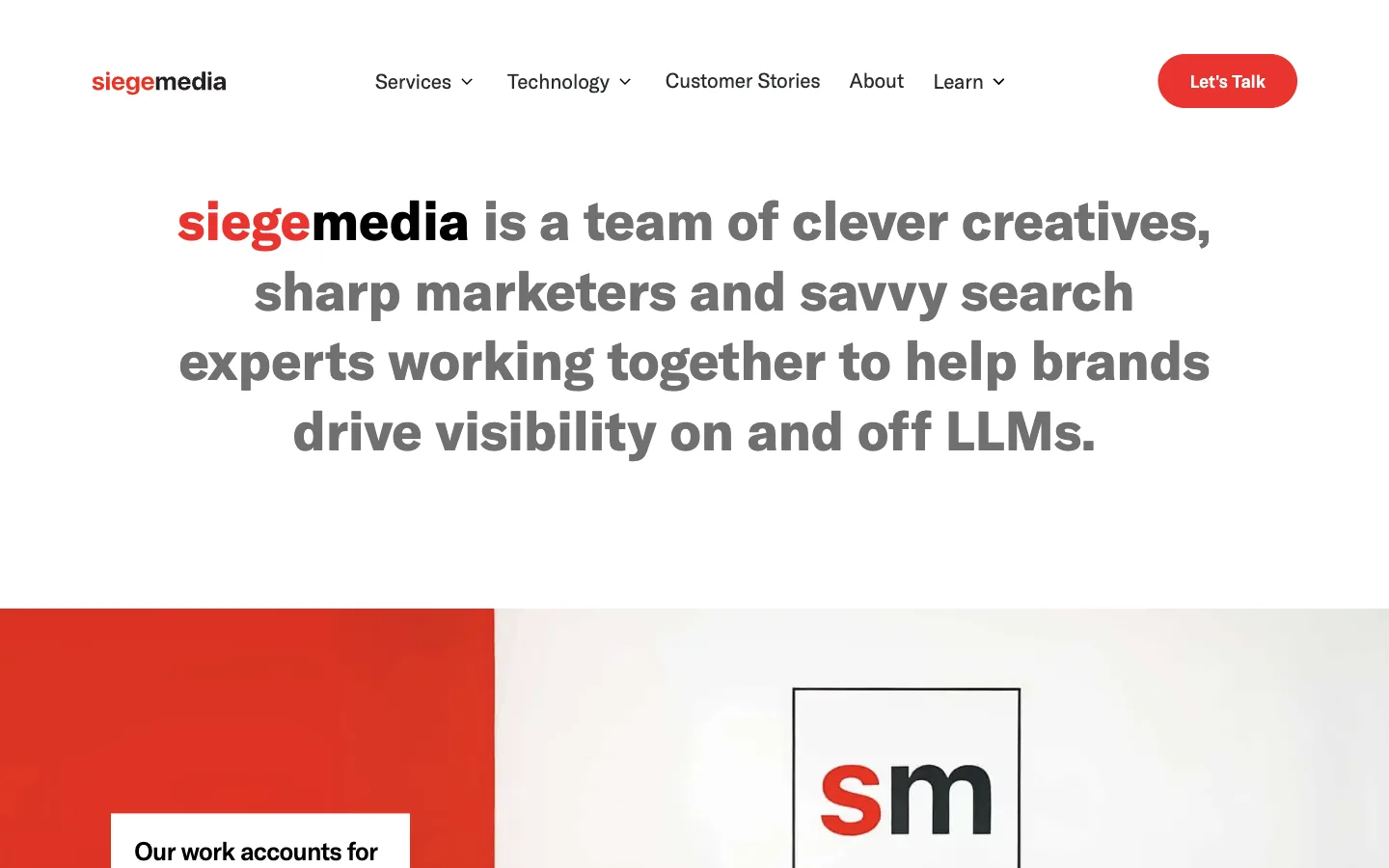
What we saw: the page lists the founder and CEO, the COO, and then the whole staff with job titles. A "Locations" block gives four full street addresses, in Austin, Chicago, New York City and San Francisco.
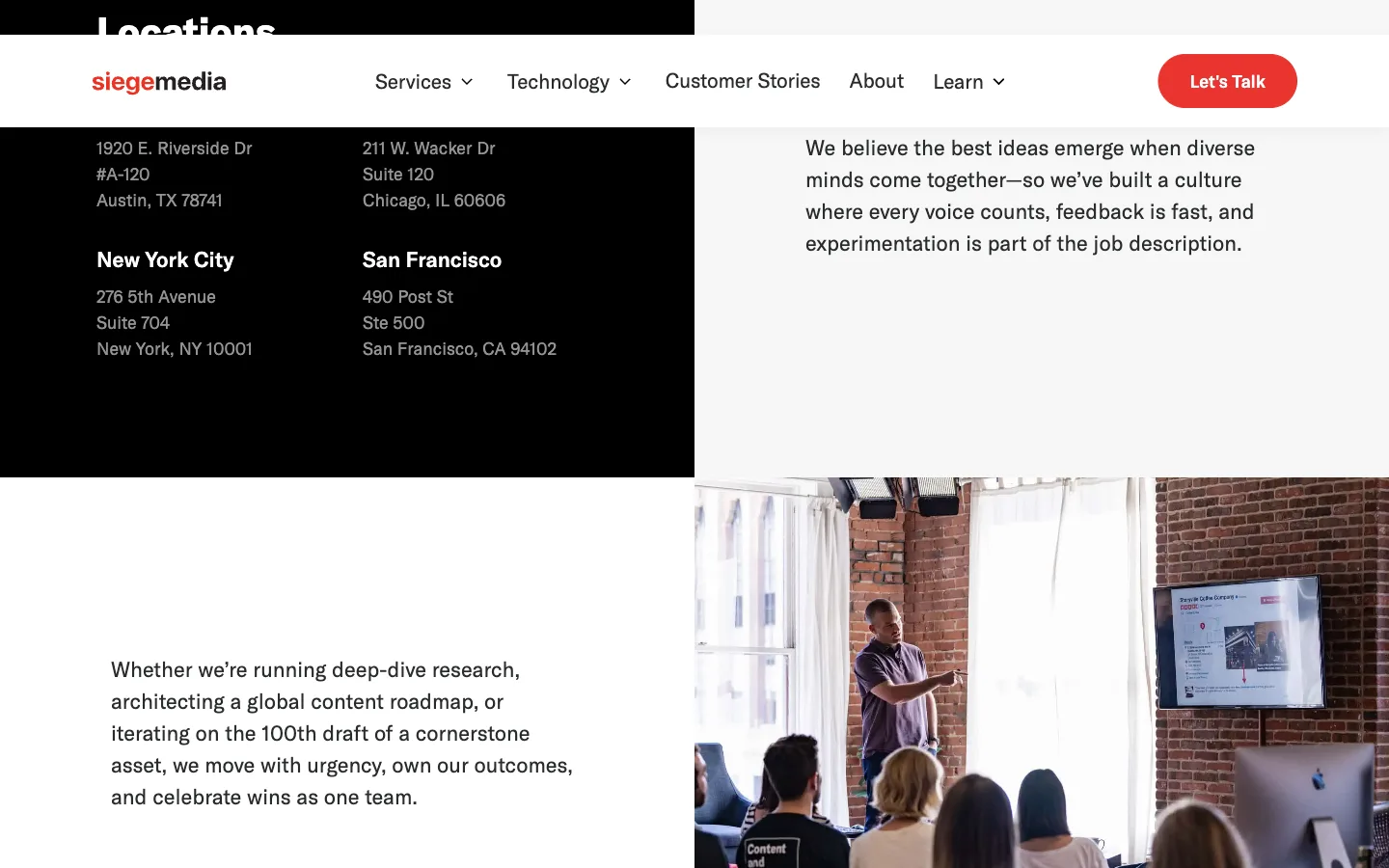
Limits: the page includes a precise claim: "approximately $12,387,175/mo in client traffic value." Traffic value is an estimate from SEO tools, and we didn't find an explanation on the page of how this one was calculated. A one-line method note would make the number more believable.
What to copy: the street address of every office, as text.
Local businesses
Zingerman's Deli: founders, date and the hours in one place
What it is: the About page of Zingerman's Delicatessen in Ann Arbor, Michigan.
Who it suits as a model: restaurants, shops and any business people visit in person.
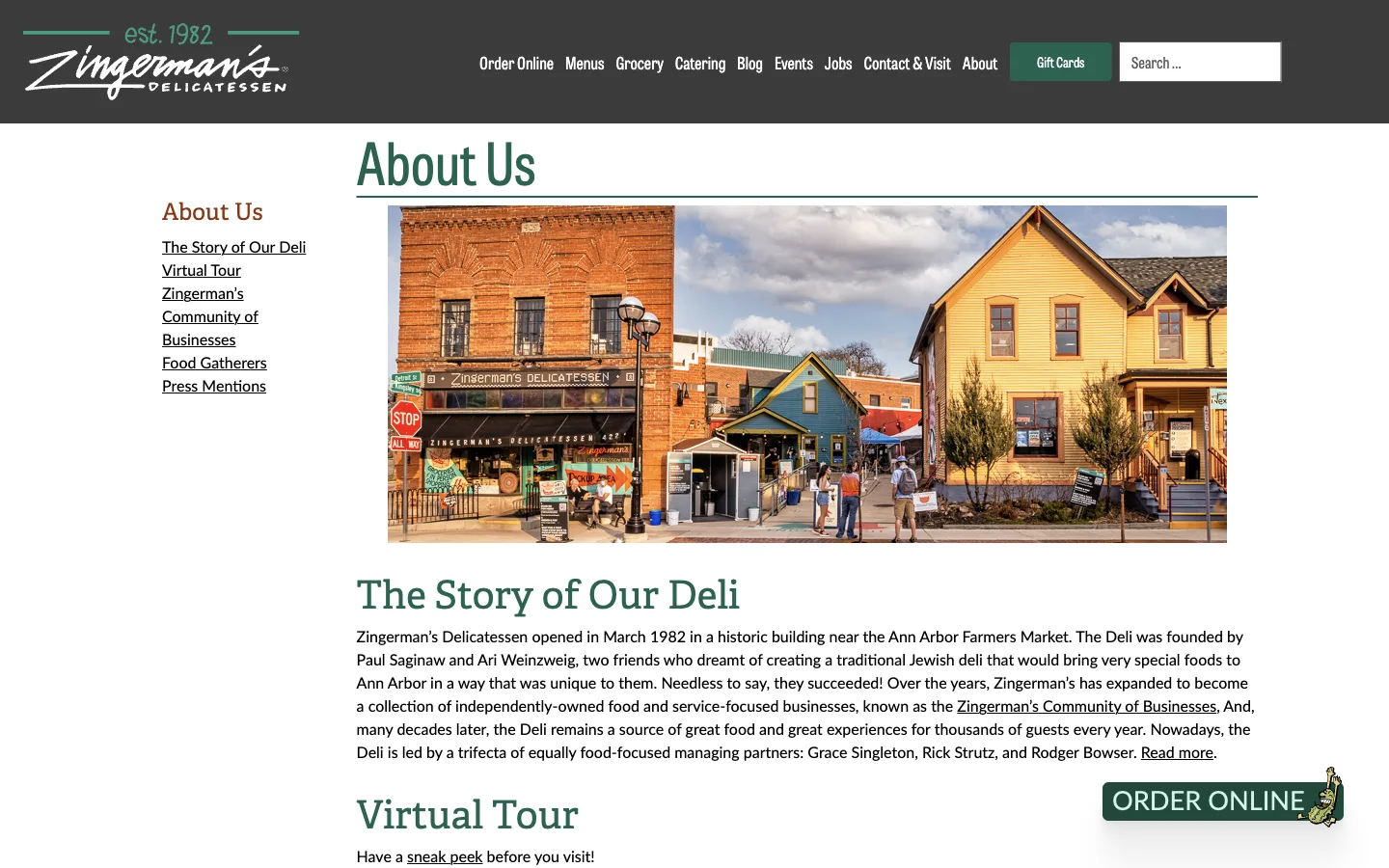
What we saw: the first paragraph gives the opening date ("March 1982"), the place ("a historic building near the Ann Arbor Farmers Market"), the founders (Paul Saginaw and Ari Weinzweig) and today's managing partners by name. A section explains that the deli founded Food Gatherers in 1988, which the page calls "Michigan's first food rescue program". The footer gives the street address, phone number and opening hours.
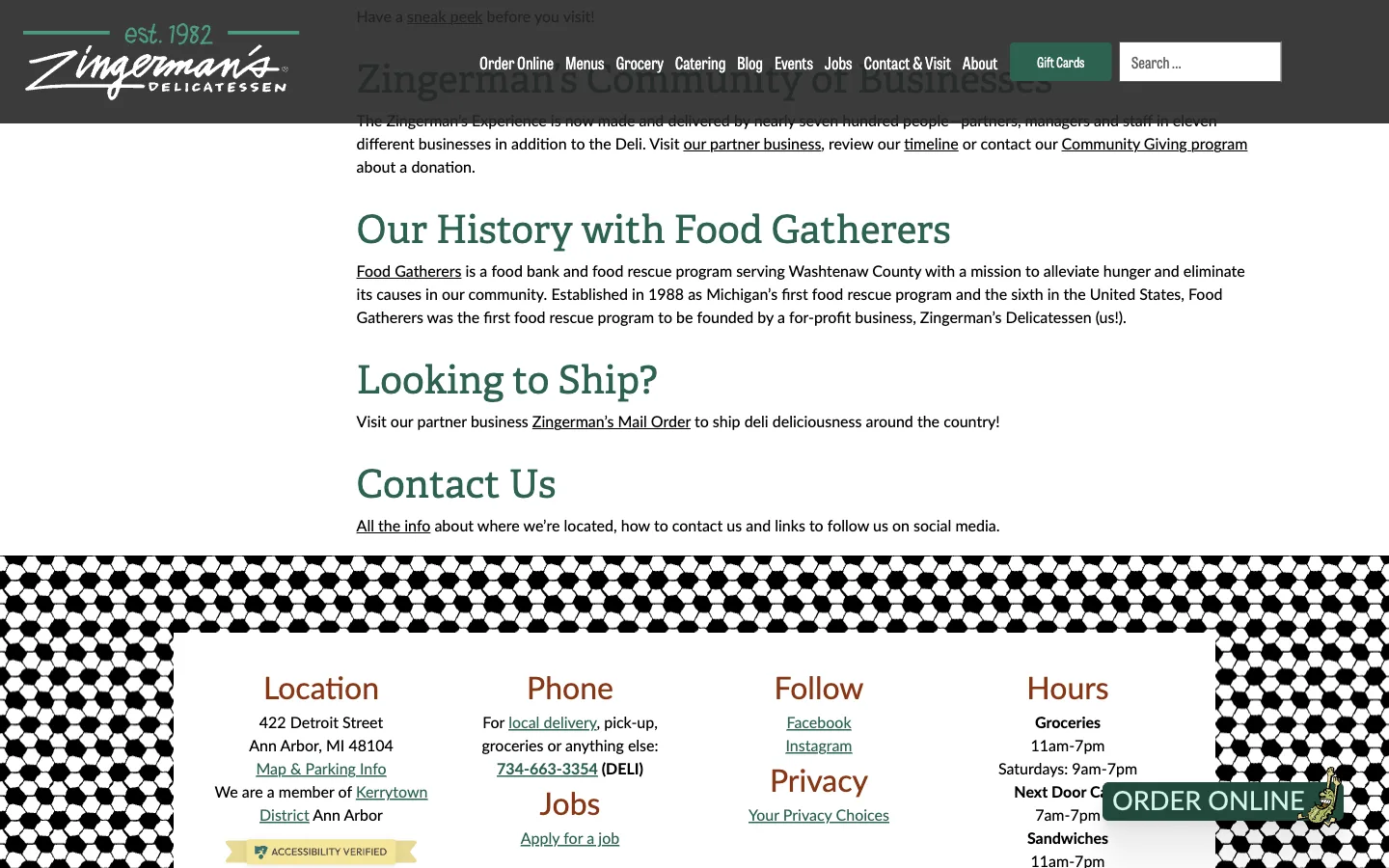
Limits: on 18 November 2026 the page title in the browser tab read "About Us %%page%% - Zingerman's Deli %". That looks like an unfilled template variable, possibly from an SEO plugin, and the title is often what searchers see first.
What to copy: founders, opening date and today's managers in the first paragraph.
Russ and Daughters: a family history told with names and dates
What it is: the History page of Russ & Daughters, a shop on Manhattan's Lower East Side.
Who it suits as a model: family businesses and any shop whose history is part of the reason people visit.
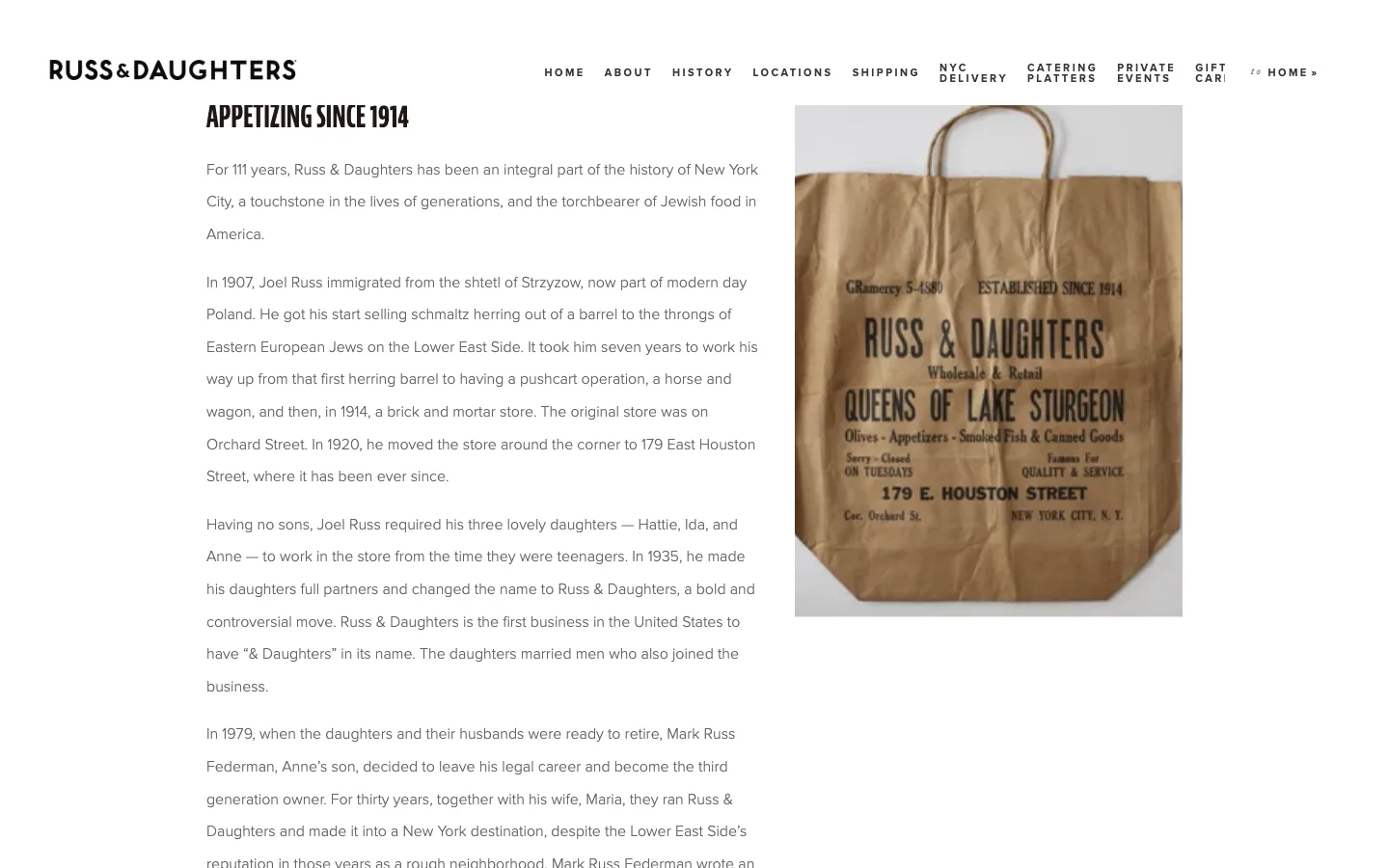
What we saw: nearly every sentence carries a fact. Joel Russ arrived in 1907, opened a store in 1914, moved to 179 East Houston Street in 1920 and made his three daughters partners in 1935. The page says it was "the first business in the United States to have '& Daughters' in its name". A photo of an old shopping bag prints the same street address. The footer repeats the address with a phone number and email.
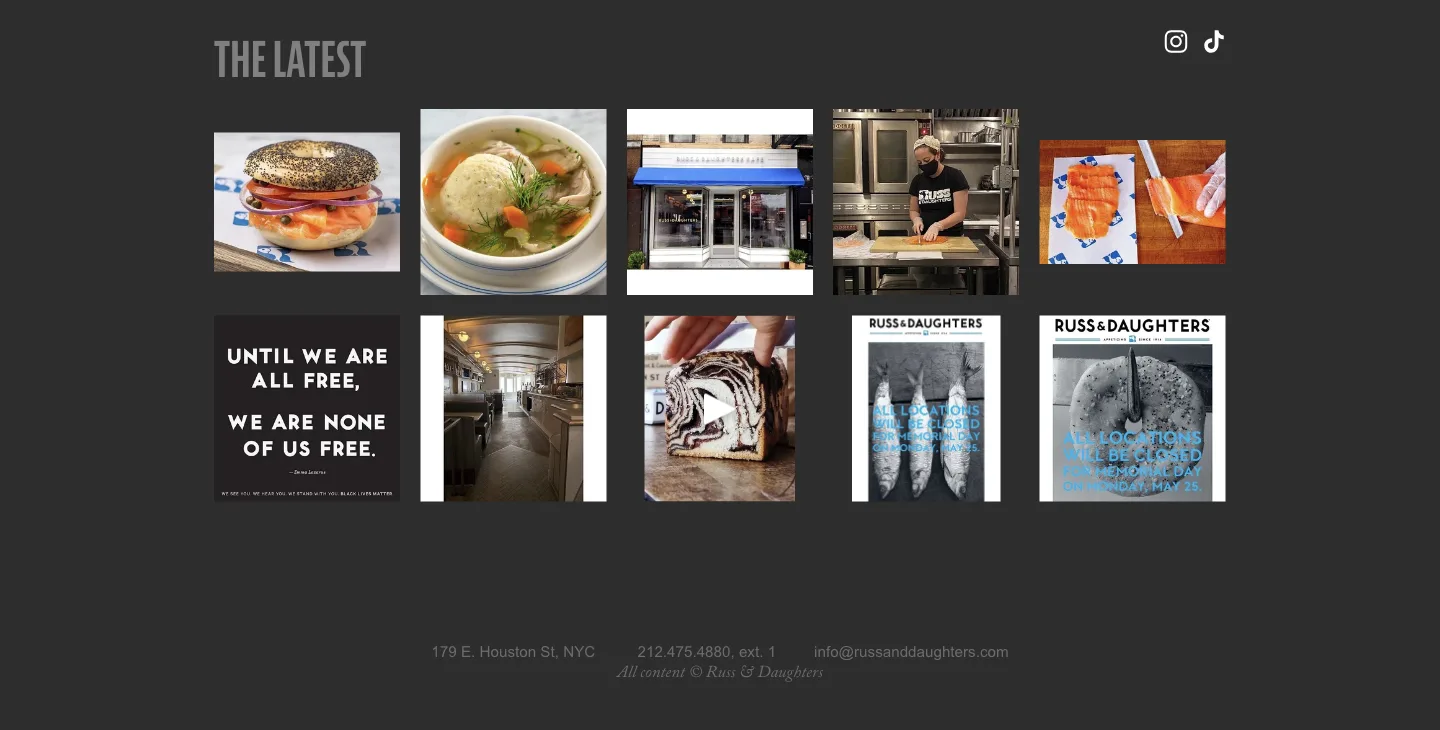
Limits: the page opens "For 111 years". Counting from 1914, that was true in 2025. A fixed count goes out of date; "Since 1914" in the heading never does.
What to copy: a story in which every paragraph has a name, a year or a place.
A manufacturer and a founder-led brand
Lodge Cast Iron: a place, a date and a timeline
What it is: the About page of Lodge Cast Iron, a cookware manufacturer in South Pittsburg, Tennessee.
Who it suits as a model: manufacturers, makers and any company whose selling point is where and how things are made.
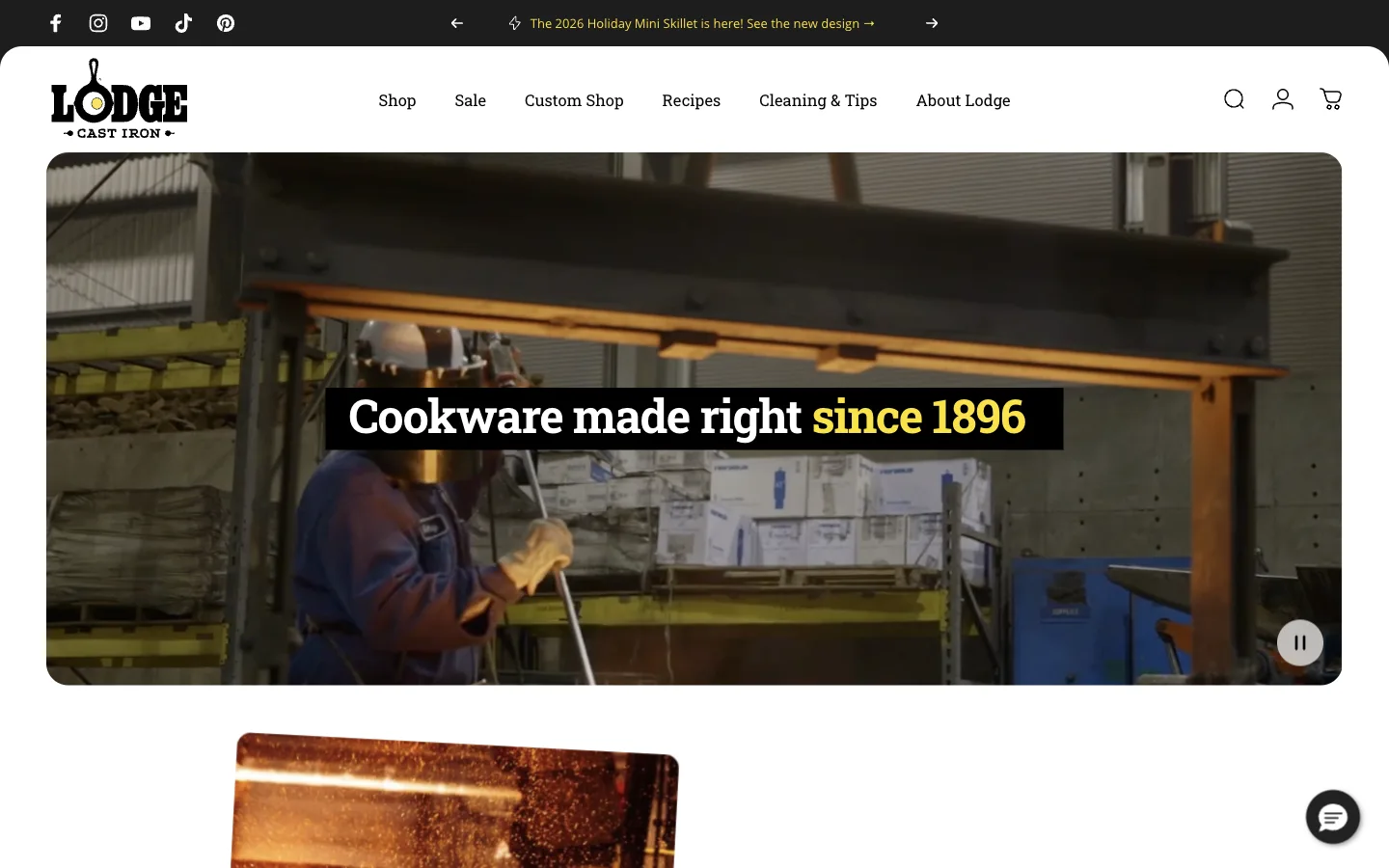
What we saw: the first paragraph says Lodge has made cookware "since 1896" and "currently operate[s] two foundries in South Pittsburg, Tennessee, our home since the very beginning." A timeline follows with dated events: the 1910 foundry fire and rebuild, novelty products made to keep workers employed in the 1930s, automated molding in 1965, a 1994 state award for cutting hazardous waste, and seasoned cookware in 2002.
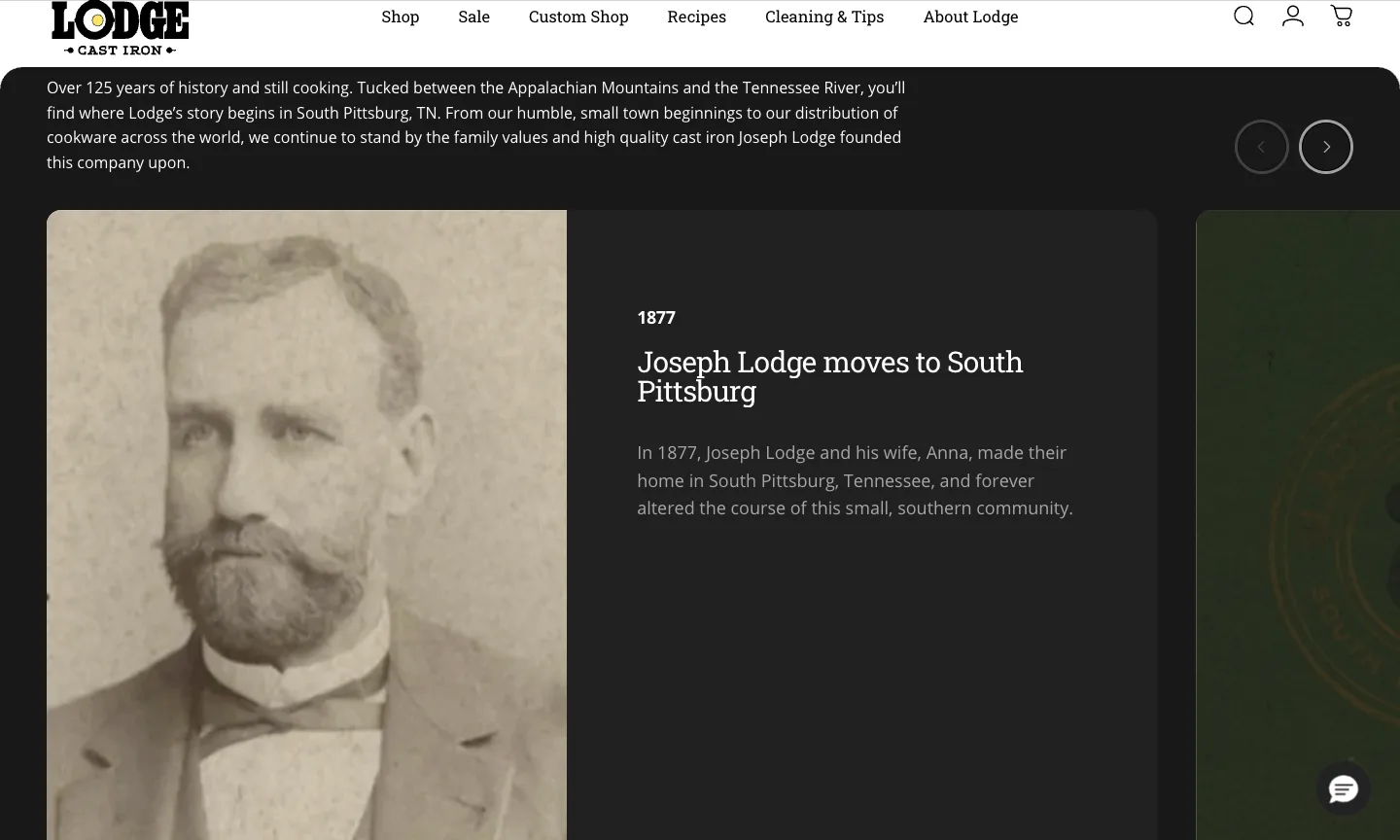
Limits: three rotating promotions (a holiday product, a sale and free shipping) sit above the About content. On a page meant to build trust, sales banners are a distraction.
What to copy: the factory's town in the first sentence, and a timeline in which each entry is a specific event.
Patagonia: archive photos with credits
What it is: Patagonia's Company History page, which tells the story from Yvon Chouinard's first climbing gear onward.
Who it suits as a model: founder-led brands with a long history and an archive to draw on.
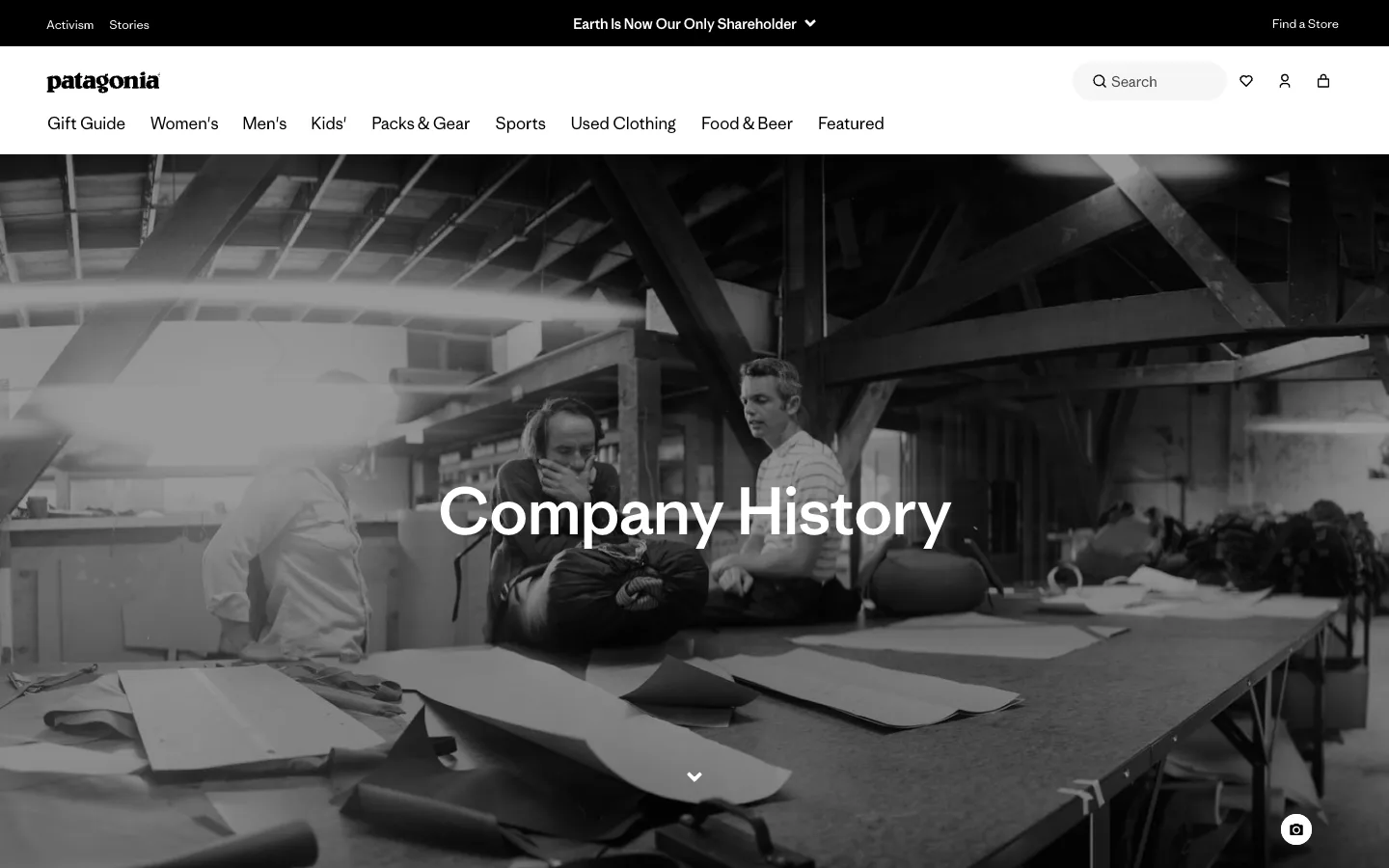
What we saw: each era is a slideshow of archive photos. Every caption we read names the people in the photo and the photographer ("Photo: Tom Frost"). The text includes decisions that went against the company's short-term interest, such as cutting back the piton business in the early 1970s because the gear "was damaging the rock". A banner at the top links to the founder's letter titled "Earth Is Now Our Only Shareholder".
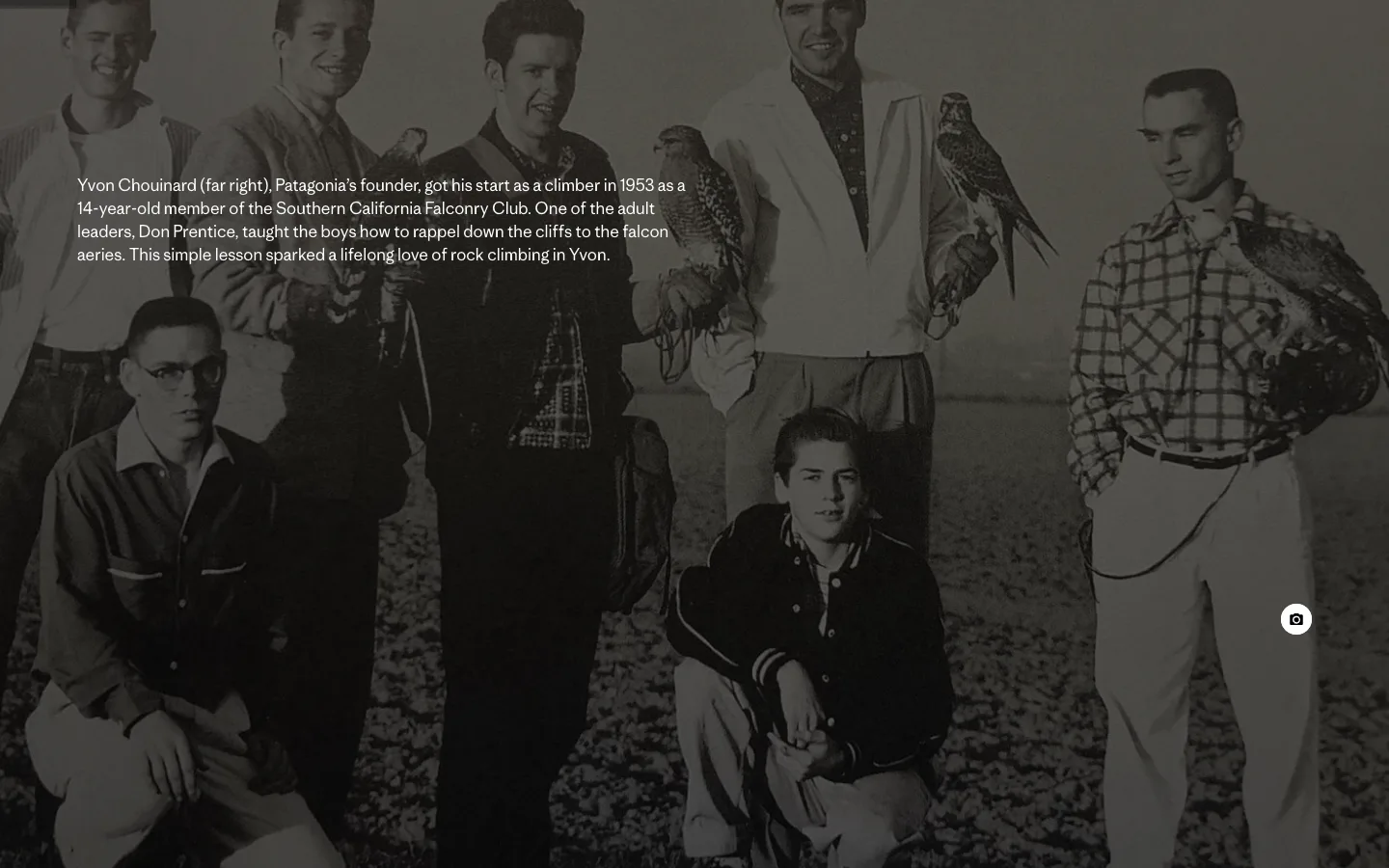
Limits: the page is very long. Our full-page screenshot failed because of its height, and we didn't see basic facts such as headquarters or ownership on this page. A short "facts" box at the top would help readers in a hurry.
What to copy: credit every photo, and include at least one decision that cost you something.
Nonprofits
charity: water: proof of where the money goes
What it is: the About page of charity: water, a nonprofit funding water projects.
Who it suits as a model: nonprofits and any business that asks people to trust it with money before they see results.
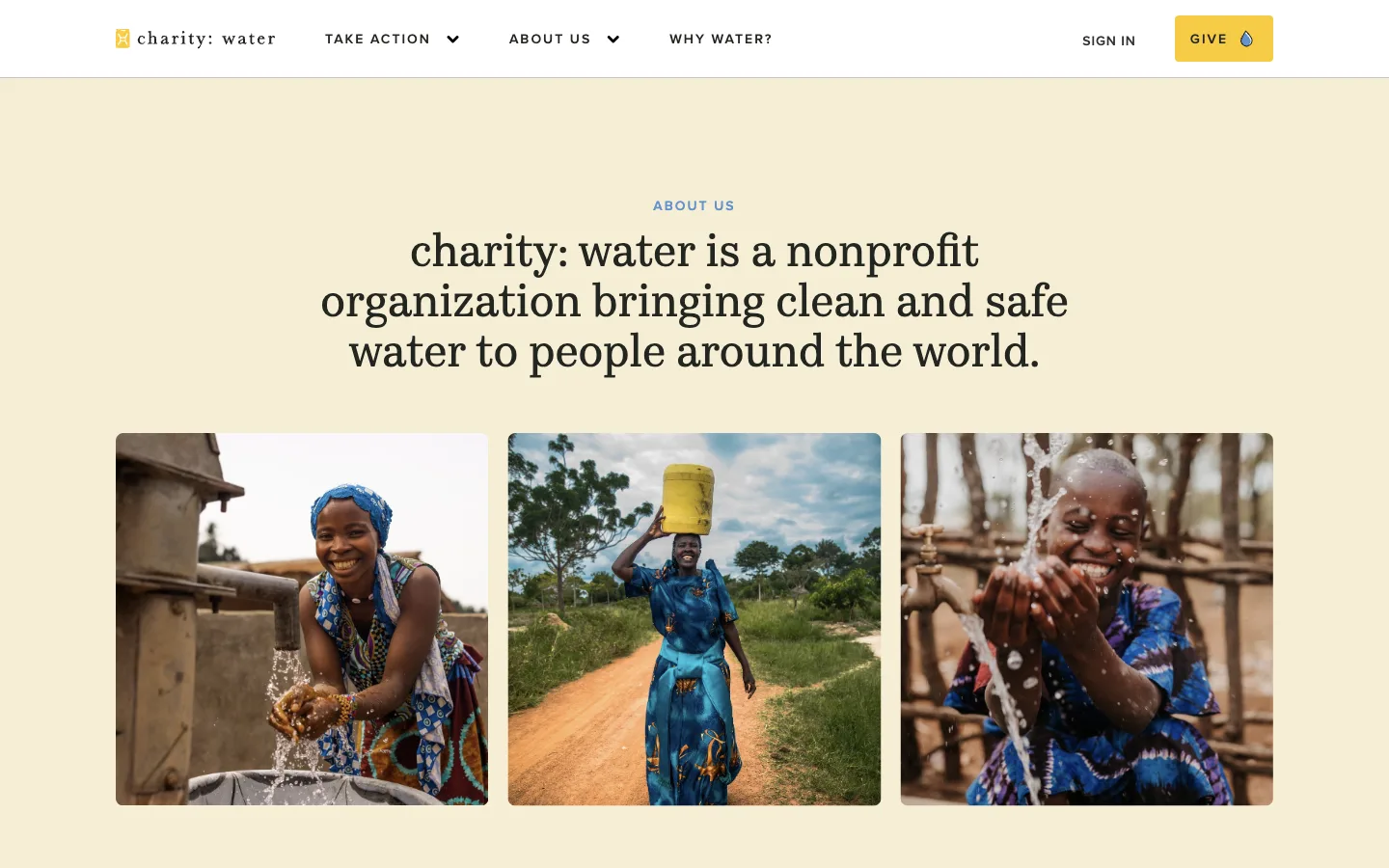
What we saw: after the mission line, a counter shows projects funded, countries and people served, each with a "?" that explains the figure. The page explains its model: "100% of public donations would go directly to fund clean water projects," because "private donors cover our operating costs." A "How we work" row lists three promises, each with a link: "see proof", "view all financials" and "learn more" about local partners.
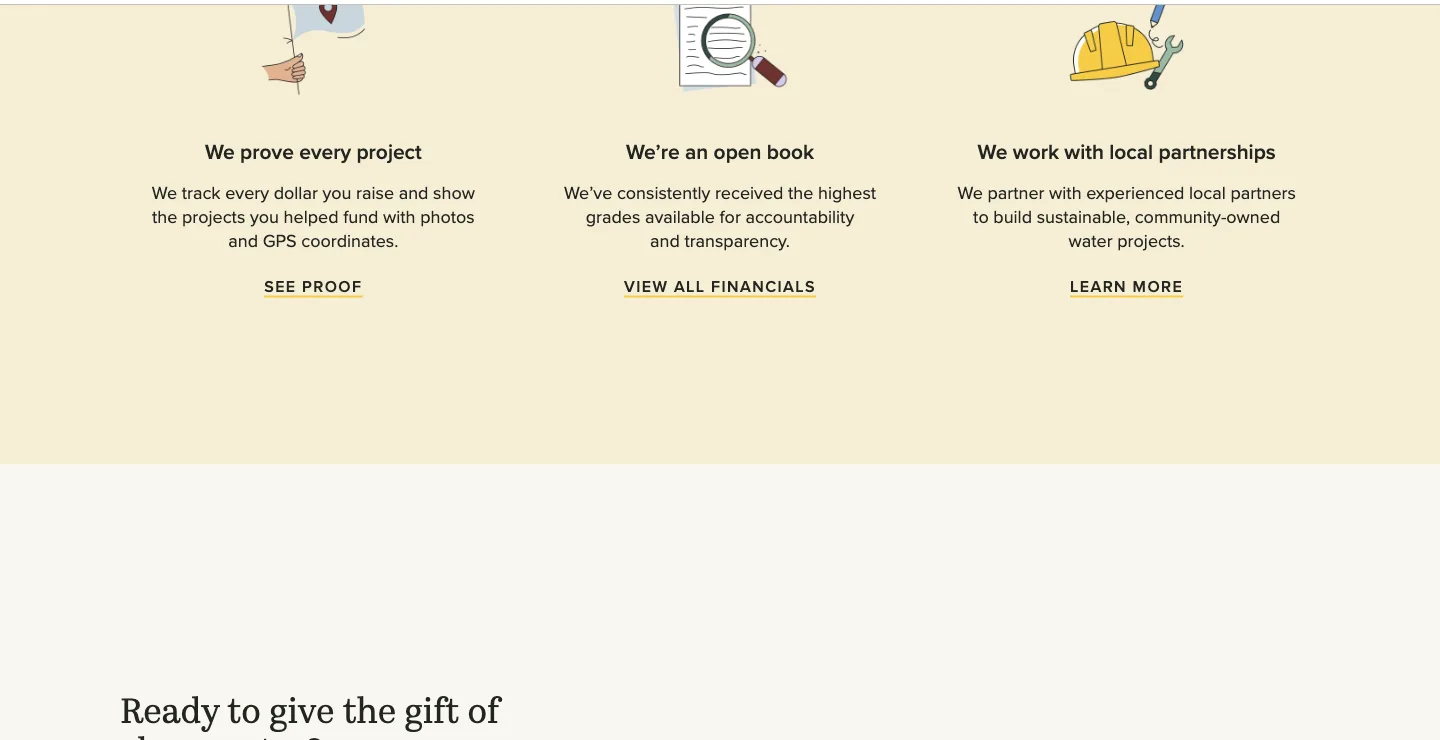
Limits: while we captured the page, a popup offering a free guide ("Turn your non-cash assets into clean water") opened over the content. On an About page, it interrupts the reader just as they are judging the organization.
What to copy: for every promise, a link to the proof.
Khan Academy: mission, numbers and outside checks
What it is: Khan Academy's About page.
Who it suits as a model: nonprofits and education or health organizations, where outside checks matter.
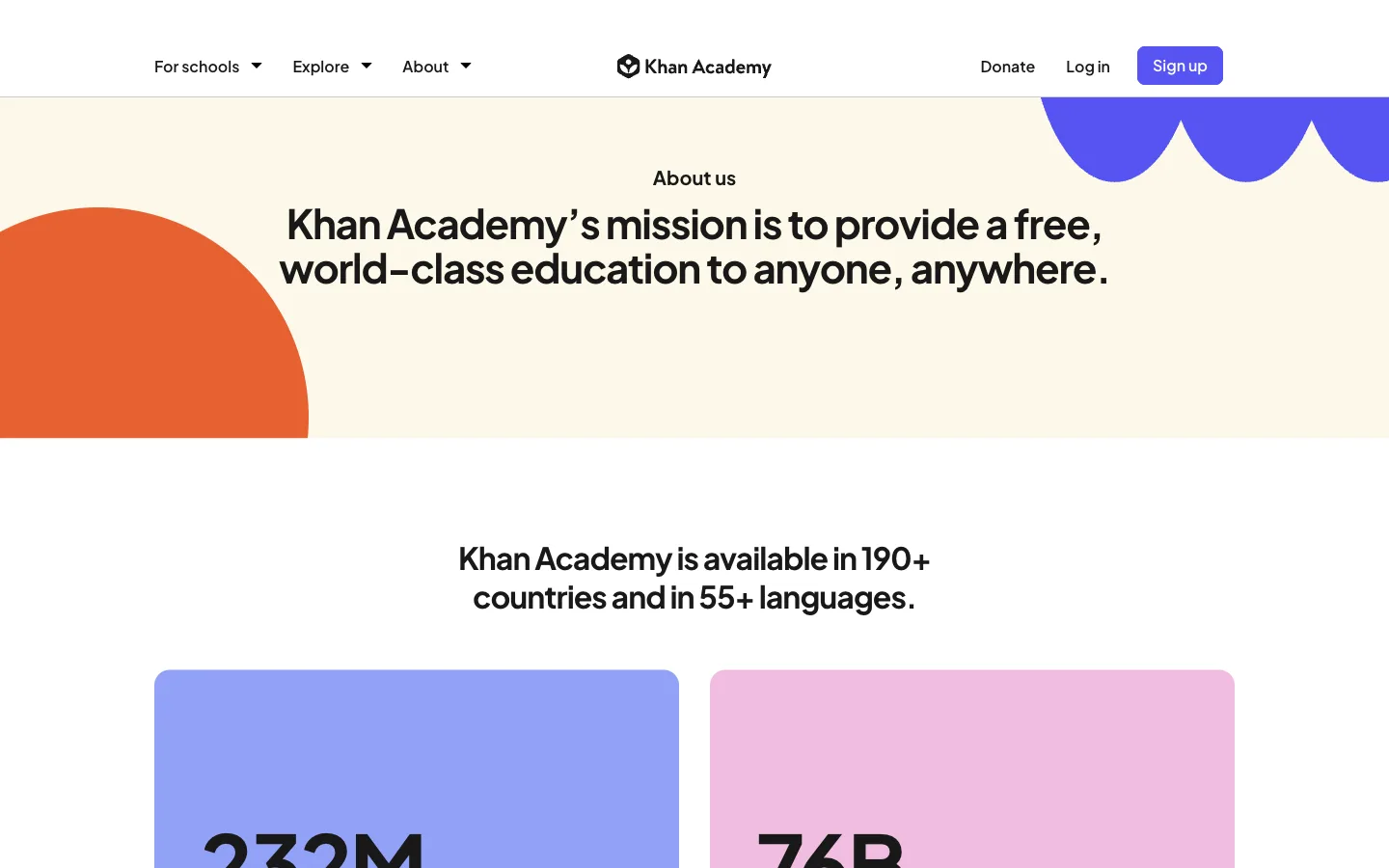
What we saw: a one-sentence mission, then totals (232 million registered users) and a dated set: "In school year 2025-2026", 100 million learners. A claim that its use "leads to higher state math scores" links to its efficacy research. A closing section links to its leadership and board, "independent charity watchdogs" and its annual report. The page also starts with a warning about recruitment scams that tells readers which email domain real recruiters use.
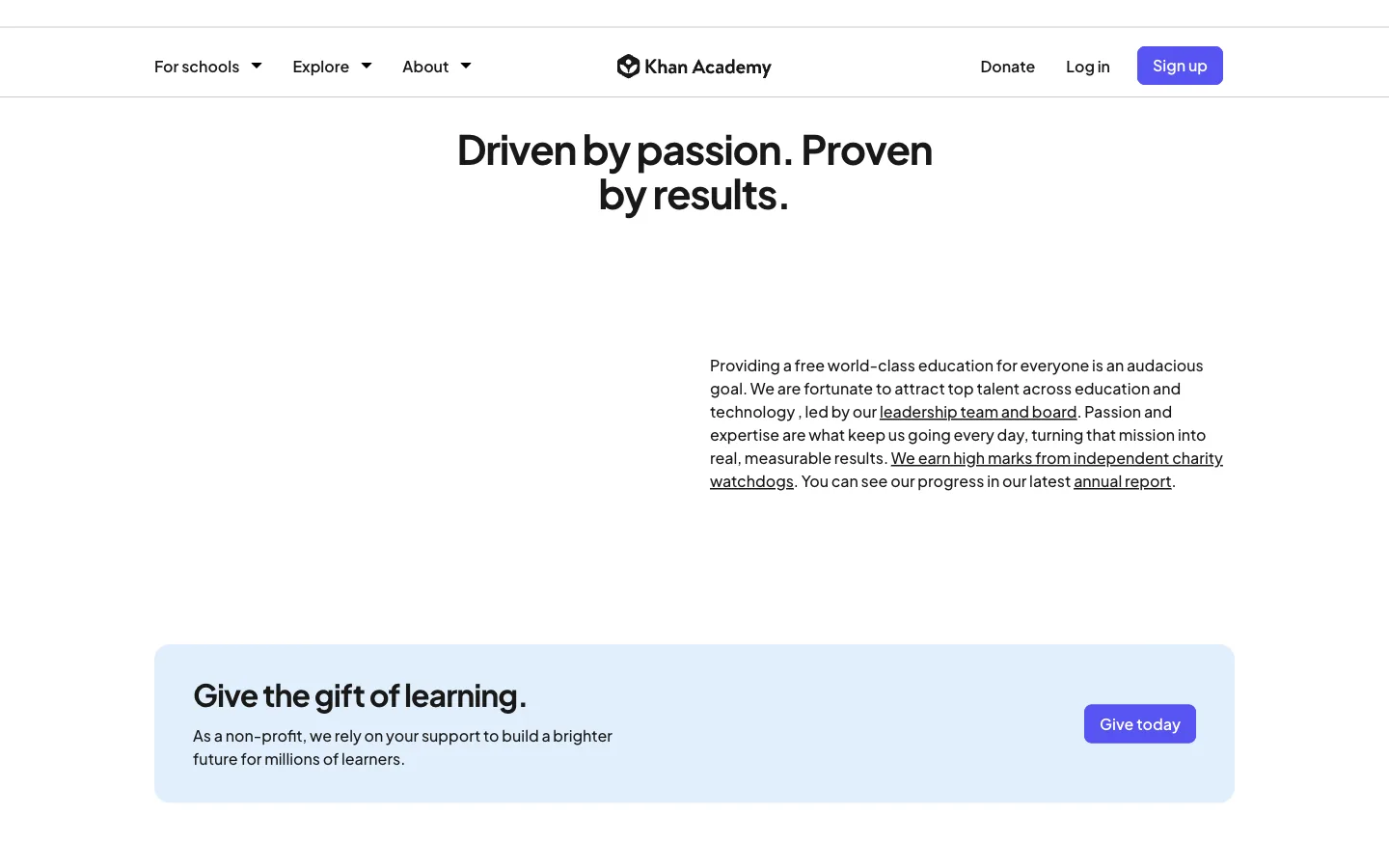
Limits: the testimonials are signed "Khan Academy student" and "High school sophomore". Anonymity protects minors, which is right, but it means the quotes add little proof. The linked research does that job better.
What to copy: a date on every usage number, and links to outside reviewers.
Our own About page (disclosed)
PolyDraft: named founder, legal entity and a corrections route
We make PolyDraft, so read this entry with that in mind. We held it to the same standard and list its weak spots.
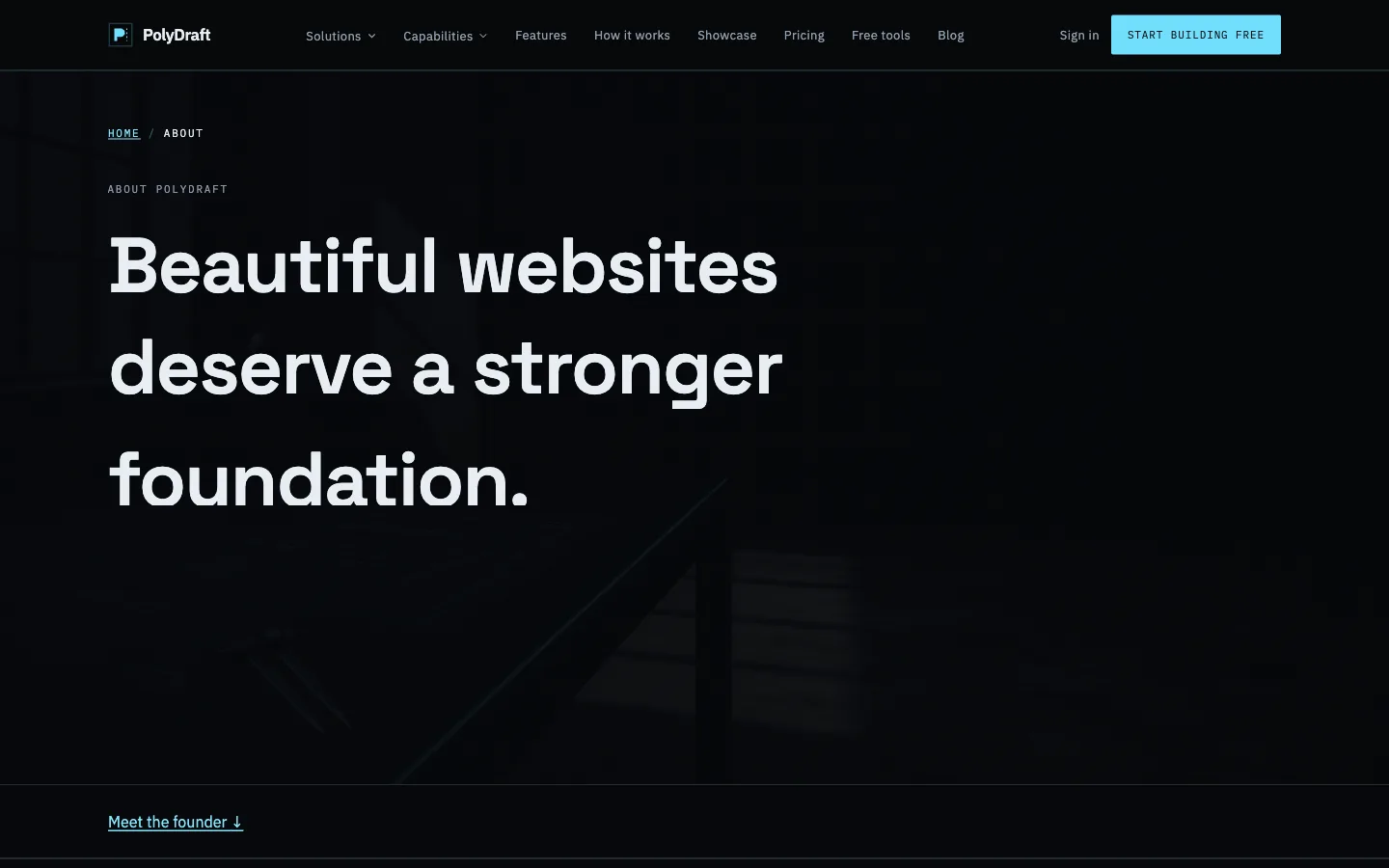
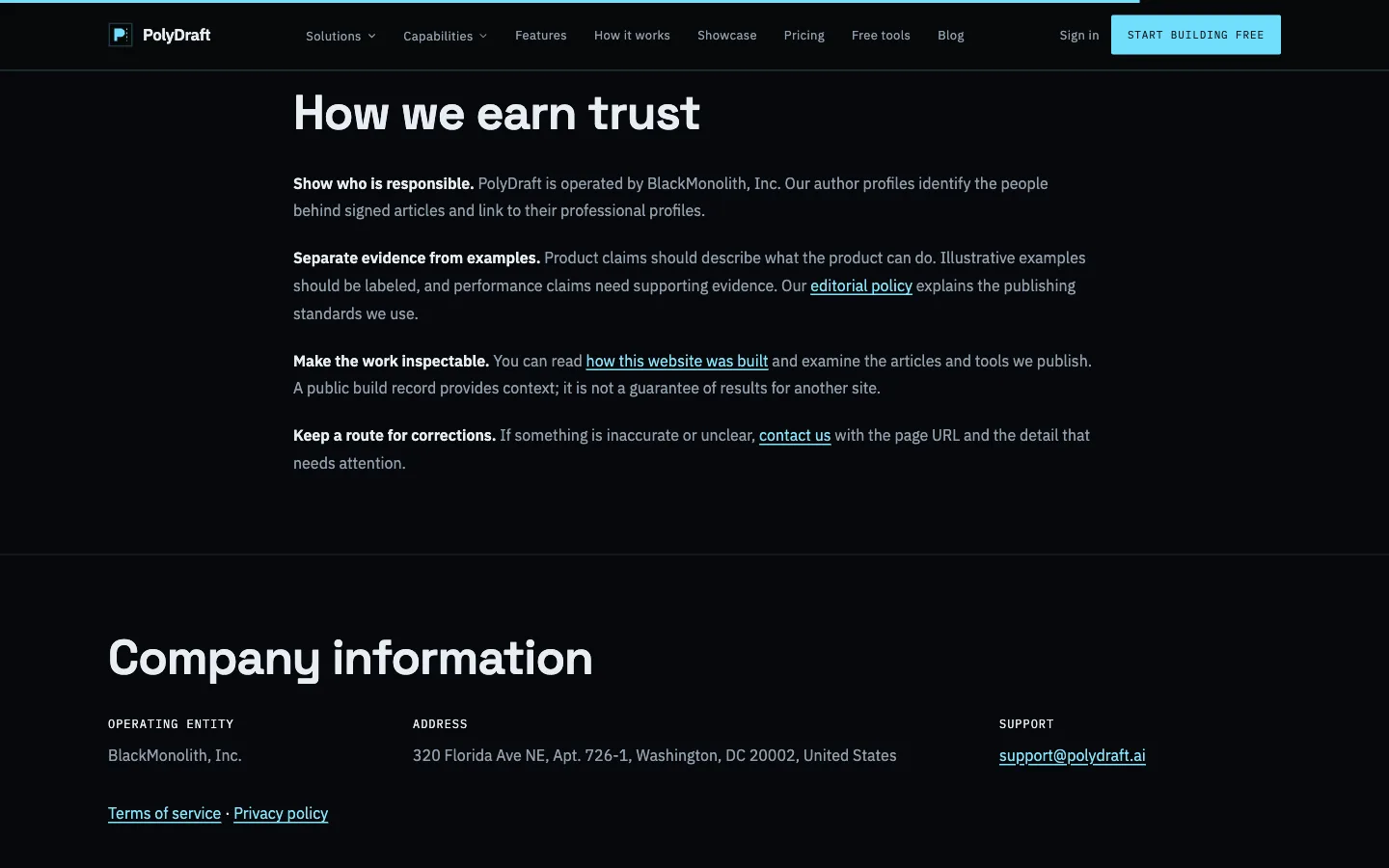
What we saw: the page explains why we started, names the founder (Vincent Chen, with a link to LinkedIn), and has a section called "How we earn trust". It names the operating company (BlackMonolith, Inc.), links our editorial policy and gives a route for corrections. A "Company information" block gives the legal name, street address and support email. The HTML we fetched carries AboutPage, Organization and Person structured data.
Limits: our first capture showed a faded hero because the headline animates in. Anyone who sees the page before the animation ends, including some screenshot tools, may see a faded or empty hero. The page also has no founding year and no photo of the founder. Measured against the template below, it misses the year in Block 1 and the photo in Block 5. Both are easy fixes.
What to copy: a short "how we earn trust" list and a corrections contact.
We also publish a showcase of sites built with PolyDraft. We left those customers' About pages out of this list, because an earlier article anonymized the same sites at the owners' request.
How Google's "who, how and why" maps to an About page
Google's guide to creating helpful, reliable, people-first content asks site owners to judge content by "Who, How, and Why". It names the About page directly. One of its self-assessment questions asks whether content offers "background about the author or the site that publishes it, such as through links to an author page or a site's About page".
The same guide says that among the parts of E-E-A-T, "trust is most important", and that "E-E-A-T itself isn't a specific ranking factor." An About page won't rank a site by itself. What it can do is answer the questions a careful reader asks before trusting the rest of your site.
| Google's question | What it means on an About page | Example above |
|---|---|---|
| Who created it? Google asks whether it's "self-evident to your visitors" who is behind the content | Named founders and staff with roles, real photos, links to profiles, legal name and address | Pentagram, Siege Media, Basecamp, PolyDraft |
| How was it made? Google says "sharing details about the processes involved" helps readers | How the product is made, how the firm is structured, how it is funded, how claims are checked | Lodge, Pentagram, Plausible, charity: water |
| Why does it exist? Google calls this "perhaps the most important question" | The problem you started with, who you serve, and what you won't do | Basecamp, Plausible, Khan Academy |
The middle column is our reading of how each question applies to an About page. Google's guide is about content in general.
Two points from the same guide apply to About pages:
- Fake profiles. Google gives "fabricating creator profiles (such as by using AI-generated headshots, made-up names, or false credentials...)" as an example of deception. Our own advice goes one step further: don't use stock photos of strangers in a team section either.
- AI use. Google's "How" section asks whether the use of automation, including AI generation, is clear to visitors, and suggests a disclosure where readers would reasonably expect one.
For structured data, Google's Organization structured data guide says that adding the markup "to your home page can help Google better understand your organization's administrative details". Note "home page". Our recommendation, which is not a Google rule, is that the About page should show the same name, address and contact details as text, matching that markup.
Several of these companies add markup to the About page as well. In the HTML we could fetch, we found Organization markup on the About pages of Ahrefs, Buffer, Pentagram and PolyDraft, and LocalBusiness markup on Russ & Daughters' History page.
A fill-in About page template
This about us page template combines the parts that worked across the 15 examples. Fill in the brackets, then delete any block you can't support with a fact. A short page with true facts beats a long one with vague ones.
Block 1. The one-sentence answer (above the fold)
[Company name] is a [type of business] in [city / country / "fully remote"] that helps [who] [do what]. We have done this since [year].
Rule: write a year, not "for X years".
Block 2. Proof strip (three or four facts)
[Number] [customers / projects / products shipped], as of [month year]. Source: [link].
Rule: every number has a date, and links to its source if one exists (Buffer, Khan Academy).
Block 3. Why we started
In [year], [founder name] was [doing what] and kept running into [specific problem]. [What they tried.] [What they built instead.]
Rule: at least one name, one year or one place per paragraph (Russ & Daughters).
Block 4. How we work Choose the ones that apply:
- How it's made:
[Where] / [process] / [standards or certifications, with a link to verify] - How we're structured:
[Who owns the business] / [who the client deals with] - How we're funded:
[Customers / investors / donors] pay for [what] - When we're not a fit:
[Type of customer] would be better served by [alternative].
Block 5. People
[Photo] [Full name], [role]. [One line of relevant background.] [Profile link]
Rule: real photos only. If you can't show people, show the founder's signature and a way to reach them (Basecamp).
Block 6. Where to find us
[Legal name] · [street address or service area] · [phone] · [email] · [hours, if people visit]
Rule: the same text, character for character, as your footer, Google Business Profile and Organization markup.
Block 7. Standards and corrections
[Links to policies, reviews, financials, certifications]. Found an error? [Contact route].
Block 8. One next step
[One call to action that fits a reader who has just learned who you are]
For example, "Book a tour", "See our work" or "Talk to the founder". One is enough.
Which blocks matter most, by business type
These are our recommendations, based on the examples above.
| Business type | Lead with | Must include | Can skip |
|---|---|---|---|
| Startup | Block 3 (why) | Block 4 funding, Block 5 founders | Long timeline |
| B2B SaaS | Block 1 and 2 | Block 4 how the product is built, a press contact | Full roster |
| Agency | Block 4 structure | Block 5 people with roles, Block 6 office addresses | Mission essay |
| Local business | Block 1 with town | Block 6 address, phone, hours | Funding |
| Manufacturer | Block 1 with factory location | Block 4 process and certifications, a timeline | Team roster |
| Nonprofit | Block 1 mission | Block 2 dated impact, Block 7 financials and outside ratings | Product detail |
| Founder-led brand | Block 3 story | Credited photos, a founder letter | Proof strip, if the story carries it |
If you are launching a new site, our SEO plan for a new website lists the About page in the launch set as the page that shows "who is behind the business and why to trust them".
Mistakes we saw, and how to avoid them
All of these come from the pages as we captured them on 18 November 2026.
- Counts that go stale. "For 111 years" (Russ & Daughters) and "27 years" (Basecamp). Write the year instead.
- Numbers that disagree. Pentagram's meta description said 24 partners and its body said 23. IDEO says "nearly 50 years" and "1991" without explaining the gap. Check numbers in the title, description and body together.
- Template leftovers. Zingerman's page title contained "%%page%%". Look at your page in a browser tab and in a search result preview after any plugin change.
- Sales messages above the story. Lodge's promo bars and Ahrefs' product banner both sit above the About content.
- Popups on the trust page. charity: water's lead-capture popup appeared during our visit.
- Claims with no method. We found no explanation on Siege Media's page of how its traffic-value figure was calculated.
- Text that animates in. Our own hero headline fades in, and our first capture caught it faded. Make sure the main text is visible without waiting.
- Anonymous proof. Unnamed testimonials add little. Link to outside reviews or research instead.
If your About page is part of a wider rebuild and you'd rather hand the work to someone, our AI FDE service offers a free website review with a PolyDraft engineer. As that page says, scope and pricing are agreed per engagement, with no ranking, traffic or AI-citation guarantees.
How we chose and checked these pages
- Date: 18 November 2026.
- Selection: we wanted live About pages from at least seven business types: startup, B2B SaaS, agency, local business, manufacturer, nonprofit and founder-led brand. We chose pages that each show at least one idea a reader can copy, from companies of different sizes. For Russ & Daughters and Patagonia, the page we used is the company history page. We left out pages that wouldn't load.
- Capture: each page was opened in a desktop Chrome window at 1440 × 900 pixels, using a browser automation helper. We took an above-the-fold screenshot and a second screenshot of one notable section after scrolling to it. Before capturing, we hid or declined cookie banners and hid a browser extension toolbar. The charity: water popup was hidden for the second screenshot of that page. Crops are noted in captions, and the hero image is a resized composite of four captures. Nothing else was edited. IDEO's tab crashed once and Lodge's page hung twice before loading; both were captured on a later attempt.
- Reading: we read each page's full text and, where the server allowed it, its HTML title, meta description and structured data types. Some sites (charity: water, Khan Academy, Zingerman's and Patagonia) blocked or challenged our command-line requests, so we report structured data only where we could fetch it. Zingerman's page title was read from the browser tab.
- What we did not do: we didn't contact any company, verify their claims (such as user counts or awards), or measure traffic or rankings. Figures quoted from the pages are the companies' own.
- Conflict of interest: PolyDraft's About page is included, labeled as ours, and judged by the same rules, including its weak spots. We didn't rank the examples. Customer sites from our showcase were left out for the reason given above.
- Pages we tried but dropped: Mailchimp's About page didn't finish loading within our time limit. Linear's About page loaded, but it repeats points made by other startups here, so we left it out to keep the list to 15.
Frequently asked questions
What should an About Us page include?
At minimum: one sentence on what you do, for whom and where; the year you started; the names of the people responsible; how to contact you, with an address or service area; and one next step. Add how you work, how you're funded and links to proof when you can support them with facts. The template above lists these as eight blocks.
How long should an About Us page be?
Long enough to answer who, how and why, and no longer. Stripe's page is a few paragraphs, and Patagonia's is a long archive. Our rule of thumb for a small business is 300 to 800 words plus photos and contact details. Cut any paragraph that has no name, date, place or fact in it.
Does an About Us page help SEO?
Not by itself, as far as Google's documentation says. Google states that E-E-A-T "isn't a specific ranking factor". But its people-first content guidance names "a site's About page" as one place readers look for background on who publishes a site. An About page that clearly states who runs the site supports the rest of your pages.
Should a small business put its address on the About page?
Yes, if people visit you or you serve one area, as Zingerman's and Russ & Daughters do. Use exactly the same name, address and phone number as your footer and Google Business Profile. A remote business can give a registered business address or a service area and a support email instead.
Can I use AI to write my About page?
You can use AI to draft it, but the facts have to come from you: dates, names, places, numbers and the real reason you started. Google's guidance treats fabricated creator profiles, such as AI-generated headshots or made-up names, as deception. Never invent team members, quotes or awards. Google also suggests disclosing AI use where readers would reasonably expect it.
Sources
- Google Search Central: Creating helpful, reliable, people-first content, last updated 5 Oct 2026, checked 18 Nov 2026
- Google Search Central: Organization structured data, last updated 8 Sep 2026, checked 18 Nov 2026
- About pages, all checked 18 Nov 2026: Plausible, Basecamp, Buffer, Ahrefs, Stripe, Pentagram, IDEO, Siege Media, Zingerman's Deli, Russ & Daughters, Lodge Cast Iron, Patagonia, charity: water, Khan Academy, PolyDraft
- PolyDraft: AI FDE service, checked 18 Nov 2026
About this article. Drafted with AI assistance following PolyDraft's editorial policy, edited in an independent review pass, and approved by Vincent Chen. Screenshots were captured on 18 November 2026 in a desktop Chrome window with a browser automation helper, then cropped where the captions say so. Claims quoted from example pages are those organizations' own; we did not verify them.