Clay Pricing 2027: Plans, Credits and Real Monthly Cost
Clay pricing as of Nov 2026: Launch from $185/mo ($167 annual), Growth from $495. Credits, rollover, top-up caps and real monthly costs.
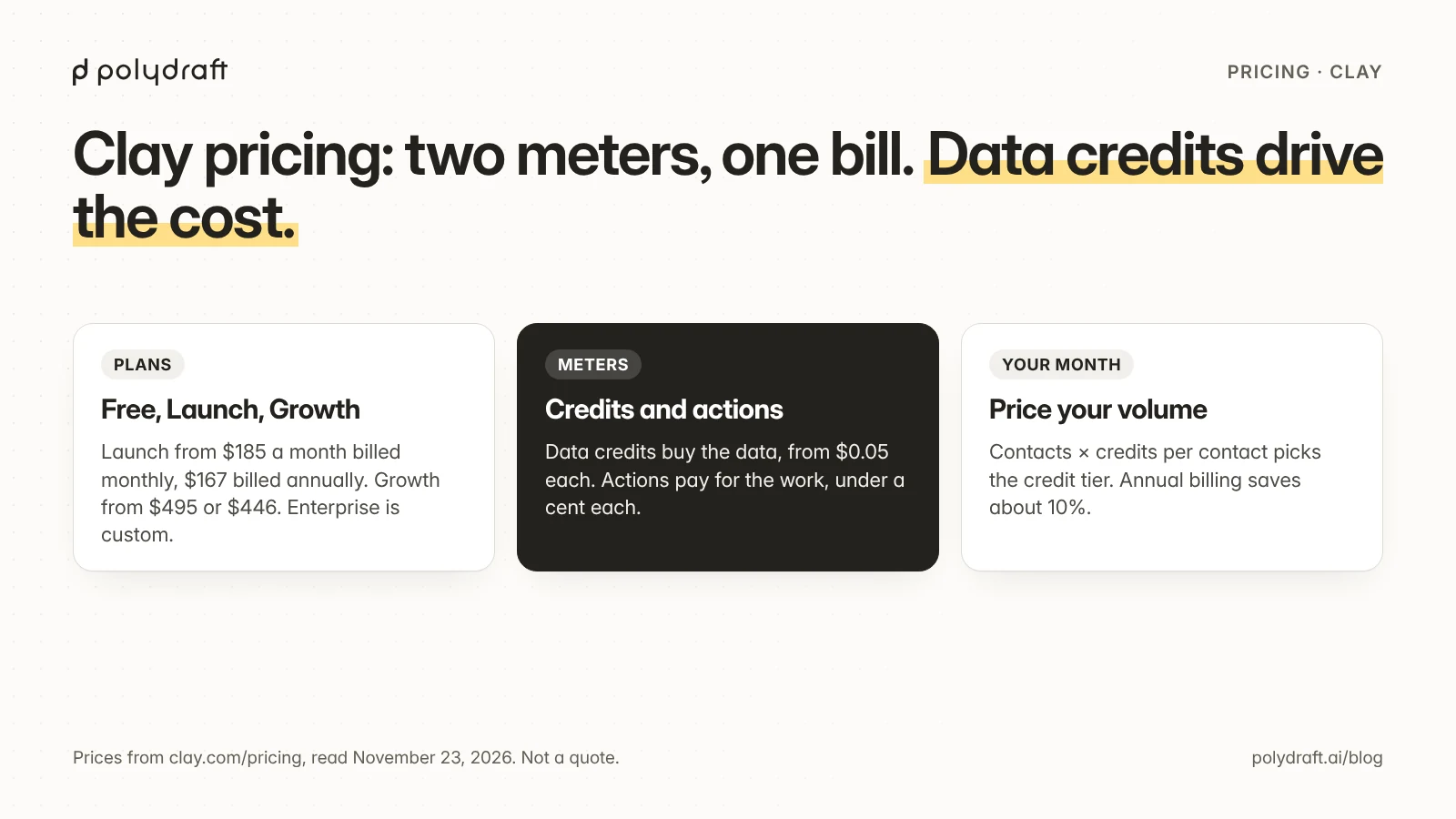
Clay pricing has a free plan and two self-serve plans. Launch starts at $185 a month billed monthly, or $167 billed annually. Growth starts at $495, or $446 annually. Enterprise is custom. Each plan has two meters: data credits buy data such as emails, and actions pay for the work Clay runs. Clay's docs say a fully enriched record typically costs 6 to 20 credits. So 1,000 such contacts a month cost about $350 to $940 on Launch billed monthly. A light profile-and-email pass costs about $185.
All prices and quotes below come from Clay's pricing page and Clay's credits documentation as of November 23, 2026. The pricing page was captured that day without the site's stylesheet, so the screenshots show plain text rather than the designed page. The monthly figures and the rollover cells come from the page's own HTML. The worked costs are our arithmetic, with every assumption labeled.
This guide is for a founder or first GTM hire budgeting Clay. We make PolyDraft, which is not a Clay alternative: it works on the website and inbound side, and it has no Clay integration.
Updated November 23, 2026: corrected the rollover rules (they depend on billing) and rebuilt the monthly costs on Clay's own 6 to 20 data credits per fully enriched record.
Key points
- Every paid plan is two dials: a data-credit tier and an action tier. The entry price is the two lowest tiers added together.
- Data credits drive the bill. In our worked table they are 68% to 94% of the monthly total.
- At Clay's 6 to 20 credits per fully enriched record, 1,000 contacts a month cost $350 to $940 on Launch billed monthly. At 5,000 contacts the low end is $2,325 on tiers alone, and the high end needs more credits than the largest self-serve tier holds.
- Unused data credits roll over by billing cycle. Monthly plans bank up to twice the monthly credits. Annual plans carry 15% over when you renew on the same or a higher plan. Actions never roll over.
- Top-ups cost 30% more and are capped: $1,000 per top-up, $5,000 in any rolling 7 days, and 4× your monthly credits in total.
- Annual billing takes about 10% off. The page implies, but does not spell out, a 12-month commitment. If so, annual only pays if you would keep Clay for 11 months or more.
- Seats are unlimited on every plan, so a bigger team does not raise the price.
Clay pricing at a glance: plans, prices and allowances
Clay has four plans: Free, Launch, Growth and Enterprise. The paid prices are not flat fees. Each card says "Starts at" and "expand anytime", because you pick an action tier and a data-credit tier, and the price is their sum.
| Plan | Billed monthly | Billed annually (per month) | Included per month | Who Clay says it is for |
|---|---|---|---|---|
| Free | $0 | $0 | 100 data credits, 500 actions (annual view: 1.2K credits and 6K actions a year) | "Start building in Clay for free. No strings attached" |
| Launch | From $185 ($125 credits + $60 actions) | From $167 ($113 + $54) | 2,500 data credits, 15,000 actions (annual: 30K and 180K a year) | "For small teams building and automating prospecting workflows" |
| Growth | From $495 ($290 credits + $205 actions) | From $446 ($261 + $185) | 6,000 data credits, 40,000 actions (annual: 72K and 480K a year) | "For teams with CRM-based workflows & growth campaigns" |
| Enterprise | Custom | Custom, "with annual commitment" | "100,000+ Data Credits and 200,000+ Actions/mo" | "For organizations building GTM systems at scale" |
The $185 and $495 figures are stated in Clay's FAQ ("Launch (starting at $185/mo)", "Growth (starting at $495/mo)"). They also equal the sum of the two lowest monthly tiers. The big price on each card, $167 for Launch and $446 for Growth, is the annual sum. The toggle above the cards reads "Annual ∙ Save 10%", and annual is the default view.
There is a trial. The Free, Launch and Growth cards each carry a "Start 14-day trial" button; Enterprise has "Get a demo". The pricing page does not say what the trial includes. Clay's credits doc says trial data credits "expire when your trial ends", and "Only 100 Data Credits will be rolled over".
The same card values appear in our earlier read of the page on November 18, 2026, so the prices were unchanged across those five days. One small inconsistency: on the monthly Launch card the credit label reads "3K data credits/mo", while the first option in its menu is "2.5K/mo ($125/mo)". The FAQ also says 2,500, so we use 2,500.
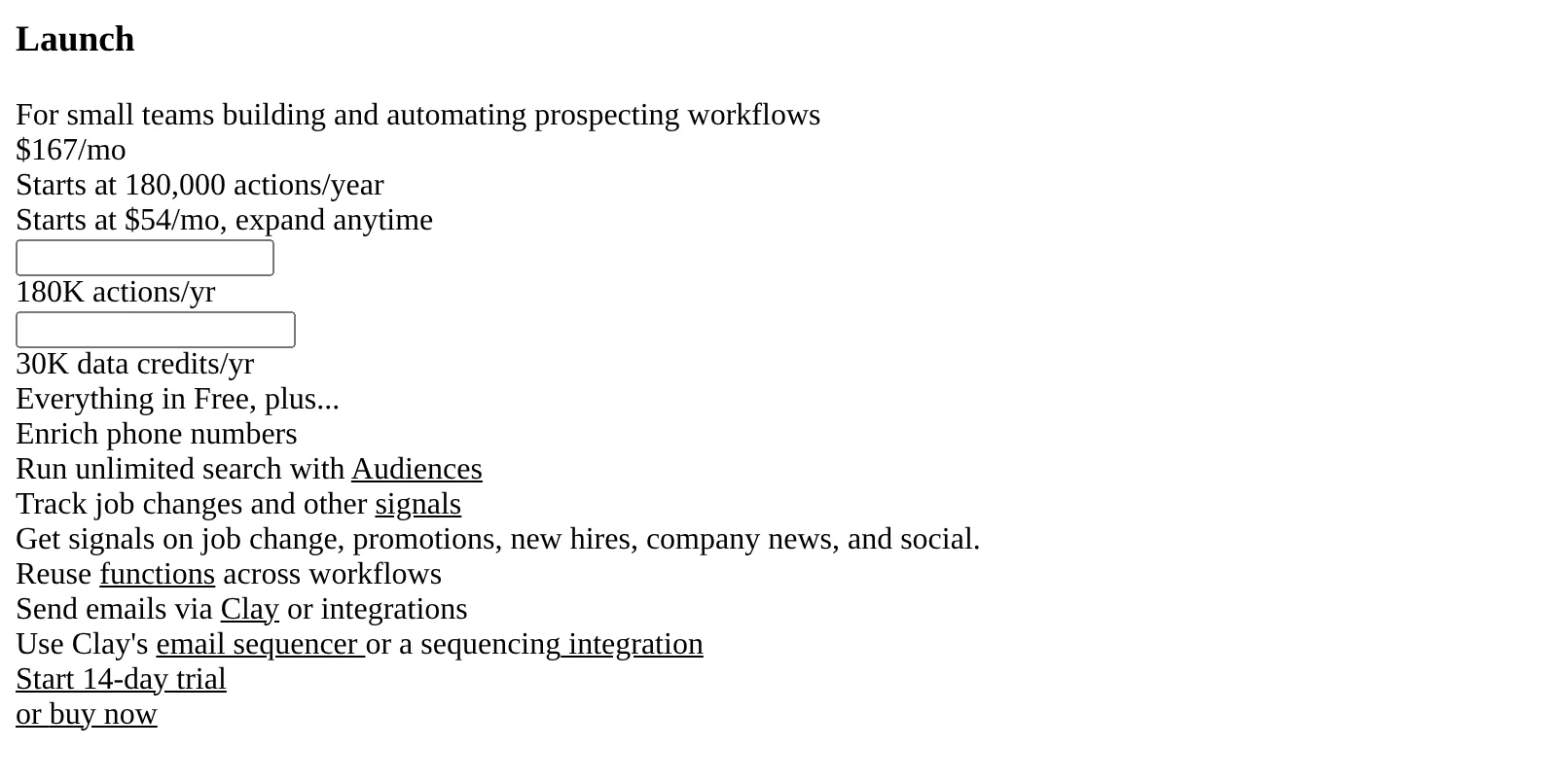
Clay's Launch card in the default annual view, captured November 23, 2026 without the site's stylesheet, which our capture environment blocked. $167 = $54 for actions + $113 for the lowest data-credit tier; the two tier menus show as empty boxes without the stylesheet, and their options are listed in the table below.
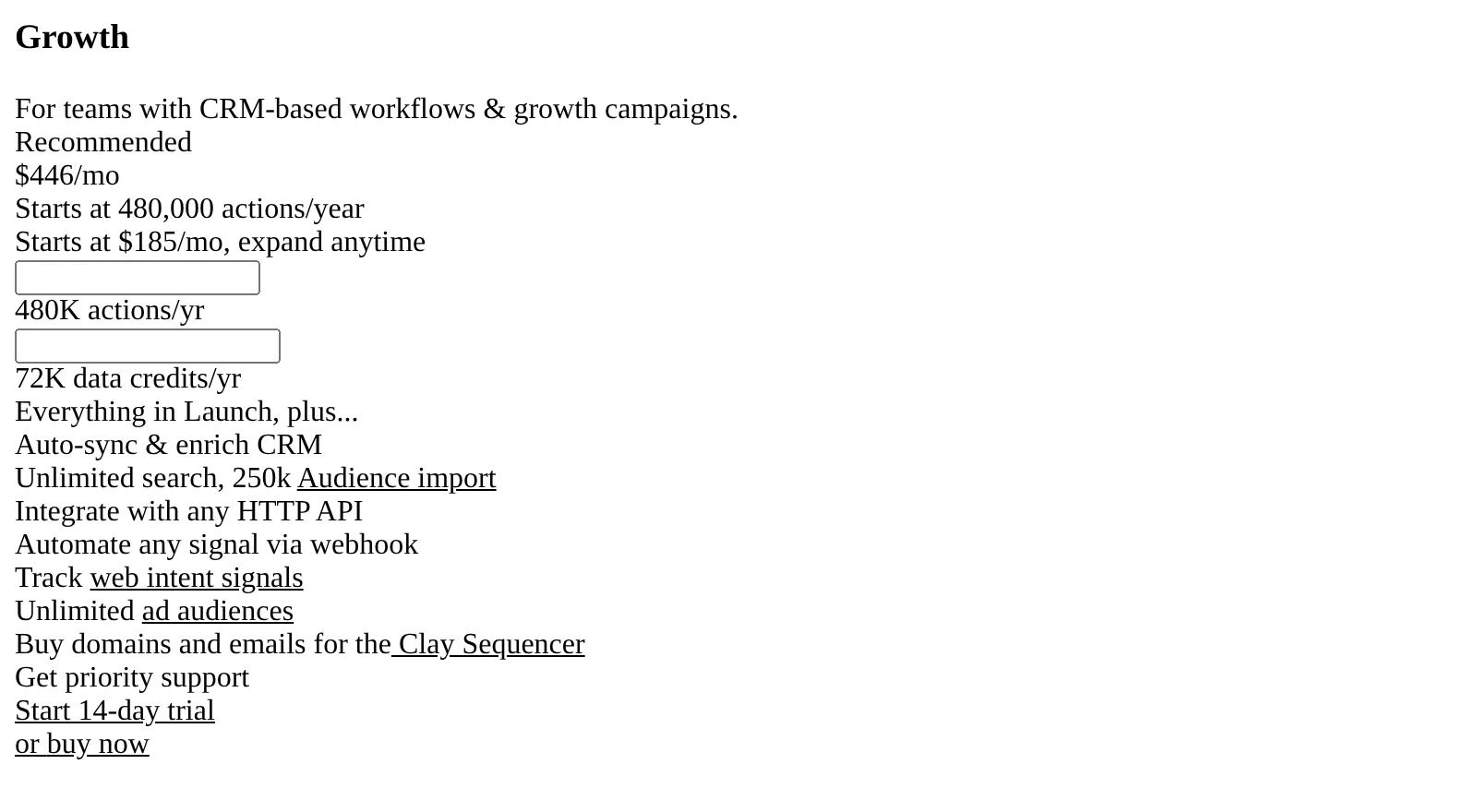
Clay's Growth card, annual view, captured November 23, 2026 without the site's stylesheet. $446 = $185 for actions + $261 for the lowest data-credit tier (from the card's menu, empty here without the stylesheet).
Every tier you can pick
Each paid card has two menus. These are all the options on the page, with the annual price shown per month as Clay shows it.
| Tier | Launch, monthly | Launch, annual (per month) | Growth, monthly | Growth, annual (per month) |
|---|---|---|---|---|
| Actions | 15K $60 · 40K $150 · 60K $200 · 100K $290 · 200K $540 | 180K/yr $54 · 480K/yr $135 · 720K/yr $180 · 1.2M/yr $261 · 2.4M/yr $486 | 40K $205 · 60K $290 · 100K $450 · 200K $850 | 480K/yr $185 · 720K/yr $261 · 1.2M/yr $405 · 2.4M/yr $765 |
| Data credits | 2.5K $125 · 6K $290 · 10K $460 · 20K $880 · 50K $2,125 | 30K/yr $113 · 72K/yr $261 · 120K/yr $414 · 240K/yr $792 · 600K/yr $1,913 | 6K $290 · 10K $460 · 20K $880 · 50K $2,125 | 72K/yr $261 · 120K/yr $413 · 240K/yr $792 · 600K/yr $1,913 |
Two things stand out. Credit tiers cost the same on Launch and Growth (billed annually, one tier differs by a dollar: 120K a year is $414 a month on Launch and $413 on Growth). Growth's premium sits in the actions. At the same volume, its action tiers cost 37% to 57% more than Launch's: 40K actions are $205 on Growth and $150 on Launch. You pay that premium for the Growth features on the pricing page: CRM auto-sync, HTTP API integrations, webhooks, web intent signals and ad audiences.
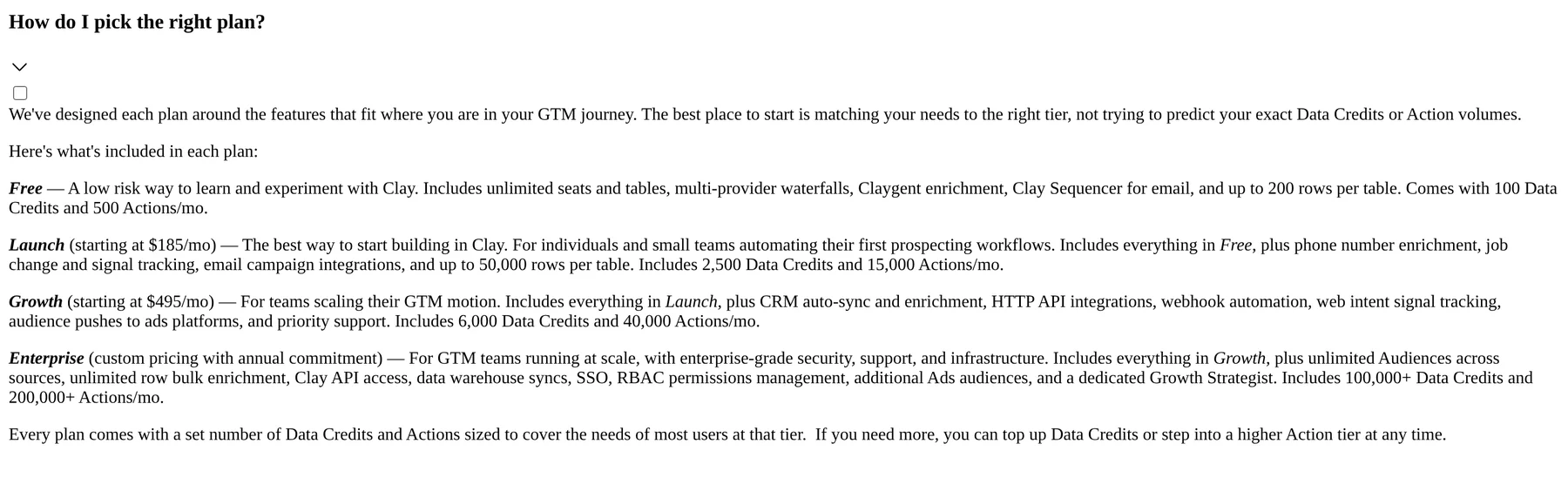
The plan answer in Clay's pricing FAQ, captured November 23, 2026 without the site's stylesheet. It states the monthly starting prices and the monthly allowances.
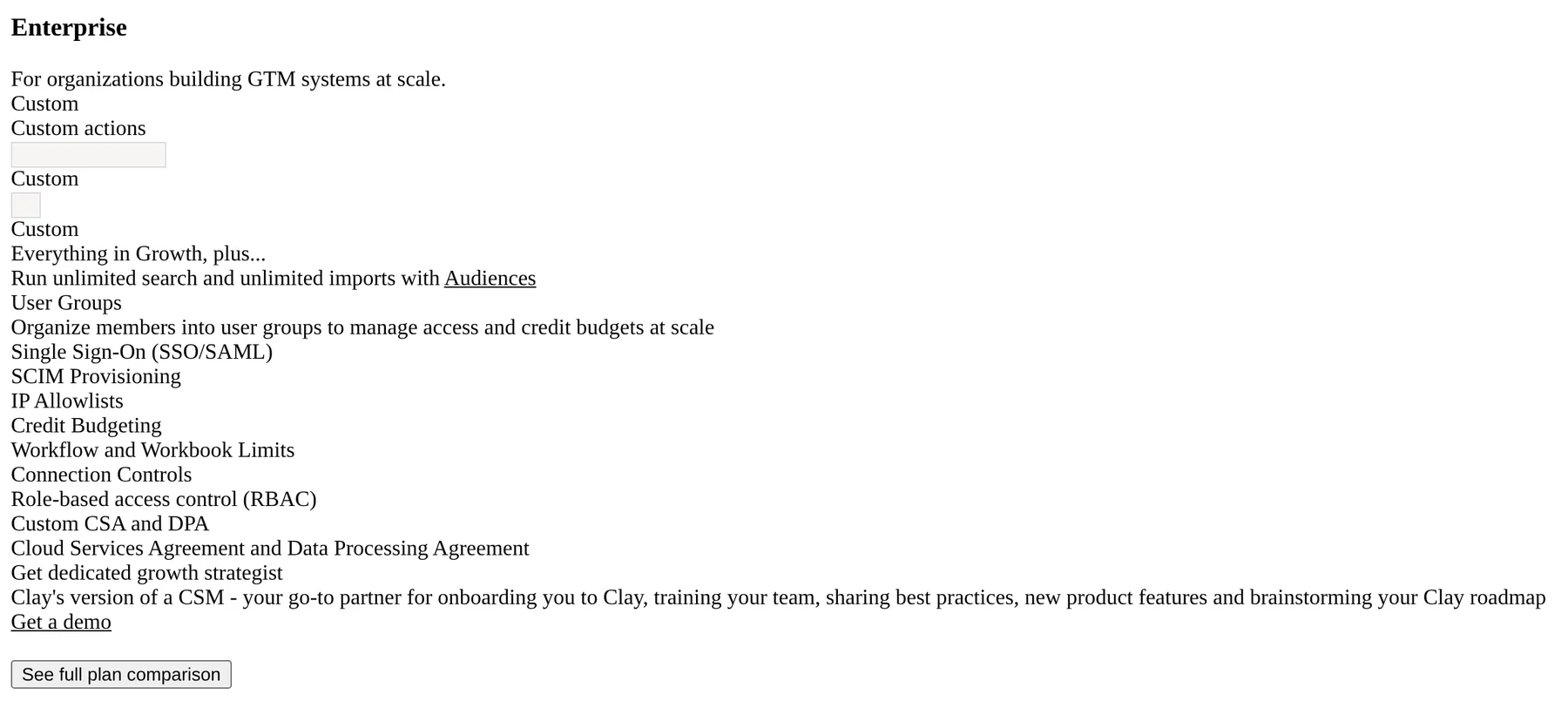
Clay's Enterprise card, captured November 23, 2026 without the site's stylesheet. No price is listed; the CTA is "Get a demo".
How Clay credits and actions work, and what uses them up
Data credits pay for data and actions pay for work. Clay's FAQ puts it as "two separate things happening at once: Clay is doing work, and Clay is buying data on your behalf".
Data credits. In Clay's words: "Data Credits are used when you purchase data from Clay's marketplace — finding emails, phone numbers, company data across our 150+ data partners". The FAQ says "Data Credits start at $0.05 each". The tiers bear that out: 2,500 credits for $125 is $0.050 each, and 50,000 for $2,125 is $0.0425 each.
Actions. "Actions measure the orchestration you do on Clay — enriching data, running a table, calling an AI model, sending data to a third-party system, or exporting data out of Clay". The FAQ says "Actions start at less than $0.01 each". On Launch's monthly tiers they run from $0.0040 (15K for $60) to $0.0027 (200K for $540). Clay's credits doc adds: "Each record enriched or exported counts as 1 Action—regardless of data source or provider".
AI models. Clay's FAQ says "80% of models in Clay continue to cost a flat number of Data Credits per task". Token-heavy models "now have variable pricing based on actual token consumption", charged "with no markup". Those models show an estimate with a tilde (~) before a run, and Clay says "75% of runs cost less than the estimate". So most AI columns cost a fixed number of credits, and the big models cost what their tokens cost.
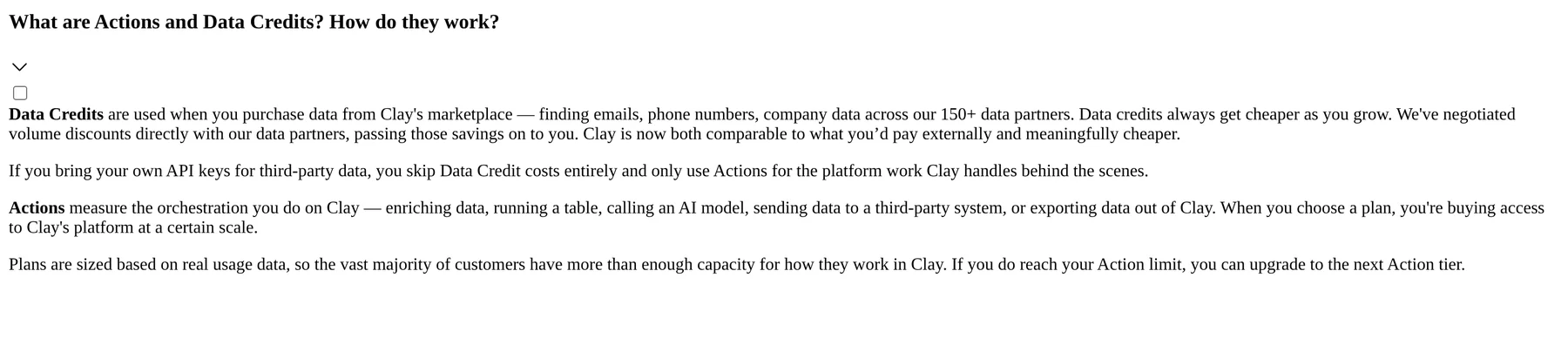
Clay's definitions of data credits and actions, captured November 23, 2026 without the site's stylesheet.
What uses an action and what doesn’t
Enrichment, AI runs and exports to other tools use actions; moving data around inside Clay and CSV export do not. This is Clay's own list from its credits doc, shortened:
| Uses an action | Uses no action |
|---|---|
| Each enrichment from any provider, including with your own API keys | Sourcing lists of accounts or contacts (for example, Find People) |
| Each AI run ("1 per AI run") | CRM and data warehouse imports |
| Clay sequencer: "1 Action per lead added to campaign (not per email sent)" | Formulas and filters |
| Each record exported to an external sequencer, a CRM, a data warehouse or an ads audience | Send Table Data and Lookup Single Row between Clay tables |
| Work a rep triggers from an AI tool through MCP | CSV export: it "does not consume an Action or any Data Credits" |
What a lookup costs in credits. It depends on the data. Clay's doc puts a single enrichment at "0.5–10+ credits based on data type". It says "emails are cheap, phone numbers are expensive", and the product shows the exact cost next to each enrichment option. Its planning figure for a whole record is "Each fully enriched record typically costs 6–20 Data Credits". The range depends on the data types, how many of your own API keys you connect, and whether you run waterfalls. The pricing page adds that "the most-used enrichments cost 50% fewer credits on average". Clay's pricing calculator estimates a bill, but in our capture only its default state loaded (100 accounts and 100 contacts a month, recommending Free).
Credit meters like this are common in marketing software. Our roundup of AI tools for marketers notes how each tool bills you, by seat, credits or usage.
Clay credits rules: failed lookups, your own keys, rollover and top-ups
Four rules change the real cost: failed lookups are free, your own keys skip credits, top-ups cost more and are capped, and rollover depends on how you are billed.
Failed lookups are free. "If an enrichment returns no result, you're not charged Data Credits or Actions". If half your list has no findable email, you pay for the half that does.
Your own API keys skip credits. "Each run will count as one Action, but no Data Credit will be used". You then pay the data provider directly, at its prices. Clay adds that "AI runs are 2x faster using Clay's API keys" because of its negotiated rate limits.
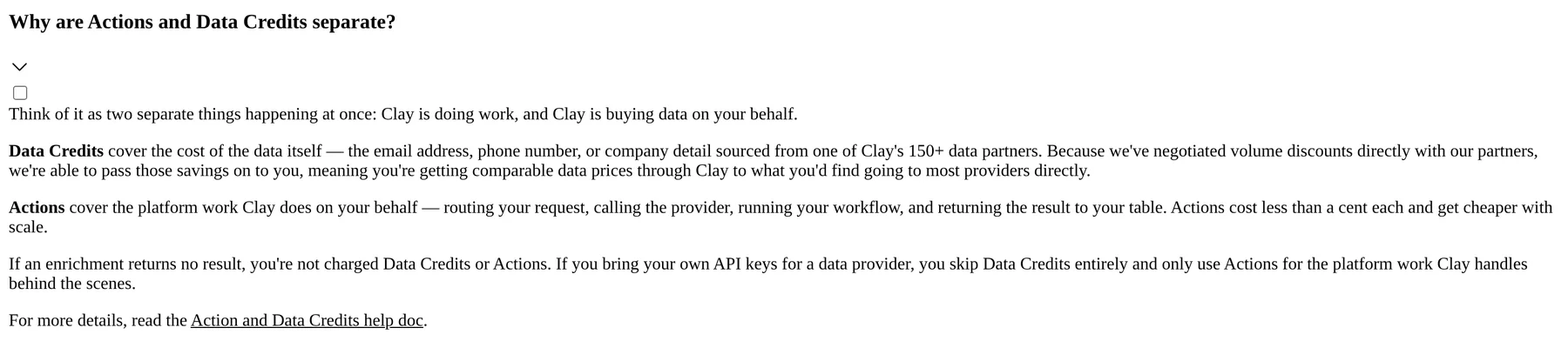
Clay's answer on why the two meters are separate, captured November 23, 2026 without the site's stylesheet. The no-result rule is in the fourth paragraph.

Clay's own-key rule, captured November 23, 2026 without the site's stylesheet.
Top-ups cost 30% more. The comparison table lists credit top-ups on Launch and Growth as "Buy more at a 30% premium", and Enterprise as "Buy more at custom price". Free has none. Neither the page nor the doc says what the premium is added to. If it applies to the $0.05 entry rate, a top-up credit costs $0.065, so 3,500 extra credits would cost about $228. Moving from the 2.5K tier ($125) to the 6K tier ($290) adds the same 3,500 credits for $165. Which is cheaper depends on how far over you go. At that assumed $0.065, topping up beats the next tier for up to about 2,500 extra credits above the 2.5K tier. Above the 20K tier it wins for up to about 19,000, because the step from 20K to 50K costs $1,245. Clay's FAQ adds that you can top up "without being pushed up to a higher plan tier".
Top-ups have hard limits. Clay's credits doc sets them:
- The minimum top-up is 250 credits, for one-time and automatic top-ups alike.
- Each top-up "is capped at $1,000, with a $5,000 maximum across all top-ups in any rolling 7-day window".
- One-time and automatic top-ups together "can add up to 4× your monthly Data Credit allocation". On the 20K tier, that is at most 80,000 extra credits.
- Automatic top-ups work on paid self-serve plans only, "not on Free, Trial, or Enterprise plans". Their trigger threshold must be at least 15% of the credits your plan includes each cycle.
- Topped-up credits "follow the same rollover and expiry rules" as plan credits, and one-time top-ups are "subject to Data Credit rollover limits".
- Actions cannot be topped up. To get more, "You must upgrade to a higher plan tier."
The doc's advice is "For regular needs, upgrading your Data Credits tier is more cost-effective." That holds for large, regular overruns. For a small overrun just past a tier, the arithmetic above favors a top-up.
Rollover depends on how you pay. Unused data credits roll over, and the cap depends on billing. The comparison table has one rollover cell per billing view. For Launch and Growth, it reads "Up to 1 month's credits" in the monthly view and "15% of annual credits" in the annual view. The page's HTML holds both cells and hides the one that does not match the toggle. Clay's credits doc spells out both rules:
- Monthly plans: "If you are on a monthly plan, unused Data Credits will roll over and accumulate in your account. The maximum accumulation is capped at 2× your plan's monthly credit limit." Its example: a 50,000-credit plan can hold at most 100,000. That matches the table's "Up to 1 month's credits".
- Annual plans: you are "eligible for a 15% Data Credit rollover of unused Data Credits, provided you renew on the same or a higher-tier plan."
- Enterprise: the pricing FAQ says customers "can roll over up to 15% of their prior year's purchased credits, provided they renew at an equal or higher commitment". The table shows "Custom".
- Free and trial: the table lists rollover as "Not included" on Free. The doc says credits "expire when your trial ends or when a free workspace refreshes at the end of the monthly cycle. Only 100 Data Credits will be rolled over."
The pricing FAQ says "unused credits can accumulate up to 2x your monthly credit amount (e.g., a 10,000 credit plan can bank up to 20,000 total)". That is the monthly rule. Actions never roll over: "Actions reset each billing cycle and don't roll over". If you downgrade or cancel, you can use excess credits until the cycle ends; then "your balance will be reduced to the Data Credit rollover limit of your new plan". Neither source says what the annual 15% is measured against. The table says "15% of annual credits"; the doc says a "15% Data Credit rollover of unused Data Credits". If your budget depends on it, ask Clay.

The Credits economics rows of Clay's comparison table in the annual view, captured November 23, 2026 without the site's stylesheet. Columns: Free, Launch, Growth, Enterprise. This shows the annual rollover cell. In the monthly view, the Launch and Growth cells read "Up to 1 month's credits" instead; the page's HTML holds both and shows one per view.

Clay's FAQ answer on rollover, from the same capture. Its "up to 2x your monthly credit amount" rule is the monthly-billing rule; Clay's credits doc states the annual rule separately.
Monthly vs annual billing: what the 10% saving is worth
Annual billing saves about 10% on every tier. If it commits you to a full year, it pays off only if you keep Clay for about 11 months or more. The toggle says "Save 10%", and each annual tier is 90% of its monthly price, rounded to the dollar on Clay's pricing page.
| Setup | Billed monthly | Billed annually (per month) | Saving per month | Saving per year |
|---|---|---|---|---|
| Launch, lowest tiers | $185 | $167 | $18 | $216 |
| Growth, lowest tiers | $495 | $446 | $49 | $588 |
| 1,000 contacts, full enrichment at 6 credits (table below) | $350 | $315 | $35 | $420 |
| 1,000 contacts, full enrichment at 20 credits | $940 | $846 | $94 | $1,128 |
| 5,000 contacts, full enrichment at 6 credits, tiers only | $2,325 | $2,093 | $232 | $2,784 |
The break-even assumes an annual plan commits you to 12 months; the page implies this ("Get all credits up front (annual plans)") but does not state it. Twelve months of annual Launch is 12 × $167 = $2,004. At $185 a month, that is about 10.8 months of monthly billing. If you might stop before month 11, monthly is cheaper. The page does not say whether annual plans are charged upfront or monthly, and it does not mention refunds. It says only "Get all credits up front (annual plans)". Ask before you sign.
Annual billing also changes rollover. A monthly plan banks unused credits month to month, up to twice the monthly amount. An annual plan carries 15% over, and only when you renew on the same or a higher plan.
What a month really costs: Clay pricing by contacts and enrichment depth
On Launch billed monthly, 1,000 contacts a month cost about $185 with light enrichment and $350 to $940 with full enrichment at Clay's 6 to 20 credits per record. At 5,000 contacts, light costs $350 and full costs $2,325 or more. At 20,000 contacts, light costs $1,080; full enrichment needs top-ups or Enterprise. Three depths, each labeled:
- Light: about 1 data credit and 3 actions per contact. The credits come from Clay's own example in its credits doc. Enriching 100 contacts with LinkedIn profiles (0.5 credit each) and emails (0.5 each, 90% found) uses 95 data credits; validating the emails uses none. The 3 actions are our count: one each for profile, email and validation.
- Full, low and full, high: 6 and 20 data credits per contact. These are the two ends of Clay's "Each fully enriched record typically costs 6–20 Data Credits".
- 10 actions per fully enriched contact. Our assumption: about eight enrichment steps that return data, one AI column and one CRM or sequencer export. Clay's own sizing implies more. Its doc pairs Launch's 15,000 actions a month with "Enriching ~10,000 records/year", about 18 actions per record. At 18 actions, 1,000 contacts need the 40K action tier ($150) instead of 15K ($60), adding $90 a month.
The formula is: credits needed = contacts × credits per contact, rounded up to the next credit tier. Do the same for actions, then add the two tier prices. Failed lookups cost nothing, so a list with a low find rate costs less than the formula says.
| Contacts a month | Depth | Data credits needed | Actions needed | Launch tiers picked (monthly) | Billed monthly | Billed annually (per month) |
|---|---|---|---|---|---|---|
| 1,000 | Light | 1,000 | 3,000 | 2.5K credits $125 + 15K actions $60 | $185 | $167 ($113 + $54) |
| 1,000 | Full, low | 6,000 | 10,000 | 6K credits $290 + 15K actions $60 | $350 | $315 ($261 + $54) |
| 1,000 | Full, high | 20,000 | 10,000 | 20K credits $880 + 15K actions $60 | $940 | $846 ($792 + $54) |
| 5,000 | Light | 5,000 | 15,000 | 6K credits $290 + 15K actions $60 | $350 | $315 ($261 + $54) |
| 5,000 | Full, low | 30,000 | 50,000 | 50K credits $2,125 + 60K actions $200 | $2,325 | $2,093 ($1,913 + $180) |
| 5,000 | Full, high | 100,000 | 50,000 | Past the largest credit tier (50K) | See the next table | Not estimated |
| 20,000 | Light | 20,000 | 60,000 | 20K credits $880 + 60K actions $200 | $1,080 | $972 ($792 + $180) |
| 20,000 | Full, low | 120,000 | 200,000 | Past the largest credit tier (50K) | See the next table | Not estimated |
| 20,000 | Full, high | 400,000 | 200,000 | Past the largest credit tier (50K) | Not possible self-serve | Enterprise |
Two cells have a cheaper route through top-ups, at the $0.065 per credit we assume above:
- 5,000 contacts, full, low: the 20K tier plus 10,000 top-up credits is $880 + $650 = $1,530 for credits, or $1,730 with the 60K action tier, against $2,325 on tiers. It fits Clay's limits: $650 is under the $1,000 per-top-up cap, and 10,000 credits are under the 80,000 allowance on a 20K plan.
- 5,000 contacts, light: the 2.5K tier plus 2,500 top-up credits is $125 + $162.50 = $287.50, against $290 for the 6K tier. A wash.
Past the 50K tier, top-ups are the only self-serve route, within Clay's caps:
| Case | Credits a month | Top-up credits over the 50K tier | Top-up cost at $0.065 | Within Clay's top-up limits? | Billed monthly |
|---|---|---|---|---|---|
| 5,000 contacts, full, high | 100,000 | 50,000 | $3,250 | Yes: under the 200,000 allowance (4 × 50,000); at least 4 top-ups of up to $1,000 | $5,575 ($2,125 + $3,250 + 60K actions $200) |
| 20,000 contacts, full, low | 120,000 | 70,000 | $4,550 | Yes: under 200,000; at least 5 top-ups; under $5,000 in any 7 days | $7,215 ($2,125 + $4,550 + 200K actions $540) |
| 20,000 contacts, full, high | 400,000 | 350,000 | $22,750 | No: over the 200,000 allowance and over $5,000 in some 7-day window | Enterprise only |
At these volumes Clay points you to Enterprise, which starts at "100,000+ Data Credits and 200,000+ Actions/mo" and has no public price. Clay also says one-time top-ups are "subject to Data Credit rollover limits" without saying how that applies, so treat the two top-up rows as upper-bound estimates to check with Clay.
On Growth, credit tiers cost the same, the smallest credit tier is 6K, and actions cost more. Billed monthly, 1,000 contacts at up to 6 credits each cost $495 ($290 + $205), and at 20 credits $1,085 ($880 + $205). At 5,000 contacts and 6 credits it is $2,415 ($2,125 + $290). At 20,000 light contacts it is $1,170 ($880 + $290). Pay that only if you need CRM sync, HTTP APIs or webhooks.
Tier steps are uneven, so a small change in usage can double the bill, and what happens to leftover credits depends on billing. Take 5,000 light contacts: 5,000 credits on the 6K tier leave 1,000 unused each month. Billed monthly, they bank until your balance reaches 12,000, twice the monthly 6,000, which takes six months. Billed annually, you get 72,000 credits for the year and use 60,000. On renewal at the same or a higher plan, 15% rolls over. That is up to 10,800 credits if it means 15% of the year's 72,000, or 1,800 if it means 15% of the 12,000 unused. Before you commit, run a small batch and count the credits it actually uses; Clay's doc suggests "10–20 records". Clay's guide to GTM engineering gives the same advice: "prove it works on a small batch" before you scale.
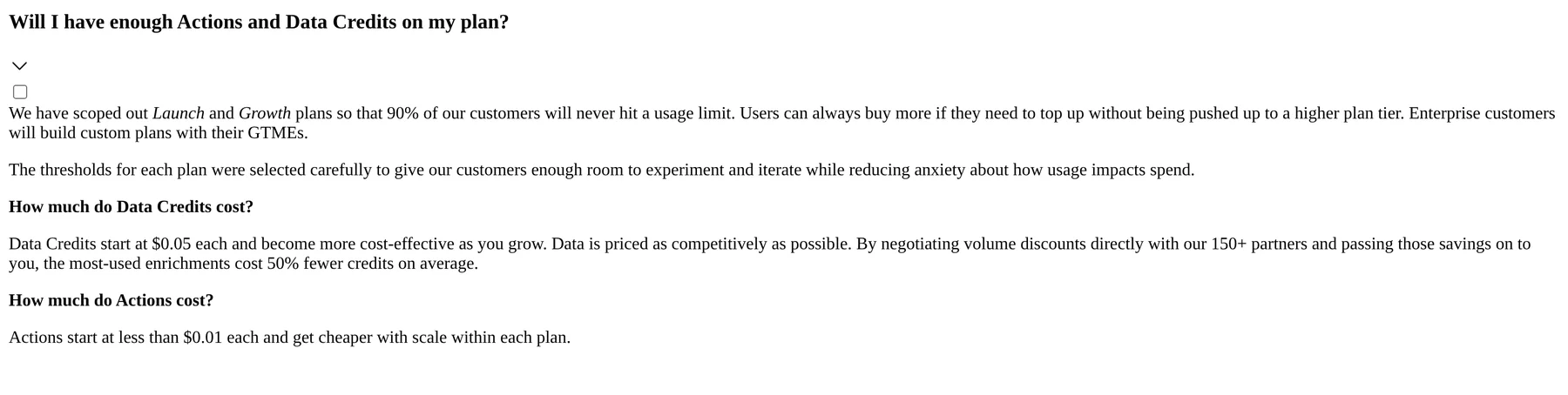
Clay's stated unit prices, captured November 23, 2026 without the site's stylesheet. Clay also says Launch and Growth are sized so "90% of our customers will never hit a usage limit".
The Clay free plan: what you can do with it
The free plan is for learning Clay, not for running a prospecting program. It includes 100 data credits and 500 actions a month, "Unlimited seats and tables", multi-provider waterfalls, Claygent, your own API keys, and "up to 200 rows per table".
At about 1 credit per light lookup, 100 credits cover about 100 contacts a month. At Clay's 6 to 20 credits per fully enriched record, they cover 5 to 16. The comparison table adds two limits: "Free plan does not include phone number enrichment", and workflows are limited to "100 runs/workflow only". Free has no top-ups, and its rollover cell reads "Not included", though Clay's doc says 100 data credits carry over when a free workspace refreshes. Launch raises the row limit to "up to 50,000 rows per table".
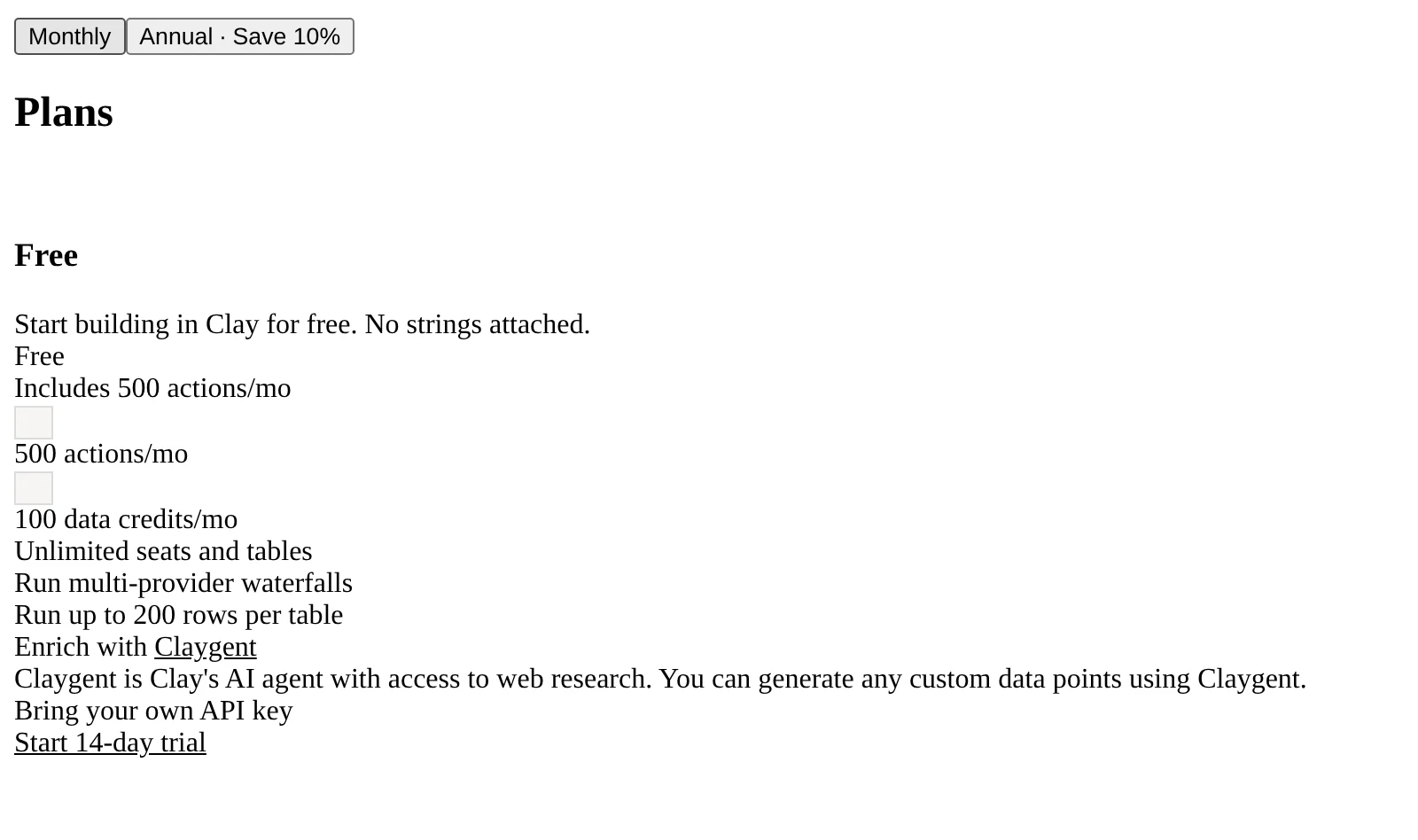
Clay's Free card with the monthly view set, captured November 23, 2026 without the site's stylesheet. The toggle's script did not load in our capture, so we switched the view with the page's own attribute.
Seats, Enterprise and costs not on the pricing page
Clay does not charge per seat, so adding teammates does not raise the price. The comparison table lists "Tables and users per workspace" as "Unlimited" on every plan.
Enterprise adds what larger teams ask for: SSO, SCIM, role-based access, IP allowlists, credit budgeting, and enrichment of "more than 50K records at once". It also syncs sources every 15 minutes instead of daily, and comes with a dedicated growth strategist and a Slack support channel. It has custom pricing "with annual commitment" and a floor of "100,000+ Data Credits and 200,000+ Actions/mo".
Costs to budget that the pricing page does not price:
- Provider bills for your own keys. Clay charges one action per run, and the data provider bills you separately.
- Token-heavy AI models. They are billed at actual tokens, so a long research prompt costs more than its estimate on some runs.
- Sending setup. Growth lists "Buy domains and emails for the Clay Sequencer" with no price on this page. If you send from a separate tool instead, see what Instantly costs with inboxes and domains, in three worked months.
- Top-ups at the 30% premium, within the caps covered above.
- The person who builds the tables. Clay's Launch card says it is for teams "building and automating prospecting workflows". Our guide to what a GTM engineer does covers that role and its salary. Some teams instead have an engineer from a vendor or service firm build the first system with them. Our explainer on the AI forward deployed engineer covers when that beats hiring.
What changed in March 2026: Clay’s legacy Starter, Explorer and Pro plans
If a guide quotes Clay's Starter, Explorer or Pro plans, it describes the pricing Clay replaced in March 2026. Clay's legacy plans doc says: "In March 2026, Clay introduced a new pricing model", with "two simple usage meters: Actions (for running workflows and automations) and Data credits (for accessing data from our marketplace)". The pricing page lists only the new plans.
- Legacy customers who stay "keep your familiar pricing and all the features you have today".
- "After April 10, 2026 11:59pm PDT, any plan change forces migration to modern plans." Legacy customers "cannot switch between legacy plans or return to legacy plans once they leave".
- Legacy plans have no action charges but pay more per credit. Clay's comparison lists about $0.07 to $0.08 per credit on Starter against about $0.05 on Launch. Legacy top-ups carry a 50% premium against 30%, and new-plan data costs are "50% cheaper on 70+ enrichments".
- Audiences, Workflows and Sequencer v2 via Audiences are on legacy Starter, Explorer and Pro plans "through December 31, 2026". Legacy Enterprise workspaces are "grandfathered indefinitely".
- Clay's test for which pricing you are on: "If you're charged for actions, you're on new pricing".
When Clay is worth it, and when it isn’t
Clay is worth it when someone on the team will build workflows and you enrich enough records each month to need waterfalls, AI research columns or CRM sync. It is the wrong buy when you need a few dozen contacts a month or nobody will maintain the tables.
Good fit:
- List-based outbound where each account is researched, scored and enriched before a sequence. Our AI GTM engineer guide maps which of those jobs agents now run.
- Enriching inbound leads already in your CRM. That needs Growth for CRM auto-sync.
- Teams that already pay for data providers and can bring their own keys, paying actions only.
Poor fit:
- Fewer than about 100 light lookups or 5 to 16 fully enriched contacts a month, where Free is enough, as long as you do not need phone numbers.
- No one to build or maintain workflows. Our guide to AI automation agencies prices the done-for-you route.
- Wanting one tool for the whole growth stack. Clay covers data and workflows; our list of growth engineer tools covers the site, analytics and experiments around it.
If your plan is mostly inbound rather than list-building, enrichment is a smaller part of the job, and the work sits closer to what a growth engineer does. PolyDraft, our product, sits on that inbound side and does no enrichment or outbound. Our roundup of AI marketing agents covers the tools that act on that side.
Frequently asked questions
How much does Clay cost per month?
As of November 23, 2026, Launch starts at $185 a month billed monthly or $167 billed annually. Growth starts at $495 or $446. Free is $0 and Enterprise is custom. Paid prices rise with the credit and action tiers you pick. At Clay's 6 to 20 credits per fully enriched record, 1,000 contacts a month cost about $350 to $940 on Launch billed monthly.
How much does a Clay credit cost?
Clay says "Data Credits start at $0.05 each". The listed tiers work out to $0.050 per credit at 2,500 a month and $0.0425 at 50,000. Top-ups cost "a 30% premium", at least 250 credits each, and are capped at $1,000 per top-up and $5,000 in any rolling 7 days. Actions start at "less than $0.01 each".
How many Clay credits does one contact use?
Clay's docs say "Each fully enriched record typically costs 6–20 Data Credits". A light pass is far cheaper: in Clay's example, a LinkedIn profile and an email cost about 1 credit per contact. Each enrichment also uses one action, and CSV export uses none.
Do Clay credits roll over?
Data credits do; actions do not. On monthly Launch and Growth plans, unused credits bank up to twice your monthly amount. On annual plans, Clay's docs say you get "a 15% Data Credit rollover of unused Data Credits, provided you renew on the same or a higher-tier plan". Enterprise carries over up to 15% of the prior year's purchased credits on renewal.
Is there a Clay free trial?
Yes. The Free, Launch and Growth cards on Clay's pricing page offer a "Start 14-day trial" button, but the page does not say what the trial includes. Clay's docs say trial credits expire when the trial ends, with only 100 rolled over.
What happened to Clay’s Starter, Explorer and Pro plans?
They are legacy plans. Clay moved to data credits plus actions in March 2026, per its legacy plans doc. Existing customers can stay on them, but since April 10, 2026 any plan change moves you to the new plans. If you are charged for actions, you are on the new pricing.
Am I charged when Clay finds nothing?
No. Clay's FAQ says "If an enrichment returns no result, you're not charged Data Credits or Actions". With your own API keys, each run uses one action and no data credits.
Is Clay’s annual plan worth it?
Annual billing saves about 10% on Clay's listed tiers, $216 a year at Launch's entry price. If annual commits you to 12 months, it pays off when you would keep Clay for about 11 months or more. Annual plans carry 15% over at renewal; monthly plans bank up to twice the monthly amount. The page does not say whether annual is charged upfront or refundable.
Continue with the next task
- Hiring someone to run Clay: read what a GTM engineer is, with the role, stack and salary.
- Deciding which GTM jobs to give agents: see the AI GTM engineer guide.
- Pricing the sender too: many teams build lists in Clay and email them from a separate tool. Our Instantly pricing guide works out that bill the same way.
- Comparing another usage-priced tool: our Lovable pricing explainer uses the same format.
About this article. Drafted by an AI agent following PolyDraft's blog workflow, checked by an automated QA script and approved by Vincent Chen. Every Clay plan price, tier and pricing-page quote comes from clay.com/pricing as captured on November 23, 2026, and an earlier capture on November 18, 2026 showed the same card values. The site's stylesheet and scripts did not load in the capture environment, so the screenshots show the page unstyled. The monthly values were read from the page's own HTML by setting the toggle's attribute that the blocked script would have set. Clay's credits and legacy-plans docs on university.clay.com could not be opened in that environment. We read them through DataForSEO's crawler on November 23, 2026, along with the pricing page's raw HTML and its billing-dependent rollover cells. The quote from Clay's GTM engineering guide was read November 18, 2026. No product was tested hands-on. The cost tables and the tier arithmetic are our own work, with assumptions labeled. PolyDraft is our product and is mentioned only to say it is not a Clay alternative.
Sources
- Clay, pricing page: plan cards, tier menus and comparison table, read November 23, 2026 (also read November 18, 2026)
- Clay, pricing page FAQ: actions, data credits, rollover, AI usage and own API keys, read November 23, 2026
- Clay University, Actions & Data Credits: credits per record, what uses actions, rollover by billing cycle, top-up limits, trial credits, read November 23, 2026 through DataForSEO's crawler
- Clay University, Legacy plans: the March 2026 pricing change, read November 23, 2026 through DataForSEO's crawler
- Clay, pricing calculator, read November 23, 2026 (default state only)
- Clay, guide to GTM engineering, read November 18, 2026
- PolyDraft, what a GTM engineer is, for the role behind the tool
- PolyDraft, AI GTM engineer guide, for how Clay was described on November 18, 2026