AI GTM Engineer in 2027: Which GTM Jobs Agents Run, What You Approve
What an AI GTM engineer is, which go-to-market jobs agents from HubSpot, Clay, Instantly and others run, what you still approve, the cost, and a 30-day plan.
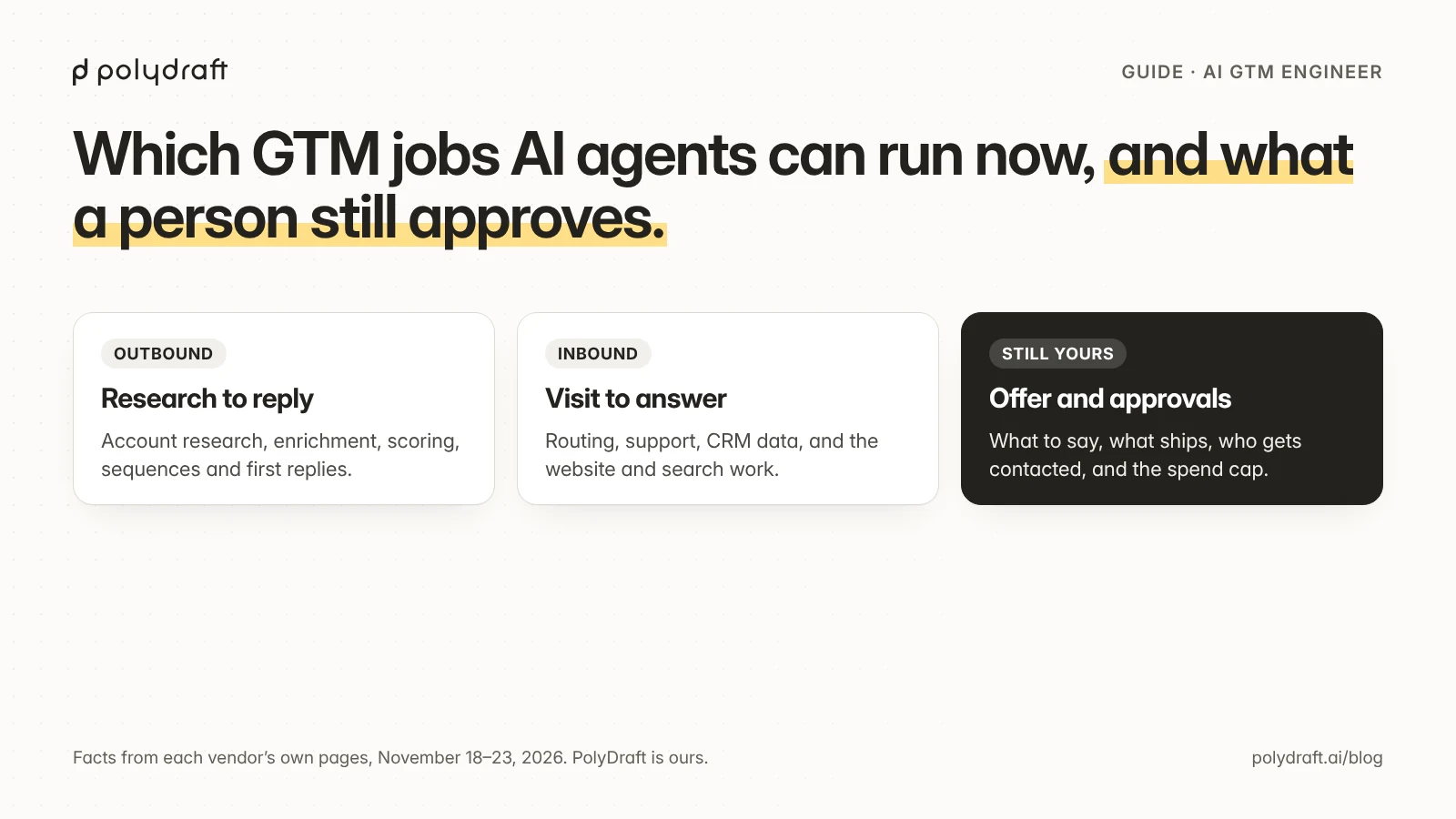
"AI GTM engineer" means two things. The first is a person: a GTM engineer who builds go-to-market systems with AI, data and workflow tools instead of doing the work by hand. The second is software: AI agents that run go-to-market tasks themselves, such as researching accounts, drafting outreach, answering replies, routing website visitors, resolving support tickets and keeping CRM records current.
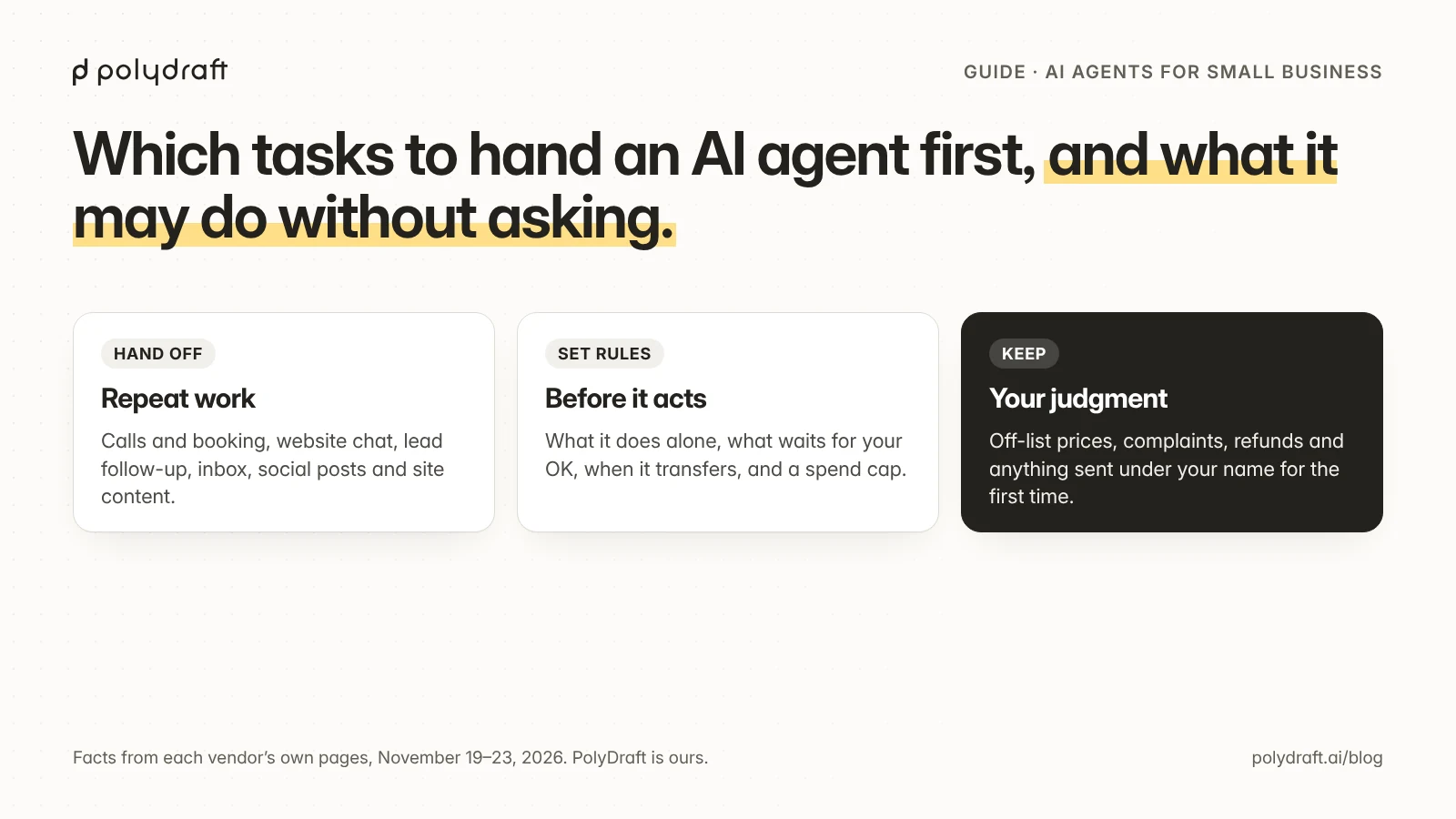
This guide covers the second meaning in depth. That is the decision in front of most founders right now: which GTM jobs to hand to agents, and what a person must keep. The short answer from the vendor pages we read: agents can now run most of the repetitive, per-row work on both halves of go-to-market. What they do not own is the offer, the decision about who gets contacted, the approval of anything sent under your name, and the budget cap. The table below maps each GTM job to the agents that run it. It also shows whether the vendor says each agent runs alone or waits for a person, the entry price, and what you still own.
This guide is for a startup founder or a first GTM hire. We make PolyDraft, which covers one part of this map (the website, its content and its search work) and none of the outbound part. It appears in labeled paragraphs. We did not test the other products hands-on: every vendor fact comes from the vendor's own page, read on the date shown. The section on how we run our own inbound GTM with agents is first-hand.
Key points
- Ask three questions of any GTM agent: what does it do without asking, where does a person approve, and what is the billing unit? The marketing name answers none of them.
- Billing has moved to units of work. HubSpot's prospecting agent costs $1 per lead it recommends outreach for, and its customer agent $0.50 per resolution. Clay and Instantly sell monthly plans with credits.
- Approval is usually a setting you choose, not a fixed rule. Workflow tools such as n8n describe "human approval when needed" as a step you add.
- Start with one job, a small batch and a spend cap. Our own agents do the research and drafting for polydraft.ai, and a person approves what gets published.
What an AI GTM engineer is: the role and the agents
An AI GTM engineer is either a person who builds go-to-market systems with AI, or a set of AI agents that run go-to-market tasks. Both meanings come from the same shift: almost every GTM step now has an API, and language models made the steps between them cheap to automate.
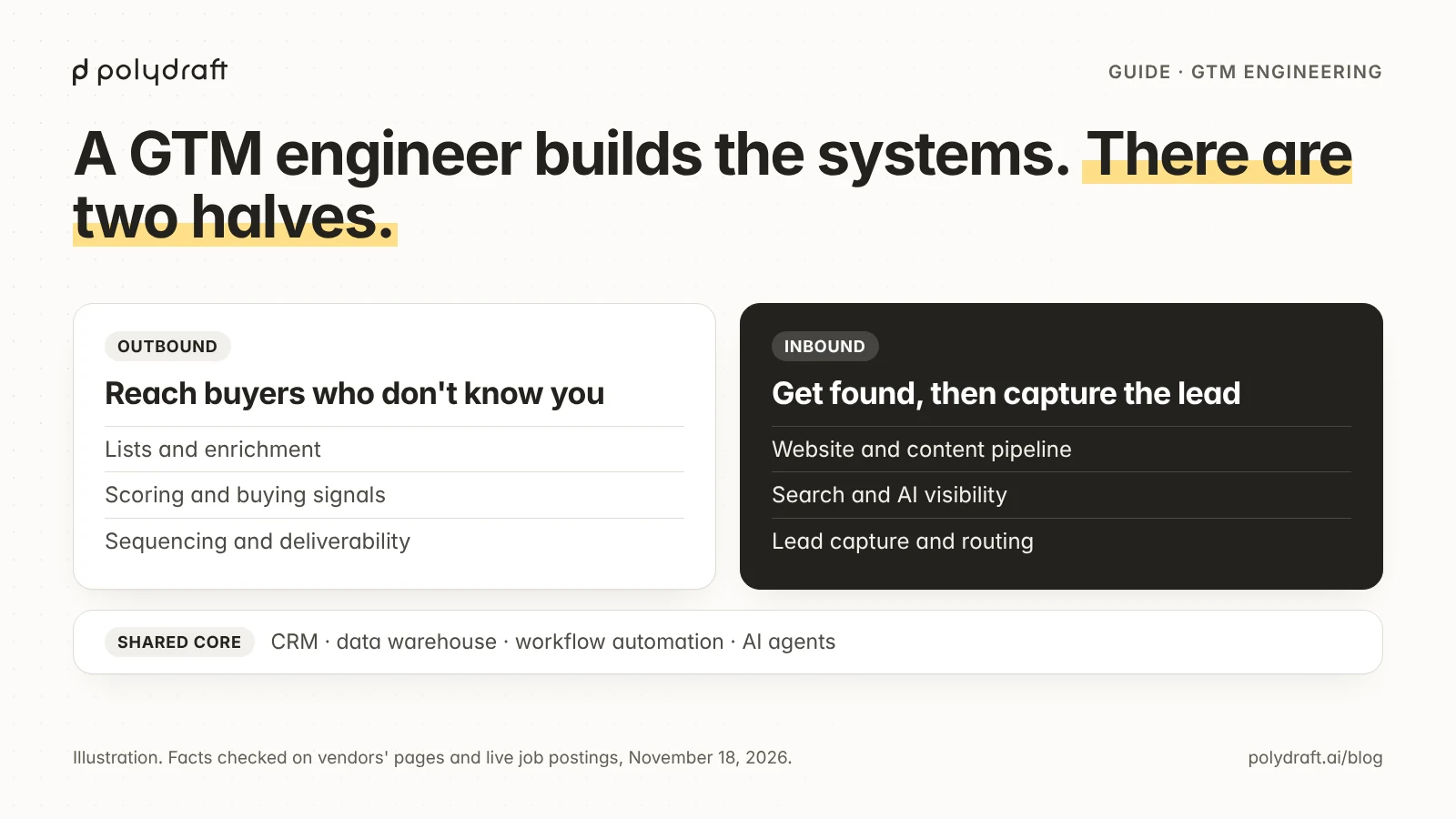
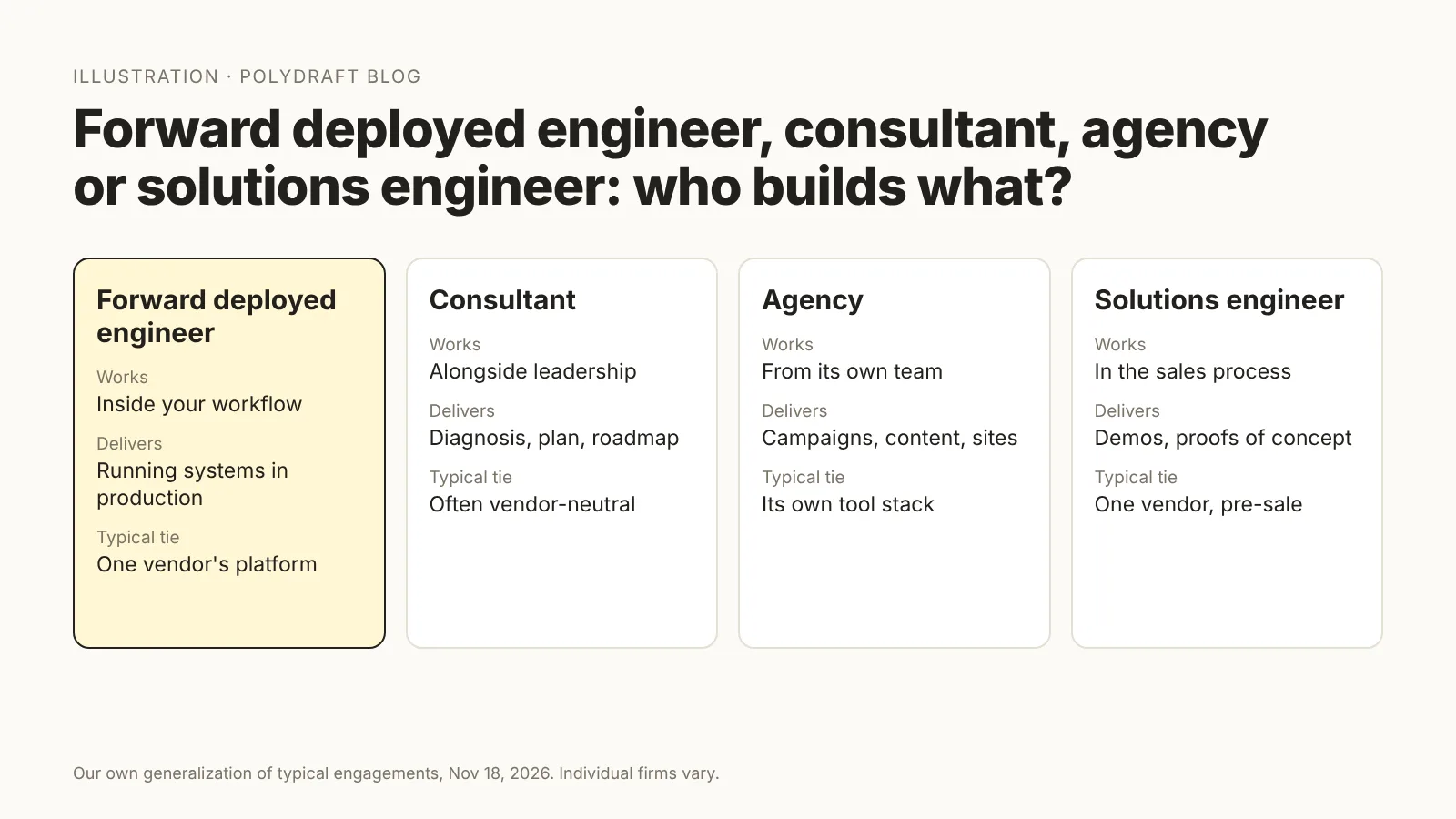
The role. Clay says it coined the role in 2023. It defines GTM engineering as "the practice of building automated revenue systems with AI, data, and workflow automation, instead of running go-to-market by hand" (Clay's guide, read November 18, 2026). The State of GTM Engineering survey describes the person as "a technical go-to-market operator who builds the data, automation, and AI workflows behind pipeline and revenue." Every GTM engineer is now an "AI GTM engineer" in this sense. Our guide on what a GTM engineer is covers the human role, the stack, the salary and how to hire one.
The agents. By November 2026 the large GTM vendors sell agents as named products with their own prices. HubSpot's Agent Hub page offers "a team of AI agents for marketing, sales, and customer service" built on your CRM data (HubSpot, read November 23, 2026). Instantly's pricing page lists an "AI SDR" described as an "Autonomous AI sales development rep" (Instantly, read November 18, 2026). When people search "GTM agent" or "gtm ai agents", this is usually what they mean.
The two meanings meet in practice. Someone still decides which agents to run, wires them to the CRM, sets the approval rules and watches the bill. In a small company that person is usually the founder. The agents take the per-row work; the person keeps the system. For the same split across other roles, see AI employees compared.
The GTM jobs map: which agents run each job
Most GTM jobs now have at least one agent that runs them. The jobs differ in how much the agent does alone. Each cell below quotes or closely paraphrases the vendor's own page on the date given; "not read" means we opened only the vendor's homepage and saw no price there. Prices are US list prices.
| GTM job | Agents, in the vendor's words | Alone or waits for a person, per the page | Entry price (date read) | What a person still owns |
|---|---|---|---|---|
| Account research and enrichment | Clay: a Claygent "research column runs the same prompt across every account"; Sculptor "turns a plain-English challenge into a live workflow" | Runs on every row once built; the guide says to "prove it works on a small batch" first | Free: 100 data credits, 500 actions a month. Launch from $185 a month, per its pricing FAQ (Nov 18) | Which questions to ask; spot checks |
| Lead scoring | Clay: a scoring agent "outputs a score and the reasoning behind it". Default: a Qualification Agent scores inbound leads "before a rep sees it" | Runs automatically inside the workflow | Clay as above; Default not read | The ideal customer profile and its weights |
| Prospecting and outreach drafts | HubSpot Prospecting Agent "researches accounts, finds the right contacts, and drafts personalized outreach". Apollo: agents "research, build lists, write outreach, follow up, and book meetings" | HubSpot's Agent Hub page: it "reaches out automatically", and you "approve automatic CRM updates and follow-up drafts after every meeting"; its FAQ says you can "review and edit AI-drafted emails before they are sent" on each enrollment, or "switch to fully autonomous mode, which sends emails without requiring review first". Apollo: "prompting you at all the key moments" | HubSpot $1 per lead (Nov 23). Apollo free Starter plan; paid prices did not load (Nov 18) | The offer, the claims, who is contacted |
| Sequencing and replies | Instantly: AI Reply Agent to "handle and qualify replies at scale"; AI SDR | The page calls the AI SDR autonomous; no approval step described on the pricing page | Starter bundle $94 a month with the AI Sales Agent; Scale $194 adds the AI Reply Agent (Nov 18) | When a reply goes to a human; consent rules |
| Buying signals | Common Room: "Let AI do everything your team doesn't have time for". HubSpot Data Agent: buyer intent "tracks 40+ live signals" | Common Room says teams can "govern how AI agents execute"; HubSpot's buyer intent "flags the ones worth acting on" | HubSpot buyer intent $0.10 per company a month (Nov 23); Common Room not read | Which signals deserve action |
| Inbound routing and booking | Chili Piper "recognizes which accounts are on your site, answers their questions, routes them to the right rep, books the meeting". Default: enrichment, qualification, round-robin | Chili Piper: "All without adding headcount". Default keeps "logs of which rule decided" | Not read | Routing rules, privacy and consent |
| Customer support | HubSpot Customer Agent "resolves questions, takes action in your CRM, and hands off to your team with full context" | Runs around the clock and hands off | $0.50 per resolution; needs a Professional or Enterprise edition (Nov 23) | Knowledge content and escalation rules |
| CRM data | HubSpot Data Agent pulls research "from your calls, emails, and deal history, writing it directly to the CRM record" | Writes to records; no review step described on the page | Smart properties $0.10 per answer; Starter and up (Nov 23) | Which fields it may write; audits |
| Workflow glue | n8n: "Connect any model, see every decision, and add human approval when needed." Zapier: an agent "bringing you in for review as needed" | Approval is a step you design | Not read | The architecture and the failure paths |
| Website, content and search | PolyDraft (ours): its pricing page lists weekly keyword opportunities, new articles and refreshes | A person approves before anything is published | Starter $39 a month, 4,000 credits (Nov 23) | Facts, positioning and the approval |
Sources for each row are listed under Sources at the end. Clay, Instantly, Apollo, Common Room, Chili Piper, Default, n8n and Zapier were read on November 18, 2026 during the fact-check for our GTM engineer guide. HubSpot and PolyDraft were read on November 23, 2026.
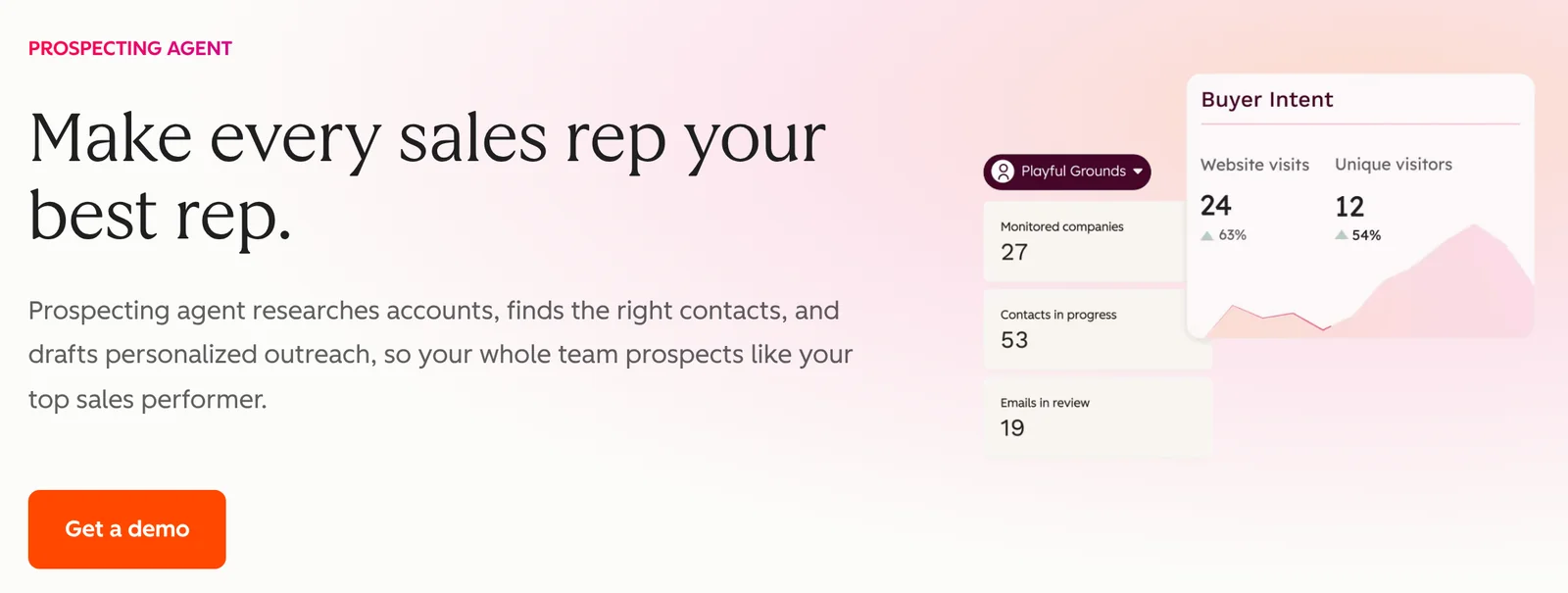
HubSpot's Prospecting Agent page, captured November 23, 2026. The product panel on the right is HubSpot's own illustration; its numbers are not customer data.
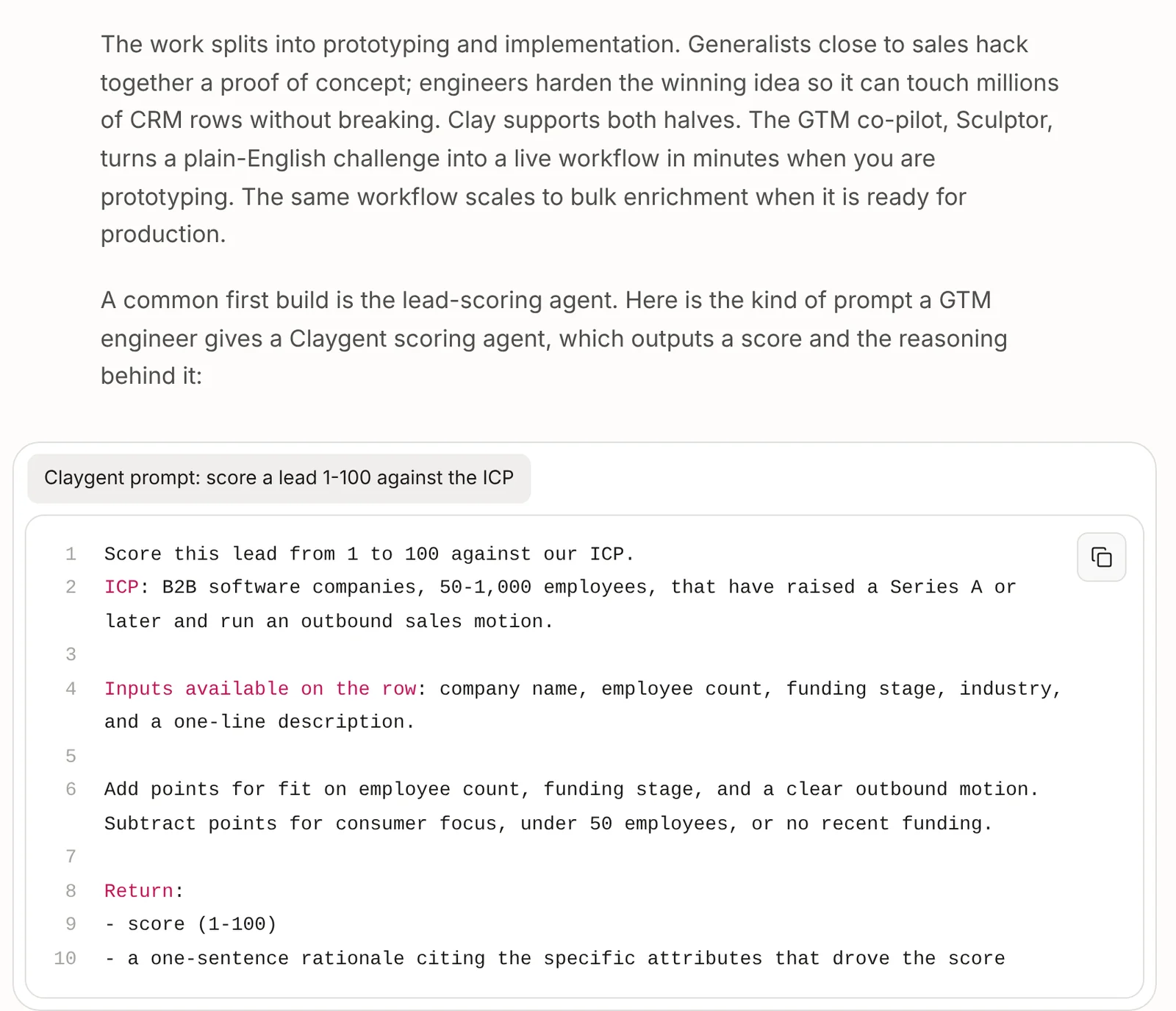
Clay's guide to GTM engineering, captured November 18, 2026: Sculptor builds the workflow from plain English, and a Claygent scoring prompt returns a score with a one-sentence reason.
The outbound half and the inbound half
Agents are further along on outbound than on inbound, because outbound work is already a list of rows. A list of accounts, each researched, scored, written to and followed up, is exactly the repeated task an agent handles well. Clay's guide describes the "lead-scoring agent" as "a common first build", and Instantly sells agents for each step from lead finding to replies.
The risk on outbound is volume. An agent that writes a thousand emails also sends a thousand mistakes if nobody looks. Apollo's homepage promises its agents prompt you "at all the key moments". It also says they are "designed to help keep your prospecting compliant, with built-in support for consent and opt-out rules". Treat that as the vendor's claim and check where the prompts actually appear before you scale.
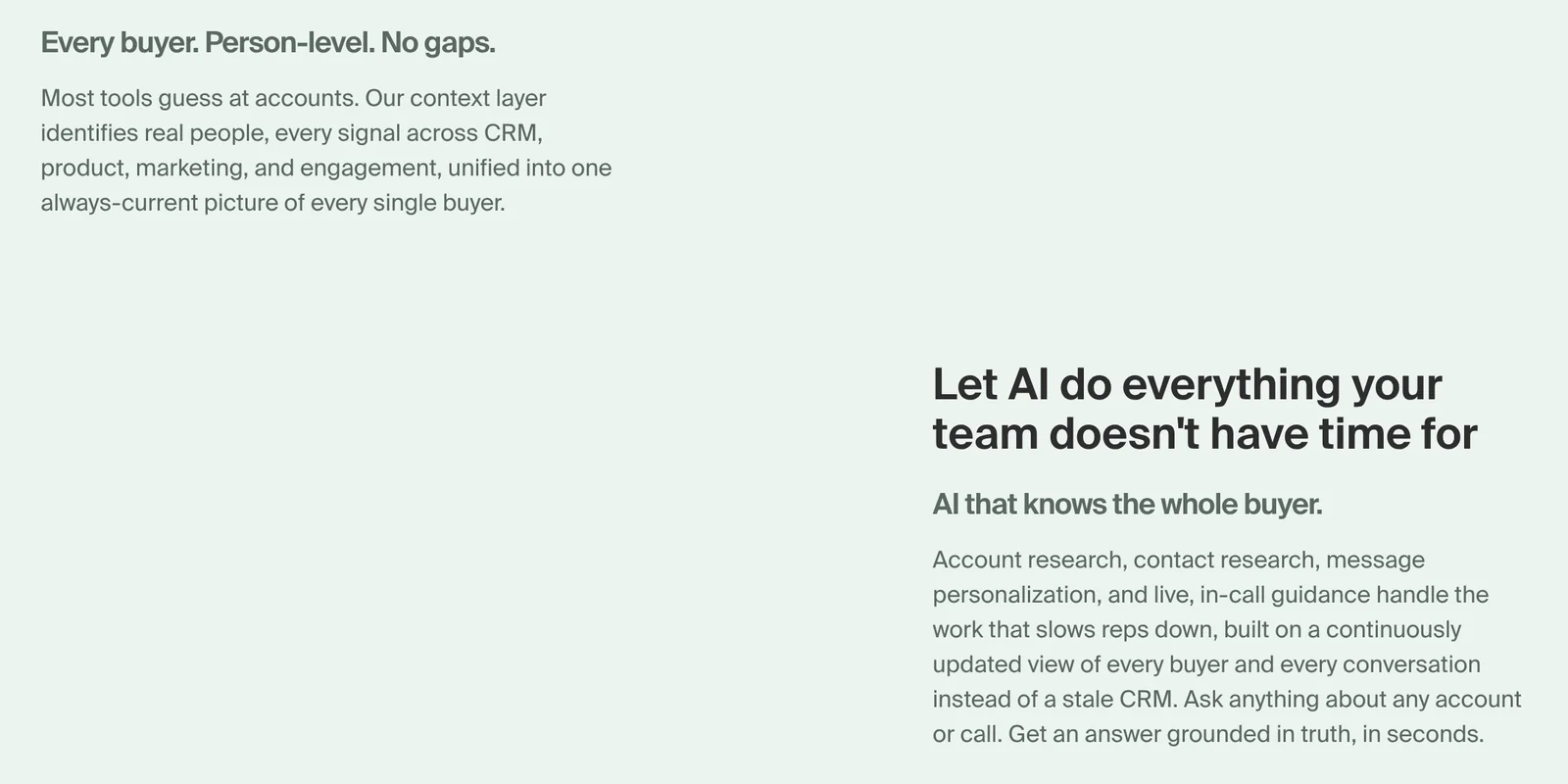
Common Room's homepage, captured November 18, 2026. The product images beside the text did not load in our capture, and a cookie banner at the bottom of the page was cropped out.
On inbound, agents now sell for the steps after a buyer arrives: Chili Piper and Default for the visit-to-meeting step, HubSpot's customer agent for support. The step before, getting found in search and AI answers, is covered in our guide to using AI agents in SEO. Our GTM engineer guide explains both halves of the role.
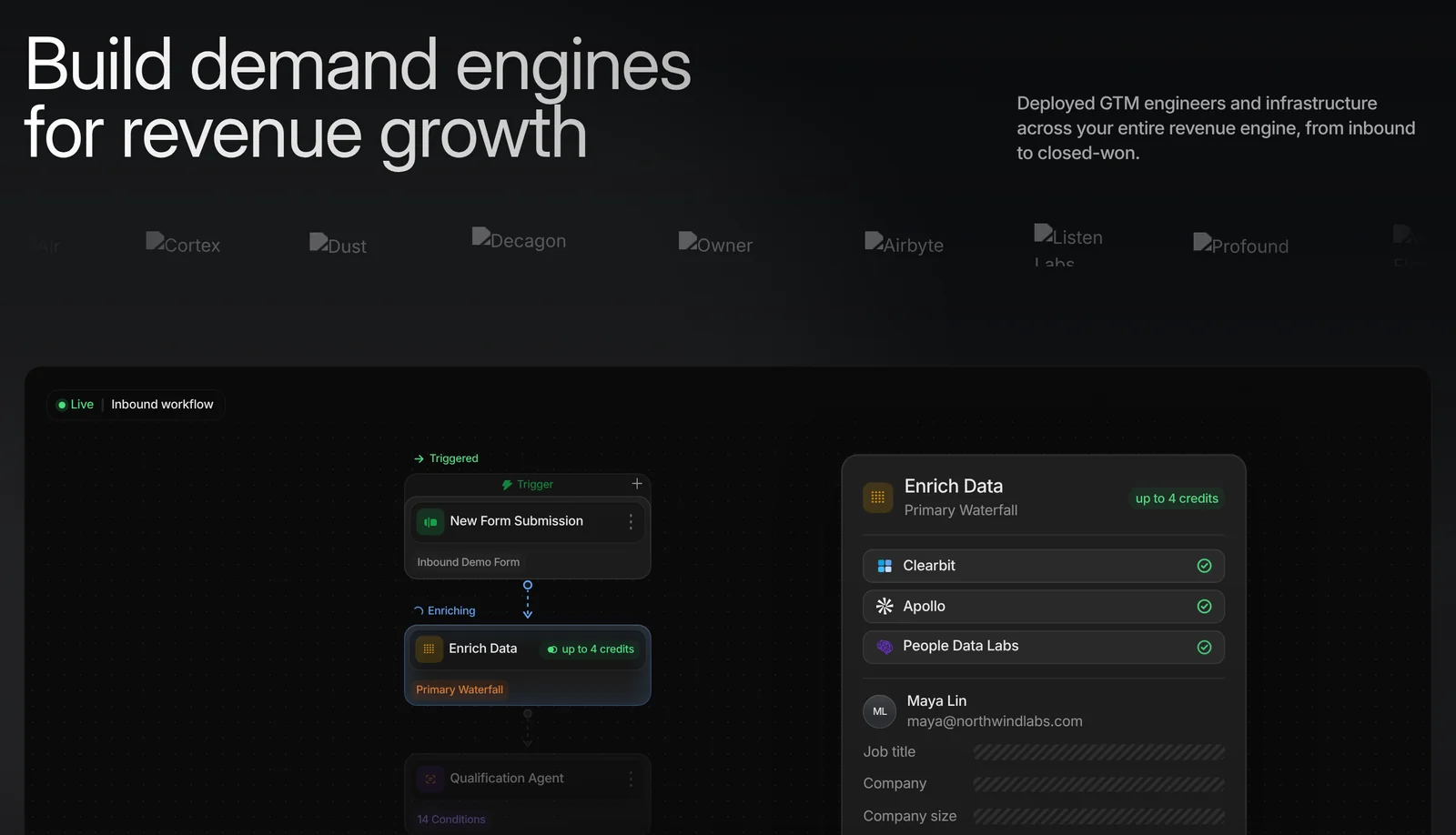
Default's homepage, captured November 18, 2026: a live inbound workflow from form submission to enrichment and a qualification agent. The contact card is Default's own demo data, the customer logos did not load in our capture, and a changelog notice at the bottom was cropped out.
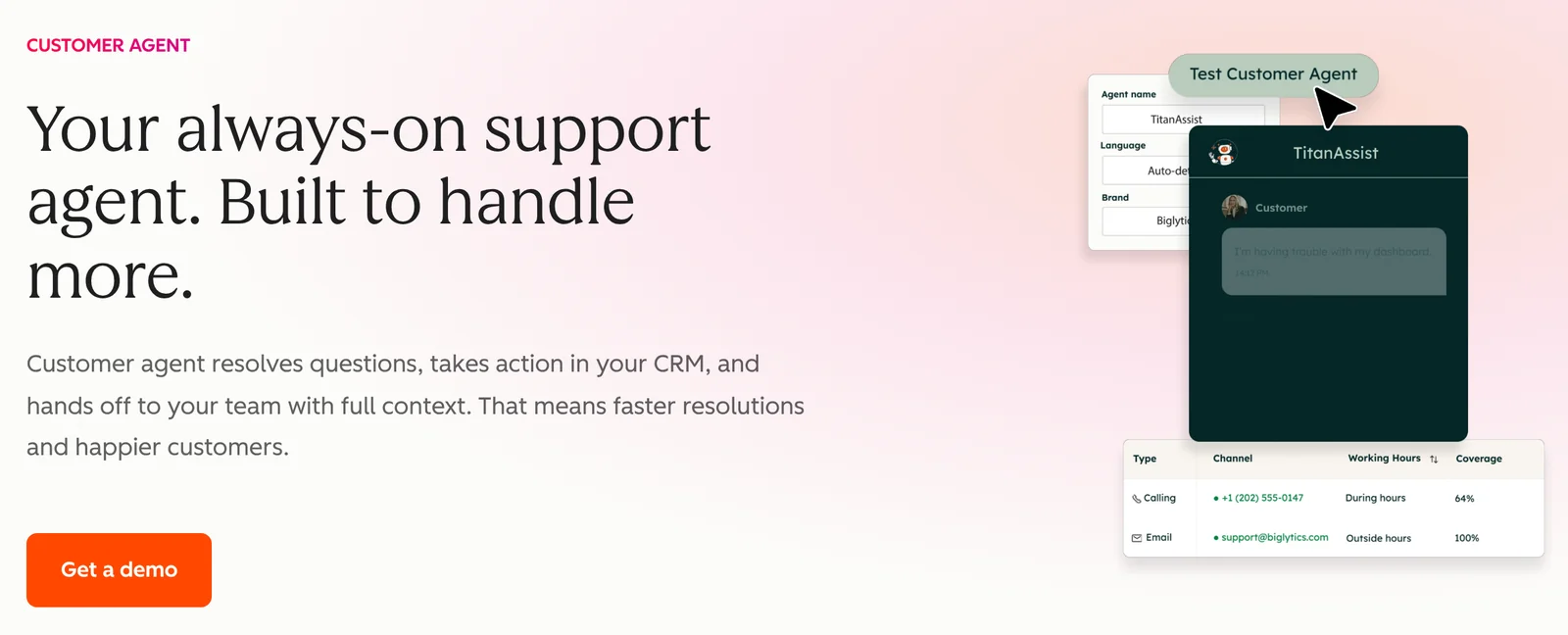
HubSpot's Customer Agent page, captured November 23, 2026. HubSpot says it needs a Professional or Enterprise edition and bills $0.50 per resolution.
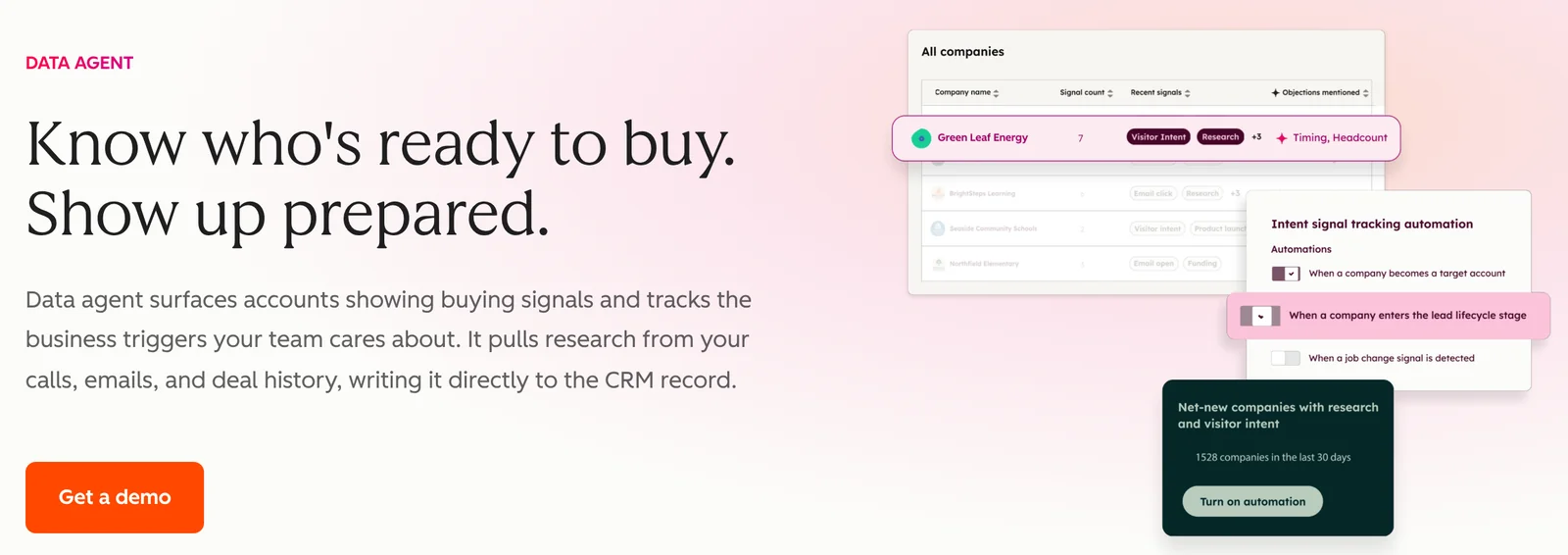
HubSpot's Data Agent page, captured November 23, 2026. Because it writes research "directly to the CRM record", a person should decide which fields it may change.
Which half to start with depends on whether buyers already search for what you sell; the GTM engineer guide covers that choice. For agents, the rule is the same on both halves: one job first. The sibling guides cover the marketing agents and the agents a small business can hand work to in more detail.
How approval, spend limits and logs work
Three controls decide whether a GTM agent is safe to run: an approval step, a spend limit and a log. Vendors describe all three, but the pages say less about defaults than about features.
Approval steps. HubSpot's Agent Hub page asks you to "approve automatic CRM updates and follow-up drafts after every meeting". Its agent builder page (from $7 a month) has a section titled "Control which actions run on their own" (HubSpot agent builder). The prospecting agent's FAQ answers "Can I review and edit outreach emails before they are sent?" with yes, on every enrollment. It adds that you "can switch to fully autonomous mode, which sends emails without requiring review first" (HubSpot Prospecting Agent). n8n's homepage lists "Human-in-the-loop, guardrails, evaluations" (n8n). Zapier separates an embedded agent that "uses approved tools and instructions" from a fully agentic one "bringing you in for review as needed" (Zapier). In every case, review is something you configure. Ask what the default is.
Spend limits. HubSpot Credits cost "$10/1,000 credits", and the credits page lists spend caps ("Set individual credit limits so no feature runs past its budget"), usage reporting and feature pausing. Clay separates data credits (the data it buys for you) from actions (the work it runs). Its pricing FAQ says "If an enrichment returns no result, you're not charged Data Credits or Actions." On Launch and Growth, unused data credits can build up to twice the monthly amount; actions reset each cycle.
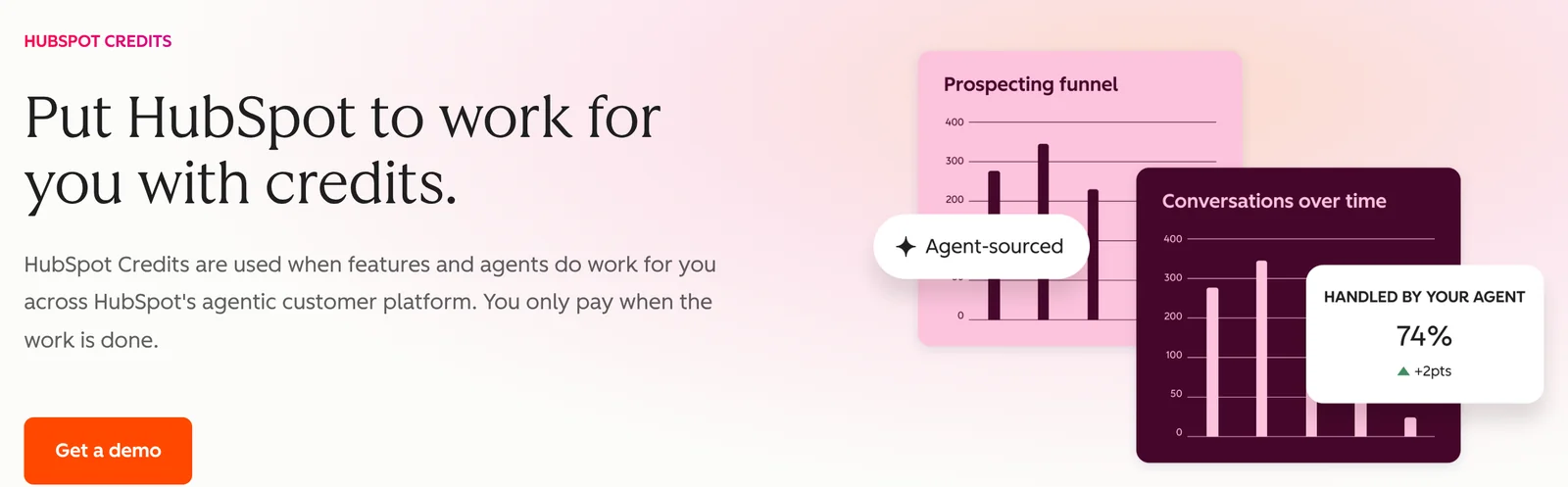
HubSpot's Credits page, captured November 23, 2026. "You only pay when the work is done" is HubSpot's description of its own billing.
Logs. n8n says you can "open any past run" and offers "Audit logs and log streaming to your SIEM". Zapier says you can "see every agent action and workflow run in one place, along with its owner and the systems involved", and "turn workflows off with a single click". Default's routing keeps "logs of which rule decided". HubSpot's credits page says you can "track every action in real time", but that describes credit use, not a record of what an agent sent. If a vendor cannot show you a log of what its agent sent and changed, do not let that agent send anything.
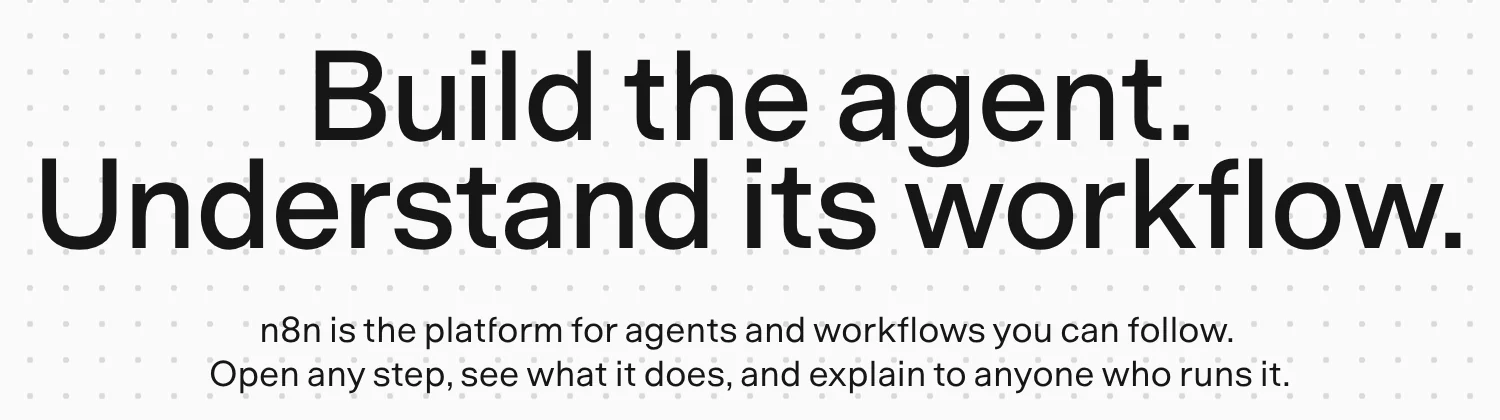
n8n's homepage, captured November 18, 2026. The page's own pitch is visibility: open any step and see what it did.
How we run inbound GTM on polydraft.ai with agents
We run the inbound half of polydraft.ai's go-to-market with AI agents, and a person approves what goes live. Everything in this section is documented in our own repository and research notes. No ranking or traffic result is claimed, because we have not measured one yet.
polydraft.ai is built and maintained with PolyDraft, and content and optimization work started in October 2026. The content work described here runs as our own pipeline of AI agents next to the product; it is our internal workflow, not a feature of a PolyDraft plan. Agents research keywords, read competitor and vendor pages, capture screenshots, draft articles and run a QA script. A person reviews the result and decides what is published.
Keyword research. On November 23, 2026, agents ran a keyword research batch on DataForSEO Labs (Google US, English). It took 78 API calls and cost USD 1.66. It returned about 5,750 unique keywords, which a script filtered to 1,388 reviewed keywords after dropping off-topic meanings, such as "AI workers" in games or Cloudflare Workers. The agents also fetched all 109 URLs in our sitemap to record which phrases our live pages already cover. The output is a proposal, marked not ready to execute. Our founder chose three pages to write from it, and this article is one of them. The phrase "ai gtm" (260 searches a month, KD 18 in DataForSEO's data) had no page on our site.
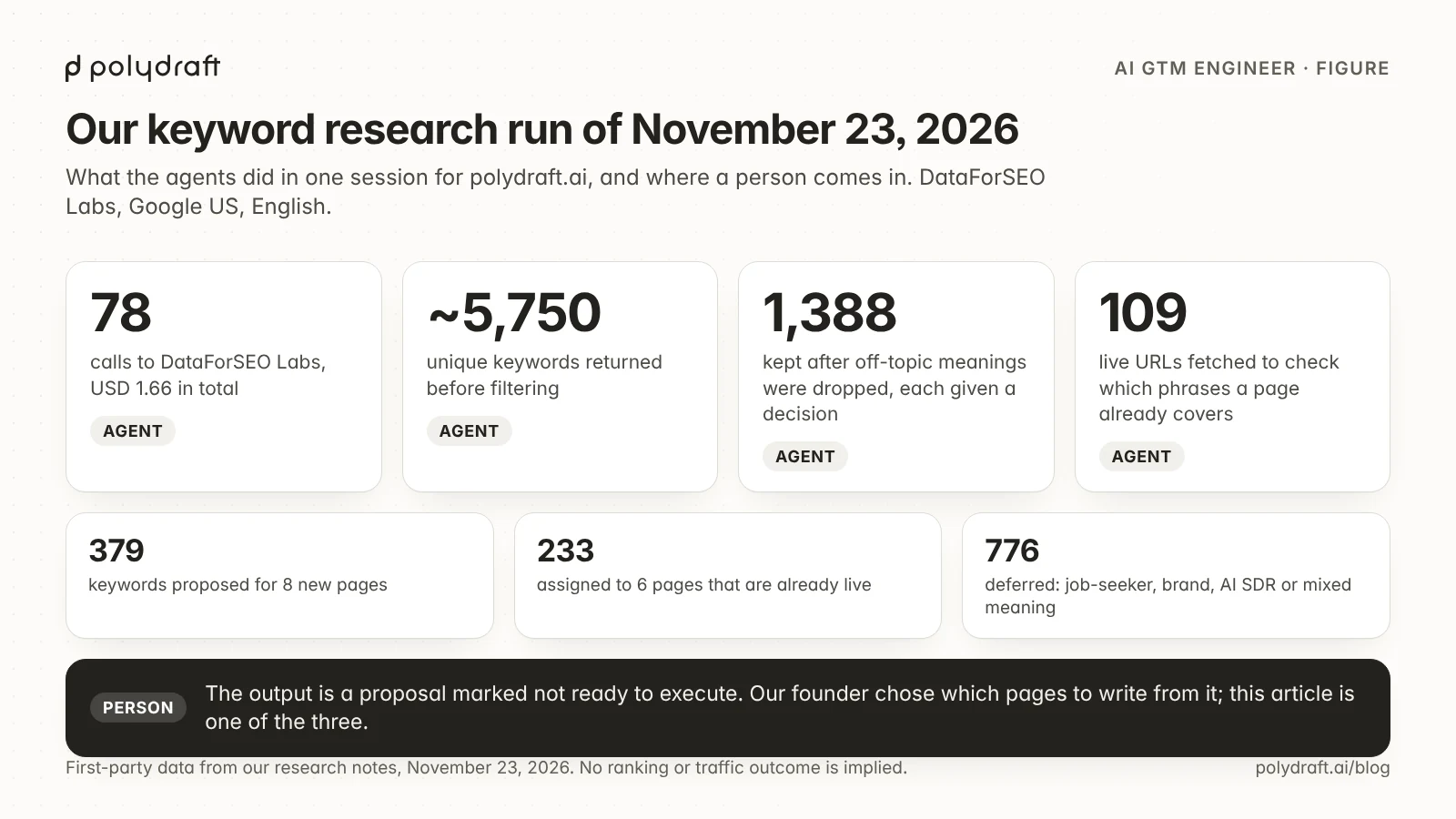
Our own figure, made from our research notes of November 23, 2026. First-party data.
Writing and publishing. On November 18 and 19, 2026, we published 26 posts through the site's content API after review. Our release script records an approver in each publish log. For the November 19 release, the logs name our founder, who approved the set by standing instruction after the review steps below. On November 19, 20 older posts were edited with links to the new ones. On November 20, the 46 new and changed URLs were submitted directly to IndexNow, because our site queues IndexNow pings and sends them only from the admin's browser. The response was HTTP 200.
Review. In the first batch of eight drafts, an independent AI review and a browser fact-check stopped 36 must-fix issues (one critical, 35 serious) before anything reached our founder. He spent about two hours of his own time on a program of 22 articles, from keywords to review. Weekly review of the site's content work still takes several hours. Before PolyDraft, the same weekly work took a team of three people one to two days. Those are our founder's figures, not an independent measurement.
| Step | What the agents did | What a person did |
|---|---|---|
| Keyword research | Pulled and filtered keywords, checked live coverage, proposed page owners | Chose which pages to write |
| Vendor facts | Opened each vendor page, saved its text and screenshots, logged every claim | Reviewed the claim ledger |
| Drafting and QA | Wrote drafts, ran the QA script, fixed what it flagged | An independent review and fact-check; the founder approved publication |
| Links and indexing | Wrote exact link edits for older posts and the IndexNow payload | Approved the release |
| Link outreach (outside PolyDraft) | Find opportunities and draft pitches and guest posts | Review and send |
What we have not measured. polydraft.ai is a new site. As of November 19, 2026 it had on the order of a dozen visitors a week, so we have not run an A/B test. We have not measured what the 26 posts did for rankings, traffic or AI citations, and we make no such claim here. What we can say is narrower: agents made the research and drafting cheap enough for a two-hour founder budget, and the review steps caught errors before publication.
What it costs a small team
For a small team, the three example setups below come to about $40 to $450 a month in agent and tool fees, before CRM editions, mailboxes and taxes. The table uses list prices from each vendor's page on the date shown. The volumes are our assumptions for a seed-stage B2B startup, not vendor figures.
| Setup | What you pay for | Assumed volume | Monthly cost | Not included |
|---|---|---|---|---|
| Outbound on its own stack | Clay Launch ($185 a month, read Nov 18) plus Instantly Starter bundle ($94 a month, read Nov 18) | One list, one sequence | About $279 | Sending domains and mailboxes; data top-ups |
| Inside HubSpot | Prospecting Agent at $1 per lead; buyer intent at $0.10 per company a month; Customer Agent at $0.50 per resolution (read Nov 23) | 300 leads, 500 tracked companies, 200 resolutions | About $450 | The HubSpot edition (its pricing pages did not render for us); a Professional edition is required for the customer agent |
| Website, content and search | PolyDraft Starter, $39 a month or $32.50 billed yearly (read Nov 23) | One site | $39 | Your domain and cloud account |
For comparison, the State of GTM Engineering salary page puts the US in-house median base salary for a GTM engineer at $135,000 a year (61 respondents, self-reported). Agents are much cheaper than a hire, but they do not replace the judgment a hire brings. Our growth engineer's martech stack prices the rest of the site and analytics tooling.
Where PolyDraft fits (our product)
We make PolyDraft, so weigh this section accordingly. PolyDraft is not a complete AI GTM engineer. It covers one row of the map, the website and its search and content work, and does no outbound, enrichment, lead scoring or CRM work. Its pricing page lists weekly keyword opportunities from your Search Console, new articles, refreshes of pages that slip and a weekly SEO report on every plan. Plans are $39, $99 and $299 a month with 4,000, 10,000 and 30,000 credits. Pro and above add the PolyDraft bot in Slack. Content is published after the user authorizes it. The SEO automation page says the autopilot will not promise rankings, mass-produce pages or build links.
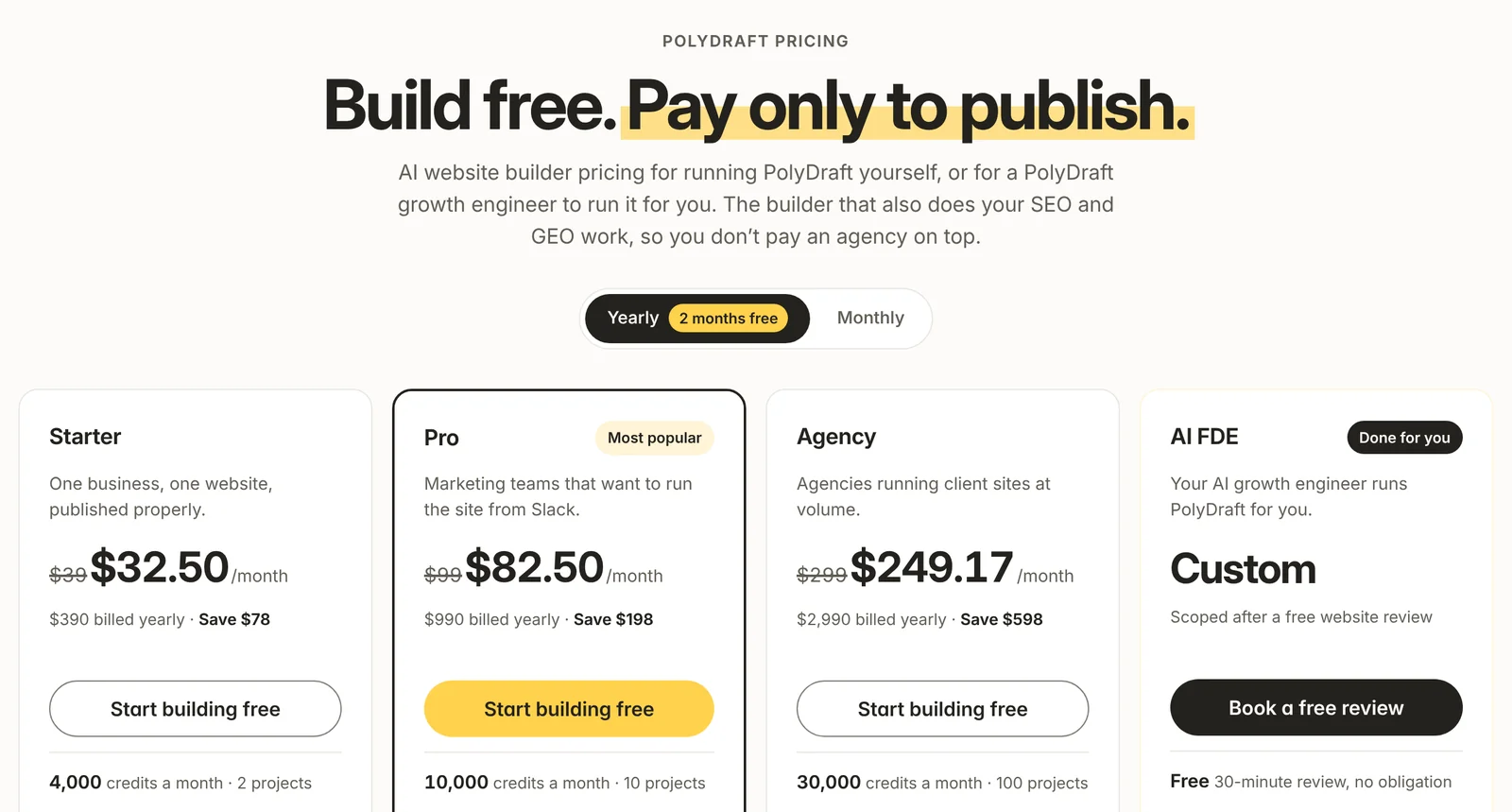
PolyDraft's pricing page, captured November 23, 2026, with yearly billing selected. Monthly prices are $39, $99 and $299.
Use something else if outbound is your main channel (start with Clay, Apollo or Instantly) or if you need support or CRM agents (HubSpot's are built into its CRM). It is also the wrong fit if your site is a store or an app with logins. The startup page explains how to request site changes as your positioning evolves.
A 30-day plan to start with GTM agents
The plan is one job, one small batch, one log and one spend cap, then a decision. Clay's guide gives the same advice: "find a single high-impact problem, build the smallest workflow that fixes it, prove it works on a small batch, and scale it from there."
- Days 1 to 5: pick one job and write the rule. Choose the job from the map where your team loses the most hours. Write down what the agent may do alone, what needs approval, the monthly spend limit, and the number you will judge it by. That number might be meetings booked, replies handled, tickets resolved or pages refreshed.
- Days 6 to 12: run it in approval mode on a small batch. Fifty accounts, one sequence, or one week of support questions. Read every output. Note each error and its type.
- Days 13 to 20: set the cap and read the log. Turn on the vendor's spend cap or credit limit. Check that the log shows every message sent and every record changed. If it does not, keep approval on.
- Days 21 to 30: widen or stop. Loosen approval only for the outputs you never had to fix. Compare the number with your baseline. Keep the agent, change it, or switch it off, and write down why.
Our guide to growth loops shows how a job that works can become a repeating loop.
When not to use GTM agents
Do not hand a GTM job to an agent in these cases:
- You have not done the job by hand. An agent repeats your playbook at scale. If you do not know which accounts convert or which message works, it repeats a guess.
- Nobody will read the output for the first weeks. If no one can check the first batch, keep the work manual.
- You cannot meet consent rules in your market. Outbound agents send at volume, and the messages go out under your company's name.
- Your data is wrong. Agents that write to the CRM spread bad records faster than people do.
- The vendor shows no log. If you cannot see what the agent did, you cannot find its mistakes.
For the human side of the decision, including when a full-time hire makes sense, see what a growth engineer is and the GTM engineer guide linked above.
Frequently asked questions
What is an AI GTM engineer?
Either a GTM engineer who builds go-to-market systems with AI, data and workflow tools, or a set of AI agents that run GTM tasks. Those tasks include account research, outreach drafts, reply handling, lead routing, support and CRM updates. Most products sold under the label are the second kind, and they still need a person to set rules and approve output.
Can AI replace a GTM engineer?
Not on the evidence of vendor pages. Agents take the per-row work: research, scoring, drafts, first replies, routing. Someone still chooses the offer and the targets, connects the systems, sets approval and spend rules, and fixes what breaks. In a small company, agents can postpone the hire.
What are the best AI GTM tools?
It depends on the job. From the pages we read: Clay for research and enrichment, Instantly and Apollo for sequencing and replies, and HubSpot's prospecting, customer and data agents if you already use HubSpot. Beyond those, Common Room for signals, Chili Piper and Default for inbound routing, n8n and Zapier to connect them, and PolyDraft (ours) for the website and search work. This is a map by job, not a ranking.
What does GTM AI mean?
GTM AI is AI used in go-to-market work: sales, marketing and customer success. It usually refers to agents and AI features that research buyers, write and send messages, route leads and answer customers. An AI-powered GTM platform bundles several of those agents around a CRM or a data layer.
How much do GTM agents cost?
As listed on November 23, 2026, HubSpot charges $1 per lead for its prospecting agent and $0.50 per resolution for its customer agent. As read on November 18, Clay starts at $185 a month on Launch, with a free plan, and Instantly's Starter bundle is $94 a month. Our three example setups come to about $40 to $450 a month in agent and tool fees, plus CRM and mailbox costs.
Continue with the next task
- Understand the human role, its stack and salary: what a GTM engineer is
- Compare with the growth role and what AI takes over there: what a growth engineer is
- See which AI products work across roles, and where you approve: AI employees compared
- Price the site, analytics and search tools around your agents: the growth engineer's martech stack
About this article. Drafted by an AI agent following PolyDraft's blog workflow and checked by an automated QA script. Vendor facts were read on each vendor's own pages: HubSpot and PolyDraft on November 23, 2026, and the other vendors on November 18, 2026, during the fact-check for our GTM engineer guide. Each fact is logged with its quoted wording and capture file. None comes from a search excerpt, vendor figures are reported as the vendor's, and no product was tested hands-on. The section on our own work comes from our repository's release records, our keyword research notes of November 23, 2026, and statements from PolyDraft's founder. PolyDraft is our product and was held to the same evidence rule. The screenshots are captures of the vendor pages, cropped and resized but otherwise unchanged.
Sources
Pages were opened on the dates shown (UTC).
- HubSpot, November 23, 2026: Agent Hub, Prospecting Agent, Customer Agent, Data Agent, HubSpot Credits, agent builder
- Clay, November 18, 2026: guide to GTM engineering, pricing
- Instantly, November 18, 2026: pricing
- Apollo, November 18, 2026: home, pricing
- Common Room, November 18, 2026: home
- Chili Piper, November 18, 2026: home
- Default, November 18, 2026: home
- n8n, November 18, 2026: home
- Zapier, November 18, 2026: home
- State of GTM Engineering, November 18, 2026: home, salary
- PolyDraft, November 23, 2026: pricing, SEO automation, for startups