The Growth Engineer's Martech Stack for 2027: 21 Tools, by Job
A martech stack from the growth engineer's seat: 21 tools for five jobs, the order to add them, and dated US list prices.
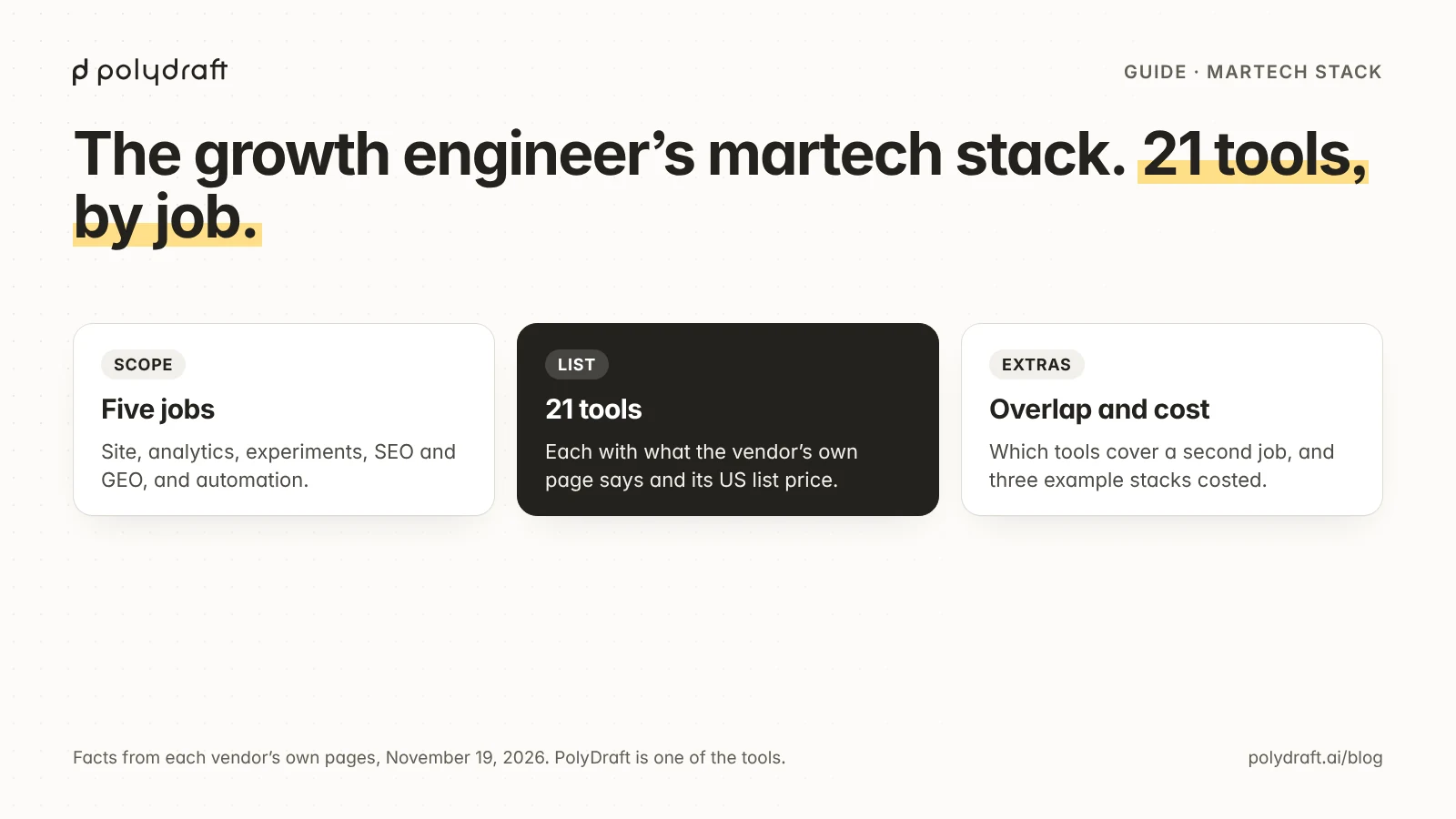
A martech stack is the set of software a company uses to plan, run and measure its marketing. A growth engineer needs only part of it: the tools for five jobs where code changes the result. Those jobs are shipping the site, measuring what visitors do, running experiments, getting found in search and AI answers, and automating the repeat work. This guide lists 21 tools for those jobs, each with its US list price.
We make PolyDraft, an AI website builder that works as a 24/7 growth engineer for your site, and it is entry 5. It is listed by fit, not first, and described as our own live pages describe it. We ran no hands-on tests for this article. Every price and product fact about the other 20 tools comes from the vendor's own page, opened on November 19, 2026. Our own experience is marked as ours.
What Is a Growth Engineer? defines the role. What Is a GTM Engineer? maps the full go-to-market stack, including the outbound, enrichment and CRM tools left out here.
Key points
- The growth engineer's slice of a marketing tech stack covers five jobs: site, analytics, experiments, SEO and GEO, and automation.
- All five jobs have a stated free starting point on the pages we read: Cloudflare Workers Free for the site, Cloudflare Web Analytics for measurement, PostHog's free tier for experiments, Search Console plus Ahrefs Webmaster Tools for search, and Zapier's Free plan for automation.
- Prices are US list prices in USD as of November 19, 2026, with the billing period stated.
We use six of the 21 ourselves: PolyDraft, PostHog, Google Analytics, Ahrefs, Semrush and DataForSEO.
The martech stack at a glance: 21 tools
| # | Tool | Job | Free starting point | Entry paid price (USD list) |
|---|---|---|---|---|
| 1 | Webflow | Site | Starter plan, 2 static pages | Basic $15/mo, billed yearly |
| 2 | Framer | Site | Free plan on a Framer domain | Basic $10/mo, yearly billing |
| 3 | Vercel | Site | Hobby $0/mo | Pro $20/mo |
| 4 | Cloudflare Workers | Site | 100,000 requests a day | Workers Paid from $5/mo |
| 5 | PolyDraft (ours) | Site, SEO and GEO | Free to build and preview | Starter $39/mo |
| 6 | Google Analytics | Analytics | Price not stated | 360 by contract |
| 7 | Google Tag Manager | Analytics | Price not stated | Not confirmed on Google's page |
| 8 | Cloudflare Web Analytics | Analytics | Free | None listed |
| 9 | PostHog | Analytics, experiments | 1M events and 1M feature flag requests a month | $0.00005 per anonymous event after the free 1M |
| 10 | Webflow Optimize | Experiments | None listed | $299/mo at 25,000 page views |
| 11 | Framer Convert | Experiments | None listed | $50 per 500,000 events, on Pro |
| 12 | Vercel Flags | Experiments | Not confirmed on Vercel's pages | Not confirmed on Vercel's pages |
| 13 | Google Search Console | SEO and GEO | Free | None |
| 14 | PageSpeed Insights | SEO and GEO | No price stated | None listed |
| 15 | Ahrefs | SEO and GEO | Webmaster Tools, verified sites | Lite $129/mo, monthly billing (a $29 Starter plan is also listed) |
| 16 | Semrush | SEO and GEO | Trial terms not checked | SEO plan $139/mo, or $117.33/mo billed annually |
| 17 | Profound | SEO and GEO | None listed | Enterprise, custom |
| 18 | DataForSEO | SEO and GEO, automation | Trial terms not checked | Pay as you go, $50 minimum top-up |
| 19 | Claude Code | Automation | Not on the Free plan | Claude Pro $20/mo, or $17/mo billed annually |
| 20 | Cloudflare Cron Triggers | Automation | Not confirmed on Cloudflare's page | Part of Workers |
| 21 | Search Console API and Analytics Data API | Automation | No price stated | None listed |
Job 1: build and ship the site
Choose between a visual builder (Webflow, Framer), code on a hosting platform (Vercel, Cloudflare), and a builder that also does the content work (PolyDraft).
1. Webflow. A visual site builder with a CMS. Webflow's pricing page lists a free Starter plan with 2 static pages, Basic at $15 a month and Premium at $25 a month, both billed yearly. Premium adds the CMS.
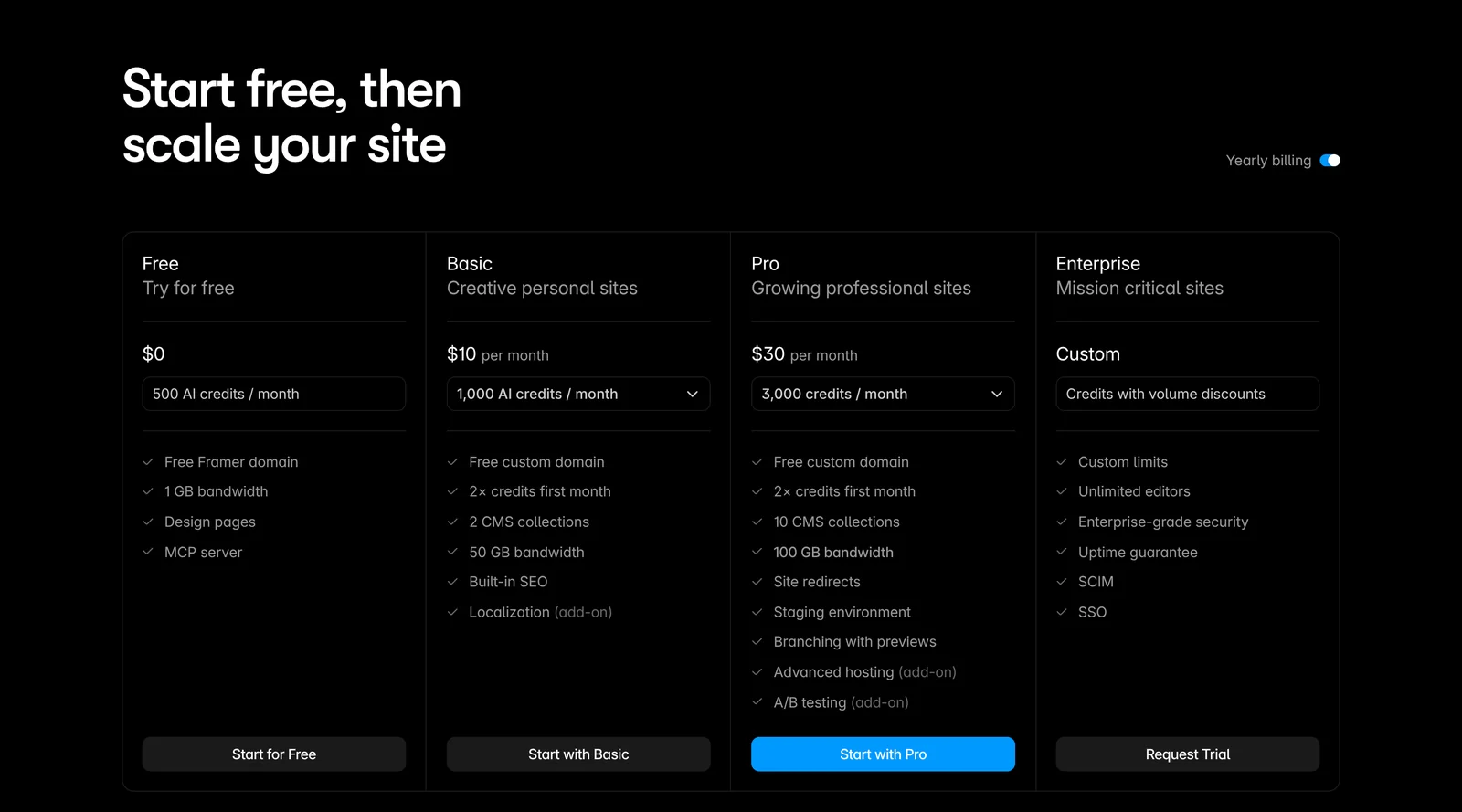
2. Framer. A design-led site builder. Framer's pricing page shows Free at $0, Basic at $10 and Pro at $30 a month with yearly billing selected.
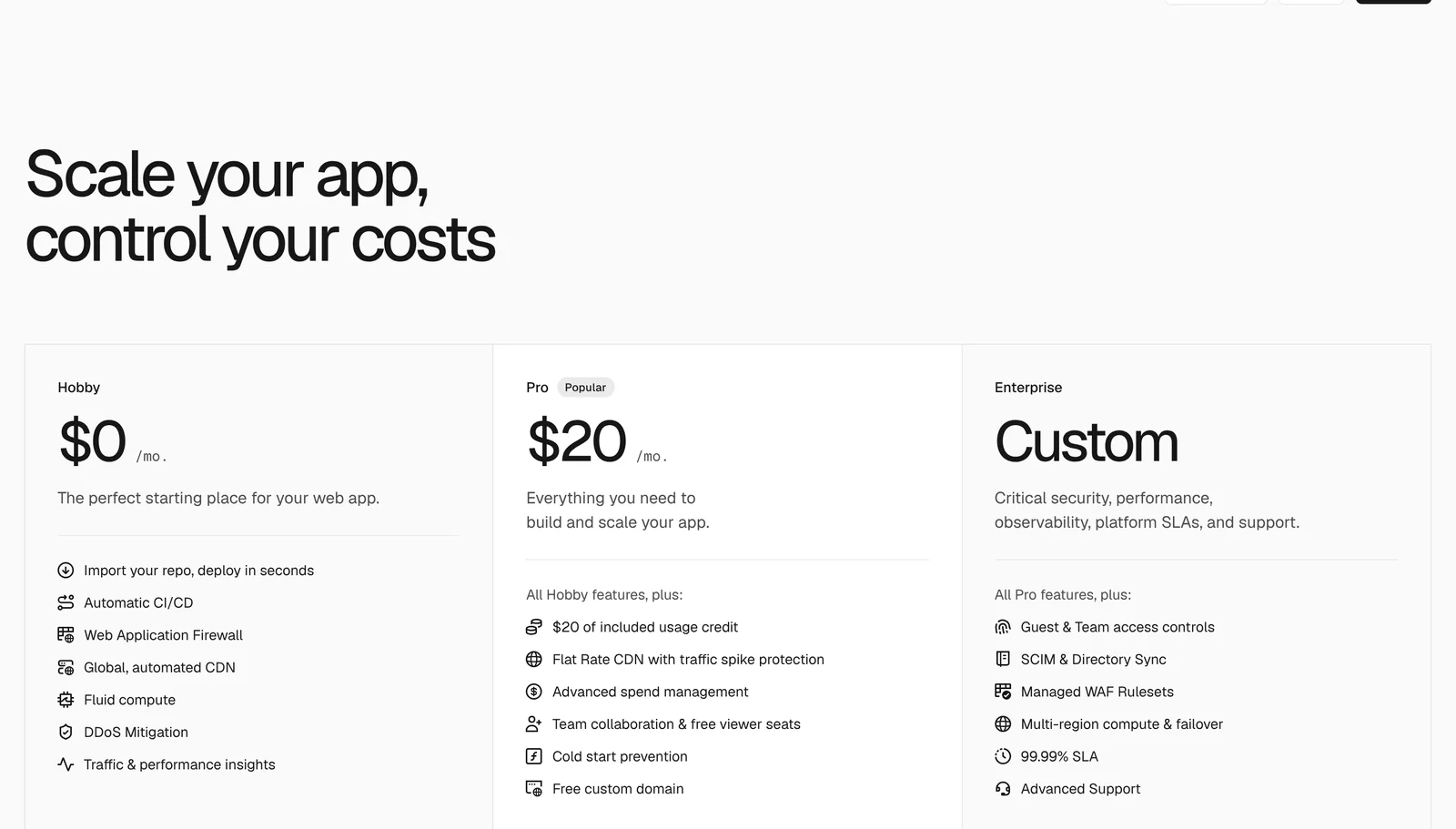
3. Vercel. Hosting for sites you build in code. Vercel's pricing page lists Hobby at $0 a month and Pro at $20 a month.
4. Cloudflare Workers. A serverless platform that also serves static sites. Cloudflare's pricing docs say the Workers Free plan allows 100,000 requests a day and that Workers Paid has "a minimum charge of $5 USD per month for an account."
5. PolyDraft (ours). An AI website builder that keeps working after launch. Our features page says it turns "a plain-language brief or an existing URL into a complete website" and deploys it to a cloud account you own. Pricing lists Starter at $39, Pro at $99 and Agency at $299 a month. It is free to build and preview, and access is invite-based.
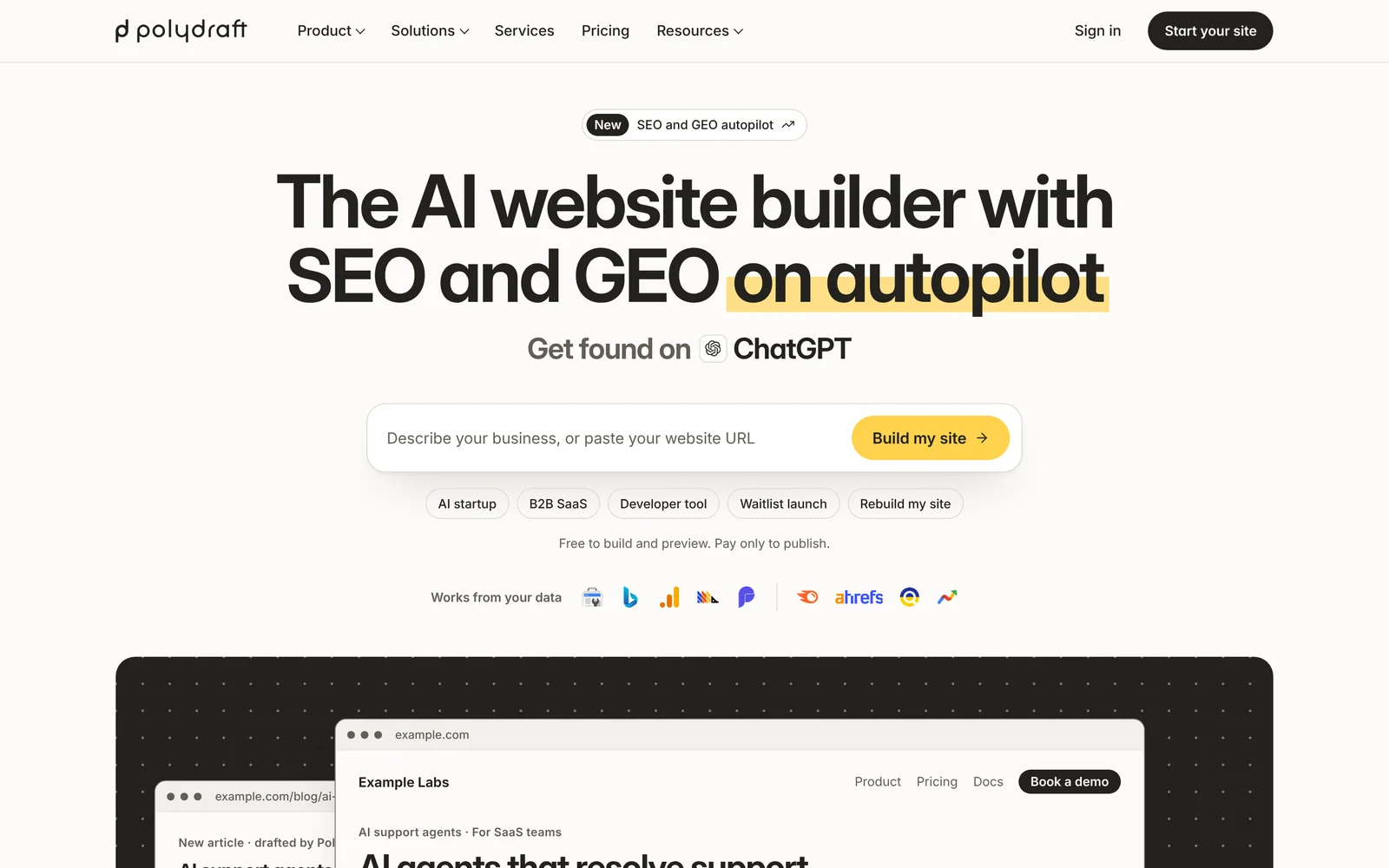
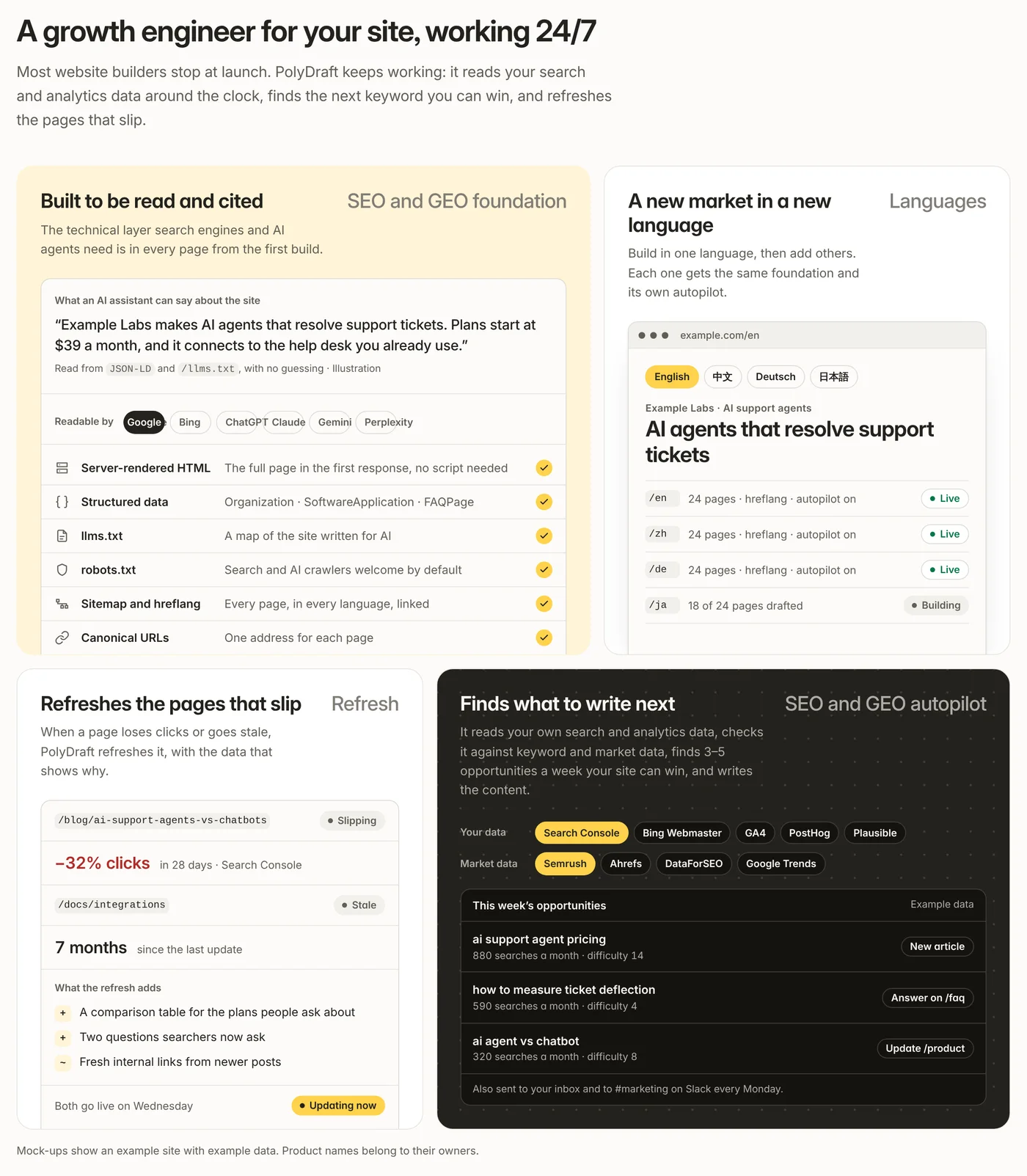
Our homepage calls it "a growth engineer for your site, working 24/7," and every paid plan includes what the pricing page calls "SEO and GEO on autopilot." In this list's terms, it covers two jobs at once and runs them as a weekly loop:
- Reads your data every day: Search Console, Bing Webmaster Tools and GA4, PostHog or Plausible, checked against keyword and market data.
- Finds new opportunities every week: 3 to 5 a week, each a new article, an answer on an existing page or an update.
- Fixes what slips or breaks: refreshes pages that lose clicks or go stale, and checks indexing, titles, canonicals, broken links and structured data on every change and every week, with fixes you can preview.
- Reports back: the opportunities go to your inbox and Slack each Monday, and it reports what moved.
Every article needs your approval before it is published. Our SEO automation page says "no one can guarantee positions, traffic or AI citations." For how this compares with AI products that act without approval, see AI employees compared.
PolyDraft is the wrong pick for some needs. The pages we read list no A/B testing feature. Our integrations page says it has no Zapier, CRM, marketing-automation, e-commerce or payment integration; it offers a script-injection field for your own analytics tag and a REST content API.
We build and maintain polydraft.ai with PolyDraft; content and optimization work began in October 2026. AFFiNE (affine.pro) uses part of PolyDraft's product for its own SEO and GEO growth: one person plus AI maintains content in nine languages and keeps optimizing it.
Manus's growth lead told us their team builds many AI-native tool pages and grows rankings through multiple languages plus internal and external links; the team is very small, and AI does most of the work.
Job 2: measure what visitors do
6. Google Analytics. Google's help page says it "collects event-based data from both websites and apps."
7. Google Tag Manager. Google describes it as "a tag management system" for managing tags "without changing your website's code."
8. Cloudflare Web Analytics. Cloudflare's product page offers it "for free" and says it "does not use any client-side state, such as cookies or localStorage, to collect usage metrics."
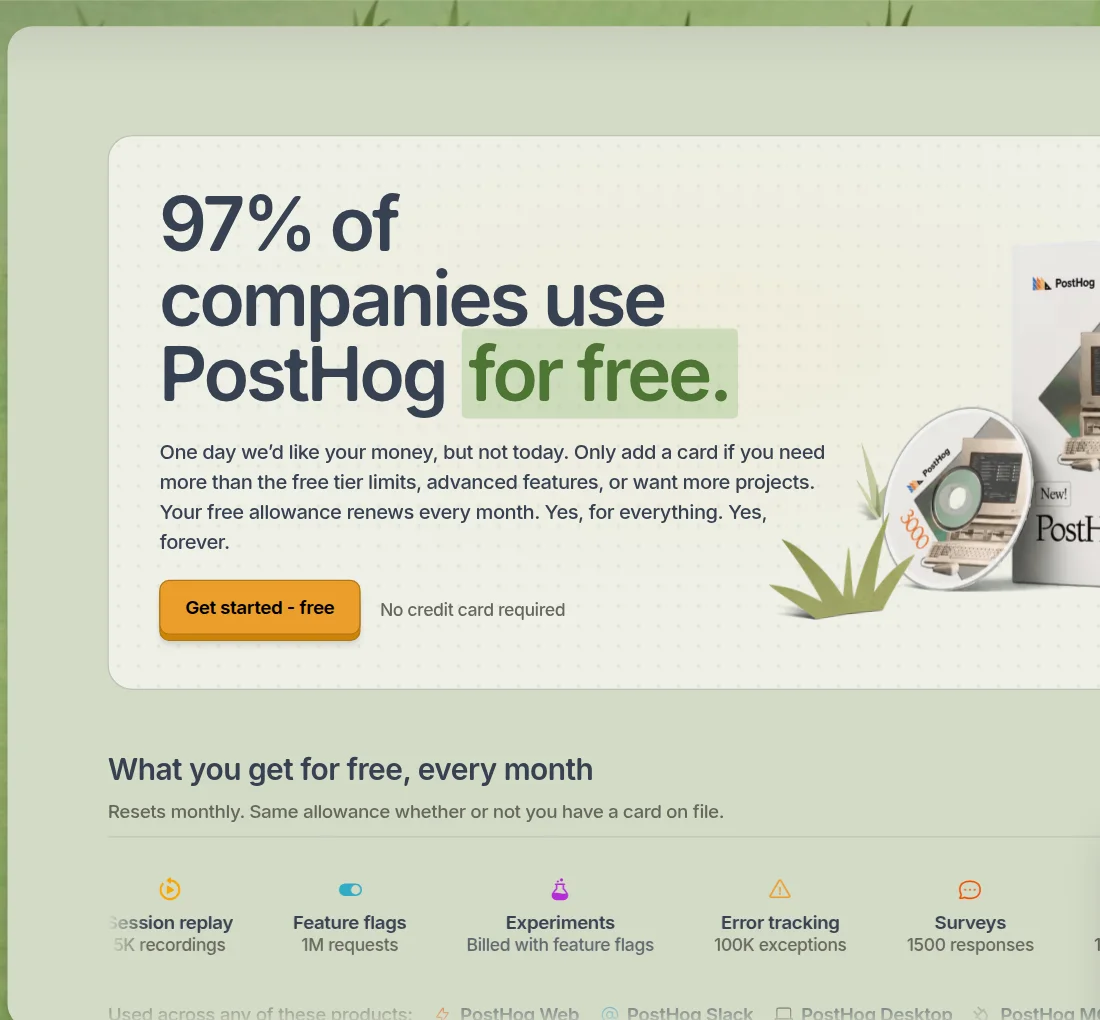
9. PostHog. Product analytics with experiments in the same tool. PostHog's pricing page lists a free tier that resets every month: 1M analytics events, 5K session recordings and 1M feature flag requests, with experiments "billed with feature flags." Pay-as-you-go keeps the free tier, then charges $0.00005 per anonymous event.
One tracking lesson comes from AFFiNE, an earlier site our founder worked on, not polydraft.ai. Its tracking tags loaded before the page content. Visitors who left before the content appeared were still counted, which distorted the data, and the early tags hurt page speed. The tracking was rebuilt to start after the content had loaded. Search clicks in our reports fell from about 2,500 to about 1,500–1,700, roughly a third to 40%, and data quality improved. The problem took a long time to find and to fix. Our advice: load analytics after the content renders, and expect reported numbers to fall.
Also checked on November 19: Plausible starts at $9 a month for 10,000 monthly pageviews on monthly billing. Manus's growth lead told us their team uses it.
Job 3: run experiments
Three vendors we read state a free starting point for experiments: PostHog, GrowthBook and Statsig. Google no longer offers a tool: its help center says "Google Optimize and Optimize 360 are no longer available as of September 30, 2023."
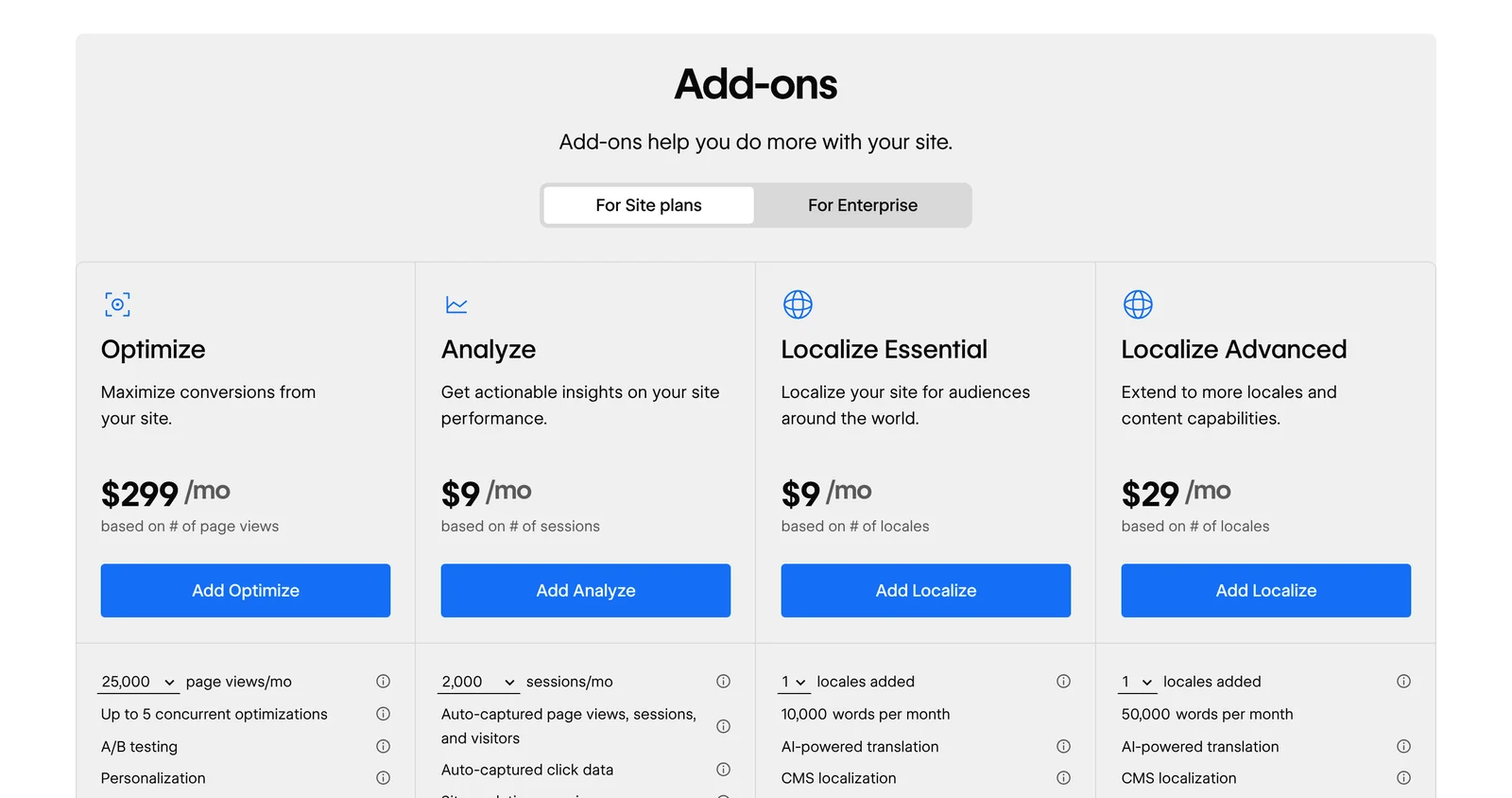
10. Webflow Optimize. An add-on for A/B testing and personalization. The pricing page shows $299 a month at 25,000 page views.
11. Framer Convert. An add-on for Framer Pro: "A/B testing, Funnels, and customization with Triggers" at $50 per 500,000 events.
12. Vercel Flags. Feature flags for code-first sites. Vercel's docs describe flags with "targeting rules, segments, splits, and environment controls."
PostHog (entry 9) also belongs here. Its experiments page lists "A/B, A/B/n, holdout, fake door, and redirect tests."
One rule applies to every tool here when the test page is indexed. Google's testing guidance says to use rel="canonical" on alternate URLs and "a 302 (temporary) redirect, not a 301 (permanent) redirect."
We have not run an A/B test on polydraft.ai yet. The site does not have enough traffic for one: as a new site, it currently gets on the order of a dozen or so visitors a week. At that stage, choosing what to build comes first; see our growth loops guide.
Also checked on November 19: GrowthBook lists a free cloud Starter plan for up to 3 users with unlimited experiments. Statsig lists a free Developer plan with 2M events a month.
Job 4: get found in search and AI answers
Google's own position is that "there are no additional requirements to appear in AI Overviews or AI Mode," per its AI features guide.
13. Google Search Console. Google calls it "a free service offered by Google" for monitoring and troubleshooting your site's presence in Google Search. For page-level checks in the browser, our guide to Chrome extensions for SEO checks sorts 15 by job, with the site access each live one requests.
14. PageSpeed Insights. Google's docs say it "reports on the user experience of a page on both mobile and desktop devices."
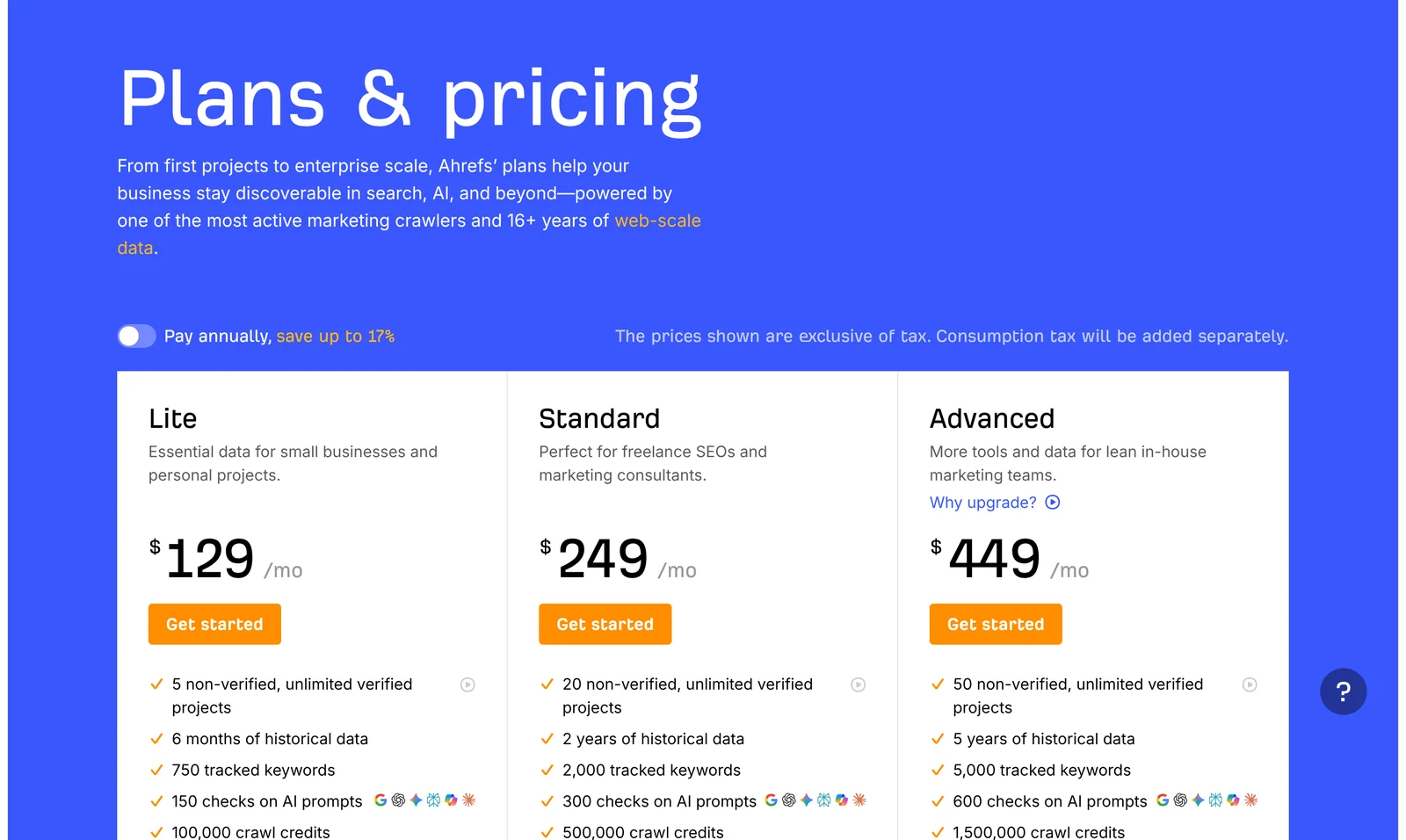
15. Ahrefs. Ahrefs' pricing page lists Lite at $129 a month on monthly billing. Lite includes 750 tracked keywords, 150 checks on AI prompts, and API and MCP access. Ahrefs Webmaster Tools gives free Web Analytics, Site Audit and Site Explorer for sites you verify.
16. Semrush. Semrush's pricing page lists the SEO plan at $139 a month, or $117.33 a month billed annually. Starter, at $199 or $165.17, adds AI visibility tracking with 50 prompts a day and MCP access.
17. Profound. A tracker for brand visibility in AI answers. Profound's pricing page showed one plan, Enterprise, at a custom price.
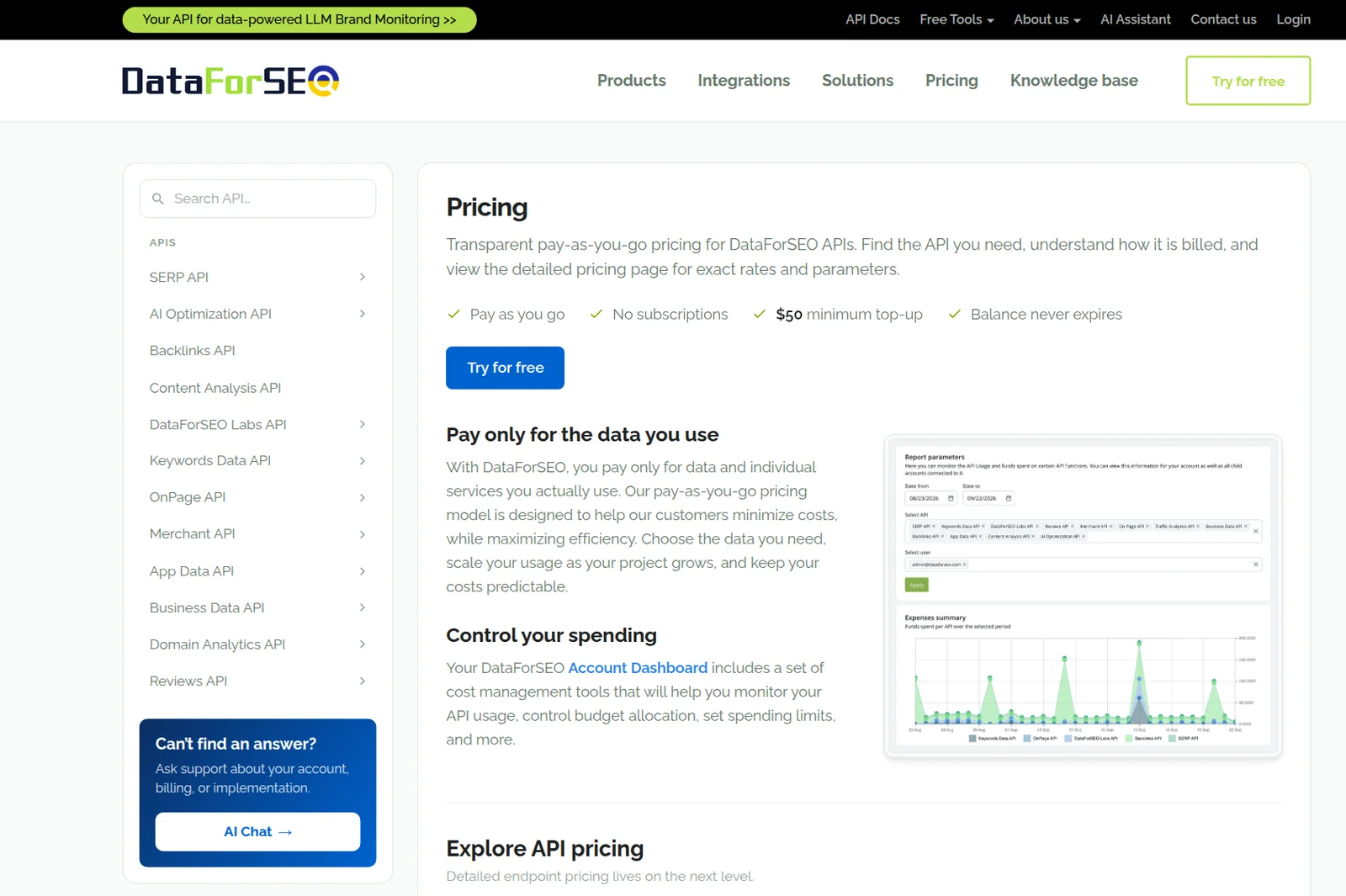
18. DataForSEO. SEO data over an API. Its pricing page says "no subscriptions," a "$50 minimum top-up," and SERP results "from $0.0006 / SERP."
We pay for three suites, not one: Ahrefs, Semrush and DataForSEO, and read them together. In our view, informed by peers, Ahrefs has the freshest data and a large crawl. We use Semrush's CPC and keyword difficulty figures as a reference. DataForSEO is a recent addition, used for its API. We think relying on a single source is a long-term risk.
Also checked on November 19: Peec AI starts at $95 a month for 50 prompts on monthly billing. We have used Screaming Frog; in our view it becomes worthwhile from about 1,000 URLs and is not needed early. For a wider list, see our GEO tools guide and SEO tools for small business.
Job 5: automate the repeat work
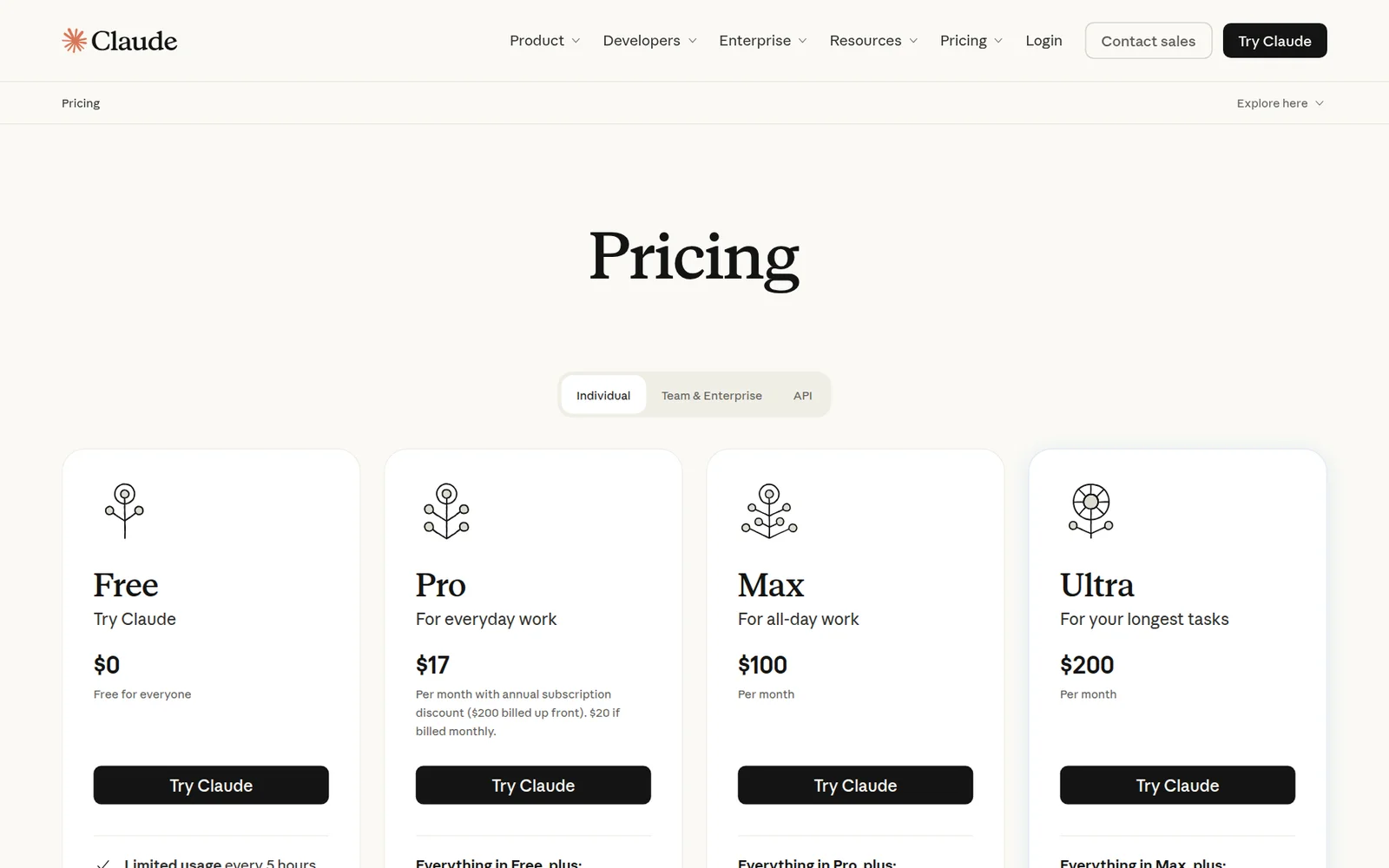
19. Claude Code. Anthropic's docs call it "an agentic coding tool that reads your codebase, edits files, runs commands, and integrates with your development tools." Claude's pricing page lists Claude Code under Pro: $20 billed monthly, or $17 a month with $200 billed up front.
20. Cloudflare Cron Triggers. Cloudflare's docs say they "are ideal for running periodic jobs."
21. Search Console API and Analytics Data API. Google's Search Console API lets you "query your search analytics." The Data API "programmatically accesses Google Analytics report data."
Our own example is link building. We use Grok and Muse (muse.ai) in three steps. An agent looks on X (Twitter) every day for link opportunities and relevant discussions. A second drafts the pitch or the submission. A third drafts the article when the placement is a guest post. We review the pitches and the drafts and send them ourselves. This has run for about two months, and our estimate is ten or more high-quality links set up a month. Separately, DataForSEO's index shows 18 new referring domains in October and 16 in the first 19 days of November, from all sources, so it does not show which came from outreach.
Also checked on November 19: Zapier lists a Free plan with 100 tasks a month. For tools sorted by marketing task, see AI tools for marketers. Several tools above list MCP access; our guide to 13 MCP servers, sorted by job covers the servers themselves.
Where the tools overlap
This table shows which entries reach into a second job, as each vendor's page states.
| Tool | Site | Analytics | Experiments | SEO and GEO | Automation |
|---|---|---|---|---|---|
| Webflow | Yes | Analyze add-on | Optimize add-on | AEO agents on the Team plan | MCP server |
| Framer | Yes | Built in | Convert add-on | "Built-in SEO" on Basic | MCP server |
| Vercel | Yes | Web Analytics | Flags | Not stated | Cron jobs |
| Cloudflare | Yes | Web Analytics | Not stated | Not stated | Cron Triggers |
| PolyDraft (ours) | Yes | Reads Search Console, Bing, GA4, PostHog or Plausible; your own tracking snippet | Not listed | Included: weekly opportunities, refreshes, technical checks | Runs the weekly loop; content API |
| PostHog | No | Yes | Yes | No | Workflows and MCP listed |
| Ahrefs | No | Web Analytics | No | Yes | API and MCP |
| Semrush | No | No | No | Yes | MCP on Starter |
Three example stacks, costed
These totals use only the list prices above, as of November 19, 2026.
| Stack | What is in it | Monthly list cost |
|---|---|---|
| Free floor | Cloudflare Workers Free, Cloudflare Web Analytics, PostHog Free, Search Console, Ahrefs Webmaster Tools | $0 on the vendors' pages, within each free limit; a free scheduler is not confirmed on Cloudflare's page |
| Code-first | Vercel Pro $20 + Ahrefs Lite $129 + Claude Pro $20, plus Search Console | $169, before usage charges |
| Visual builder | Framer Pro $30 (yearly billing) + Convert $50 + Semrush SEO $139 + Claude Pro $20 | $239, at up to 500,000 events |
One tool we dropped is Microsoft Clarity. Its session replay was good, but it loaded too slowly, and PostHog has a similar feature that works well for us.
How to build a martech stack, in order
Build a marketing technology stack in the order your site creates problems, not all at once. One rule keeps it small: add a tool only when no tool you already pay for covers the job, using the overlap table above.
| Stage | Add | Why now | From this list |
|---|---|---|---|
| Before launch | A site, Search Console and lightweight analytics | You need the site live and indexed before any other tool has data to work on | Webflow, Framer, Vercel, Cloudflare or PolyDraft; Search Console; Cloudflare Web Analytics |
| First visitors | Event analytics on signup and the key pages, and free search data | You need to see where visitors drop off before deciding what to change | PostHog Free or Google Analytics; Ahrefs Webmaster Tools |
| Steady content work | One paid SEO suite and a repeatable content loop | Keyword and competitor data start to decide what you write and refresh | Ahrefs Lite or Semrush; PolyDraft's autopilot, or Claude Code with the Search Console API |
| Enough traffic to test | An experiment tool | A test needs traffic to finish: at a 4% signup rate, detecting a lift to 4.8% takes roughly 4,800 visitors a week to that page over four weeks | PostHog experiments, Webflow Optimize, Framer Convert or Vercel Flags |
| Repeat work piles up | Schedulers and APIs | The same report or check is done by hand every week | Cloudflare Cron Triggers, the Google APIs, DataForSEO, Zapier |
The traffic figure comes from the sample-size rule of thumb worked through in what a growth engineer is; use your experiment tool's calculator before you start. Our own stack followed this order: polydraft.ai has no A/B testing tool yet because it doesn't have the traffic, DataForSEO was the most recent addition, for its API, and we dropped Microsoft Clarity once PostHog covered session replay.
How we picked
We grouped tools by the five jobs, then applied one test: could we open the vendor's own page on November 19, 2026 and quote it? Tools that passed are numbered entries. Others, opened in a second pass the same day, carry one verified line each under "also checked." A missing tool is not a judgment against it, and the numbering is not a ranking.
Frequently asked questions
What is a marketing tech stack?
A marketing tech stack, also called a martech stack or marketing technology stack, is the set of software a company uses to plan, run and measure marketing. For a growth engineer, the relevant part covers five jobs: the site, analytics, experiments, search and AI visibility, and automation.
What is a martech stack strategy?
It is the order in which you add tools and the rule for adding one. A workable rule from the overlap table: add a tool only when no tool you already pay for covers the job. The stage table gives an order: site and Search Console first, then event analytics, then an SEO suite and content loop, an experiment tool once traffic allows, and automation last.
How do you build a martech stack?
Start with the free floor (a site, Search Console and lightweight analytics), then add one tool per new problem: event analytics when you need to see drop-off, a paid SEO suite when keyword data decides your content, an experiment tool when a page gets enough traffic for a test to finish, and schedulers and APIs when the same work repeats every week. Our guide to conversion rate optimization tools shows how much traffic a test needs before it can give an answer.
What tools does a growth engineer use?
Tools for five jobs: a site builder or host, analytics, experiments, search and AI-visibility data, and automation (a coding agent, a scheduler and APIs).
Can you build a martech stack for free?
For these five jobs, the vendor pages we read state a free starting point for each, within limits; the key points list them. Expect to pay once you pass a free limit or need competitor data.
Continue with the next task
- Decide what to build before you buy tools: Growth loops, with a worked example for each
- When a page gets enough traffic to test: 15 conversion rate optimization tools, by test type
- Choose the channels before the tools: 9 marketing strategies for startups, ranked by cost and time
- Understand the role these tools serve, and which tasks AI already does: What is a growth engineer?
- Pick AI tools by marketing task: AI tools for marketers
- Set up the recurring search work after launch: Post-launch SEO checklist
- Put agents to work on search: How to use AI agents in SEO
- See what AI employees do alone and where you approve, before you add one to the stack: AI employees compared: 10 products
Updated November 20, 2026: New stage-by-stage table for building a martech stack, fuller FAQ answers, and PostHog, DataForSEO and Claude pricing screenshots (prices re-checked, unchanged).
About this article. Drafted by an AI agent (Claude) following PolyDraft's blog workflow, checked by an automated QA script and approved by Vincent Chen. PolyDraft is one of the tools listed, under the same evidence standard. Vendor facts and prices come from each vendor's own page, opened in a browser on November 19, 2026. Statements about polydraft.ai, AFFiNE and our link outreach come from our founder. We ran no hands-on tests. The November 19 screenshots are unedited captures of vendors' public pages. The PostHog, DataForSEO and Claude pricing screenshots were captured on November 20, 2026 through a third-party page-rendering service, with a cookie notice or chat widget cropped out; the PolyDraft screenshots are of our own homepage the same day.
Sources
All pages opened November 19, 2026.
- Webflow: pricing
- Framer: pricing
- Vercel: pricing, Flags docs
- Cloudflare: Workers pricing, Web Analytics, Cron Triggers
- Google: Analytics introduction, Tag Manager overview, Optimize sunset, About Search Console, Search Console API, Analytics Data API, PageSpeed Insights, website testing, AI features
- PostHog: pricing, experiments
- Ahrefs: pricing, Webmaster Tools
- Semrush: pricing
- Profound: pricing
- DataForSEO: pricing
- Anthropic: Claude Code overview, Claude pricing
- Also checked: Plausible, GrowthBook, Statsig, Peec AI, Zapier
- PolyDraft: homepage (November 20, 2026), features, pricing, integrations, SEO automation