Is Webflow Dead? What 240+ Replies on X Actually Say
We read 242 replies across 12 X threads about leaving Webflow: what's driving people away, who's actually leaving, what keeps the rest, and a migration checklist.
On November 20, Paul Mit, a three-time founder with 29,000 followers, asked a question on X:

It got nearly 9,000 views and more than a hundred replies before the weekend was over. It also wasn't the only thread like it. The same week, Webflow partners, agency owners, and bootstrapped founders were posting about the same thing, usually after getting a renewal invoice.
We collected all of it: 12 threads and 242 replies from 147 accounts, posted between November 14 and 23, 2026. This post covers what they said, with the numbers.
Short answer: Webflow isn't dead. But for small sites with simple CMS needs, the math has stopped working, and a lot of the people saying so are the designers and agencies who made Webflow popular.
By the numbers
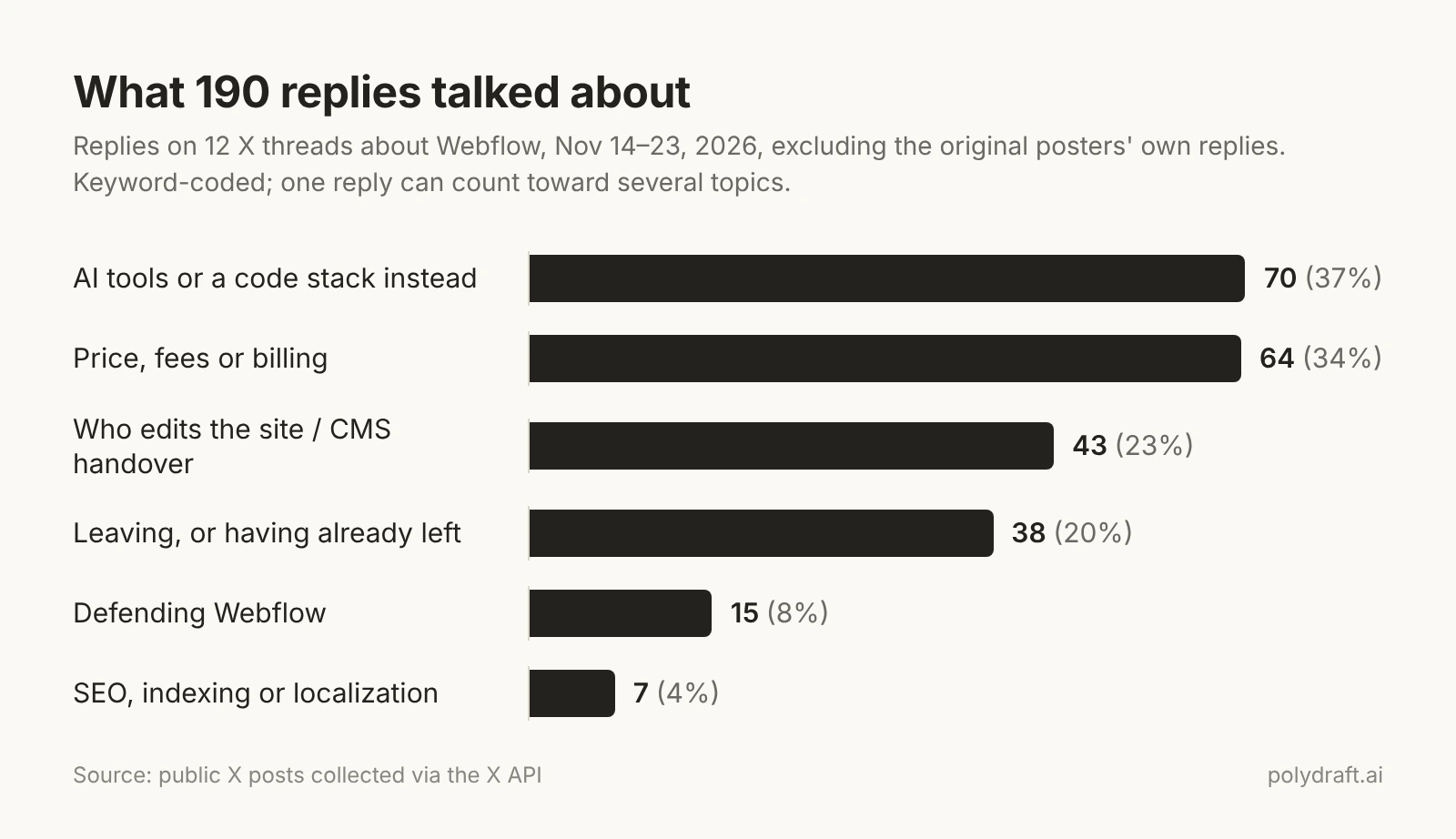
- 242 replies across 12 threads. The three biggest threads drew 24,400 views combined.
- At least 19 people said they had personally moved their own or their clients' sites off Webflow, or were in the middle of doing it. Several gave site counts: 5 sites, "two small businesses," "every client site," "like 10 sites."
- About 1 in 3 replies mentioned price, fees, or billing.
- About 1 in 4 raised the problem of who edits the site after you leave.
- 15 replies defended Webflow. We cover their arguments too.
What people said they pay
Every figure below is one person's own account, quoted from a public post. We haven't verified them, but together they show the scale of what people are reacting to. (For comparison, our own pricing is at the end of this post.)
| What | Amount | Who said it |
|---|---|---|
| Renewal for a small CMS site for a local band | $360 / year after tax | @SimonWebflow (Webflow Partner) |
| A personal site, before switching | $400 / year | @dylandgtl |
| A company's annual plan, with no refund after leaving | $7,000 / year | @taka_shirasu |
| Quoted price for going beyond 10 languages | $15,000 extra | @taka_shirasu |
| Refund refused after a migration ran a few days late | $1,000+ | @ebaqdesign |
| The replacement stack: Claude + GitHub + Cloudflare | ~$20 / month | @joevancena |
1. The price of small sites stopped making sense
The most-shared complaint came from someone who still likes the product.
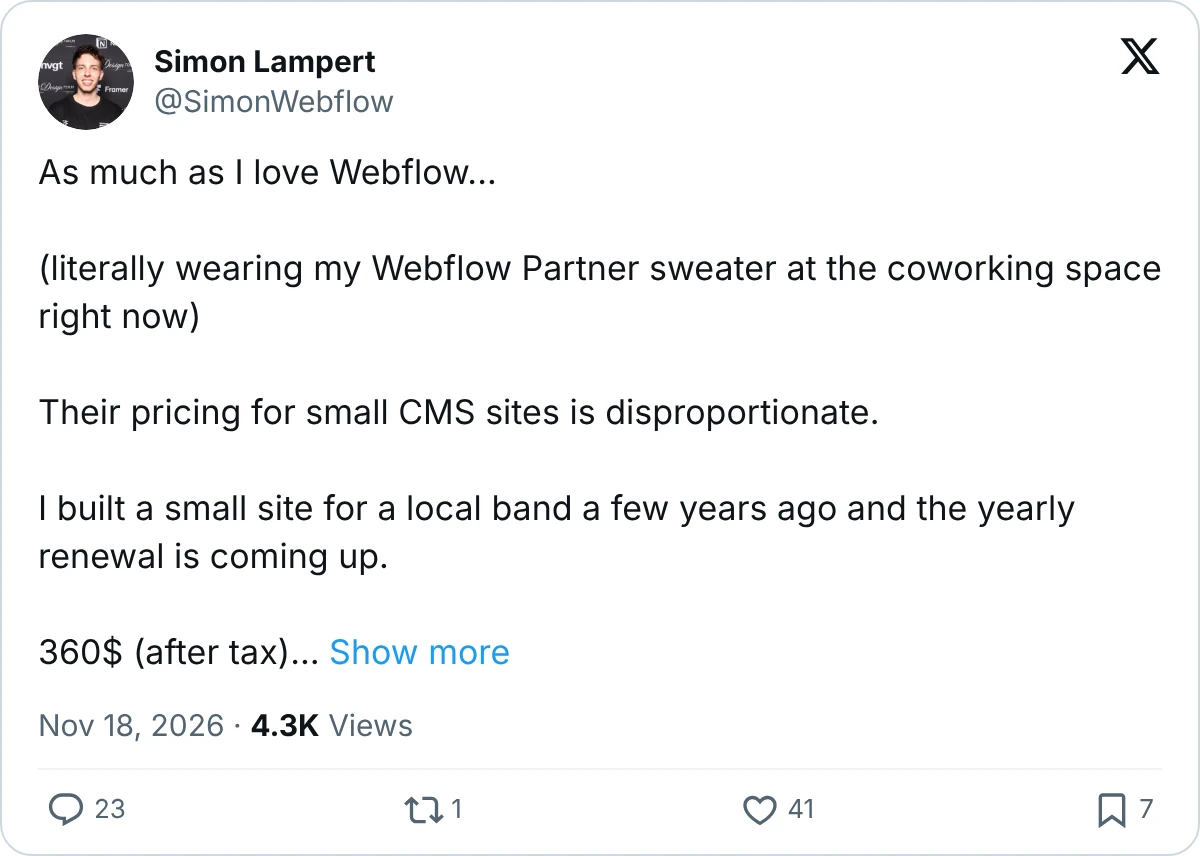
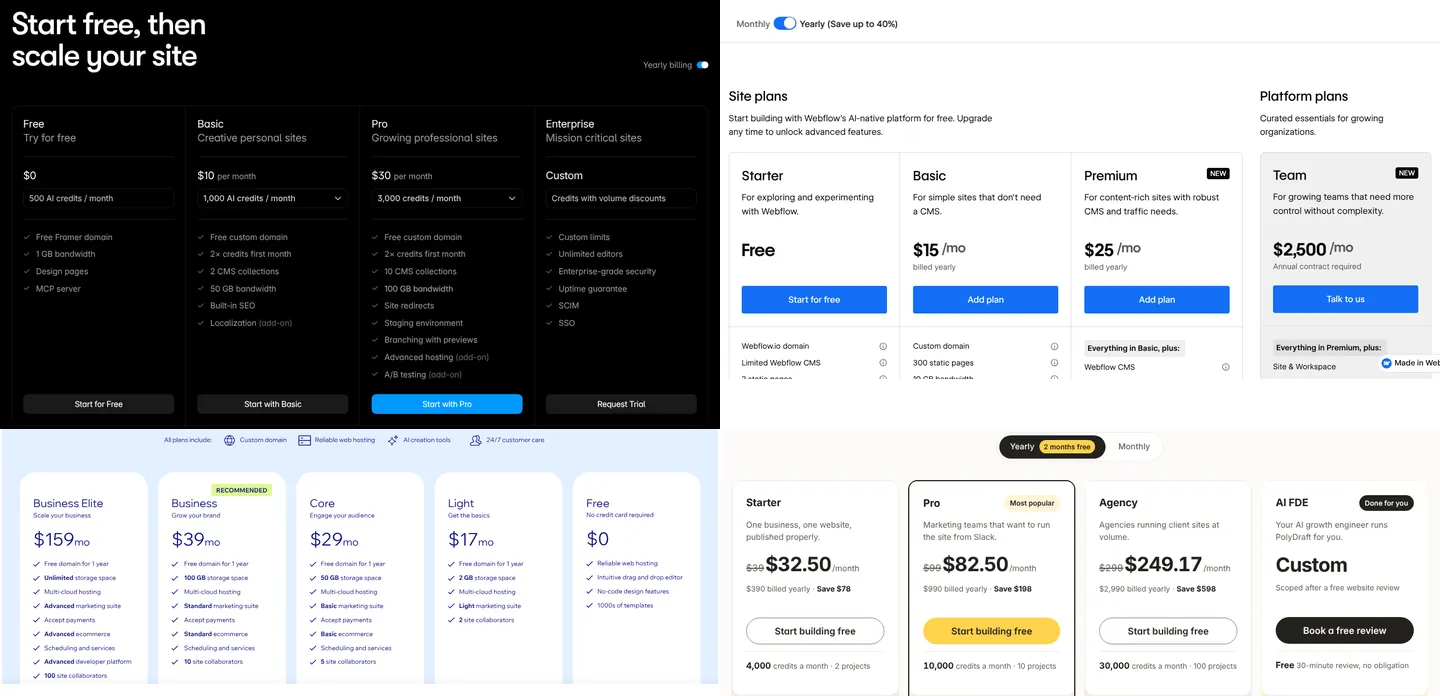
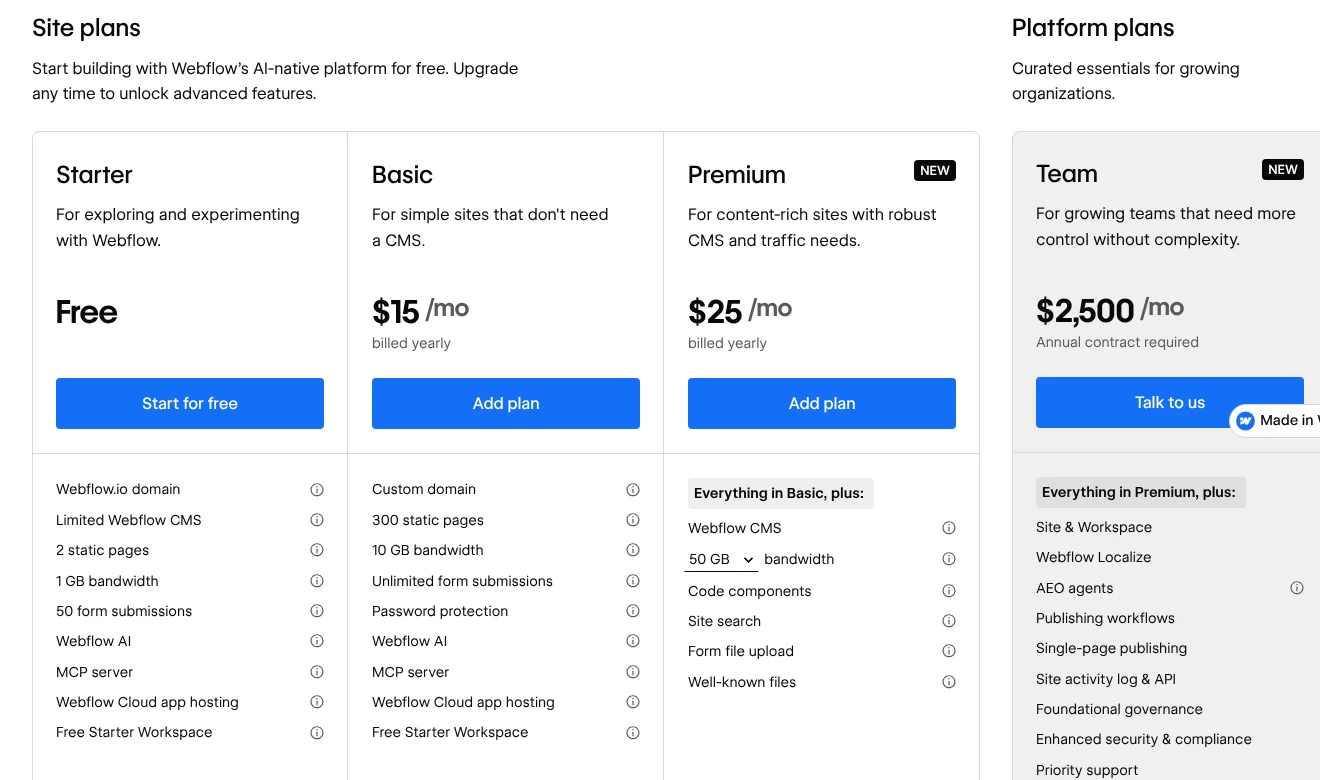
Simon is a Webflow Partner. The site is a small CMS site for a local band, and the renewal is $360 a year after tax. That figure matches Webflow's own pricing page. The cheapest plan that includes the CMS, Premium, is $25 a month billed yearly, which comes to $300 a year before tax:
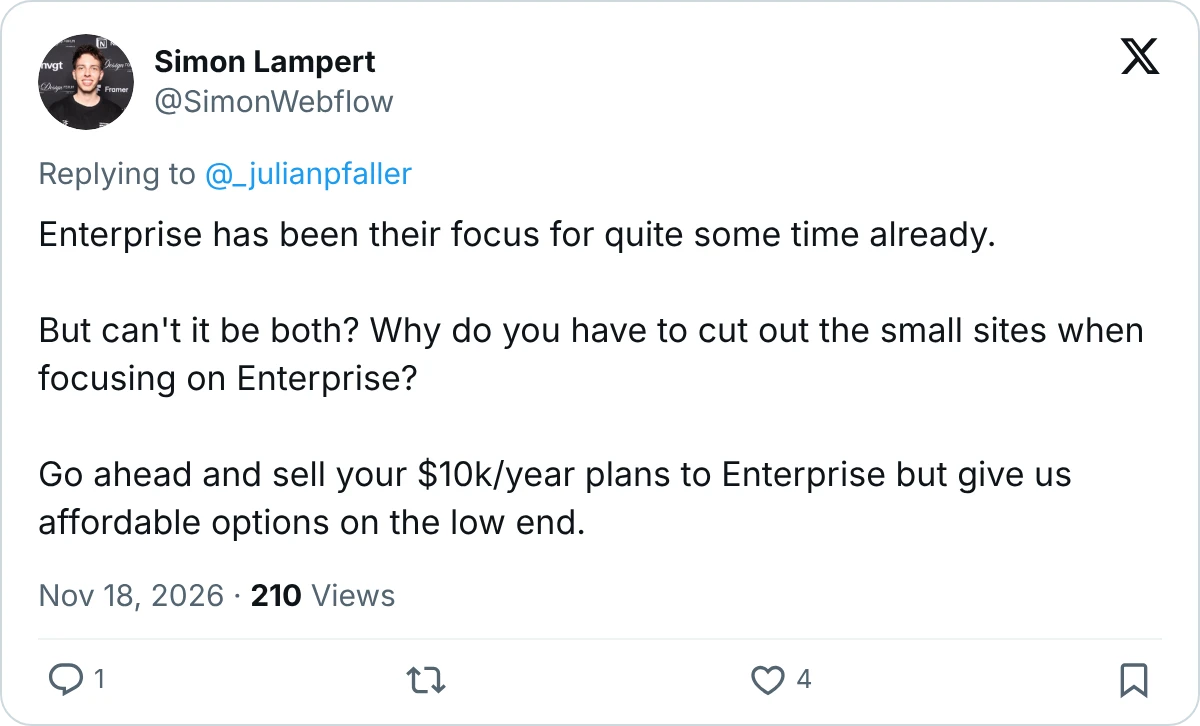
In a reply, Simon explained what bothered him:
Chris Bolliger's thread a few days earlier was the most-viewed post in our dataset, at 11,100 views:
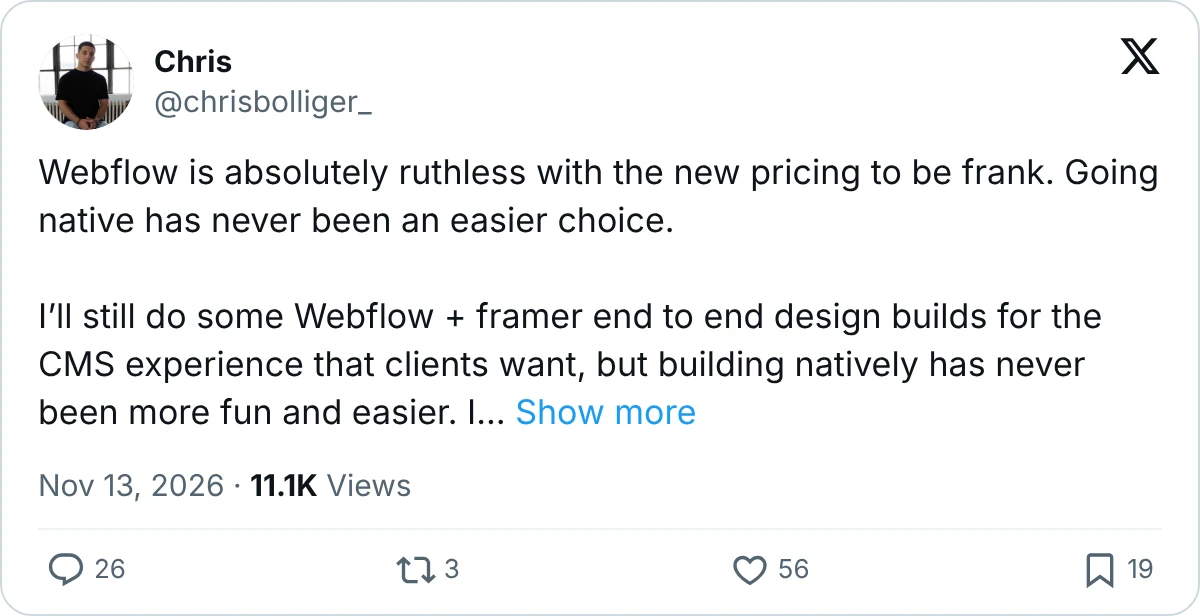
The top reply under it explained exactly what people object to:
@devinsfountain: How, in this economy, in the absolute bounty of hosting choices and AI-forward platforms, do they decide to raise hosting prices… If they raised the tool prices, I could understand and accept. But not this.
People would accept paying more for the design tool. Paying more just to keep a finished, rarely changed site online felt like a different deal. Others in the threads said the same thing:
- "For small startups who barely change their website, Webflow's pricing is insane." (@_julianpfaller)
- "I have already switched two small businesses off of Webflow because of the price increase." (@cwilliams0013)
- "Not over, just way too expensive for what people need now." (@DPxskrhg)
- Bandwidth: Webflow "likes to throw temp_[id].[filetype]" files that make bandwidth hard to audit, which pushes you toward "a plan or add-on you don't need." (@StarshipMine)
- Seats: the last straw for one designer was having to buy a seat for the client's content editor. (@anavel_creative)
2. Who's actually leaving, and who isn't
As the week went on, the replies got more specific about who is leaving.

@Jack_S1pa: The interesting question is who actually leaves and who stays. My guess: hobbyists and small teams churn to cheaper builders, agencies stay because their whole workflow is built around it.
Most of the threads agreed with the first half of that. Several people disagreed with the second:
- "I talk to other players and all of them who served SMBs and cared about good design and didn't want WordPress nightmare and went with Webflow are going away after the price spikes." (@vickinsf, whose agency is moving its own sites to SSR)
- "Big companies with big teams with multiple publishers will need some sort of CMS… but start-up teams are going all in on Astro." (@dmitryshamis)
- "I see SMB businesses moving but enterprise hold has only been going up." (@deemadh19)
Webflow's pricing page points the same way. The new Team plan, shown in the screenshot above, starts at $2,500 a month with an annual contract, and features like Webflow Localize and publishing workflows are bundled into it. Put together, the pattern is consistent: enterprise is staying, and the SMB and small-agency segment is leaving. Some replies predicted a "death spiral," where prices rise, people leave, and prices rise again. That's speculation, not data, but it's how the pricing feels to the people paying it.
3. AI made "just build it" cheap
Pricing explains why people want to leave. AI explains why they finally can.
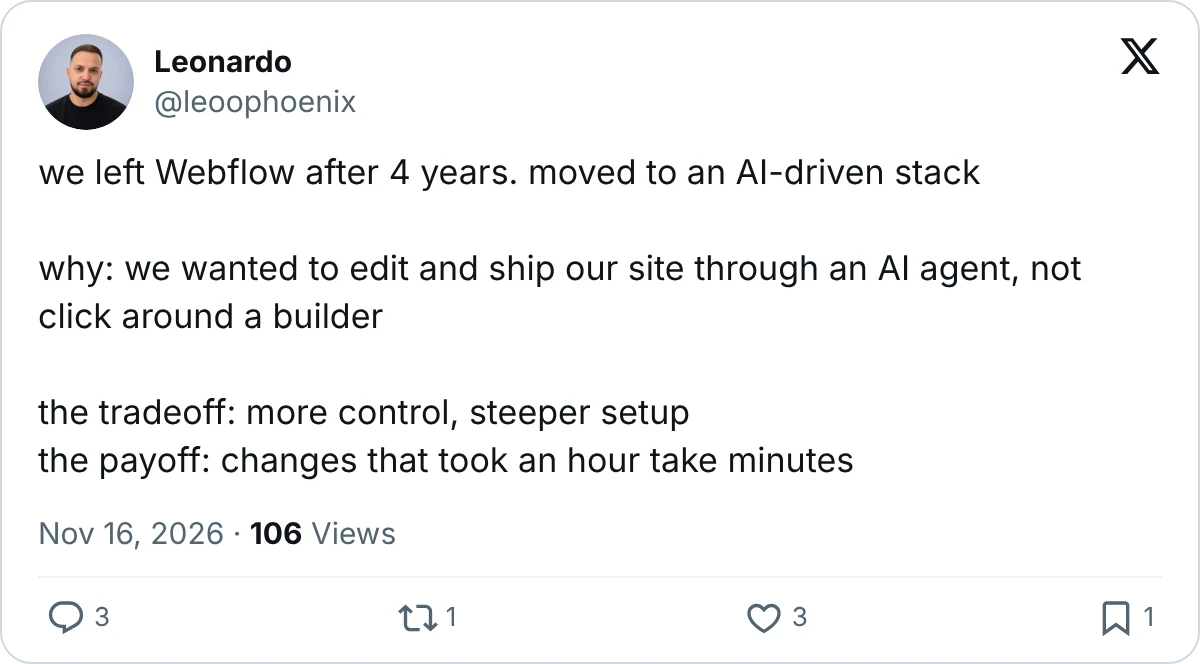
Leonardo's team left after four years. Others described a similar switch:
- "Claude + GitHub + Cloudflare and you're live for $20/month." (@joevancena)
- "Claude + build me a Next.js site and connect it to Vercel… have stopped 9/10 Webflow and Framer subscriptions." (@duncanabdelnour)
- "Moved 5 sites off Webflow this year and haven't looked back." (@benjhaberman)
- "I used to pay $400 yearly for a site. Now I just buy a domain, sign up for Netlify to host, and have Claude build my site." (@dylandgtl)
- A team that used WordPress for 10+ projects between 2020 and 2025 said it has used it for zero in the past year. (@Nithin_Jawahar)
- "With AI tools, we couldn't justify the cost… our team can do that now by ourselves." (@tberny46)
4. SEO, localization, and billing terms
The most detailed complaint in the dataset came from Taka, who moved his company to Vercel:
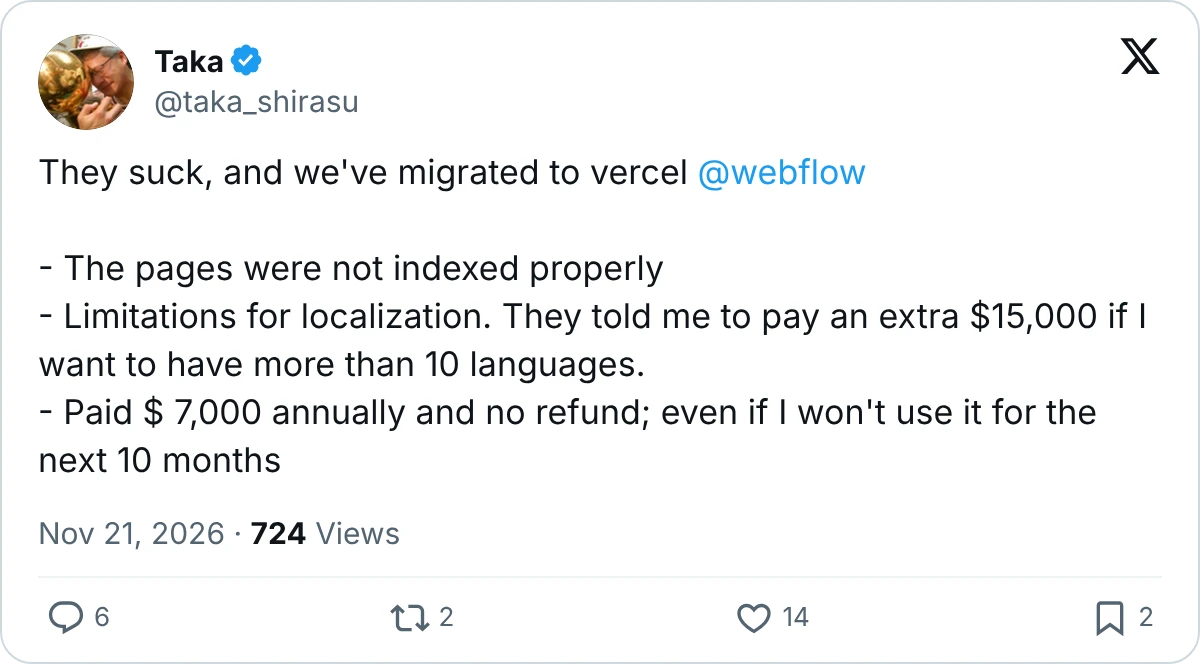
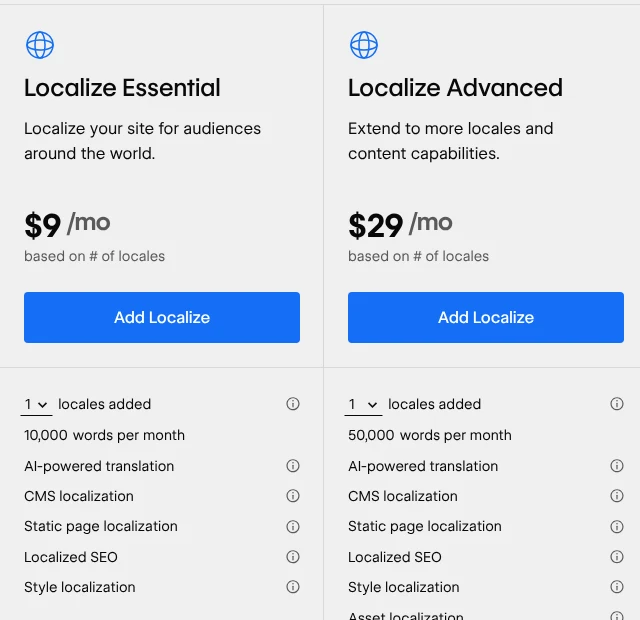
On Webflow's public pricing page, localization is an add-on billed per locale. The selector on Localize Advanced goes from 1 to 10 locales, at $29 per locale per month, so $290 a month at the maximum. The page doesn't list a self-serve option for more than 10.
Two more people replied under it with similar stories:
- Localization: "The localization feature is the absolute worst value in the WF ecosystem. Claude/Astro/Sanity can do it automatically for fractions of a penny compared to what WF charges." (@cterickson)
- Annual billing: "I was late only a few days with my migration and they… refused to refund for unused yearly subscription." (@ebaqdesign, who put the amount at over $1,000)
These are individual accounts. Still, indexing, locale pricing, and annual commitments hit hardest for a site that depends on organic growth, and they're the costs that are hardest to see when you sign up.
5. The part everyone skips: who edits the site afterward?
For every "just use Claude Code," someone asked the follow-up question:
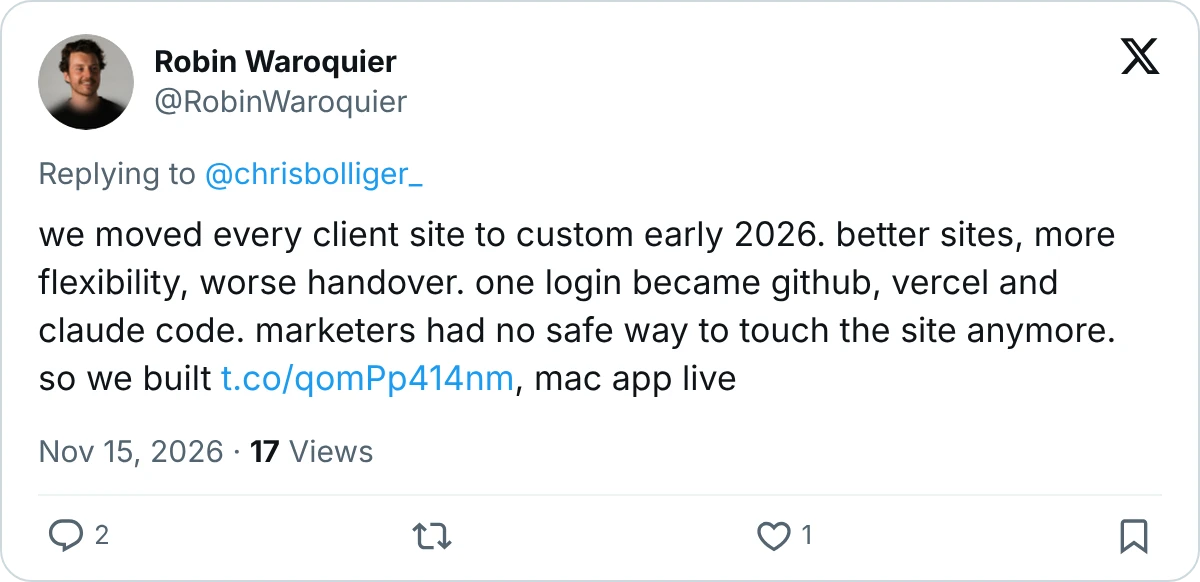
The same point came up again and again:
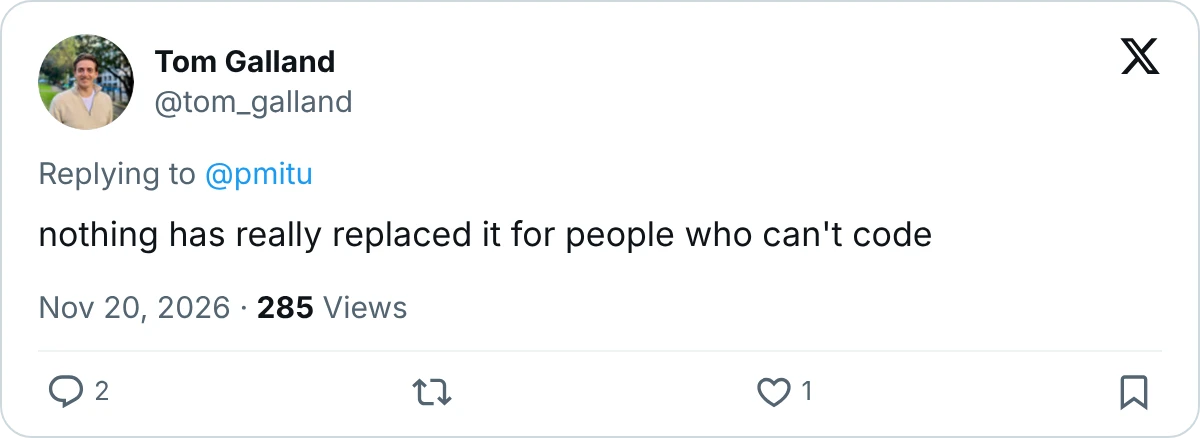
- "Agencies we talk to who left still get asked how to change a headline." (@seifalsaatie)
- "CMS is the final boss for vibecoders." (@boardyai)
- "Astro + Sanity is perfect here… The trade-off is you become the support instead of Webflow." (@ehujo14)
- "The 'CMS' owners actually want is usually 'change my hours and prices from my phone.' That's a small admin, not a platform." (@sudievudev)
In a separate thread, Eldar Dizdarevic, who builds sites for clients, put it well:
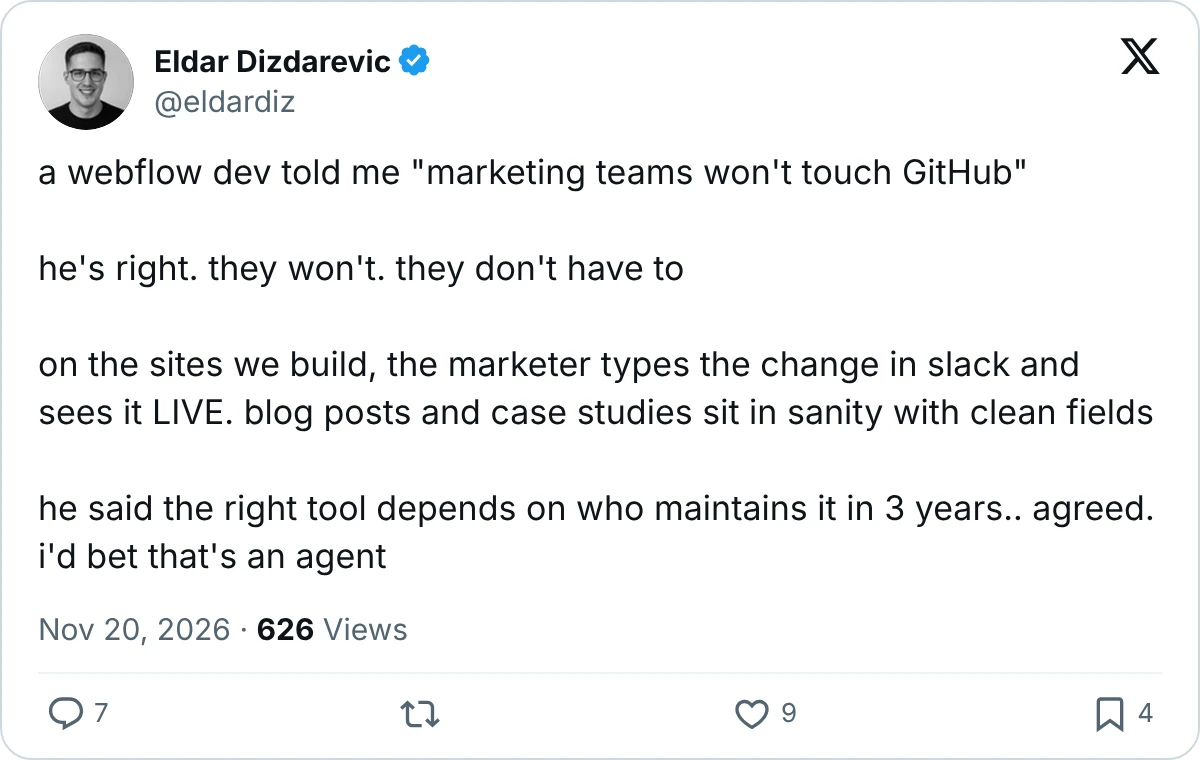
This is the real tension. Leaving Webflow is easy for developers. The hard part is leaving without making yourself your client's permanent help desk. The answer people keep coming back to is that the person making edits shouldn't need to see the code at all.
6. The case for staying
To be fair, 15 replies pushed back, and they made good points:
- "Plenty of teams can still benefit more from Webflow compared to AI and GitHub. Heavily depends on a team's technical level." Webflow's MCP "became really powerful" after its August update. (@wckdgenius)
- "B2B marketing teams still need visual CMS control and clean Client-First builds they can edit on Tuesday without pinging a dev." (@rishabh_webflow)
- "The CMS still makes sense when non-dev teams own the site." (@i_mika_el)
- For a SaaS company investing in organic growth and AEO, "it's a bargain." (@ale_sannazzaro)
- One agency reported doing "full migrations to Webflow in a weekend through the MCP." (@jesselnieman)
If you have a marketing team that ships pages every week, a real design system, and the budget for it, Webflow is still a strong choice. Most of the people leaving aren't in that position. If you're staying, our Webflow SEO audit covers what to check.
So, should you leave? A quick decision guide
| Your situation | Probably… |
|---|---|
| Marketing team ships pages weekly, enterprise budget, needs a visual editor | Stay. Try the Webflow MCP before migrating. |
| Small site, few edits a year, renewal is $300+ | Leave. This is exactly where the threads say the math breaks. |
| You're a developer building for yourself | Leave, if you're comfortable owning hosting and maintenance. |
| You build for clients who can't code | Be careful. Solve "who changes the headline" before you migrate. |
| You need 10+ languages or rely on organic search | Get a quote first. Compare localization costs and plan SEO either way. |
| You're partway through an annual plan | Check your renewal date first. Time the move to land just before it. |
If you do migrate: the checklist people learned the hard way
The most useful replies in these threads weren't the hot takes. They were these:
- Find out where your leads come from. "Before moving a client's site, check which forms and booking links bring in leads. A cheaper hosting bill won't help if the contact form goes quiet." (@wang_dx7909)
- Test on the live domain, not staging. "Submit every form once and click the booking links on the live domain… DNS and SSL switches break more lead forms than the hosting itself." (@edshmanov)
- 301 every old URL, including CMS collection pages. "Check every old Webflow URL 301s to its new path (collection pages too) and resubmit the sitemap." (@HeyReloque) Our website redesign SEO checklist walks through the full process.
- Set up hreflang if you're multilingual. "With 10+ languages, make sure hreflang is set up, or Google treats each locale as a brand-new page." (@HeyReloque)
- Check indexing after launch. Use Google Search Console to confirm pages are being crawled. Indexing problems were one of the reasons people left in the first place.
- Decide who edits, and how, before launch day, not after the first "how do I change this?" email.
- Know your billing cutoff. Check whether you're on monthly or annual billing and when it renews. One person in these threads lost more than $1,000 by migrating a few days late.
Where PolyDraft fits
We build PolyDraft, so take this section with that in mind.
The threads describe a gap: people want a site that is cheap to run, fully theirs, good for search, and still editable by someone who doesn't write code. Right now most of them have to give up at least one of those.
That gap is what we're building for:
- Start from a brief or your current site. PolyDraft generates a server-rendered site built for SEO and AI search (GEO). Languages are included in the plan price: up to 10 on Starter, 30 on Pro and 100 on Agency, with hreflang handled for you.
- Edit by describing the change. "Update our opening hours" or "add a pricing section" works without touching GitHub, Vercel, or a terminal. On the Pro plan, anyone on your marketing team can ask for changes in Slack.
- Deploy to your own Cloudflare account. The hosting belongs to you, not to a platform plan that can be repriced.
- Build and preview for free. Publishing starts at $39/month, or $32.50/month billed yearly.
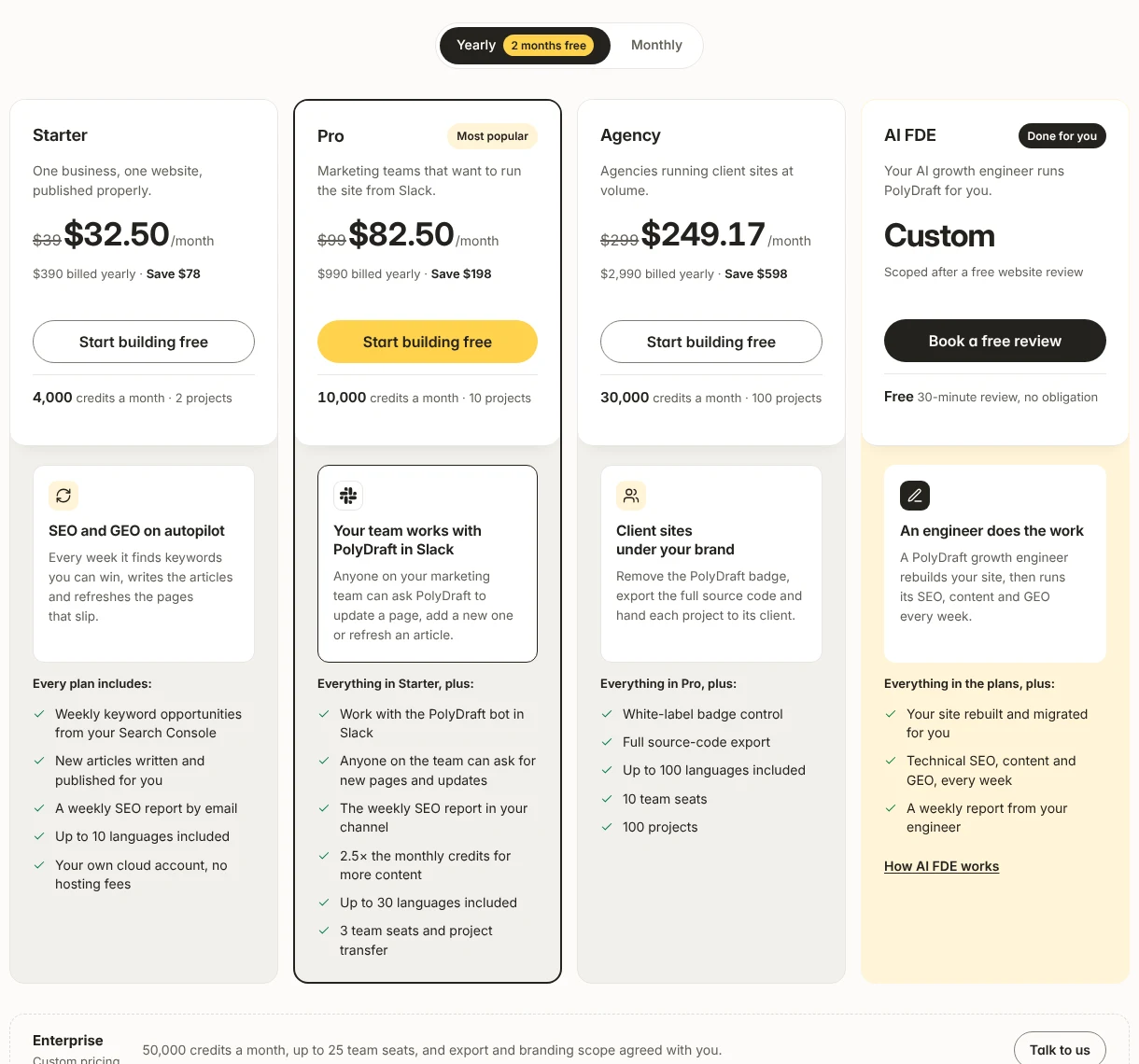
It isn't the right tool for every team in this post. If your marketing team works in a visual canvas every day, Webflow may still fit better. For a side-by-side comparison, see PolyDraft vs Webflow, or our wider list of Webflow alternatives. But if you're the band, the small startup, or the agency tired of explaining renewal invoices, try it with your current site's URL and see what comes back. You pay nothing until you publish.
Methodology: We collected public posts and replies on X that mentioned leaving or reconsidering Webflow, posted between November 14 and 23, 2026: 12 threads, 242 replies, 147 accounts. Topic counts are keyword-coded across the 190 replies not written by the original posters, and one reply can count toward several topics. The "at least 19" figure is a manual count of first-person accounts of moving sites off Webflow. Pricing screenshots were captured from webflow.com/pricing and polydraft.ai/pricing on November 23, 2026. Post images are rebuilt from X API data, with view, like, and reply counts as collected on November 21–23, 2026; each one links to the original post. Quotes in the text are lightly trimmed for length. Pricing and refund figures are as reported by individual users and have not been independently verified.