OpenSEO Review: Open-Source SEO Data for Your AI Agent
An OpenSEO review from its pricing, docs, GitHub and our DataForSEO data: what the open-source SEO tool does, what it costs, and who it suits.
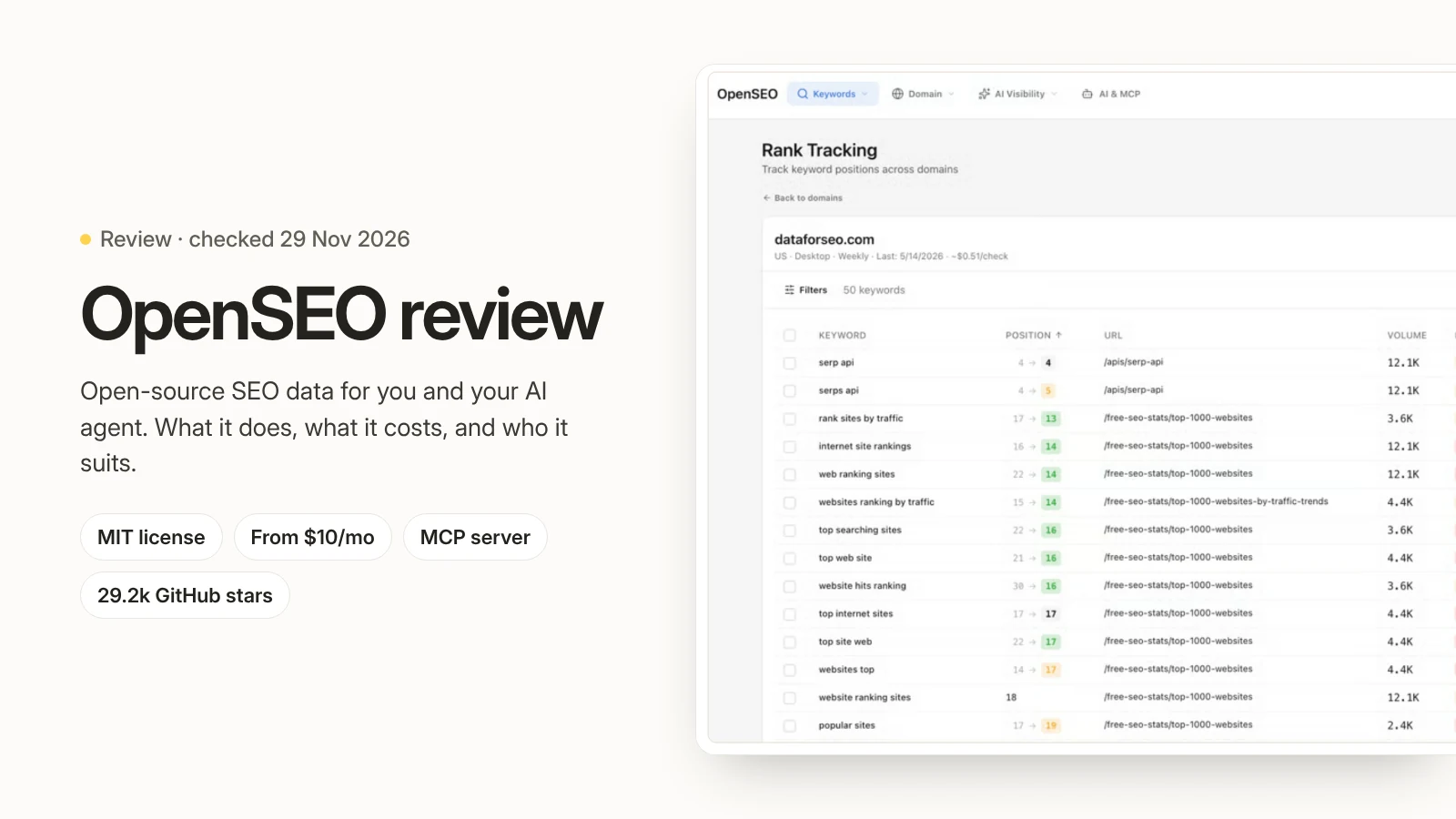
Our OpenSEO review in short: OpenSEO is an open-source SEO tool under the MIT license. It covers keyword research, backlinks, rank tracking, site audits and AI visibility on DataForSEO data. An AI agent such as Claude or ChatGPT can use the same data through its MCP server. Hosting starts at $10 a month with $10 of usage, or you can self-host it with your own DataForSEO account. It suits people who want cheap SEO data inside their AI agent. It does not build or publish your website.
About this article. We wrote this OpenSEO review from OpenSEO's own pricing, feature and documentation pages, its GitHub repository, and search data we pulled with DataForSEO, all checked on November 29, 2026. We did not open a paid OpenSEO account, so the screenshots are OpenSEO's own published product images and pages, and we say so under each one. We make PolyDraft, a website builder that also uses DataForSEO keyword data; we say where it fits near the end. Vincent Chen researched and reviewed the article, which was drafted with AI assistance and checked against the sources listed at the end.
Key points
- OpenSEO is software you can read, change and run yourself. You still pay for search data: DataForSEO charges per lookup, and the hosted app adds a flat fee on top.
- The hosted plans are Base at $10, Pro at $30 and Max at $100 a month, each with usage credits included. A keyword search costs about 5 cents.
- It covers the core of what people use Semrush and Ahrefs for, without seats. It does not have its own crawler or keyword index, so its data is DataForSEO's.
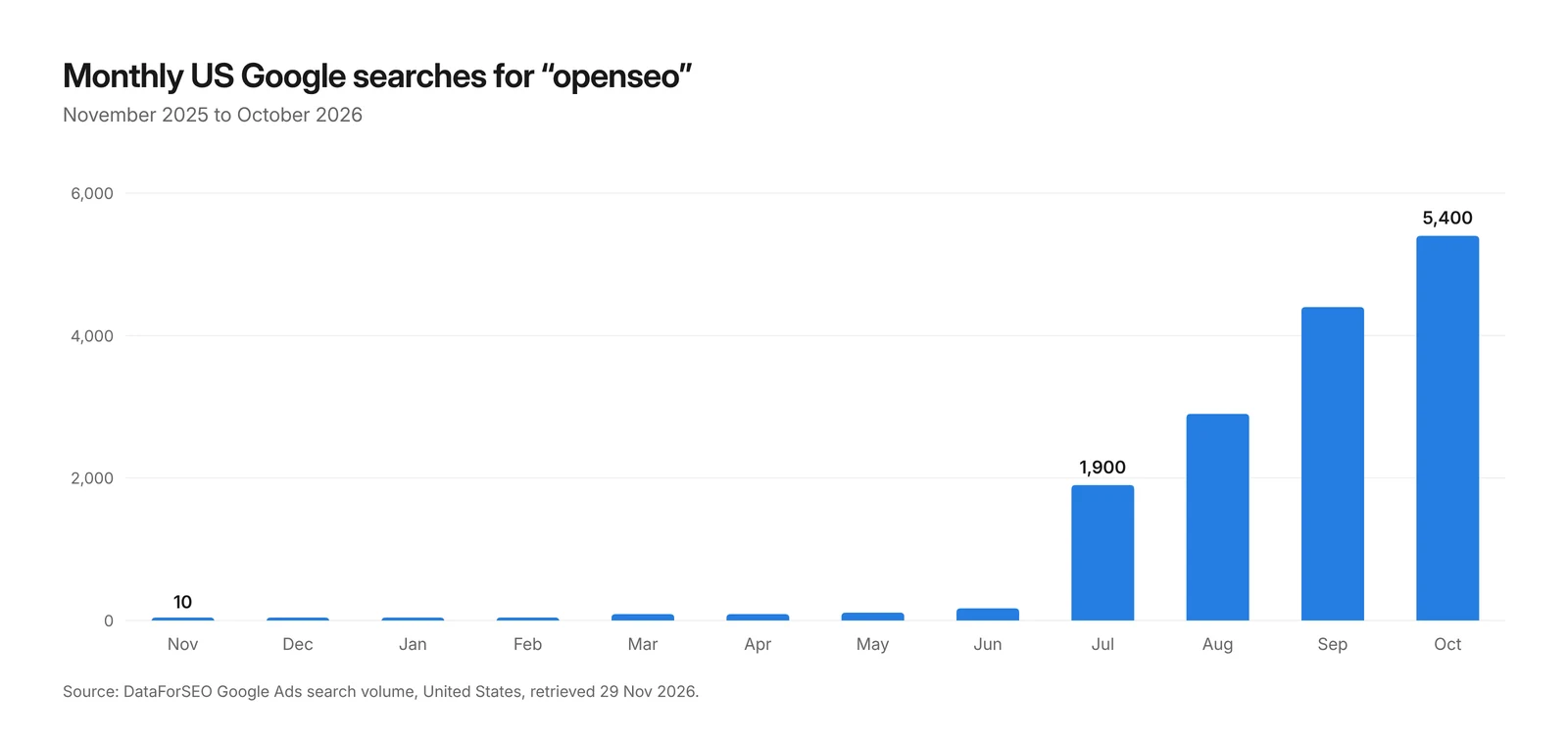
- Interest is rising fast. US Google searches for "openseo" went from 10 a month in early 2026 to 5,400 in October 2026, according to DataForSEO.
OpenSEO review at a glance
| OpenSEO (as of November 29, 2026) | |
|---|---|
| What it is | Open-source SEO platform with a web app, an MCP server and agent skills |
| Made by | Every App, Inc. |
| License | MIT |
| Data source | DataForSEO (keywords, SERPs, backlinks, AI answers), plus your own Google Search Console and Analytics |
| Features | Keyword research, domain overview, backlinks, rank tracking, site audit, AI visibility, prompt research, saved keywords, reports |
| Works with | Claude, Claude Code, ChatGPT, Codex, Cursor and other MCP clients |
| Hosted price | Base $10/mo, Pro $30/mo, Max $100/mo, each with usage included |
| Self-hosted price | $0 for the software; you pay DataForSEO and your own hosting |
| Free start | $0.50 of credits on the hosted app, no card; site audits up to 50 pages |
| Does not | Build, host or publish your website |
Which OpenSEO is this?
Several unrelated projects use the name, and they all show up when you search for it. This review covers OpenSEO at openseo.so, from Every App, with its code at github.com/every-app/open-seo. It is not openseo.info (a decentralized search engine), openseo.gg, the older OpenSEO page checker on Azure, or the separate OpenSEO repository by another developer on GitHub. If a review or directory listing mentions a desktop app, a Rust build or a "decentralized web", it is about a different product.
How fast OpenSEO is growing
OpenSEO's first version came out in early 2026, and interest took off in the summer. We pulled three kinds of data to show the size of that growth.
Search demand. DataForSEO's Google Ads data shows US searches for "openseo" at 10 a month from November 2025 to February 2026. They stayed between 90 and 170 from March to June. Then they climbed to 1,900 in July, 2,900 in August, 4,400 in September and 5,400 in October 2026. Searches for the phrase "openseo review" only started registering in August and reached 40 in October.
GitHub. The repository had 29,200 stars and 4,100 forks on November 29, 2026, nine months after it was created on February 27. It had 42 open issues and 25 open pull requests, and its last commit was on November 23, so the project is actively maintained.
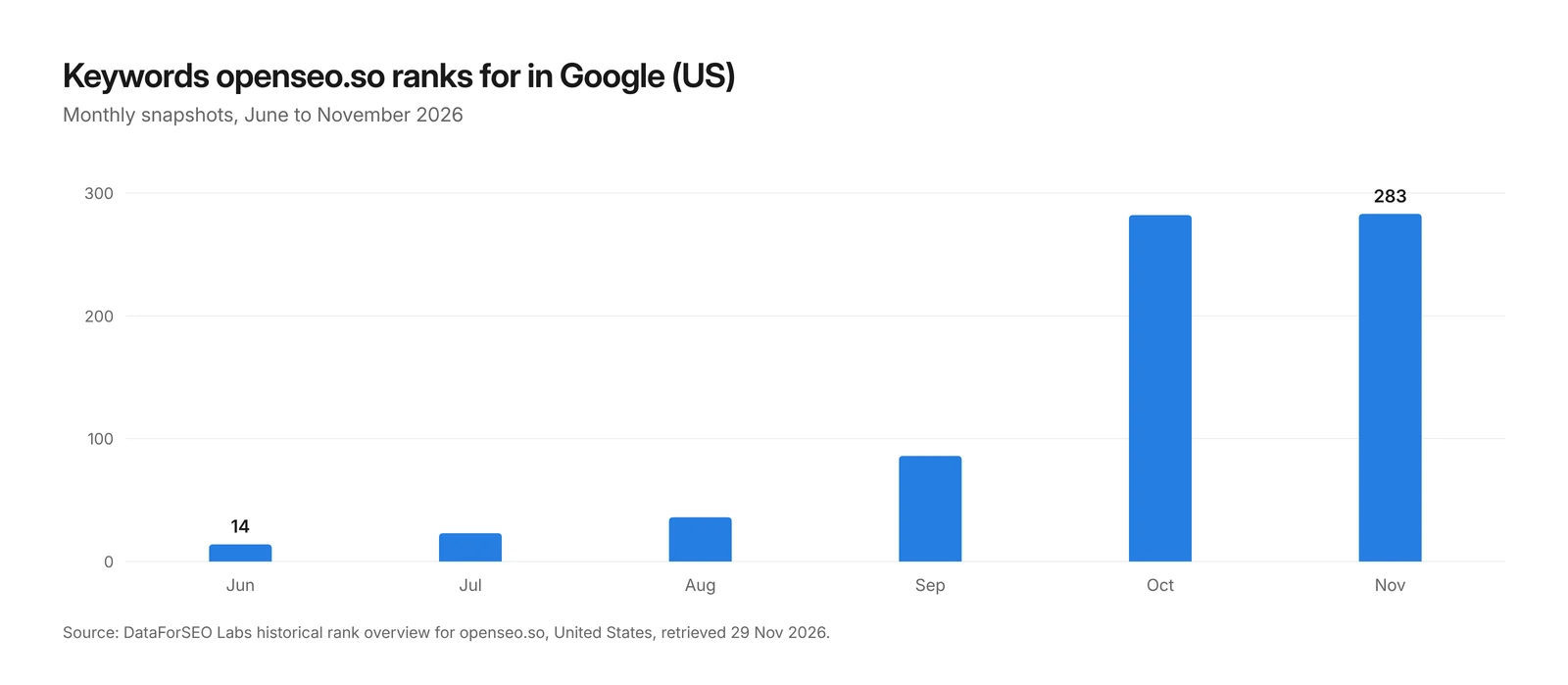
OpenSEO's own search footprint. DataForSEO Labs counted 14 Google keywords that openseo.so ranked for in the US in June 2026 and 283 in November. It ranks first for "open source seo tools" and "open seo". Its estimated organic traffic is a different story. The November snapshot says 303 visits a month, while the live estimate on November 29 says 3,225. Almost all of that comes from "backlink checker" searches, where it sits at positions 7 to 9. OpenSEO's own domain-overview page makes the same point about its own site, so treat any single traffic estimate with care. Backlinks are steadier: 13,102 links from 580 referring domains, first seen on April 17, 2026.
| Measure (DataForSEO, US, November 29, 2026) | Value |
|---|---|
| Monthly searches for "openseo", October 2026 | 5,400 |
| 12-month average | 1,300 |
| Keywords openseo.so ranks for, November 2026 | 283 (14 in June) |
| Backlinks and referring domains | 13,102 from 580 |
What OpenSEO does
OpenSEO's app is organized around a project: your site, your competitors and your goals. Every feature reads and writes to that project, and an AI agent can use the same features through MCP. The screenshots below are OpenSEO's own published product images, taken from its website on November 29, 2026.
Keyword research and domain overview
Keyword research returns up to 500 ideas per search with volume, difficulty, CPC and search intent, for 211 countries, 94 of which have every metric. Domain overview estimates a site's organic traffic, lists the keywords it ranks for and its top pages, and exports to CSV, Excel or Google Sheets. Backlink research shows backlinks, referring domains, domain rank and spam score, and hides links with a spam score of 40 or more by default.
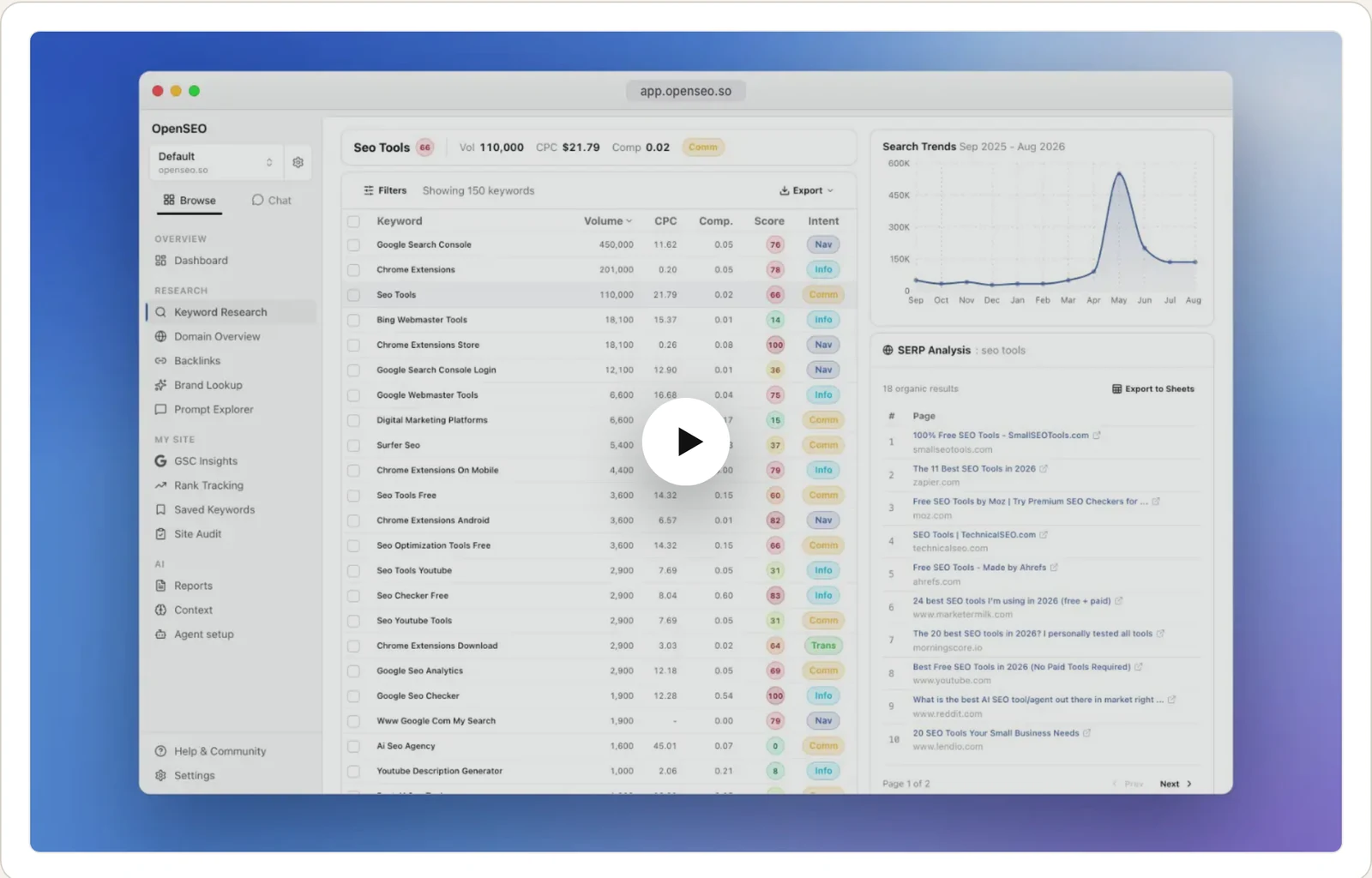
Screenshot: the product video's opening frame on the openseo.so home page, November 29, 2026.
Site audit
The crawler follows robots.txt, stays on your domain and checks status codes, titles, meta descriptions, headings, canonicals, links, image alt text and response time on every page. Issues are sorted as a work queue: 4 critical types (crawler blocked, server error, broken internal link, missing title), 20 warnings and 9 info items. You can turn on rendering for JavaScript sites and add Lighthouse checks. The free plan audits up to 50 pages per crawl; paid plans go up to 10,000.
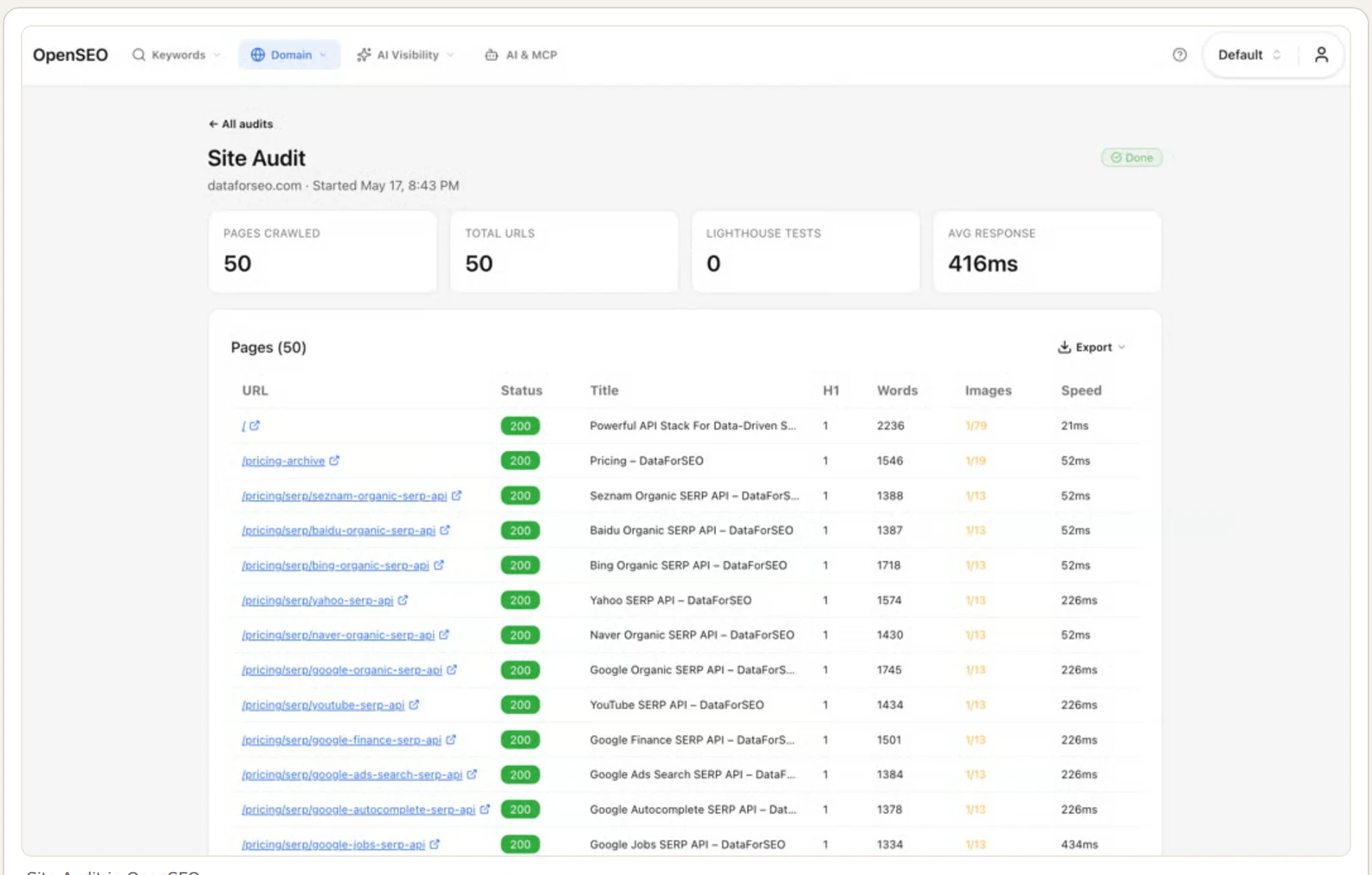
Screenshot: openseo.so/features/site-audit, November 29, 2026.
Rank tracking
Each tracker checks daily, weekly, monthly or on demand. It holds up to 1,000 keywords (2,500 on Pro, 5,000 on Max), tracks desktop, mobile or both, and can be set to a city or region. The app shows the most a tracker can cost before you save it. Rank tracking only runs on paid plans.
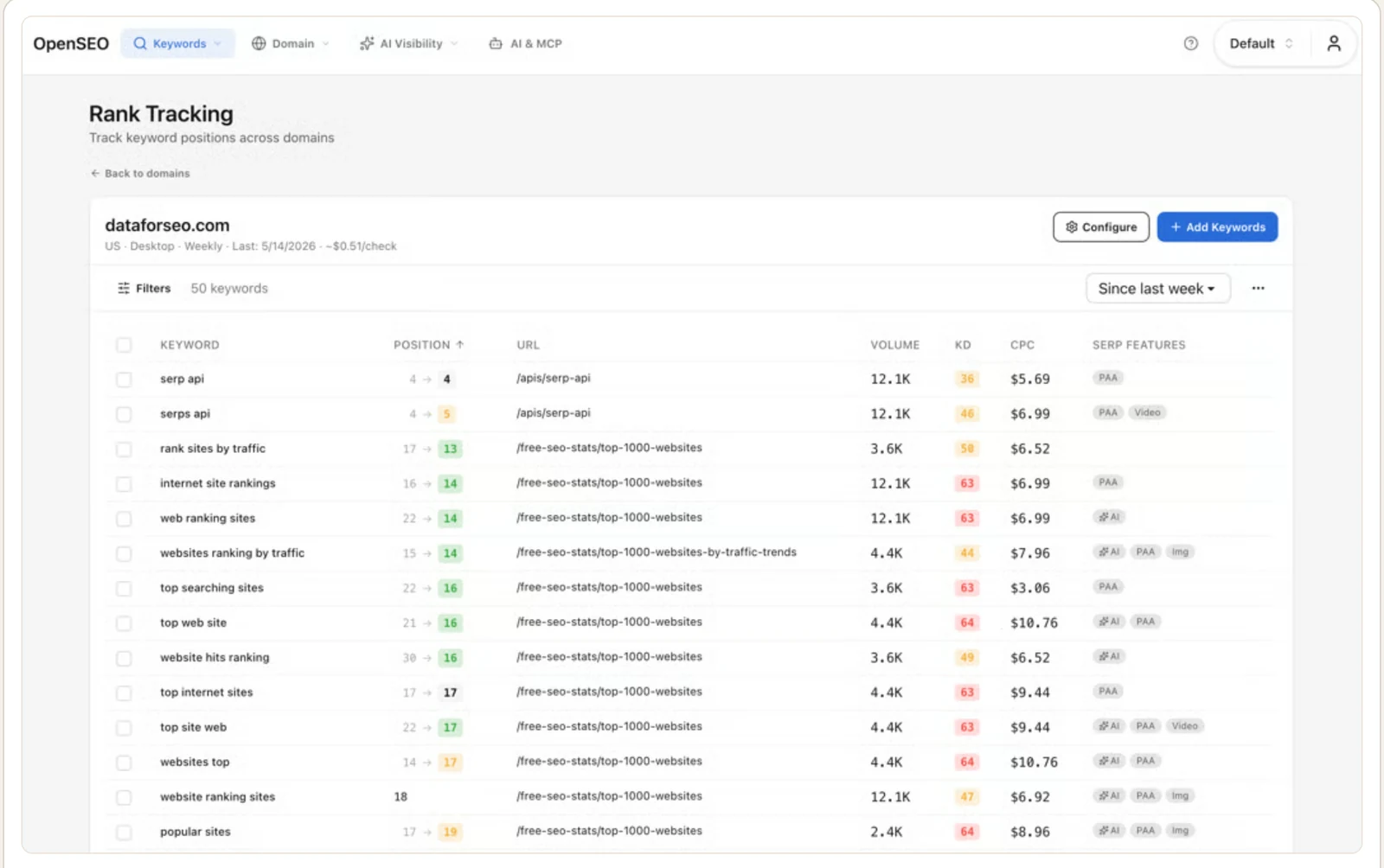
Screenshot: openseo.so/features/rank-tracking, November 29, 2026.
AI visibility
AI visibility tracks whether answers in ChatGPT, Gemini, Google AI Overviews, Google AI Mode, Claude and Perplexity mention your brand or cite your site, and which competitors appear instead. A tracker holds up to 100 questions in 30 topics. Scheduled answers from ChatGPT, Gemini, AI Overviews or AI Mode cost $0.002 each, so 50 questions on two engines checked weekly is about $0.80 a month. Claude ($0.231 an answer) and Perplexity ($0.052) cost much more, because OpenSEO asks their model APIs rather than their consumer sites. Prompt research costs about $0.25 per keyword and needs a paid plan.
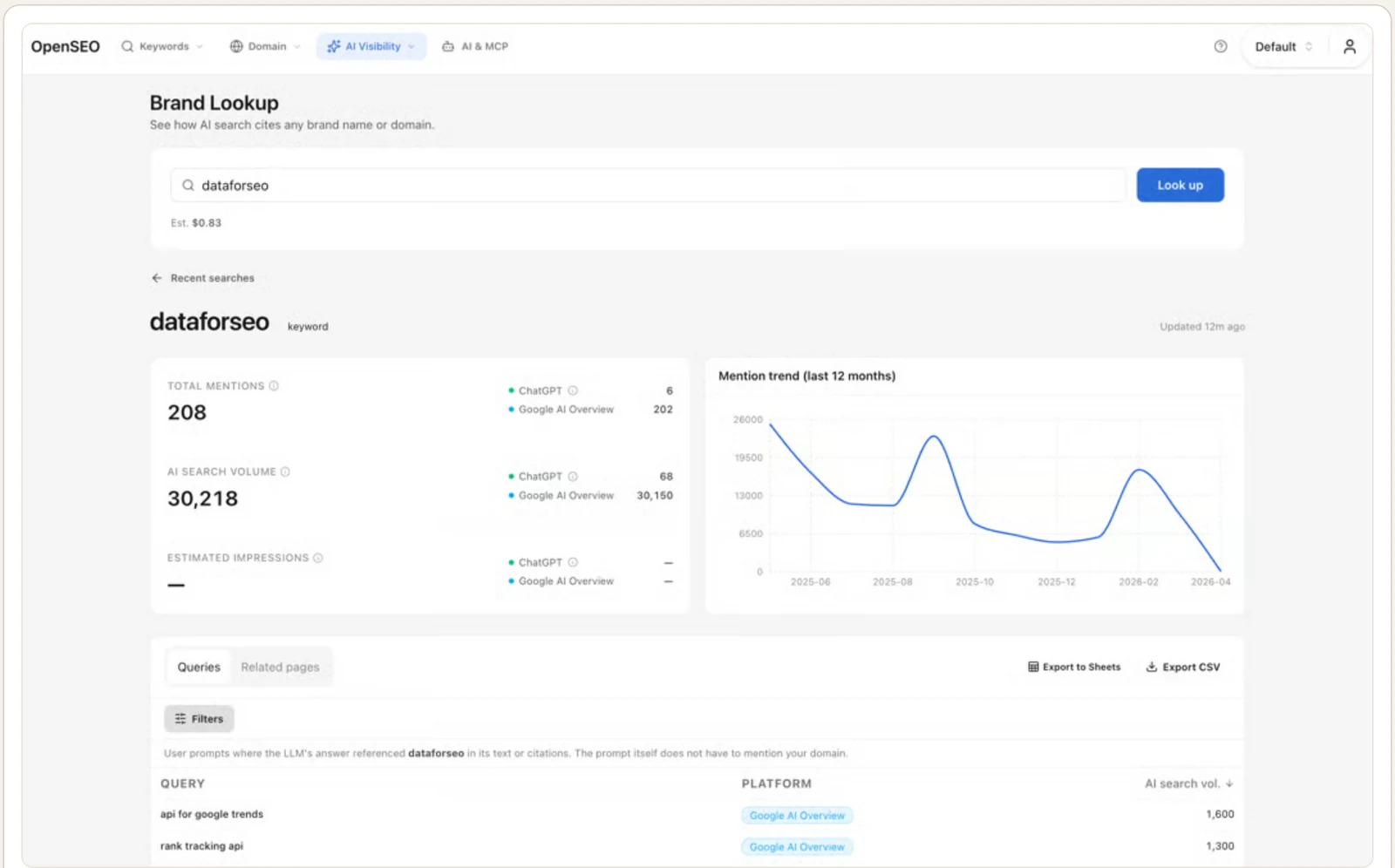
Screenshot: openseo.so/features/ai-brand-visibility, November 29, 2026.
The MCP server and agent skills
This is where OpenSEO differs most from older SEO suites. Its MCP server has more than 80 tools. An agent in Claude, Codex, Cursor or ChatGPT can research keywords, read live SERPs, compare competitor domains and check backlinks. It can also read Search Console data and save results back to your project. The Search Console tools are read-only and use no credits. OpenSEO also publishes 12 agent skills, including SEO Coach, SEO Audit, Keyword Research, Keyword Clustering, Competitor Analysis, Local SEO and Link Prospecting. Each one saves its result as a report in your project. OpenSEO trims DataForSEO's responses before the agent sees them, for example by dropping the 12-month trend from keyword rows, so the agent spends fewer tokens per call.
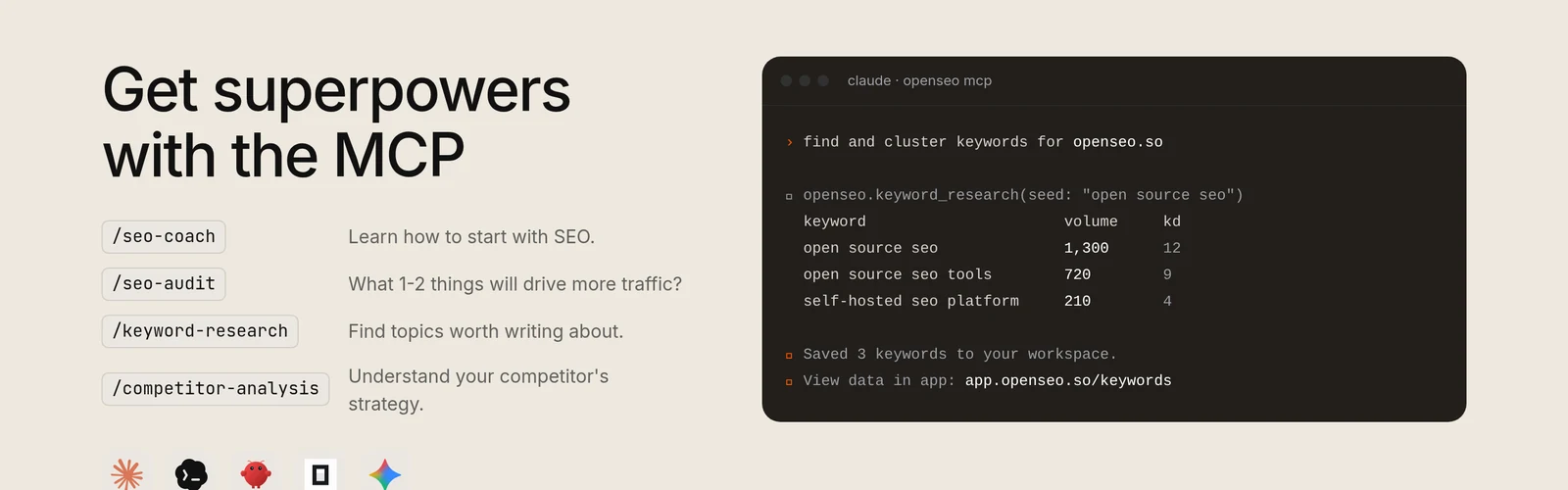
Screenshot: openseo.so home page, November 29, 2026. The terminal is OpenSEO's illustration.
Our guide on how to use AI agents in SEO covers where the human stays in the loop. Claude SEO skills explains how skills are built. To connect DataForSEO directly instead, see our list of the best MCP servers for marketing and SEO.
OpenSEO pricing: is OpenSEO free?
The software is free; the data is not. OpenSEO's code costs nothing, and you can run it yourself with Docker or on a Cloudflare account. Search volumes, rankings, backlinks and AI answers come from DataForSEO and are charged per lookup. When you self-host, DataForSEO bills you directly. On the hosted app, OpenSEO bills you and adds a flat 28% to the data cost.
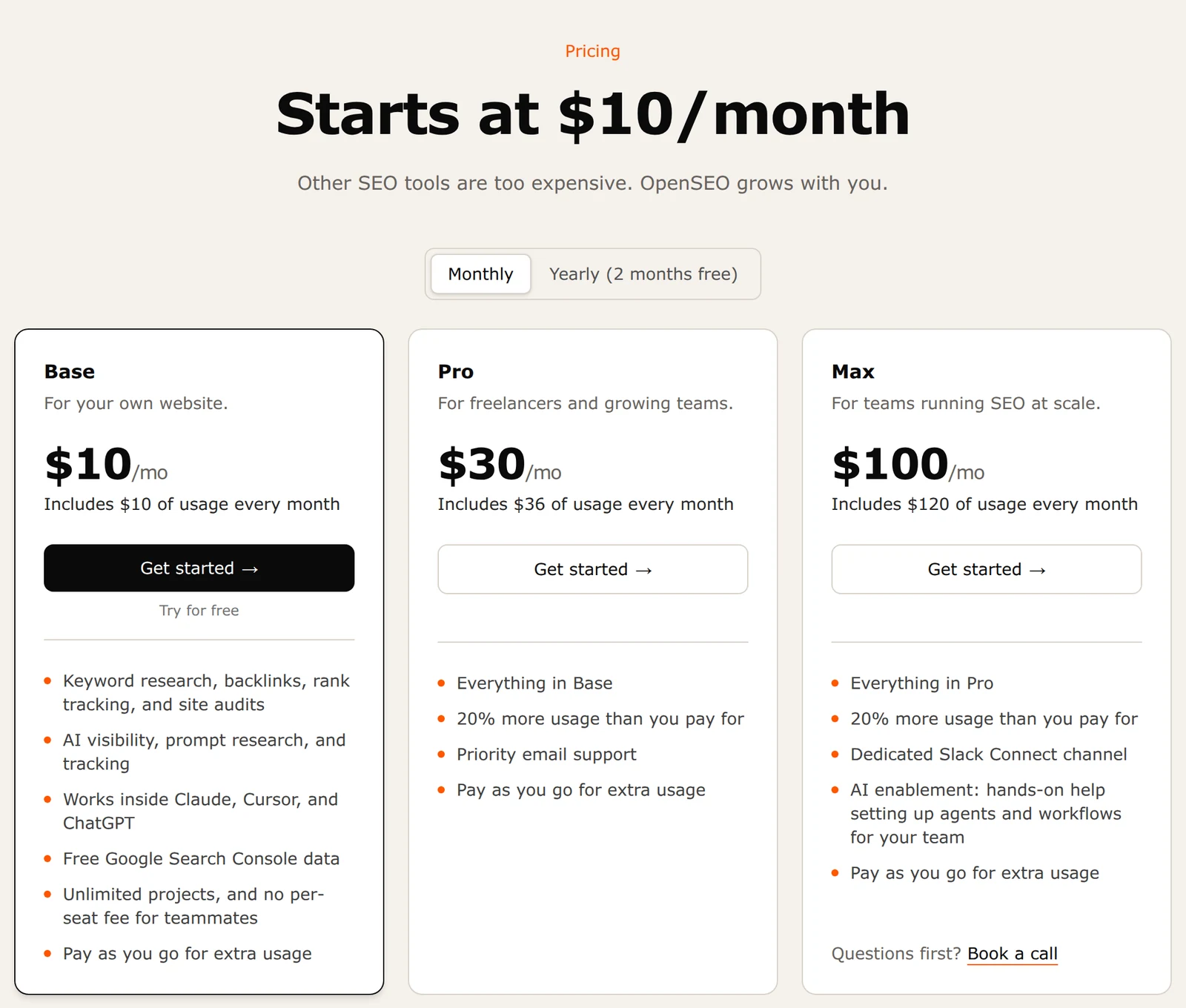
Screenshot: openseo.so/pricing, November 29, 2026.
| Hosted plan (as of November 29, 2026) | Price | Usage included | Extras |
|---|---|---|---|
| Base | $10/mo | $10 a month | Every feature, unlimited projects, no per-seat fee |
| Pro | $30/mo | $36 a month | Priority email support |
| Max | $100/mo | $120 a month | Slack Connect channel, help setting up agents |
What common actions cost on the hosted app, from OpenSEO's pricing and open-source pages:
| Action | Typical cost |
|---|---|
| One keyword research search | About $0.05 |
| Domain overview with a year of history | About $0.08 |
| One rank check | Up to $0.015 per keyword |
| 50 AI questions on ChatGPT and Gemini, weekly | About $0.80 a month |
| Standard site audit, Search Console data, saved results | Free |
One detail to watch: OpenSEO's rank-tracking page gives two different monthly figures for 100 keywords checked weekly on one device, "$1.30 to $2.60" and "$3 to $6". Its pricing page caps a rank check at 1.5 cents per keyword, which works out to at most about $6.50 a month for 433 weekly checks. Use the app's own estimate, which it shows before you save a tracker.
Self-hosting. You need your own DataForSEO account, which gives new accounts $1 of credit and has a $50 minimum top-up, plus a server or Cloudflare account. The same lookups then cost about a fifth less than on the hosted app, because you skip OpenSEO's fee.
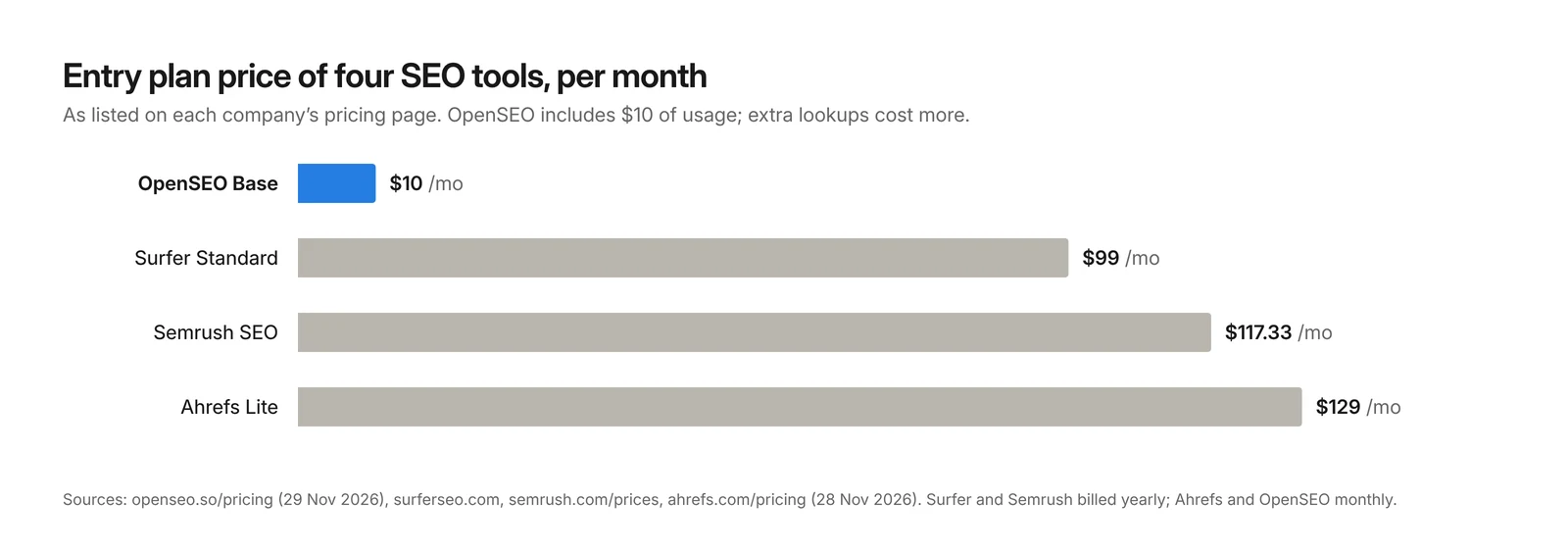
Compared with the big suites. OpenSEO's Base plan costs a fraction of the established tools' entry plans. A heavy user will still spend more than $10 once usage runs past the included credit.
What OpenSEO doesn’t do, and what’s missing
- It has no data of its own. Every volume, ranking and backlink count comes from DataForSEO. OpenSEO says this openly. Semrush and Ahrefs run their own crawlers and keyword databases.
- It doesn't do the SEO work on your site. OpenSEO and your agent research, plan and write reports. Writing pages, publishing them and updating the site stay with you, your agent and your CMS.
- Reports and schedules are still coming. Its own roadmap plans these for the next three months: daily and weekly email reports, scheduled site audits, Search Console reports and rank-tracking alerts. Content-writing workflows for agents and Bing Webmaster Tools are on the same list.
- Costs move with use. Pay-as-you-go is cheap for light research but harder to budget than a flat seat. Claude and Perplexity answers in AI visibility cost far more than ChatGPT or Gemini.
- It's young. The project is nine months old. Its pages occasionally disagree with each other (the site audit page says both 32 and 33 issue types), and features change quickly.
OpenSEO vs Semrush and Ahrefs
| OpenSEO | Semrush | Ahrefs | |
|---|---|---|---|
| Entry price (as listed) | $10/mo with $10 of usage | SEO plan $117.33/mo billed yearly | Lite $129/mo |
| Pricing model | Pay as you go, no seats | Subscription | Subscription; extra users cost more |
| Data | DataForSEO | Own databases | Own crawler and index |
| Open source, self-host | Yes (MIT) | No | No |
| AI visibility tracking | Yes, six AI engines | Yes, AI Visibility Toolkit | Yes, Brand Radar |
| Builds or hosts your website | No | No | No |
Semrush and Ahrefs prices are from their pricing pages as checked on November 28, 2026. For a wider list of tools by job and budget, see our guide to the best SEO tools for small business. For AI answer tracking, see the best GEO tools.
Who should use OpenSEO
Choose OpenSEO if:
- You already work in Claude, ChatGPT, Codex or Cursor and want real SEO data inside the conversation.
- You do light or occasional research and don't want a $100-plus monthly seat.
- You run an agency and want one bill for many projects without per-seat fees.
- You want to self-host or change the tool, or build your own workflow on top of it.
Look elsewhere if:
- You need a tool with its own backlink and keyword databases and long historical data. Ahrefs or Semrush will serve you better.
- You want a fixed monthly cost with no usage to watch.
- You want something to do the work on the website itself, not research it.
Where PolyDraft fits
We make PolyDraft, so read this section with that in mind. PolyDraft is not an SEO research tool. It builds your website and hosts it in your own Cloudflare account. It reads your Search Console data and DataForSEO keyword data to score what to write next. Then it writes the pages you pick and publishes them when you say so. OpenSEO and PolyDraft do different jobs and work well side by side: OpenSEO for research and AI visibility tracking in your agent, PolyDraft for the site and its pages. See how PolyDraft compares with other tools on our Compare page, or its plans and prices.
Frequently asked questions
Is OpenSEO free?
The software is free and open source under the MIT license. If you self-host it, you pay for your own server and your own DataForSEO usage. The hosted app at openseo.so starts at $10 a month with $10 of usage included. New accounts get $0.50 of credits to try it without a card, as of November 29, 2026.
What is OpenSEO?
OpenSEO is an open-source SEO platform from Every App, Inc. It covers keyword research, competitor and domain research, backlinks, rank tracking, site audits and AI visibility on DataForSEO data. It also includes an MCP server and agent skills, so AI agents like Claude and ChatGPT can use the same data.
Is OpenSEO open source?
Yes. The code is on GitHub at every-app/open-seo under the MIT license, so you can read it, modify it and self-host it with Docker or on Cloudflare. The repository had 29,200 stars and 4,100 forks on November 29, 2026.
Does OpenSEO work with Claude and ChatGPT?
Yes. OpenSEO runs an MCP server with more than 80 tools and publishes agent skills and plugins for Claude, Claude Code, ChatGPT and Codex. Any other MCP client, such as Cursor, can connect too. The agent can research keywords, read SERPs and Search Console data, and save reports to your OpenSEO project.
Is OpenSEO better than Semrush?
It is cheaper and more flexible, not deeper. OpenSEO covers keyword research, backlinks, rank tracking, site audits and AI visibility for a fraction of Semrush's price, and it works inside AI agents. But it uses DataForSEO data rather than its own databases, and it has fewer reporting features. Teams that need Semrush's data depth, ads and local tools should keep Semrush.
Where does OpenSEO get its data?
From DataForSEO, which sells search data by the request. When OpenSEO shows a search volume, ranking or backlink count, it comes from DataForSEO. The hosted app adds a flat fee to DataForSEO's price; self-hosted users pay DataForSEO directly. Your own Search Console and Google Analytics data come from Google and cost nothing.
Continue with the next task
- Choosing a research tool by job and budget: best SEO tools for small business.
- Tracking how AI answers mention your brand: best GEO tools and our AI visibility checker guide.
- Turning keyword ideas into a shortlist a small site can win: how to find low competition keywords.
- Putting an agent to work on SEO safely: how to use AI agents in SEO.
- Comparing website builders by who does the work after launch: Compare.
Sources
- OpenSEO, home page, pricing, open-source SEO, OpenSEO and DataForSEO, roadmap, about. Checked November 29, 2026.
- OpenSEO feature pages: site audit, rank tracking, AI visibility, MCP, domain overview, backlink checker, agent skills. Checked November 29, 2026.
- every-app/open-seo on GitHub: license, self-hosting paths, stars and forks. Checked November 29, 2026.
- DataForSEO: Google Ads search volume, DataForSEO Labs keyword difficulty, historical rank overview, domain rank overview and backlinks summary for openseo.so, United States, retrieved November 29, 2026 through the DataForSEO API.
- Competitor prices: Semrush pricing, Ahrefs pricing, Surfer AI Tracker and plans. Checked November 28, 2026.