In this article
- 01 Why published redesign prices don’t help
- 02 What drives the cost of a redesign
- 03 A budget model you can fill in
- 04 The hidden cost: migration risk
- 05 Five ways to get a redesign done
- 06 A website redesign RFP template
- 07 Where PolyDraft fits
- 08 Frequently asked questions
- 09 Continue with the next task
- 10 Sources
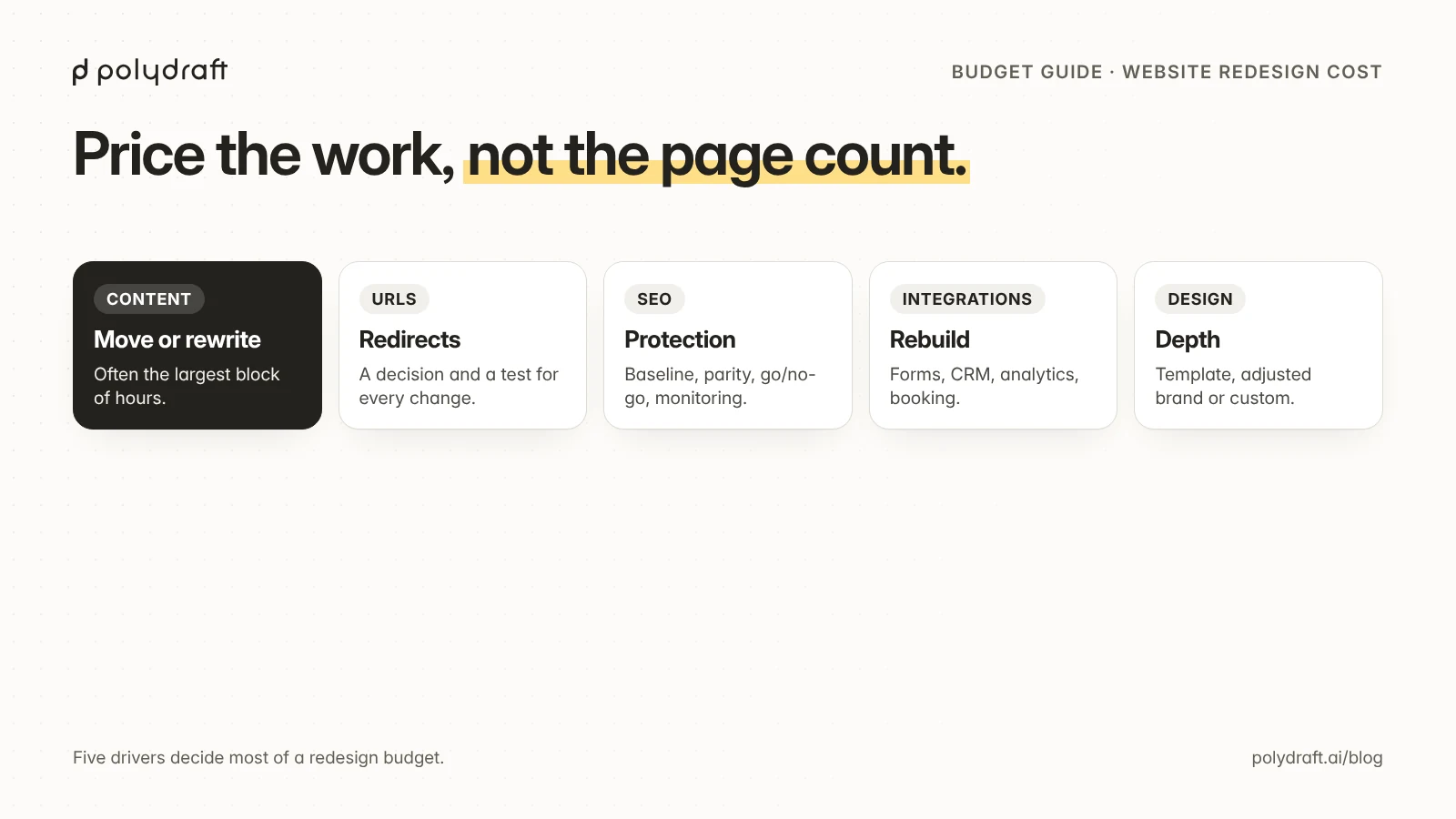
For a typical 15-page business site, our worked example below comes to about 148 hours of work before your own team's time. At a sample rate of $100 an hour that's about $17,000 including contingency, but your number depends on local rates and scope. Five things decide most of it: how much content has to be moved or rewritten, how many URLs change and need redirects, how much you protect your search traffic, which integrations have to be rebuilt, and how custom the design is. Published ranges are too wide to plan with, so build your own estimate. List the work, estimate the hours for each role, multiply by the rates you're actually quoted, and add the cost of what could go wrong. Then send every vendor the same request for proposal (RFP), so the quotes can be compared.
This guide is for owners and marketing leads planning a redesign of an existing site. It covers the cost drivers, a budget model you fill in with your own numbers, the hidden costs that come from migration risk, how the main ways of doing a redesign differ, and an RFP template you can copy. If you're building a new site from scratch, our website cost breakdown covers that budget.
Key points
- Redesign cost depends on the work, not the page count alone. Content, URLs, SEO protection, integrations, and design depth decide most of it.
- Published price ranges vary enormously and rarely say where they come from. Build a bottom-up estimate with your own rates.
- Budget for migration risk: redirects, content parity checks, and monitoring cost far less than recovering lost traffic.
- Ask every vendor the same questions in writing, so you're comparing like with like.
- Count what you'll pay after launch, and what it would cost to leave.
Why published redesign prices don’t help
On October 26, 2026, across four searches for "website redesign cost" and close variants, plus some single-site lookups, we looked at 18 sources. We could only read the search summaries, not the full pages. In those summaries, estimates ran from under $1,000 for a page or two to more than $200,000 for large projects, and most came from agencies or vendors selling redesigns. Only 2 of the 18 visibly cited data, and one of those, Clutch, used its own project data. We couldn't open the pages to check.
That isn't a criticism of the agencies. A redesign really can cost anything from a weekend to a year of work. A range that wide just can't tell you what your project will cost. The useful question is what work your redesign needs, and what that work costs at the rates available to you.
What drives the cost of a redesign
| Driver | What it includes | Why it moves the price |
|---|---|---|
| Content | Auditing, moving, rewriting, or retiring pages, images, and downloads | Rewriting is often the biggest single block of hours, and it waits on your approvals |
| URLs and redirects | Deciding the new structure and mapping each old URL that matters | Every changed URL needs a decision, a redirect, and a test |
| SEO protection | A baseline export, content parity checks, staging tests, a launch-day go/no-go, and monitoring | Small next to the cost of losing traffic, but it's work someone has to do |
| Integrations | Forms, CRM, analytics, booking, payments, search, and logins | Each one has to be rebuilt or reconnected, and tested |
| Design depth | A template, adjusted brand styles, or a fully custom design system | Custom components need design, build, and accessibility testing |
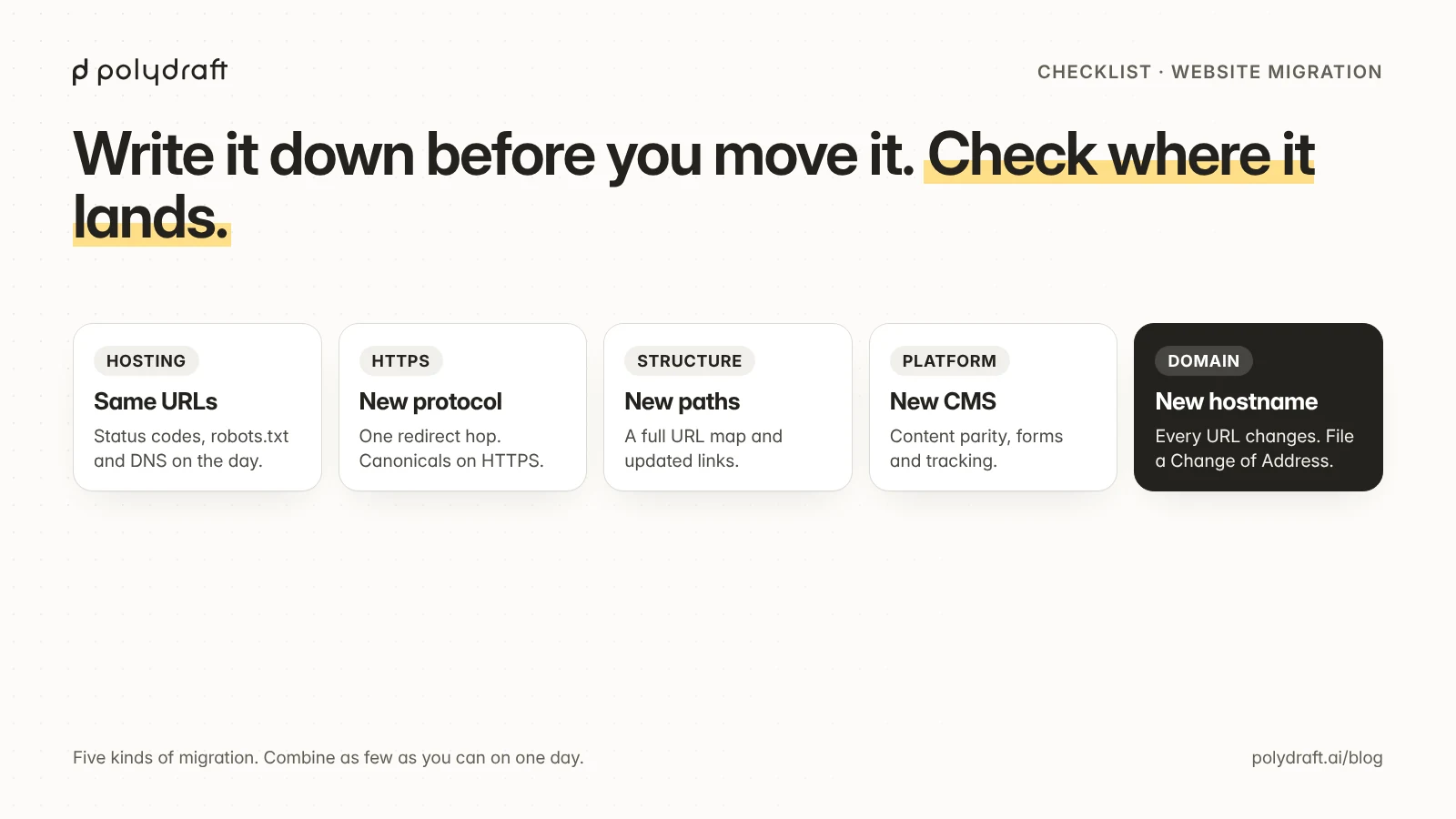
Platform changes add a sixth driver. If the redesign also moves you to a new CMS or platform, add the migration work: exports, rebuilding features a plugin used to handle, and a DNS cutover. Our website migration checklist lists what that involves.
A budget model you can fill in
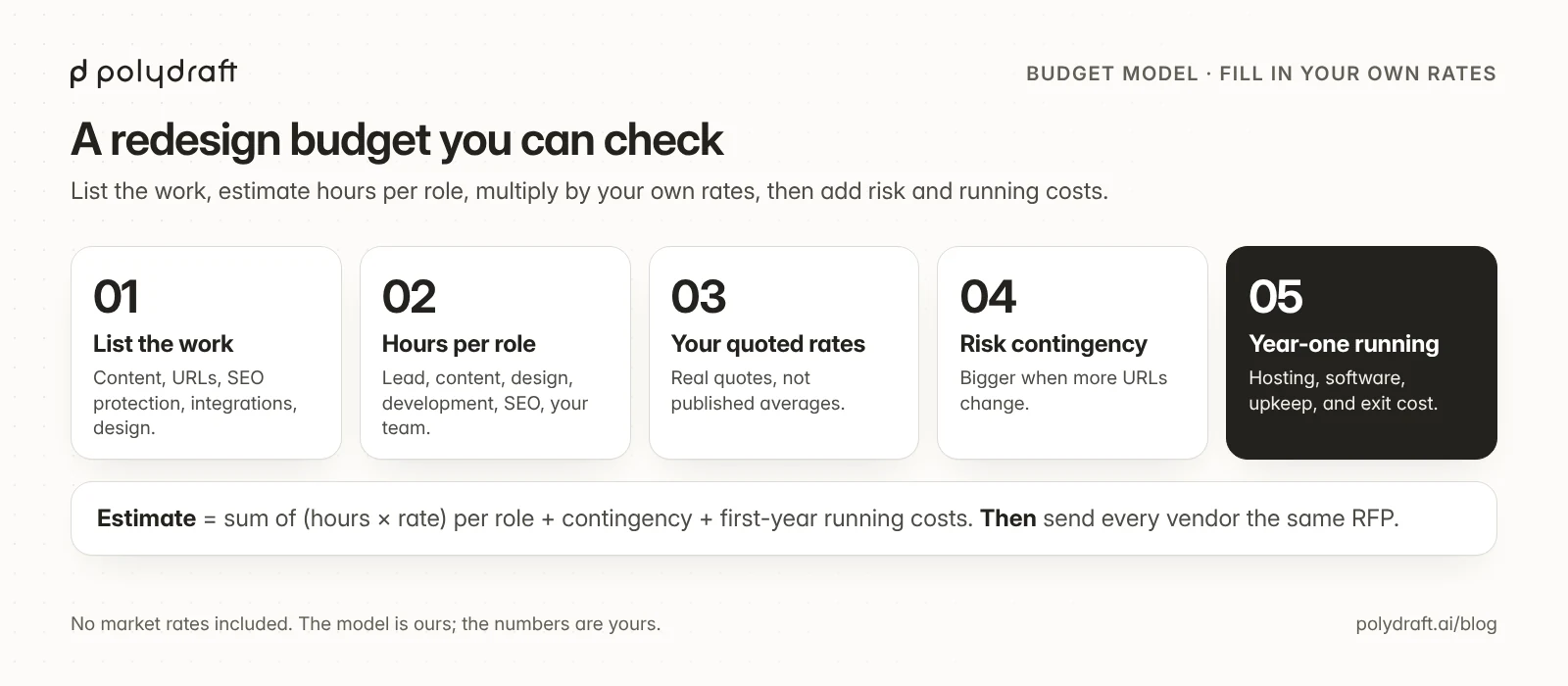
Estimate hours per role for each driver, then multiply by the rates you're quoted:
| Role | Typical work in a redesign | Your hours | Your rate | Cost |
|---|---|---|---|---|
| Strategy or project lead | Goals, scope, page plan, approvals | [ ] | [ ] | [ ] |
| Content | Audit, rewriting, new pages | [ ] | [ ] | [ ] |
| Design | Layouts, components, brand styles | [ ] | [ ] | [ ] |
| Development | Templates, integrations, performance | [ ] | [ ] | [ ] |
| SEO | Baseline, URL map, redirects, checks, monitoring | [ ] | [ ] | [ ] |
| Your own team | Reviews, facts, approvals, testing | [ ] | [ ] | [ ] |
A worked example: a 15-page redesign
Here is the model filled in for an illustrative project: a 15-page marketing site on the same platform and domain, with a contact form and a CRM connection, adjusted brand styles, and about a third of the pages rewritten. The hours are our own illustrative assumptions, and $100 an hour is a sample rate to show the arithmetic, not a market figure. Replace both with your own.
| Role | Work in this example | Hours | Sample rate | Cost |
|---|---|---|---|---|
| Strategy or project lead | Goals, page plan, weekly check-ins, approvals | 12 | $100 | $1,200 |
| Content | Audit 15 pages, rewrite 5, edit the rest | 40 | $100 | $4,000 |
| Design | Adjusted brand styles, 4 page layouts | 30 | $100 | $3,000 |
| Development | Templates, form and CRM, performance | 50 | $100 | $5,000 |
| SEO | Baseline, URL decisions, redirect tests, launch checks, 3 months of monitoring | 16 | $100 | $1,600 |
| Subtotal | 148 | $14,800 | ||
| Contingency for migration risk | 15 percent of the subtotal, our illustrative choice | $2,220 | ||
| Estimate | $17,020 |
Your own team's time isn't in the total above. In this example, budget around 20 hours for reviews, facts, and approvals. Change any one input and the total moves with it: rewriting all 15 pages, or a custom design system, can change the estimate more than the page count does.
Then add three lines that estimates often leave out:
- Contingency for migration risk. A share of the total for things that go wrong. The more URLs change, the bigger it should be.
- First-year running costs. Hosting, domain, software, and any maintenance retainer.
- Exit cost. What it would take to move again: can you export the site, and do you own the accounts?
For the running-cost side, our website cost calculator models build, recurring, and operating costs over several years.
The hidden cost: migration risk
The most expensive redesign mistakes don't appear in a quote. Old URLs that 404, pages that lose the text that ranked, a noindex left over from staging, or a form that silently stops sending leads. Each one costs traffic or enquiries until someone notices, and fixing it takes time on top.
Protecting against them is mostly bookkeeping:
- Record a baseline of URLs, traffic, and conversions before anything changes.
- Give every URL that matters a decision: keep, redirect, or retire.
- Test redirects end to end on staging, including where they land.
- Agree a go/no-go check and a rollback trigger for launch day.
- Monitor in fixed windows for at least three months.
Ask every vendor whether this work is in their quote, and who does it. Our website redesign SEO checklist has the full version, including a tested redirect-check script.
Five ways to get a redesign done
Prices depend on your market and scope, so this compares what you're paying for, not amounts:
| Approach | What you pay for | Your time | Where it fits | Watch out for |
|---|---|---|---|---|
| Do it yourself on a builder | A subscription | High | Small sites, simple needs | SEO protection and migration steps are on you |
| Freelancer | Their hours for agreed work | Medium | Clear scope, one main skill needed | Gaps between design, development, and SEO |
| Agency | A team and a process | Low to medium | Larger sites, many integrations | Scope creep. Who owns the accounts and the code |
| AI website builder | A subscription. Building is often free until you publish | Medium | Marketing and lead-generation sites | What carries over, and what doesn't |
| Done for you on a builder (for example, PolyDraft's AI FDE) | An engagement with someone who runs the builder for you | Depends on scope | Teams without time to run a builder themselves | Agree scope, approvals, and handover in writing |
Whichever you choose, put ownership, approvals, and handover in the agreement. Our SEO contract checklist lists the clauses, and most of them apply to redesign contracts too.
A website redesign RFP template
Send every vendor the same request, so you can compare their answers. Replace the bracketed text:
WEBSITE REDESIGN: REQUEST FOR PROPOSAL

1. About us
   [Business, audience, what the website must achieve]

2. Current site
   URL: [ ]   Platform: [ ]   Indexable pages: [number]
   Top pages by traffic and enquiries: [attach export]
   Integrations: [forms, CRM, analytics, booking, payments, ...]

3. Goals and success measures
   [e.g. more qualified enquiries, faster updates, new languages]
   Measured by: [metric, data source, baseline date]

4. Scope
   Pages to keep / rewrite / add / retire: [attach list or "to be agreed"]
   Content: who writes it [us / you / shared]
   Design: [template / adjusted brand / custom design system]
   Platform: [stay on X / open to change]

5. SEO and migration protection (please describe how you handle each)
   - Baseline of URLs, traffic and conversions before work starts
   - URL map: keep / redirect (301 or 308, one hop) / retire
   - Redirect testing, including the final destination
   - Staging blocked from indexing, removed at launch
   - Launch-day go/no-go and rollback trigger
   - Monitoring for [3] months after launch

6. Ownership and handover
   We own the domain, hosting account, CMS, analytics and Search
   Console. Content, code and design files belong to us on payment.
   Describe what we receive at handover.

7. Approvals
   Named approver: [ ]. Turnaround: [ ] business days.
   Nothing goes live without written approval of the exact version.

8. AI and automation
   Describe where you use AI tools and who reviews the output.

9. Budget and timeline
   Budget range: [ ]   Target launch: [ ]   Hard deadlines: [ ]

10. What we need from you
    - Itemized quote by role and phase (hours x rate)
    - What is excluded, and what costs extra
    - Running costs for the first 12 months
    - Two comparable projects, and who did the SEO work on them
    - Proposal due: [date]. Questions to: [contact]
Where PolyDraft fits
PolyDraft is an AI website builder for marketing and lead-generation sites. As of October 26, 2026, building and previewing a complete site is free on every plan, and you pay only to publish. Plans on our pricing page are Starter at $39 a month, Pro at $99, and Agency at $299, with Enterprise on custom terms, and access is currently invite-based. Each plan deploys to your own Cloudflare account. Project transfer is on Pro and above, and full source-code export is on Agency. For a redesign, our AI website redesign page explains what carries over from your current site and what doesn't.
PolyDraft also offers AI FDE (AI forward-deployed engineering): a PolyDraft engineer runs PolyDraft for you, building or migrating your site and doing its technical SEO, content, and AI-visibility work with PolyDraft's agents. Nothing goes live without your approval. Contact us to scope an engagement.
Frequently asked questions
How much does it cost to redesign a website?
It depends on the work. Content, URL changes, SEO protection, integrations, and design depth decide most of the cost. Published ranges run from under $1,000 for a page or two to more than $200,000, so build an estimate from hours and the rates you're actually quoted.
Why do website redesign quotes vary so much?
Vendors scope different work. One quote may include content rewriting, redirects, and monitoring while another doesn't. Send every vendor the same RFP and ask for an itemized quote by role and phase.
Is it cheaper to redesign or to rebuild a website?
A light redesign on the same platform is usually less work than a rebuild on a new one, because nothing has to migrate. If the platform itself is the problem, the migration work may still be worth it. Compare the two scopes line by line.
What hidden costs come with a website redesign?
Your own team's review time, content rewriting, redirects and SEO checks, rebuilding integrations, the first year of running costs, and recovering from mistakes such as lost URLs or broken forms.
What should a website redesign RFP include?
Your goals and how they're measured, the current site and its integrations, scope, how the vendor protects SEO during the move, ownership and handover, approvals, budget and timeline, and an itemized quote format.
How long does a website redesign take?
Anything from weeks to months, depending on scope and how fast approvals happen. Content and approvals are the most common causes of delay.
Continue with the next task
- Moving platforms or domains too: Website migration checklist
- Protect search traffic during the redesign: Website redesign SEO checklist
- Budgeting a brand-new site instead: Website cost breakdown
About this article. Drafted by an AI agent following PolyDraft's blog workflow, checked by an automated QA script, reviewed by separate AI agents, and approved by Vincent Chen. The price ranges come from 18 sources we sampled on October 26, 2026, as summarized in search results. We report only the spread, not individual figures. The budget model, worked example, and RFP template are our own. The example's hours are illustrative assumptions and its $100 hourly rate is a sample, not a market figure. PolyDraft prices are from our pricing page as of October 26, 2026. The diagrams are original illustrations made for this article.
Sources
- Google Search Central: Site moves with URL changes
- Google Search Central: Redirects and Google Search
- Search Console Help: Page indexing report
- Google Search Central: Creating helpful, reliable, people-first content
Written by
Founder of PolyDraft and CEO of BlackMonolith, Inc.