8 Growth Loops for 2027, With a Worked Example for Each
Eight growth loops a startup can run, each with a worked example from a company's published terms or our own measurements, and how to choose your first.
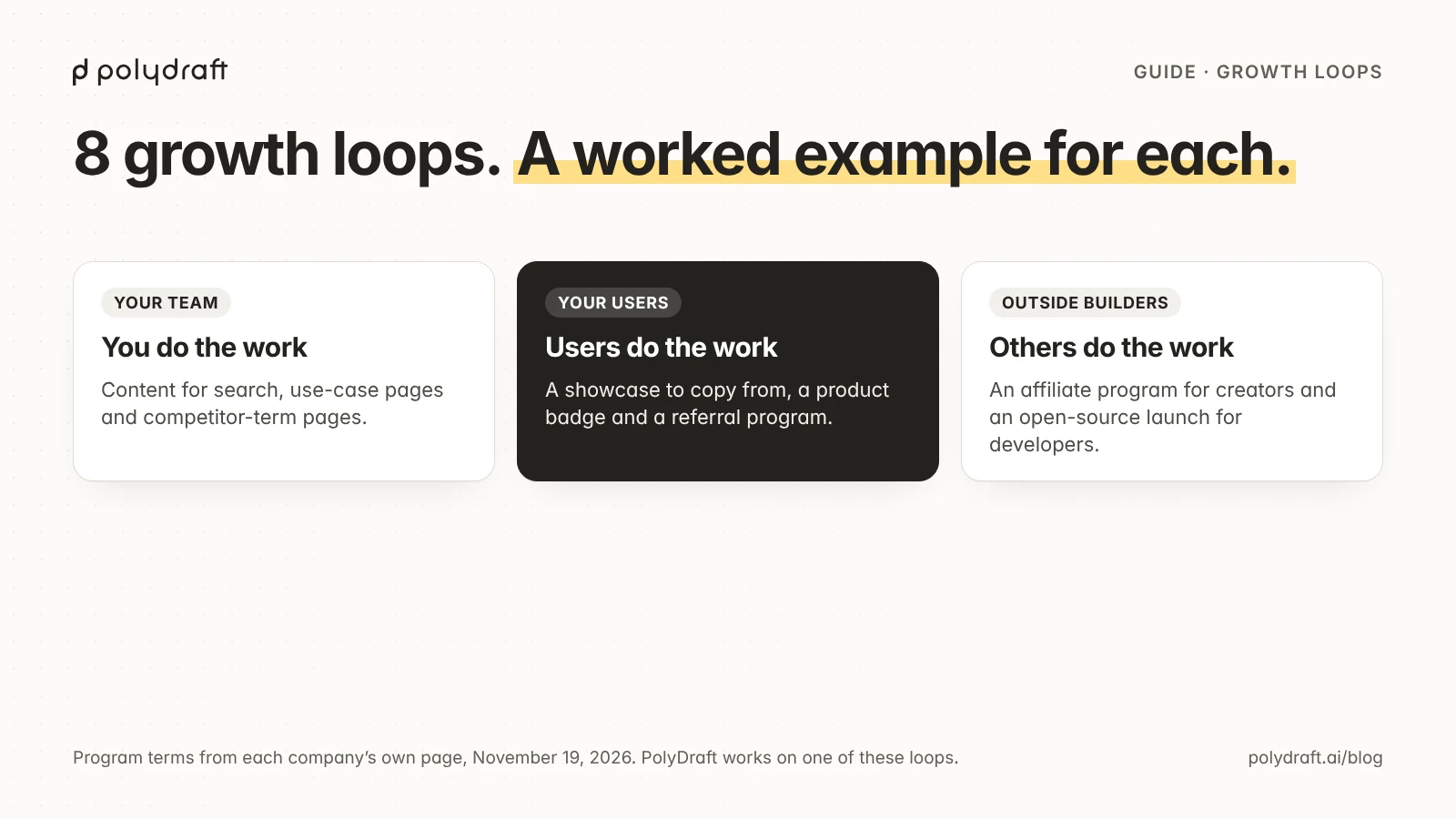
A growth loop is a cycle in which the result of one round becomes the input for the next. That result can be a new page, a new user or a published site. The eight loops below are ones a startup with a website and a small team can start. They are content for search, use-case pages, competitor-term pages, a showcase, a product badge, referrals, affiliates, and an open-source launch. Each has a worked example from a real company.
We did not run these companies' programs and have no inside numbers. Each example comes from the company's own page, opened on November 19, 2026, or from our own benchmark. That benchmark is our own one-time measurement of ten startup websites on November 17, 2026. It uses DataForSEO estimates of each site's US search traffic and rankings, plus our own crawls of the Cursor and Replit sitemaps. Two passages are different and say so. One is an account Manus's growth lead gave us in a private conversation (loop 2); the other is our own link outreach, described after loop 8. We make PolyDraft, which works on one of these loops (loop 1).
Key points
- A loop needs a return path. Content that brings signups is a channel. It becomes a loop when signups pay for, or supply, the next piece of content.
- In our November 17 benchmark of ten startups, a median of 90% of estimated search traffic came from branded searches. On those sites, search mostly collects demand that was created somewhere else.
- Pick one loop where your product already creates the output and measure one full turn before adding another.
The eight growth loops at a glance
| # | Loop | What comes back around | Who does the work | What you pay | Worked example |
|---|---|---|---|---|---|
| 1 | Content for search | Revenue funds more articles | Your team | Writing time | Ahrefs |
| 2 | Use-case pages | Signups show which use cases to add | Your team | Page templates and upkeep | Replit |
| 3 | Competitor-term pages | Same as loop 1, on other brands' names | Your team | Research and frequent updates | Emergent |
| 4 | Showcase and remix | Each published project is a new entry page | Your users | Moderation, gallery upkeep | Webflow, Lovable, Cursor |
| 5 | Product badge | Each published site carries a link back | Your users | A lower-priced plan keeps the badge | Lovable, Webflow |
| 6 | Referral | Each paying user can invite the next | Your users | Credits, after payment | Lovable, Replit |
| 7 | Affiliate | Creators publish, earn, publish more | Outside creators | Revenue share or bounty | Webflow, Shopify |
| 8 | Open-source launch | Builders show projects, which draw builders | Developers | A free product and support time | Supabase |
Growth loops, funnels and "growth strategies"
A funnel describes one pass from stranger to customer. A loop adds the step where that customer, or the money and content they produce, brings in the next stranger. For the channels themselves, ranked by cost and time, see our marketing strategies for startups.
Two nearby terms mean something else. "Growth strategies" as a search returns corporate strategy (the Ansoff matrix), and HubSpot's "Loop Marketing" is a campaign method. The FAQ covers both.
1. Content for search
A content loop works when each article brings readers, some readers become customers, and that revenue or learning pays for the next article. Without the last step it is a channel.
Worked example: Ahrefs. Ahrefs calls SEO-driven content "the core of our marketing strategy" in its own SaaS marketing guide. First, Ahrefs picks topics by a "business potential" score, so that an article can show the product while solving the reader's problem. In its words, it will "pitch our product in every piece of content we create". Second, it uses paid ads to promote content and free tools, not to sell the software directly. The Ahrefs Blog header reported 322K monthly search traffic and 284K subscribers when we opened it.
Where it fails. It is slow on a new domain. Our own site is the example. In the three months to November 5, 2026, Google Search Console recorded 49 clicks and about 5,700 impressions for polydraft.ai, as we reported in how this website was built.
Where PolyDraft fits (our product). PolyDraft works on this loop only. Its SEO automation page says that "every week it finds the keywords your site can win, writes the content, refreshes the pages that slip and reports what moved". Articles are published after the user authorizes them. It does not set up or run referral, affiliate or outbound programs for you, and it cannot promise rankings or traffic.
2. Use-case pages
A use-case page loop works when one page per job ("AI app builder", "landing page builder") ranks for the category term and sends visitors straight into the product.
Worked example: Replit. In our November 17 measurements, Replit's /usecases/ai-app-builder and /usecases/ai-website-builder were its two highest-traffic content pages after the homepage. Replit ranked third in the US for both "ai website builder" and "ai app builder" (DataForSEO estimates). On November 19, Replit's marketing sitemap listed 19 pages under /usecases and 222 under /gallery. The AI app builder page describes the job, lists the steps, and ends with seven questions.
Told to us in conversation: Manus. Manus's growth lead told us that their team builds many AI-native tool pages and grows rankings through multiple languages plus internal and external links. The team is very small, and AI does most of the work. This is their account from a private conversation; we have not verified it from a public page.
Where it fails. Pages that differ only by a swapped keyword add nothing for the reader. Each page needs its own facts.
3. Competitor-term pages
Review, pricing and alternatives pages about better-known products borrow demand that already exists. They need the most care with facts.
Worked example: Emergent. Of the ten startups we measured, nine got at least 78% of their estimated search traffic from their own brand name. Emergent was the exception at 54%. Its top pages by estimated traffic were /learn/replit-reviews, /learn/manus-ai-review and /learn/chatgpt-pricing, and it ranked 17th for "replit" and 10th for "manus". We could not open emergent.sh from our research environment, so we have not read those pages and cannot say how accurate they are.
Where it fails. Prices and plans change, and a wrong number about someone else's product costs trust. We publish pages of this kind ourselves, for example Lovable pricing, and each one carries a check date.
4. Showcase and remix
A showcase loop works when users publish what they made, each published item becomes a public page, and a visitor can copy it into a new account.
Worked examples. Made in Webflow invites visitors to "Browse, clone, and customize thousands of websites", with a "Cloneable sites only" filter and a "Showcase your site" button. Lovable's remix documentation describes the same path. With public remixing on, a visitor who is not logged in sees a preview and a Remix button, and clicking it "opens the Log in to remix dialog". Public remixing is off by default. On Cursor, 4,077 of the 4,668 URLs in the sitemap we crawled on November 17 were under /marketplace, against 122 blog posts.
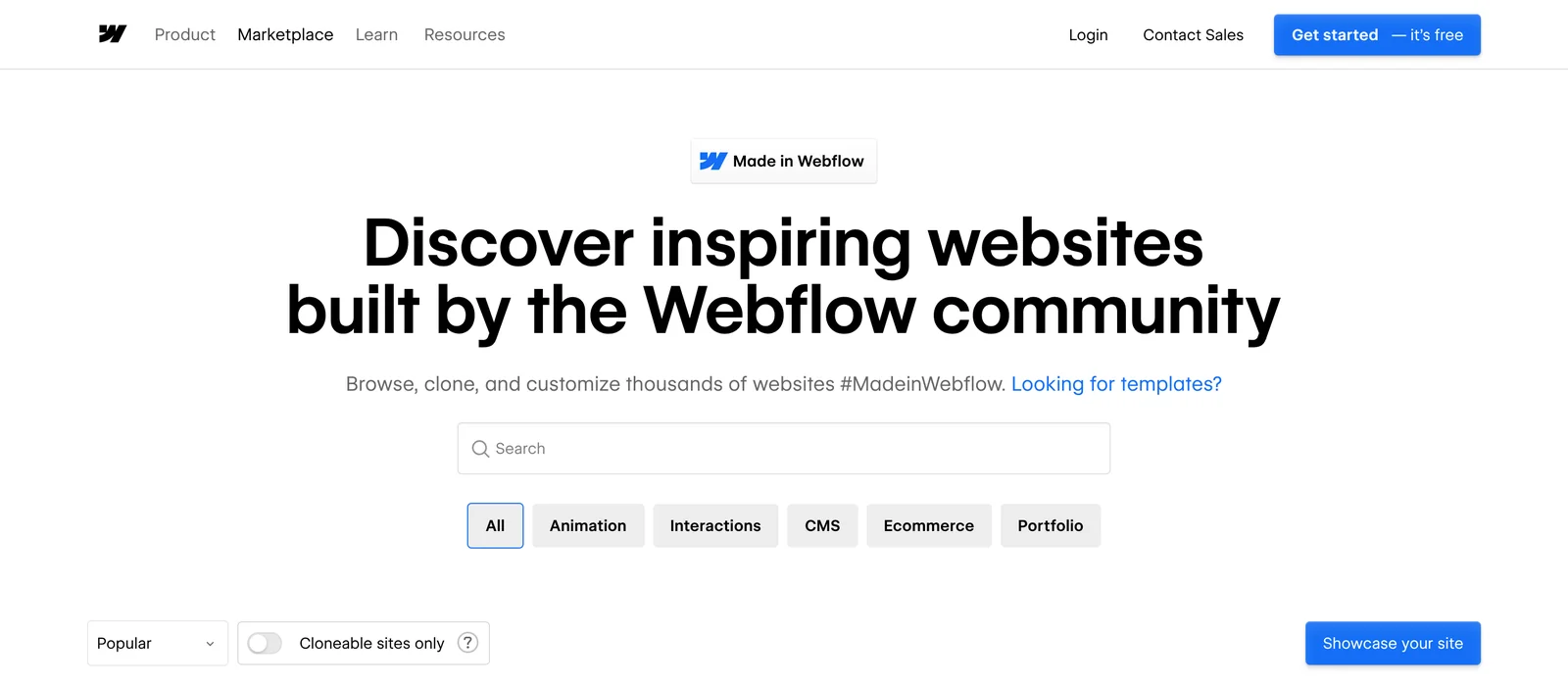
Where it fails. An empty gallery convinces nobody. PolyDraft's own showcase listed three sites in the sitemap on November 19.
5. Product badge
A badge loop puts a small link on everything free or low-tier users publish. Removing the badge is then a reason to upgrade.
Worked examples. Lovable's project settings list "Hide Lovable badge", which removes the "Edit with Lovable" badge on Pro plans and above. If the workspace later drops to a plan without it, "the badge comes back the next time you publish". Webflow's pricing page lists "Remove Webflow badge" as a plan feature. PolyDraft's pricing page (our product) lists "White-label badge control" on the Agency plan. Agencies meet the same badge from the other side; our comparison shows which white label builders drop the vendor's badge and which rebrand the whole dashboard.
Where it fails. The badge works only if users publish sites that get visitors, and none of these companies publishes how many signups a badge brings.
6. Referral
A referral loop rewards a user for bringing a paying user. The safest design pays in product credits and only after the new customer pays.
Worked example: Lovable. Under Lovable's referral program, the invited person gets 10 bonus credits at signup. The referrer gets 100 credits at the new customer's first monthly payment and 25 for each later payment, up to 400. Lovable's plan table prices 100 monthly credits at $25 on monthly billing. Our arithmetic: a customer on that tier who pays for 13 months has paid $325. By then the referrer has reached the 400-credit cap, which is $100 of credits at list price. The reward is about 31% of that revenue, paid in product, and nothing is paid if the first paid plan includes fewer than 100 credits.
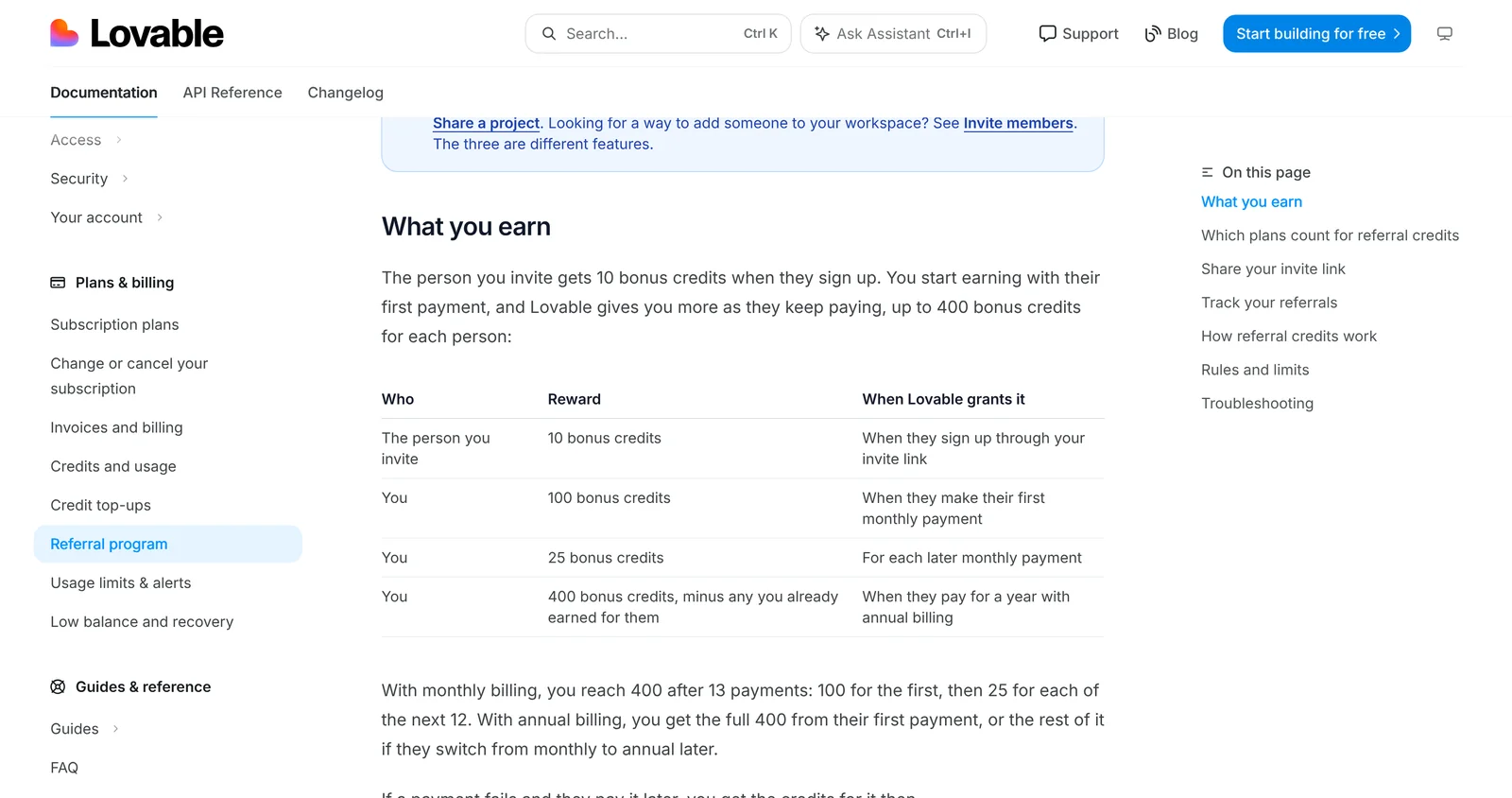
Replit's referral page is simpler: "For every new paying customer you refer, you both get $20 in Replit credits."
Where it fails. Referrals multiply existing users, so a product with 50 users gets little from them.
7. Affiliate
An affiliate loop pays outside creators for customers. Creators publish reviews and tutorials, those pages rank and get watched, and commissions pay for more of them.
Worked examples. Webflow's affiliate program pays "a 50% commission on a new customer’s first subscription for up to 12 months", with first-touch attribution and a 90-day cookie window. It excludes client work: "your clients’ purchases are not eligible for commissions". Shopify's affiliate program pays a bounty: "up to $150 USD per qualified referral" on Basic, Grow or Advanced plans, with amounts that vary by the referral's location.
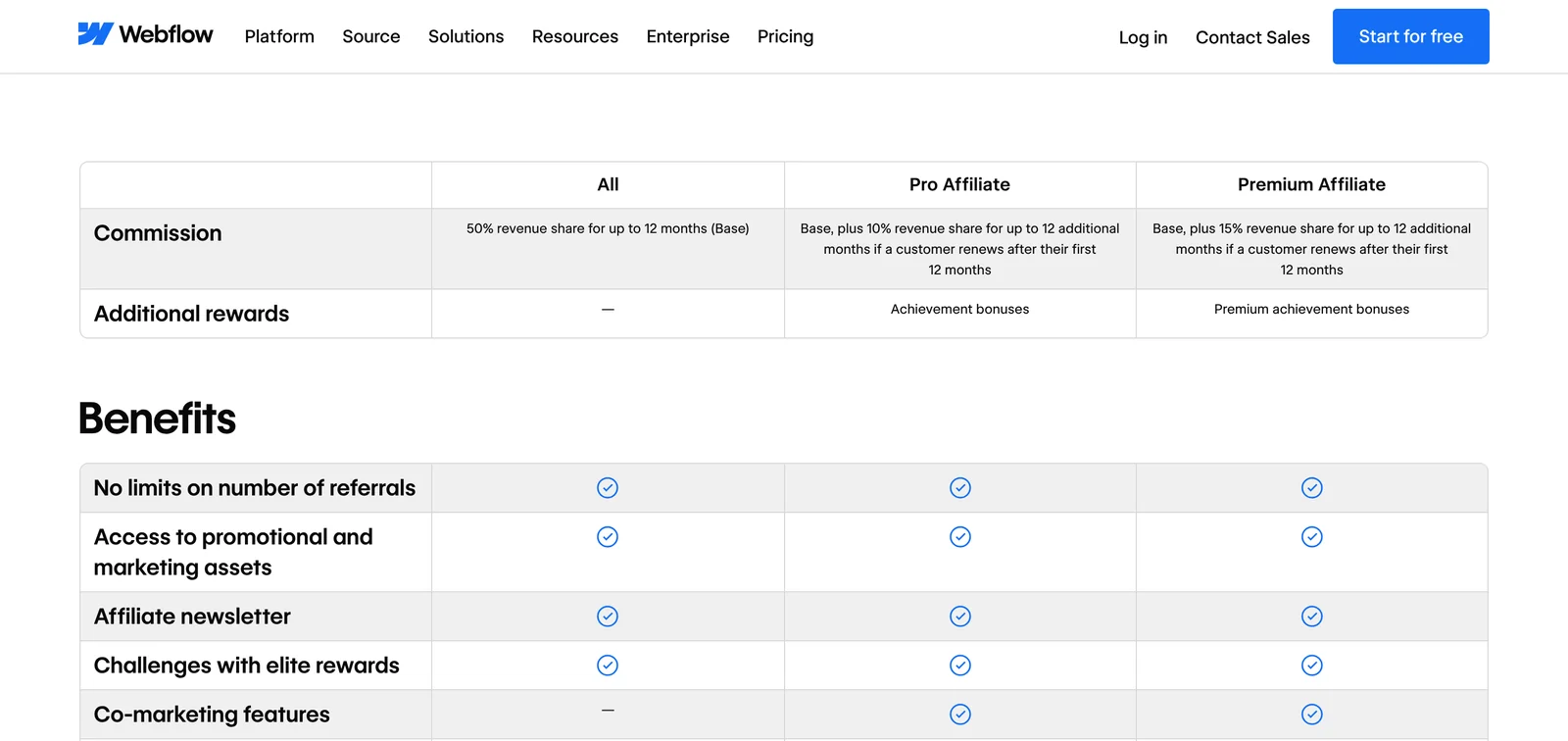
Where it fails. Affiliates write for the commission, so their pages compete with your own for your brand terms, and you pay for customers who would have signed up anyway.
8. Open-source launch
An open-source loop gives developers the product for free. Some build on it in public, and their projects and questions bring the next developers.
Worked example: Supabase. The Hacker News thread "Supabase (YC S20) – An open source Firebase alternative" reached 1,120 points and 366 comments on May 27, 2020. A commenter writing as "we" for Supabase did two things a small team can copy. The replies explained the positioning: developers "wanted to use" Postgres but "chose other options (like Firebase) because they were easier", so "we made 'database UX' our main focus". And they asked builders for their work: "if you build something and want it featured, let us know". In our November 17 measurements, Supabase ranked third in the US for "pgvector" and first for "free database", which is documentation doing the work of loop 1.
Where it fails. It fits developer tools. A launch spike fades in days unless documentation and community keep answering questions.
A channel we run ourselves: link outreach that agents draft and we send
Agents find link opportunities and draft the pitches and guest posts; we review them and send them ourselves. Our list of growth engineer tools describes the three steps. This has run for about two months, and our estimate is ten or more links set up a month. DataForSEO's index shows 18 new referring domains to polydraft.ai in October and 16 in the first 19 days of November, from all sources.
This outreach feeds loop 1. We have not measured which of those links came from outreach, or any visits and signups from them. By this article's own test it is a channel, not yet a proven loop.
What our measurements say about search
Search rewards a loop that is already turning somewhere else. Across the ten startups in our November 17, 2026 benchmark, the median share of estimated US search traffic that came from branded keywords was 90%. The non-branded traffic came from three kinds of page: a category page or homepage, documentation, and glossary-style posts (Glean ranked third for "ai prompt").
These are one-time DataForSEO estimates for each site's top 300 keywords, and brand names such as "cursor" are ambiguous. Treat them as direction.
How to choose your first loop
Start from the output your product already creates, and choose the loop that reuses it.
| If this is true | Start with |
|---|---|
| Using your product puts something public on the web (a site, a page, a shared file) | A badge (5) or showcase (4) |
| You have at least a few dozen paying users who like the product | Referrals (6), paid in credits after payment |
| People already search for the problem or for your competitors | Content (1) with competitor-term pages (3); read SEO for business first |
| Your users are developers | Open what you can and write documentation (8) |
| Creators already cover your category | An affiliate program (7) with a short commission period |
Then measure one turn: how many new users one round of output brings, and how long that takes. A growth engineer is the role that typically owns this measurement.
How we picked
We listed loop types from the titles of pages ranking for "growth loops" and "growth marketing strategies" on November 19, 2026. We kept the ones for which we could open a company's own page that day or had our own measurements. That left out paid acquisition, sales-led loops and collaboration invites. We did not test any program, and apart from the Manus conversation in loop 2 we did not interview these companies. Program terms change, so check the linked page before you copy a number.
Frequently asked questions
What is a growth loop?
A growth loop is a repeating cycle in which each round's output is the next round's input. For example, a user publishes a site, the site's badge brings a visitor, and the visitor becomes a user who publishes another site.
What is Loop Marketing and how does it work?
Loop Marketing is HubSpot's name for a campaign method, described on its Loop Marketing page as "a four-stage framework any marketing team can use to grow in the AI era". The stages are Express, Tailor, Amplify and Evolve. A growth loop is different: users or content bring the next users.
What are the four growth strategies in marketing?
Google's results for this question on November 19, 2026 point to the Ansoff matrix, a corporate-strategy framework. We did not open a primary source for it, so we do not list its four parts here. Growth loops answer a different question: how new customers will arrive.
What is the fastest growth strategy for a startup?
There is no single fastest one. A badge and a referral program are the quickest to set up because they reuse existing users, and their effect grows with the number of users. Content for search starts slowest.
Continue with the next task
- Pick the tools to measure one turn of a loop: Growth engineer tools
- Places to list a new product: 17 SaaS and startup directories
- Compare the channels that feed a loop by cost and time: Marketing strategies for startups
- Plan the content loop: SEO for business
- Decide who builds and runs the loop: What a GTM engineer builds for outbound and inbound
- Before handing a loop to software, check what it may do without approval: AI employees compared: what 10 products do alone
About this article. Written with AI assistance: an AI agent drafted it following PolyDraft's blog workflow, and it is published only after Vincent Chen approves it. Company facts were read on each company's own page on November 19, 2026, and each is recorded with its quote in a claim ledger. The ten-startup figures are our own measurement from November 17, 2026, built on DataForSEO estimates. The Manus account and the description of our link outreach are first-hand statements from PolyDraft's founder. PolyDraft is our product and is labelled as ours where it appears. The screenshots are real captures of the linked pages, cropped only.
Sources
All pages opened November 19, 2026 unless stated.
- Ahrefs: What Is SaaS Marketing? 8 Tactics We Use at Ahrefs, Ahrefs Blog
- Replit: AI app builder use-case page, referral program, marketing sitemap
- Webflow: Made in Webflow, affiliate program, pricing
- Lovable: referral program, subscription plans, project settings, remix a project
- Shopify: affiliate program
- Hacker News: Supabase launch thread, May 27, 2020
- HubSpot: Loop Marketing
- PolyDraft: SEO automation, pricing, showcase, how this website was built
- Our own benchmark of ten startup websites, November 17, 2026; DataForSEO's backlink index for polydraft.ai, November 19, 2026
- First-hand: founder statements of November 19, 2026 (the Manus conversation; our link outreach)