AI Employees in 2027: 10 Products, What They Do Alone, Where You Approve
AI employees compared from vendor pages: what Viktor, Lindy, 11x, Fin, Devin and five more do alone, where a person approves, and what each bills for.
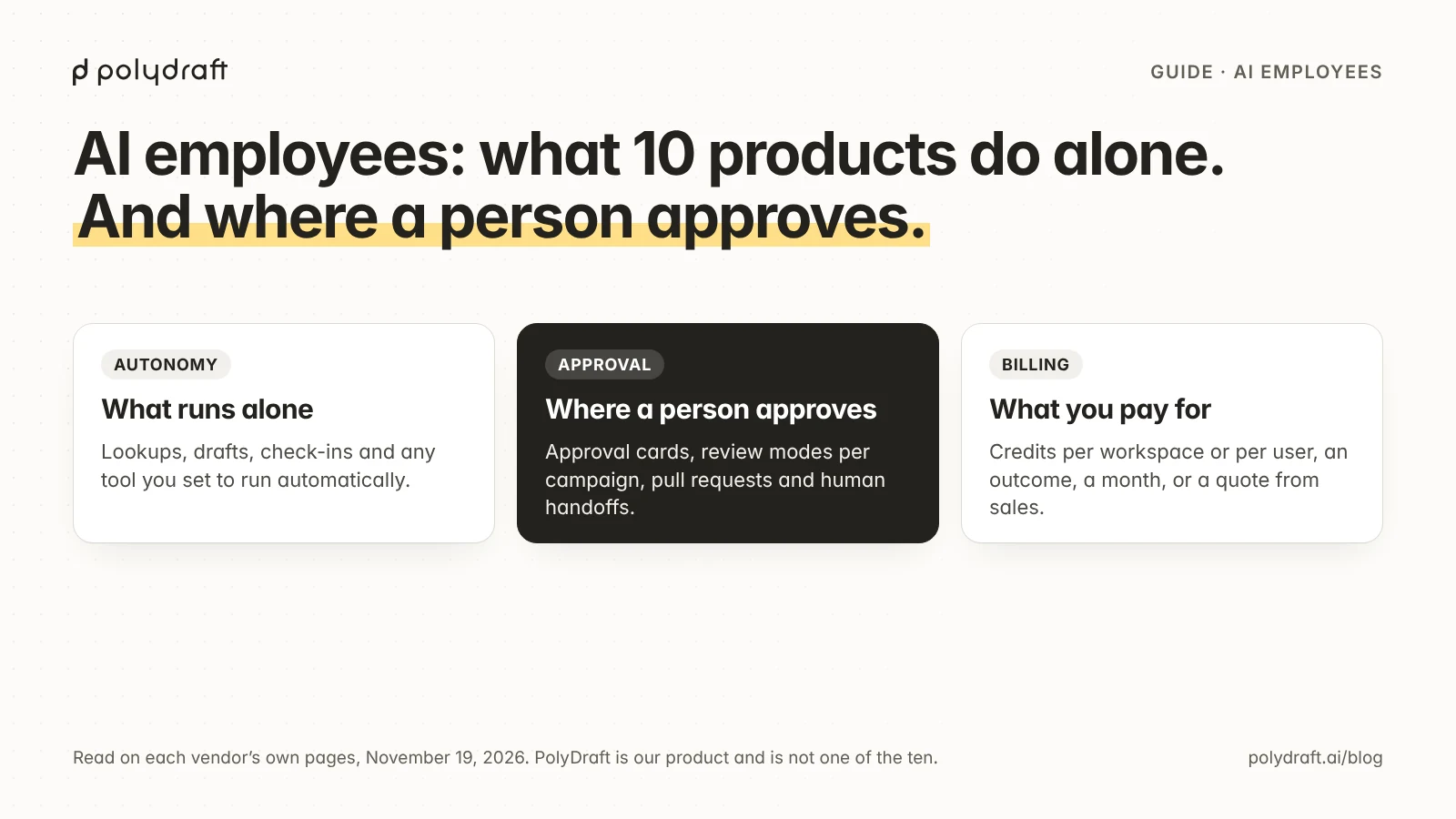
AI employees are software agents sold as a hire. The pitch: you give one a job inside your team's tools, it does the work, and it stops for a person at the steps your settings mark. The clearest example in November 2026 is Viktor, which calls itself "the AI employee in Slack and Microsoft Teams". Around it sit role products. 11x and Artisan sell to sales teams, Fin and Zendesk to support, Paradox to recruiting, Pilot to bookkeeping and Devin to engineering. Lindy and Marblism cover general or small-business work.
This guide is for owners and team leads deciding whether to buy one. We make PolyDraft, which appears in one labeled section near the end. We did not test any product hands-on. Every product fact comes from the vendor's own pages, opened on November 19, 2026, and vendor claims are reported as claims.
Key points
- Three things separate these products: what runs without asking, where a person approves, and the unit you pay for. The job title tells you none of them.
- Viktor's documentation is more exact than its marketing: nine workspace actions always need approval, and each connected tool is set to run automatically, ask first, or off.
- No page we read promises an outcome, and two benchmarks of general-purpose agents show low completion of end-to-end work.
What an AI employee is, in the vendors’ own words
Viktor's fact sheet defines the term by what gets finished: "He works in the team's own tools through connected accounts and posts finished work back in the thread". Marblism treats the common labels as synonyms: "AI employees, AI workers and AI staff are different names for the same thing: software that owns a whole job in your business".
An AI coworker is the same idea named for where it sits. Viktor's article on the term separates the two labels in two sentences: "The first is a location. The second is a responsibility".
Under the label, each product has four parts. It has access to your tools, a trigger (a message, a schedule or an event), memory of your business, and a rule for when it stops and asks. The products differ most on the fourth.
Viktor: the category’s lead example
Viktor matches the label most fully, so it gets the closest reading. Everything below is from viktor.com, its pricing page and its documentation.
What it says it is. "Viktor is an AI employee that works in Slack and Microsoft Teams. Your team messages him like a colleague, and he does the work across 9,800+ connected tools". One Viktor serves the whole workspace; the site also lists a web app, Discord and email. Its list of what it is not is direct: "Not a customer-facing support bot" and "Not fully autonomous: approvals and audit logs are part of the product".
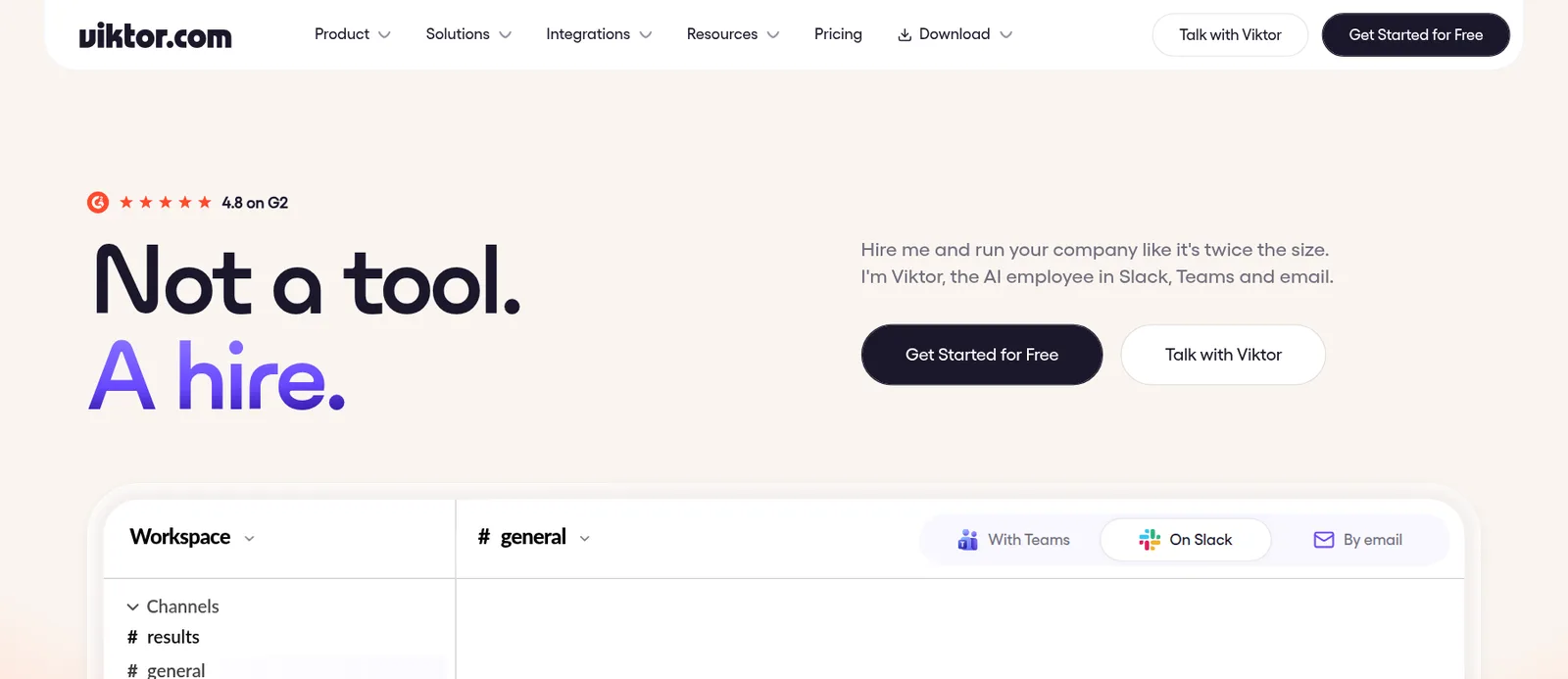
What it does without being asked. The proactive updates page says: "Besides answering when asked, Viktor does some work on his own". It installs a few system tasks in every workspace, including a check-in that "runs twice a day". These can be paused but not edited, and "there is no single switch that turns off all proactive behavior at once". Recurring work is handled differently: Viktor proposes a scheduled task "and leaves it paused. Nothing runs until someone on your team reads it and approves".
Where a person approves. The approvals page says: "When Viktor wants to take one, he prepares it as a draft and posts an approval card. The action runs only after someone clicks Approve". Nine actions always need approval, all of them workspace changes such as integration permissions or a member's spend limit. For work in your connected apps, the integration permissions page gives each tool one of three levels: "Off", "Run automatically", or "Ask for confirmation". In Slack, an approval card can carry an "Always approve this tool" button, after which later calls run without a card.
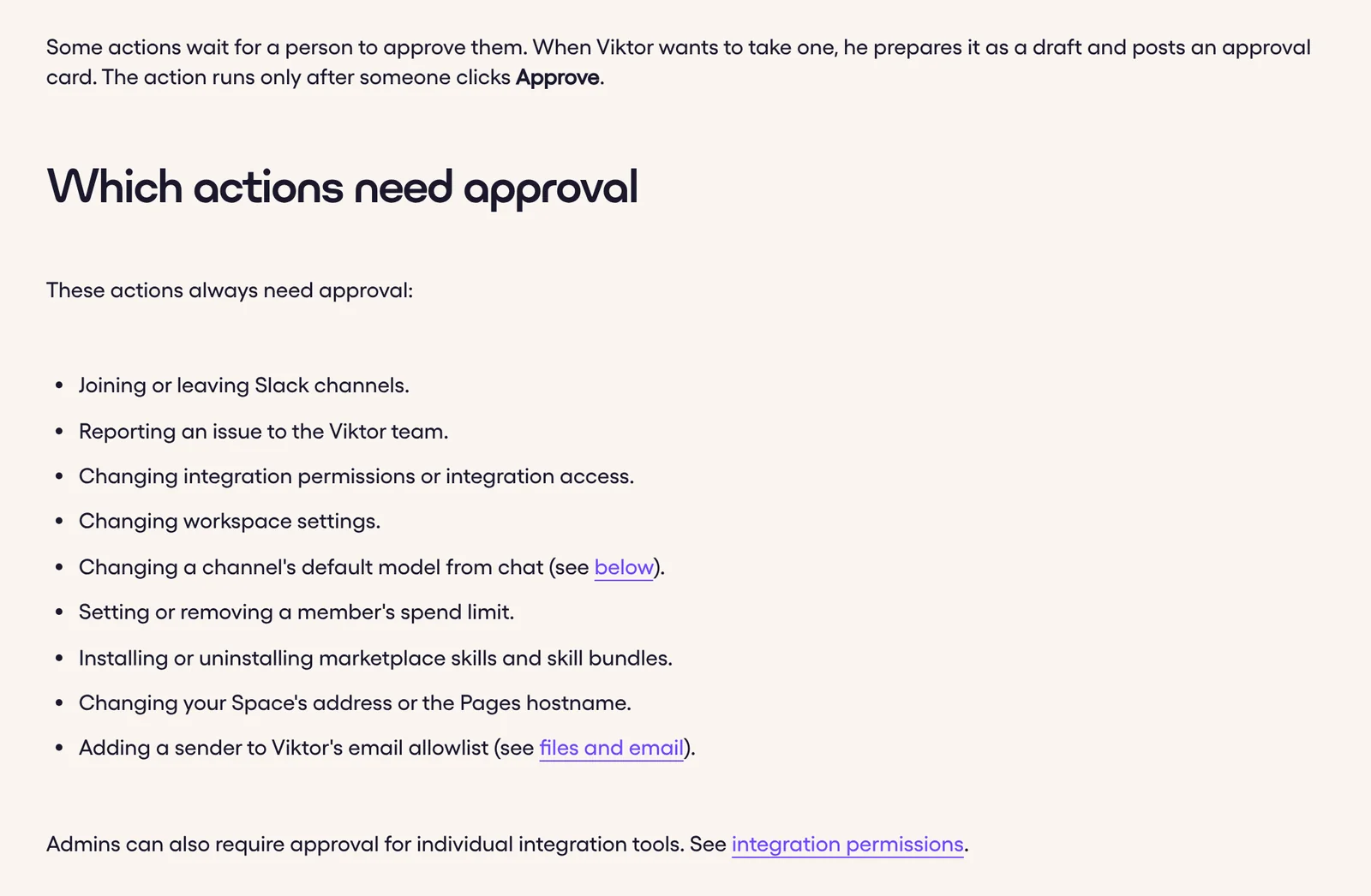
The marketing pages are broader. The business page says "Anything that leaves your workspace, like sending an email, moving money, or pushing code, waits for your explicit yes". The documentation shows that this depends on how each tool is set. Ask to see the default level for every tool you plan to connect.
Admin controls. There are two roles, Admin and Member. In Slack, admins choose who can use Viktor and who it may message directly; the permissions page says those settings "apply to Slack workspaces only", so Teams workspaces get fewer. Audit logs are documented for Enterprise workspaces. One privacy point: "All team members on a plan share the same Viktor instance and context".
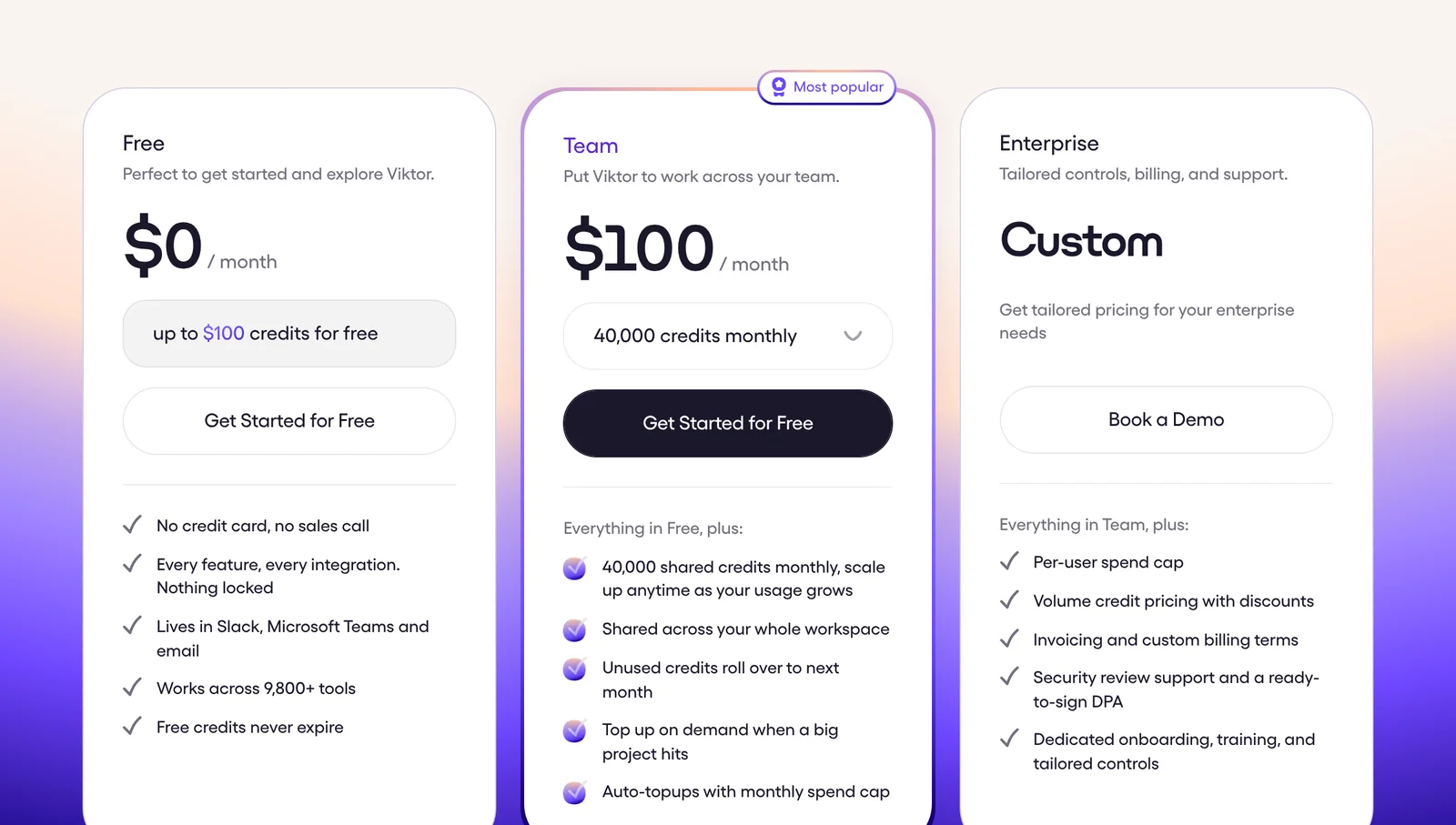
Price and what a credit buys. Viktor is priced per workspace, not per seat. The free tier is "up to $100 in credits" with no credit card. The Team plan is $100 a month for 40,000 credits, and the plans documentation gives one rate for every plan: "$25 per 10,000 credits". Unused plan credits roll over for one month. The pricing page estimates 40,000 credits at "roughly 80-400 tasks depending on complexity". At zero credits, "Viktor pauses".
Where its own pages disagree. Three places, none large:
| Topic | One Viktor page says | Another Viktor page says |
|---|---|---|
| Annual billing | Business page: "Annual plans come with a discount." | Plans documentation: "Annual plans are no longer offered." |
| Cost of a quick task | Pricing page, example card: "100-300 credits" | Pricing page, FAQ: a quick question "might cost 50-100 credits" |
| Free credits | Pricing page: "up to $100" | Documentation: the amount "depends on how the workspace signed up" |
Company facts, from its own fact sheet. Zeta AI, Inc., founded 2023; a "$75M Series A led by Accel, announced 19 May 2026"; and "81,000+ teams" as of November 2026, where a team means a workspace. These are the vendor's figures.
AI employees compared at a glance
Each cell quotes or paraphrases the vendor's own page as read on November 19, 2026. "Not stated" means the pages we opened did not say.
| Product (role) | Does alone, per its page | Where a person approves | Price and unit | Where it runs |
|---|---|---|---|---|
| Viktor (whole team) | Research, drafts, routine updates, check-ins | Nine workspace actions always; each tool set to ask, run or off | $100/mo for 40,000 credits, per workspace | Slack, Teams, web, Discord, email |
| Lindy (whole team) | Lookups; jobs you have released | Anything with outside impact, until you release it | $29.99/mo per active user, 3,000 credits | Slack, email, text |
| Marblism (small business) | Posts, outreach, calls, articles | Checks in when it needs approval | $24/mo billed yearly; $44 monthly | Not stated |
| 11x (sales) | Researches accounts, writes messages | Not stated | No public price | Email, social, voice |
| Artisan Ava (sales) | Sends sequences, handles replies, books meetings | Per campaign: approval mode or send | No public price | Email, social |
| Fin (support) | Answers customers, takes actions | No per-reply approval described; a testing suite before launch | $0.99 per outcome | Intercom or your helpdesk |
| Zendesk AI agents (support) | Resolve requests, take actions | Hand off to humans when needed | Per automated resolution; rate not on the page | Zendesk |
| Paradox Olivia (recruiting) | Screening, scheduling, offer letters | Not stated | No public price | Chat and text |
| Pilot (bookkeeping) | Categorizes and reconciles | A bookkeeper reviews on Core | From $99/mo | Pilot's service |
| Devin (engineering) | Builds, tests, opens a pull request | You review and merge | Free; Pro $20/mo; Teams $80/mo | Cloud or your machine; Slack, Teams |
Which one to look at first
- One assistant for the whole team, inside Slack or Teams: Viktor if you want per-workspace pricing and per-tool approval levels; Lindy if you want approval on by default until you release a job.
- A small business that wants several roles for one fee: Marblism, after asking which posts, emails and calls go out without review.
- Outbound sales: Artisan if you need a documented approval mode; 11x if you want reps to keep the calls. Both quote prices only on request.
- Customer support: Fin if you want to pay per outcome on any helpdesk; Zendesk's agents if you already pay for Zendesk seats.
- Bookkeeping: Pilot, where a human bookkeeper reviews on the Core plan.
- Engineering: Devin, where every change arrives as a pull request you merge.
- Website growth (search, content, technical fixes): none of the ten covers it. That job belongs to a growth engineer; see what a growth engineer does and what AI can take over, and our own product in the labeled section below.
AI employees by role
1. Lindy: a general teammate
Lindy is the closest product to Viktor here. Its home page calls it "the AI employee that plugs into your tools, learns how you work, and takes real work off your plate". The same page places it "in Slack, email, text and your calendar".
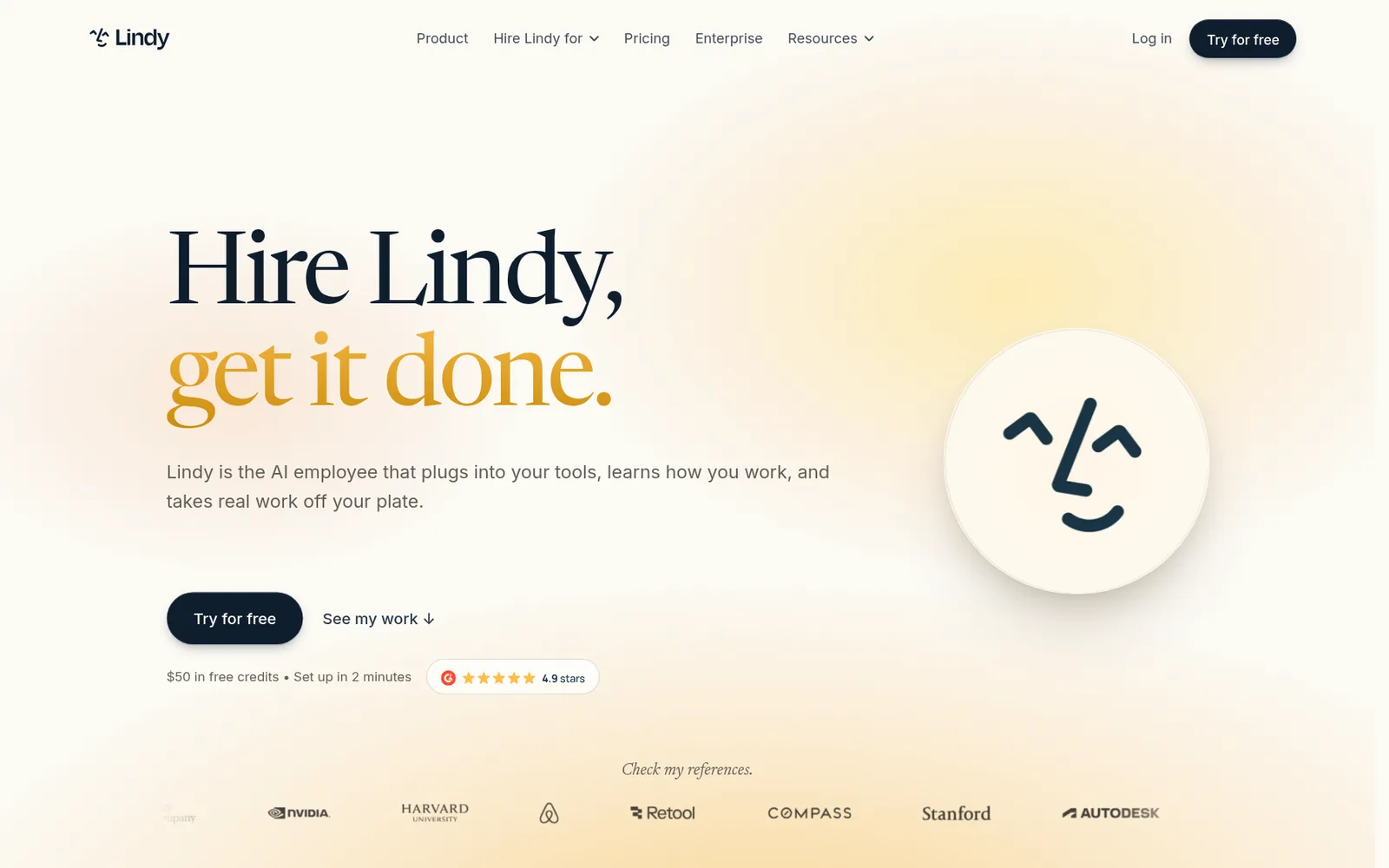
Approval is a starting state: "At first, anything with outside impact waits for your OK. Once you trust me with a job, I can run it end to end on my own". The FAQ answers "Will Lindy do anything without my approval?" with "No". Read the two together: no by default, yes once you release a job.
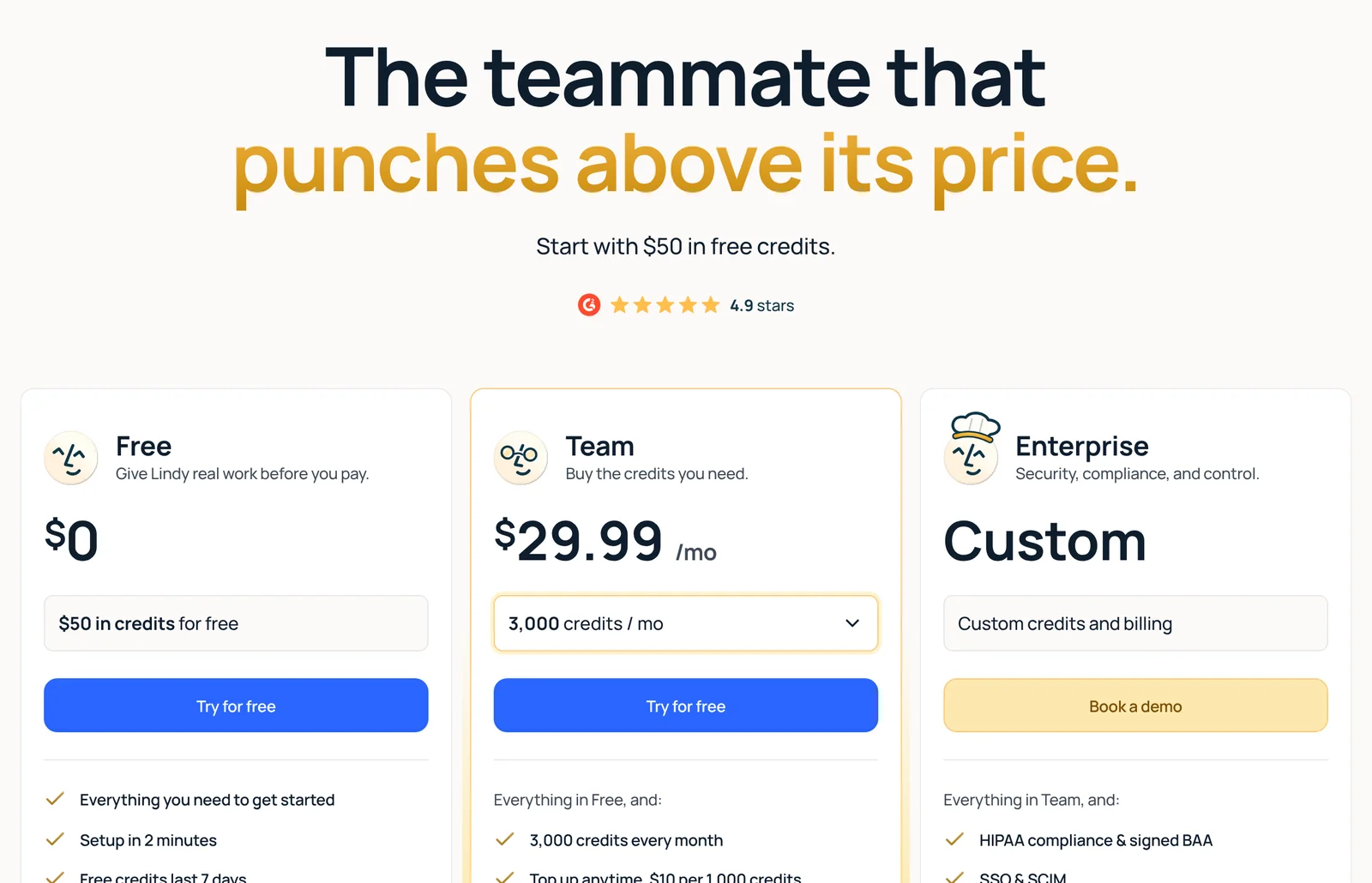
The bill is built differently from Viktor's. Lindy's pricing page says "Every active user in your workspace is billed, from $29.99 a month for 3,000 credits each". The free tier is $50 in credits that "last 7 days".
2. Marblism: a bundle of named roles
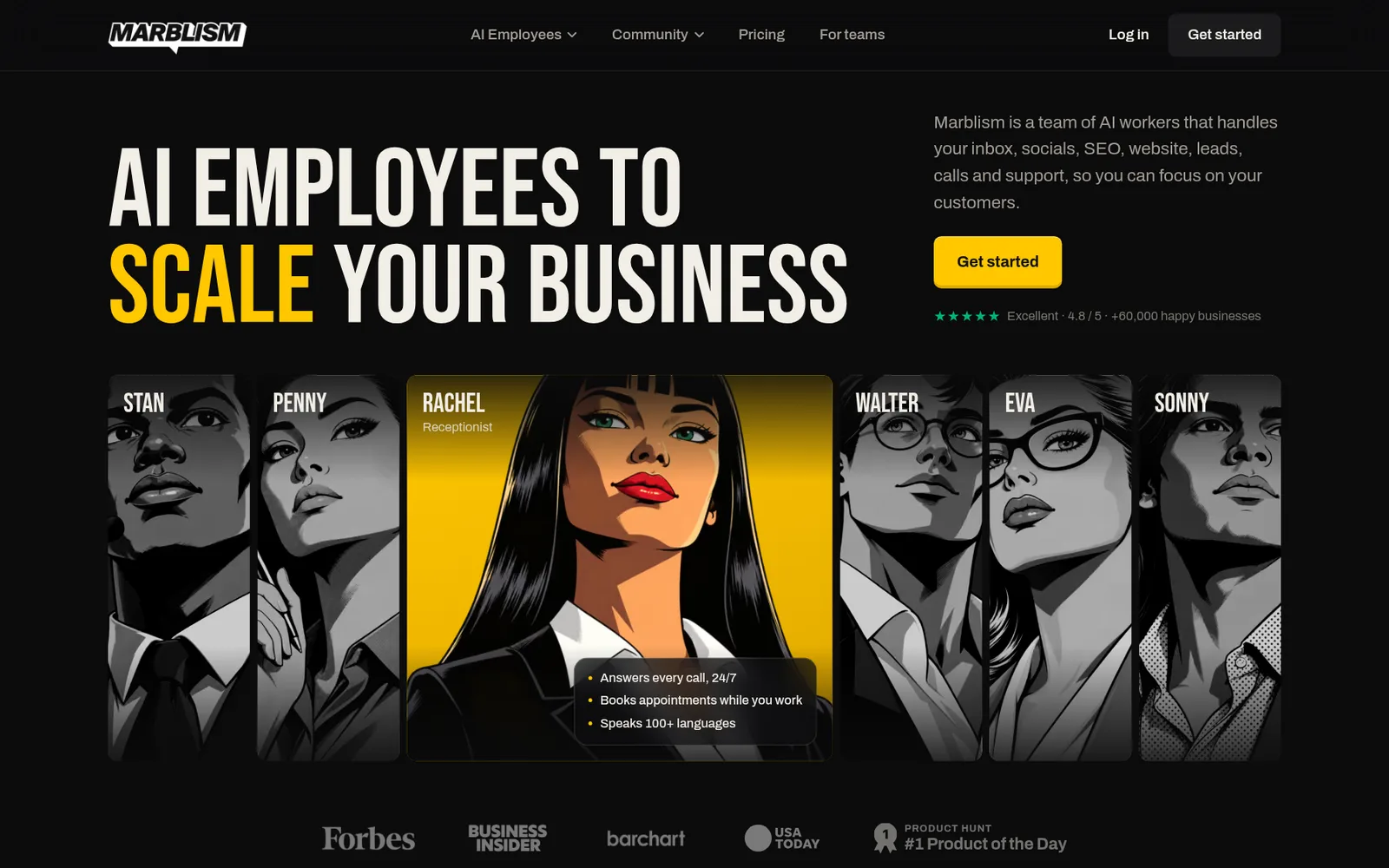
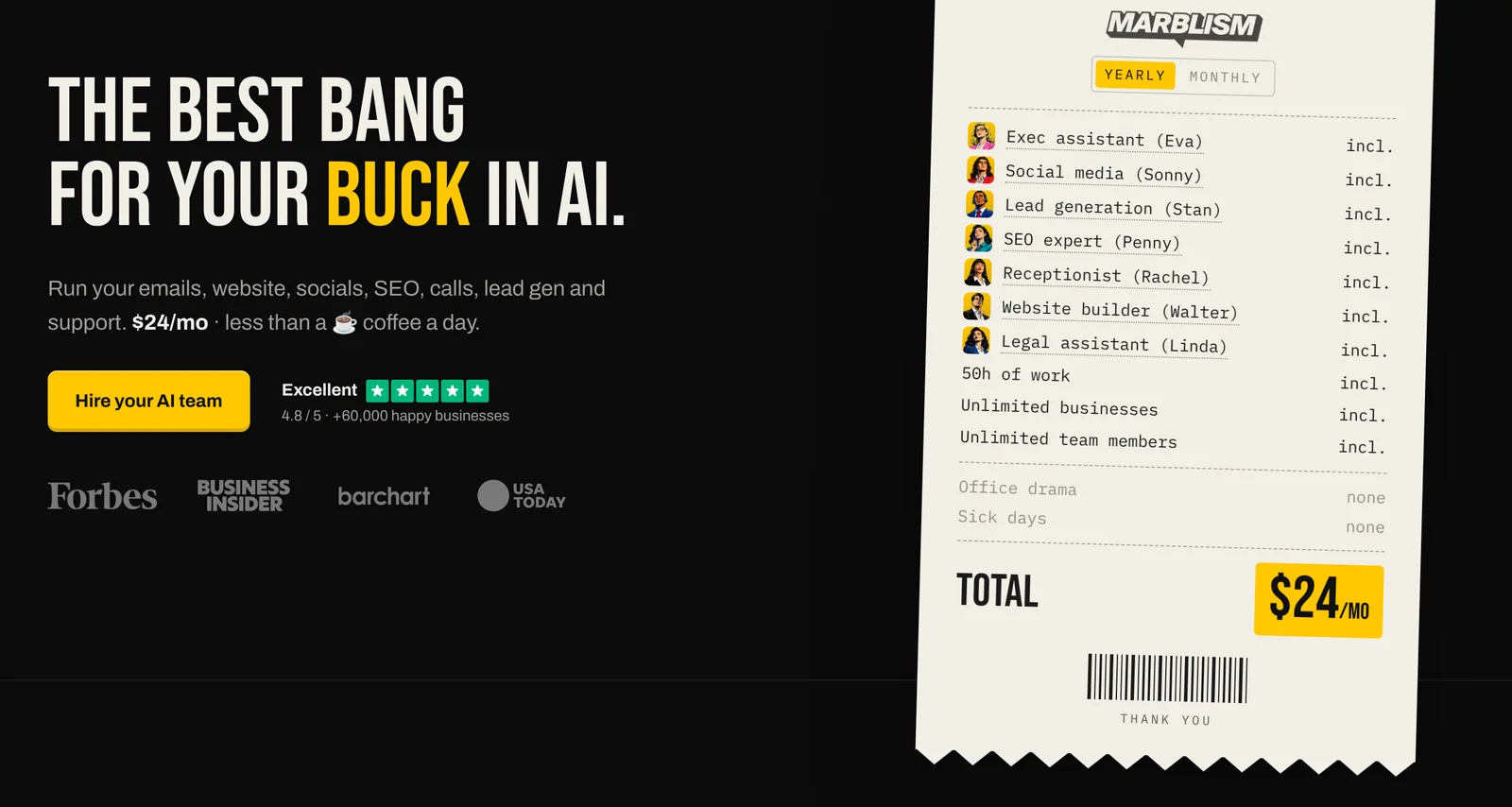
Marblism sells the phrase itself: "AI employees to scale your business". Its pricing page lists seven named roles in one subscription, among them an executive assistant, a social media manager, a lead generation role, an SEO role and a phone receptionist. The total is $24 a month on the yearly toggle and $44 on the monthly one. The card includes "50h of work", and the page does not explain how those hours are counted.
On approval the page gives one sentence: the roles "handle tasks automatically and check in only if they need your input or approval". It does not say which posts, emails or calls go out unreviewed.
3. 11x and Artisan: sales development
Both sell an AI that prospects and writes outreach, and both keep the price off the page. The in-house role that builds this kind of outreach system is the GTM engineer; see what a GTM engineer does and the stack behind the role.
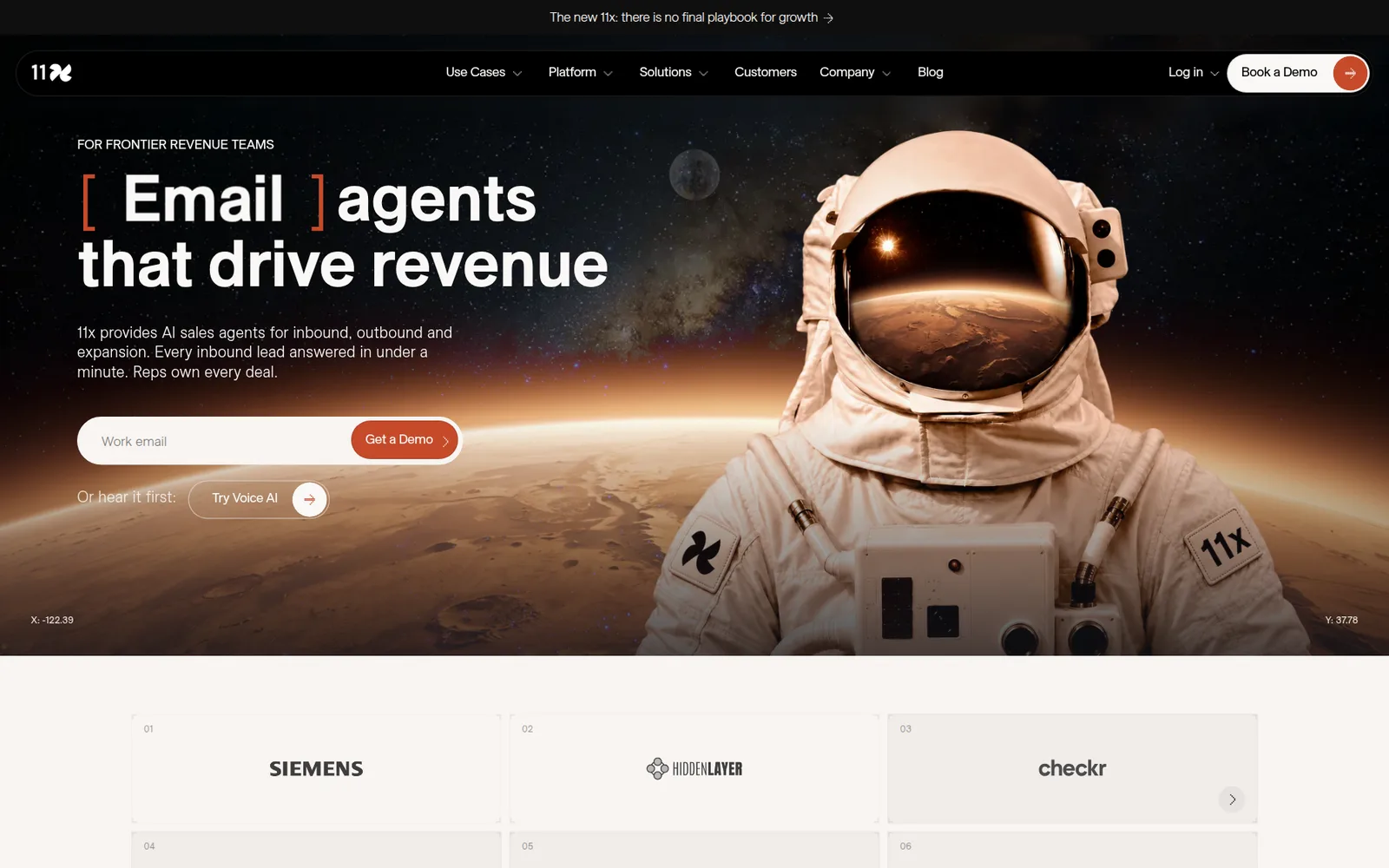
11x says it "provides AI sales agents for inbound, outbound and expansion". It says its outbound product "researches every account and contact in your territory and writes each email and Social message from what it finds. Reps make the calls". The pages we read do not say whether a person reviews messages before they send.
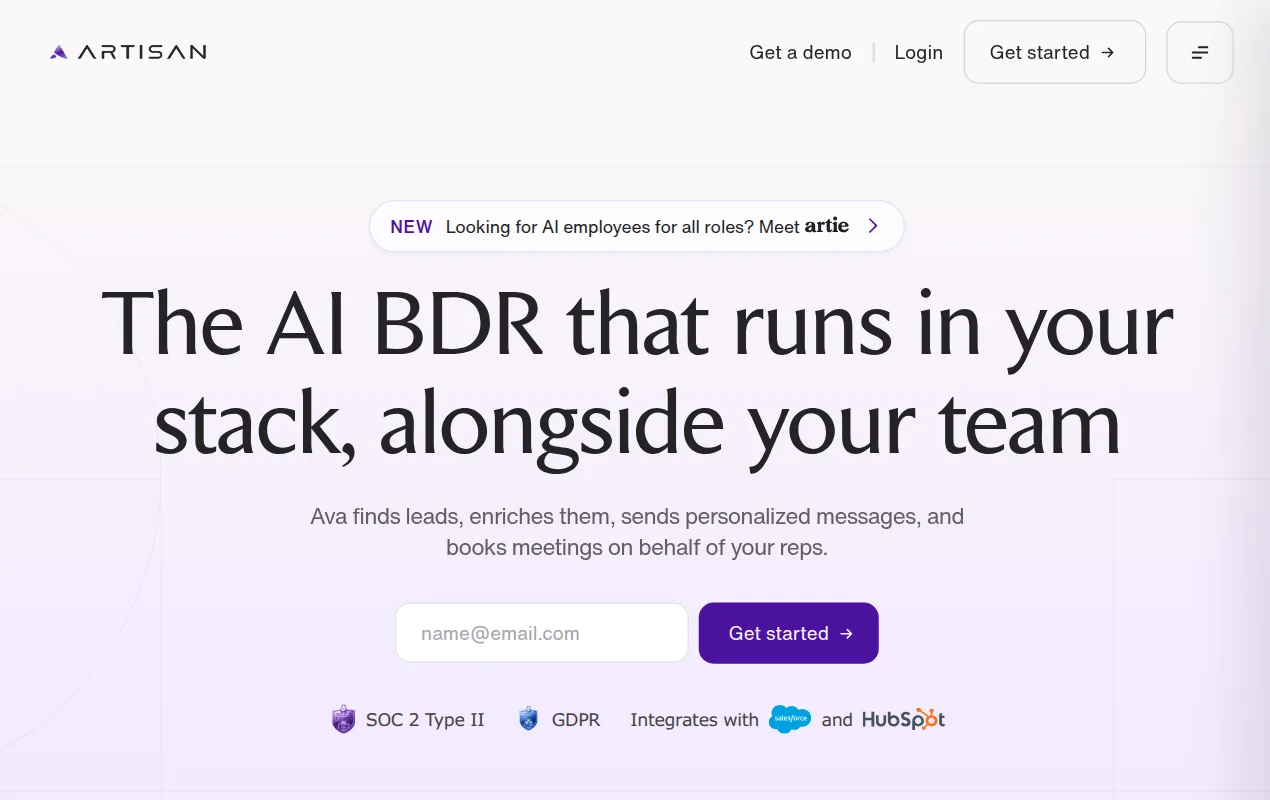
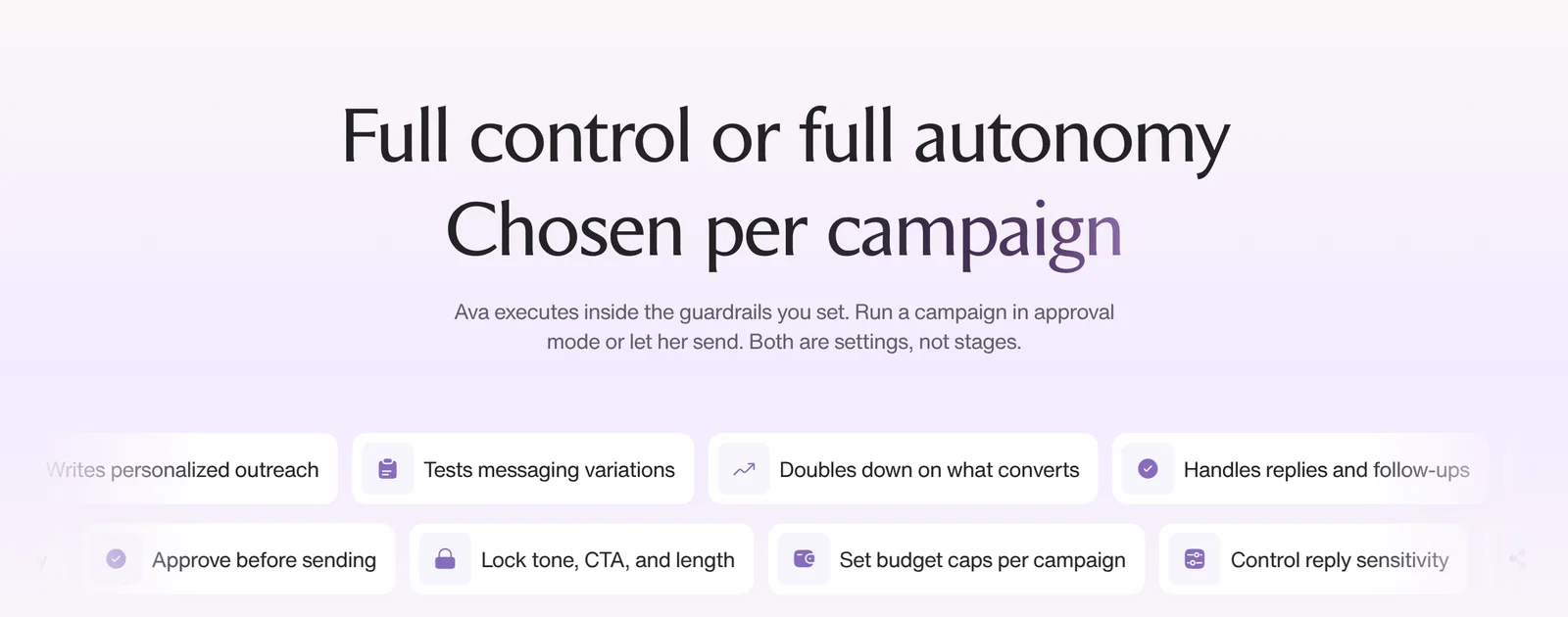
Artisan says its agent Ava "sources leads, writes personalized emails, handles replies, and books meetings on your reps' calendars". Artisan states the approval rule in one line: "Run a campaign in approval mode or let her send. Both are settings, not stages". Its pricing page says "Pricing scoped on your plan".
4. Fin and Zendesk: customer support
Support is where an agent talks to your customers directly and billing follows a counted result.
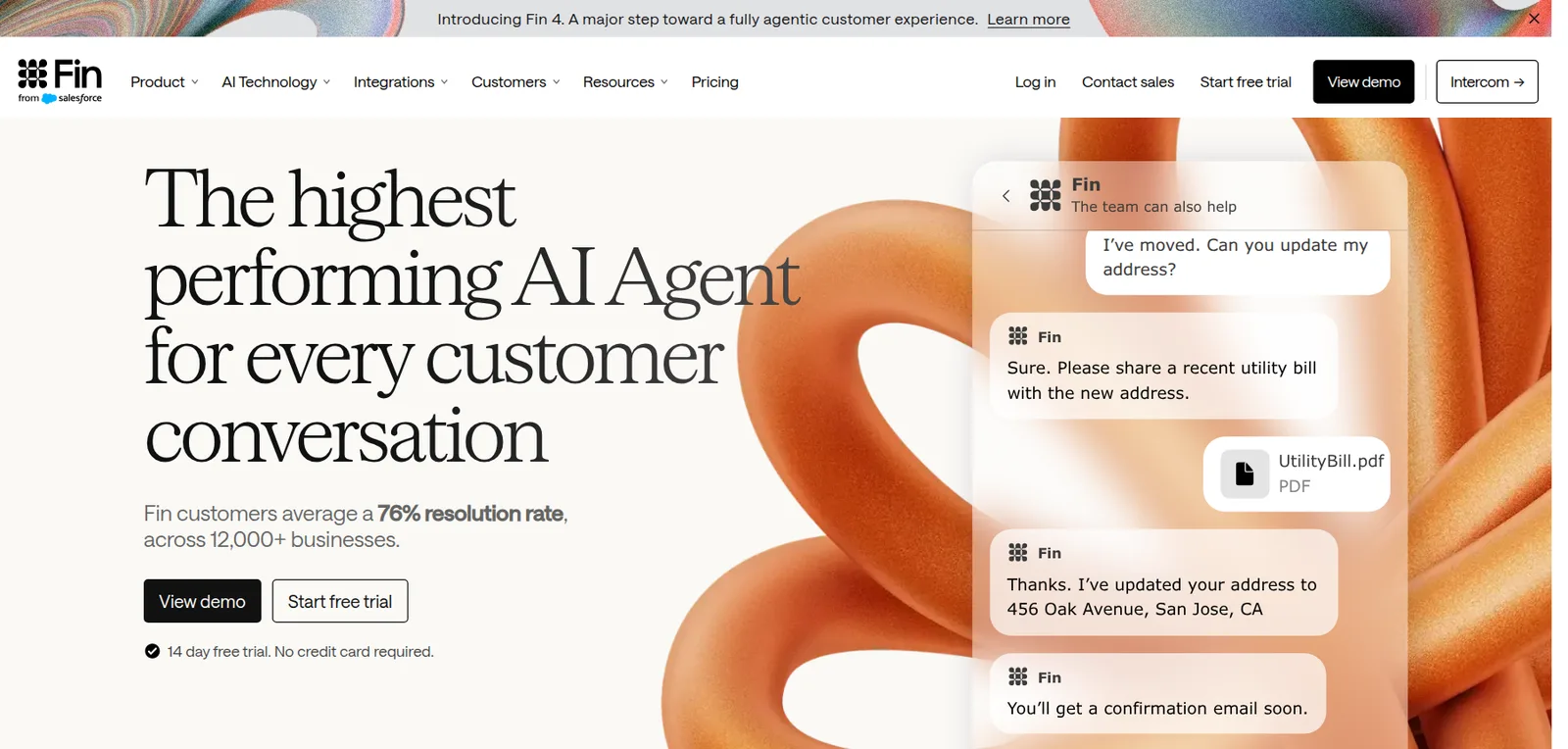
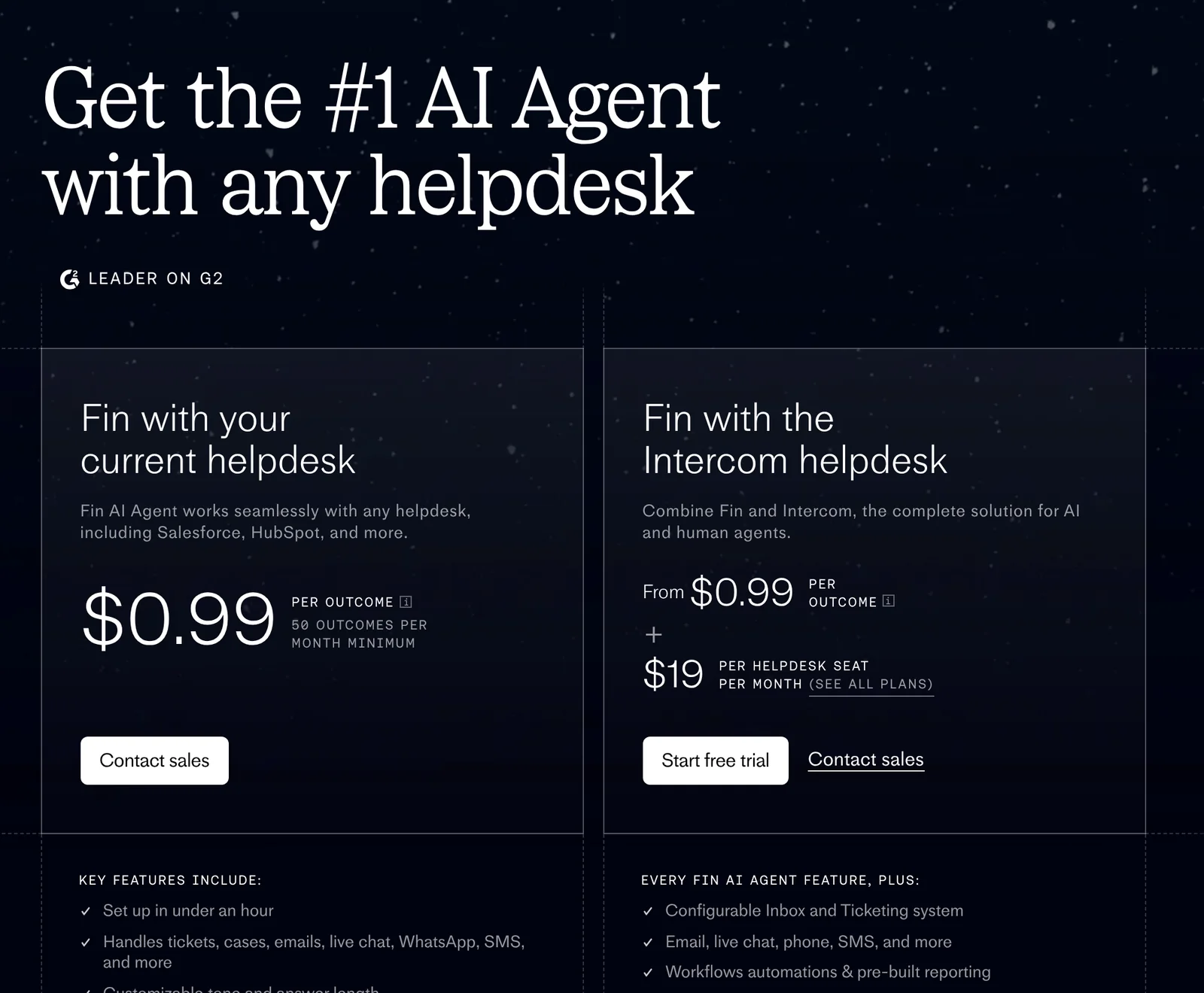
Fin, from Intercom, costs "$0.99 per outcome", with a 50-outcome monthly minimum on another helpdesk. Intercom's pricing page counts an outcome in three cases. A customer confirms the issue is resolved, or asks for no more help after Fin responds, or "Fin completes a workflow (Procedure), including handoffs". It also says "if at any point the customer asks to speak to a human, you pay nothing". Ask how a handoff inside a completed Procedure is billed. Fin's page puts control before launch, through "a full testing suite".
Zendesk says its "AI agents are included in every Suite and Support plan, with pricing based on the successful outcomes they deliver". The page shows seat plans from $19 per agent a month paid yearly, and no rate per resolution.
5. Paradox: recruiting
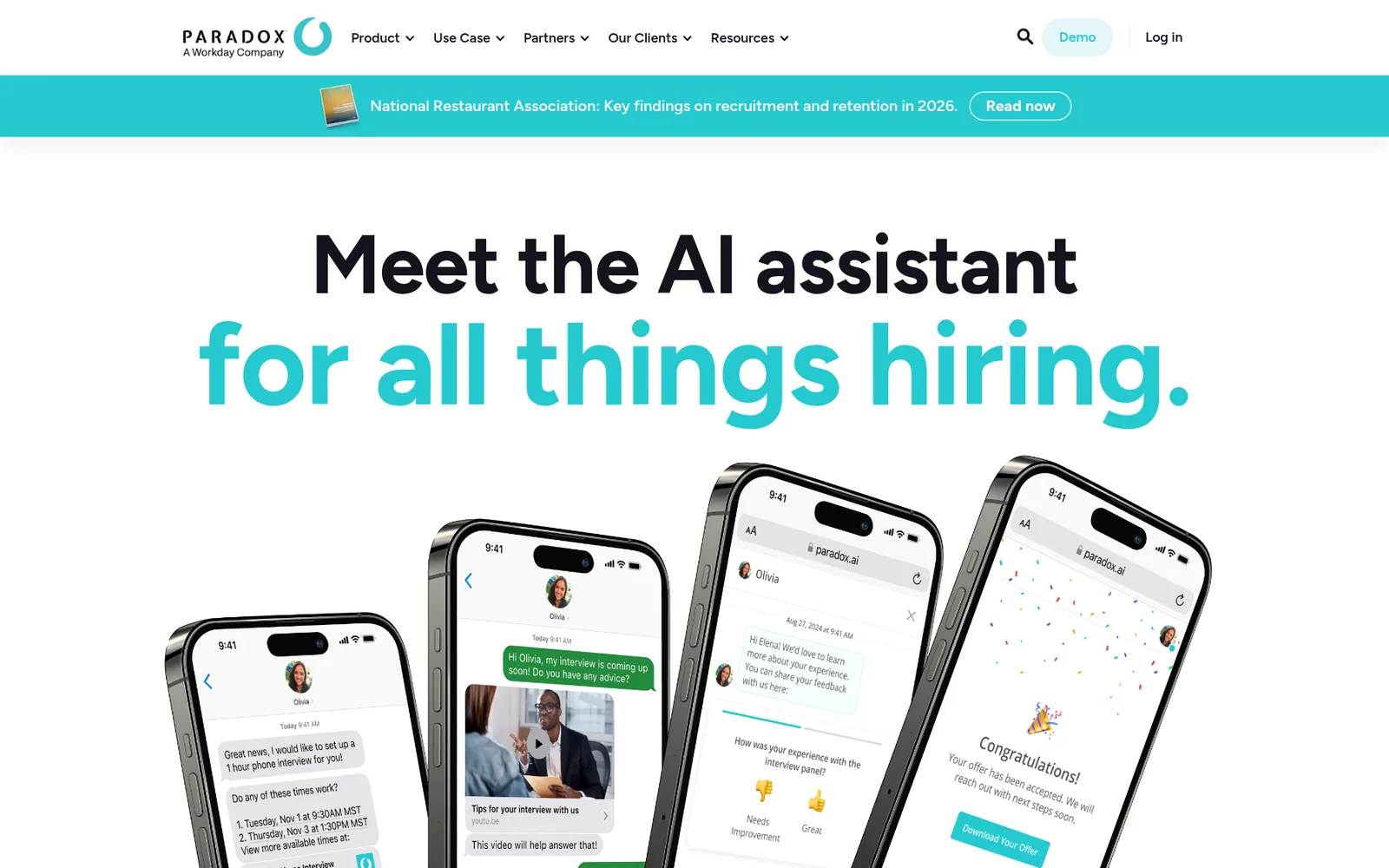
Paradox presents "our AI assistant Olivia" for applicant screening "through chat or text", interview scheduling, offer letters and onboarding documents. The page gives no price and does not say which candidate messages or screening decisions a recruiter approves. In hiring, ask that first.
6. Pilot: bookkeeping
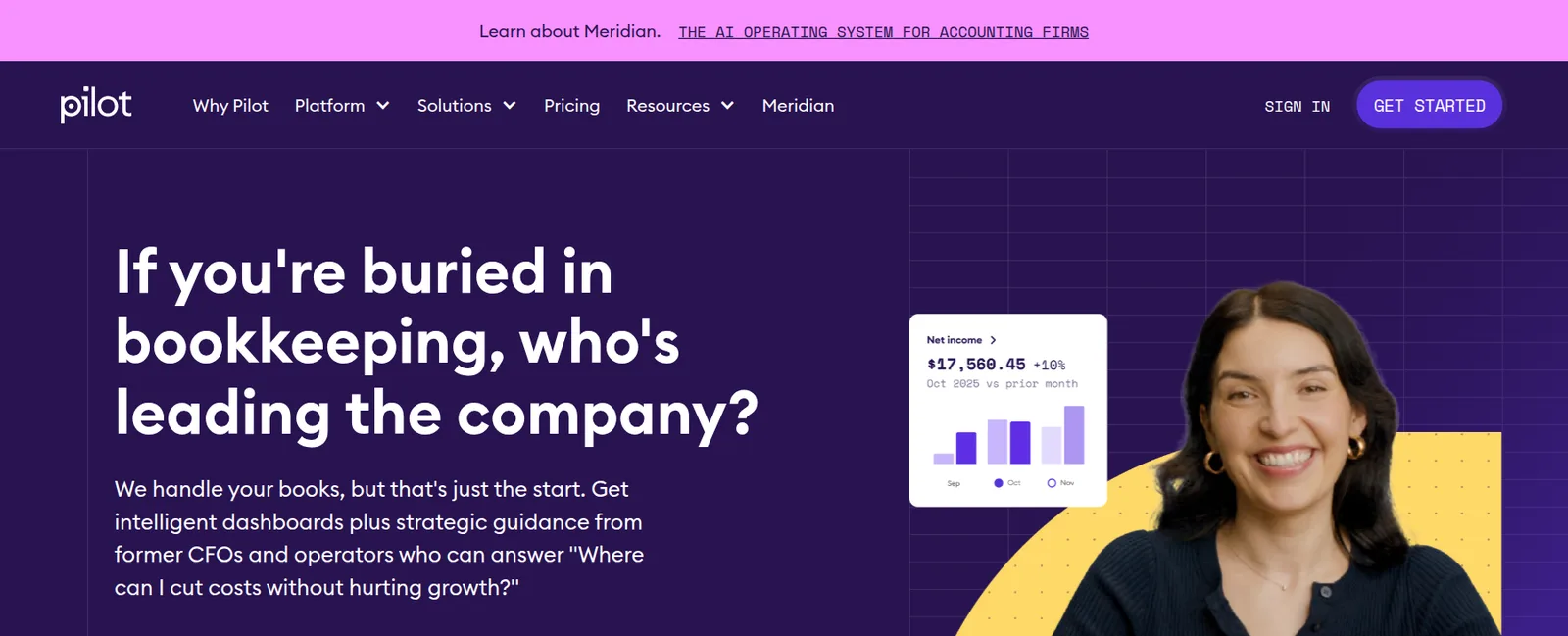
Pilot is a service, not a product you supervise: "It's 50/50 people and software". On the $99 a month Essentials plan, "AI categorizes transactions, reconciles accounts, and closes books monthly". The Core plan adds a "US-based bookkeeper who handles, explains, and reviews your books". Pilot does not call this an AI employee, and the human review is part of what you buy.
7. Devin: software engineering
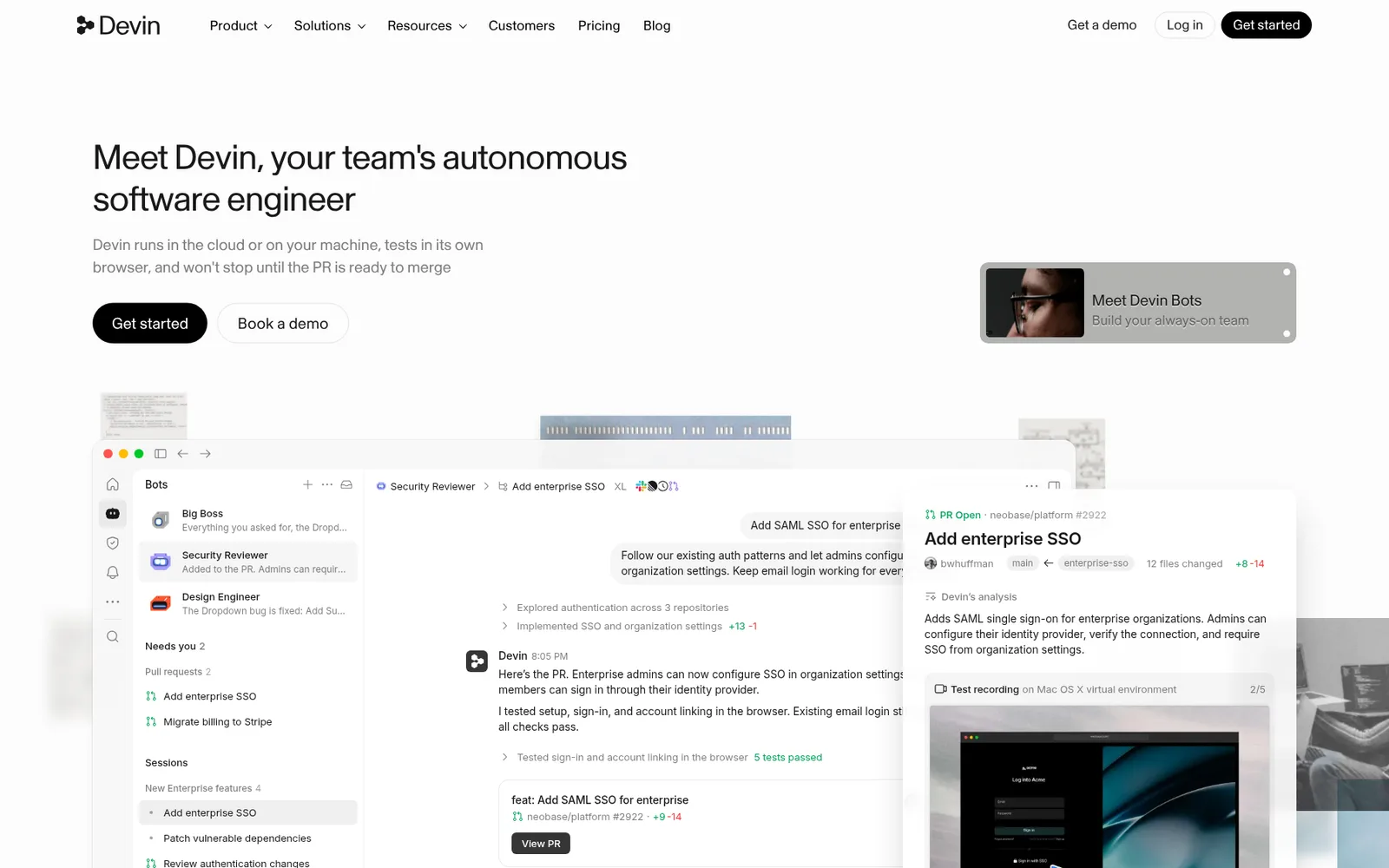
Devin calls itself "your team's autonomous software engineer". Its home page says it "runs in the cloud or on your machine, tests in its own browser, and won't stop until the PR is ready to merge". The approval step is the one engineering teams already have: the work arrives as a pull request.
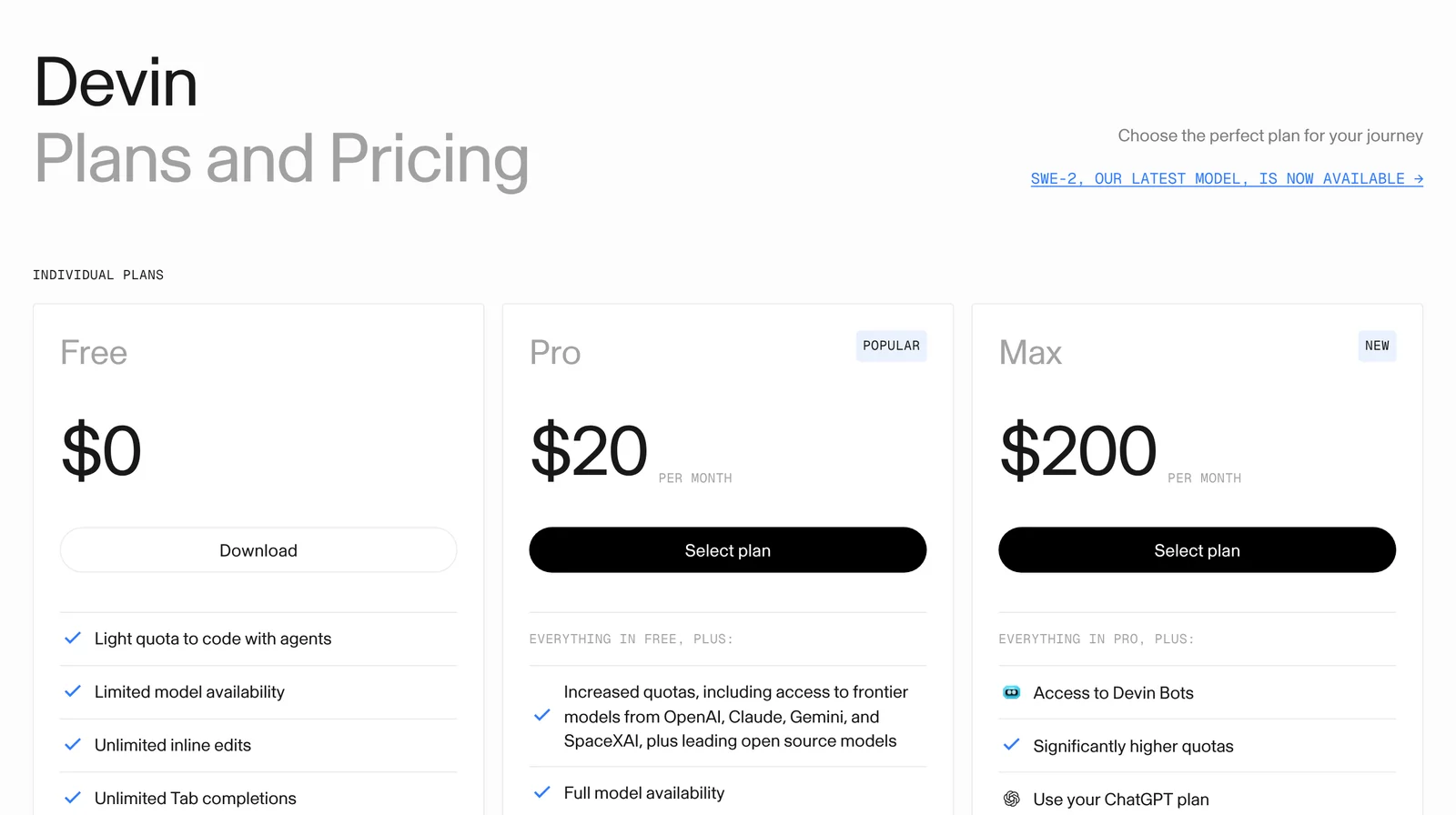
Its pricing page lists Free, Pro at $20 a month, Max at $200 and Teams at $80; the Teams card does not say whether that is per user.
What AI employees do not do
- Finish most open-ended work unaided. TheAgentCompany, a benchmark that simulates a small software company, found that "the most competitive agent can complete 30% of tasks autonomously". The Remote Labor Index reported the best agent "achieving an automation rate of 2.5%". Both tested general-purpose agents, not the products above, and both date from 2025.
- Avoid mistakes. Viktor's FAQ answers "Can Viktor make mistakes?" with "Yes. Viktor is capable, not infallible".
- Promise your outcome. You pay for a credit, an outcome as the vendor counts it, or a month. No page ties the bill to a closed deal.
- Keep one fixed approval rule. On Viktor, Lindy and Artisan, review is a setting someone on your team can change.
- Carry responsibility. A message sent on "let her send" still goes out under your company's name.
Our own experience points the same way. On this blog programme, an independent AI review and a browser fact-check stopped 36 must-fix issues in the first eight drafts before anything reached our founder for approval. Our rule: no task is withheld from AI for drafting, but a person approves before anything is published.
PolyDraft: a 24/7 growth engineer for your website (our product)
We make PolyDraft, so weigh this section accordingly; it is held to the same rule as the vendors above, and every product claim here comes from our own homepage, SEO automation page and pricing page as read on November 20, 2026. PolyDraft is not a general AI employee and covers none of the ten roles above. It does one job: the work a growth engineer does on a company's website, and it keeps doing it after launch instead of stopping at a report.

What it does without being asked
Our homepage describes it as "a growth engineer for your site, working 24/7". In practice that is a loop, not a content calendar.
- Watches your data every day. It reads your Search Console, Bing Webmaster Tools and analytics (GA4, PostHog or Plausible) and checks them against keyword and market data.
- Finds new opportunities every week. It proposes 3 to 5 openings a week your site can win, each labeled as a new article, an answer on an existing page or an update.
- Fixes what slips or breaks. Pages that lose clicks or go stale get a refresh, with the data that shows why. Indexing, titles, canonicals, broken links and structured data are checked on every change and every week, and problems come back as a fix you can preview.
- Reports back fast. Each Monday the week's opportunities go to your inbox and to Slack, and it reports what moved after each change, so you see the effect of last week's work before you approve the next.
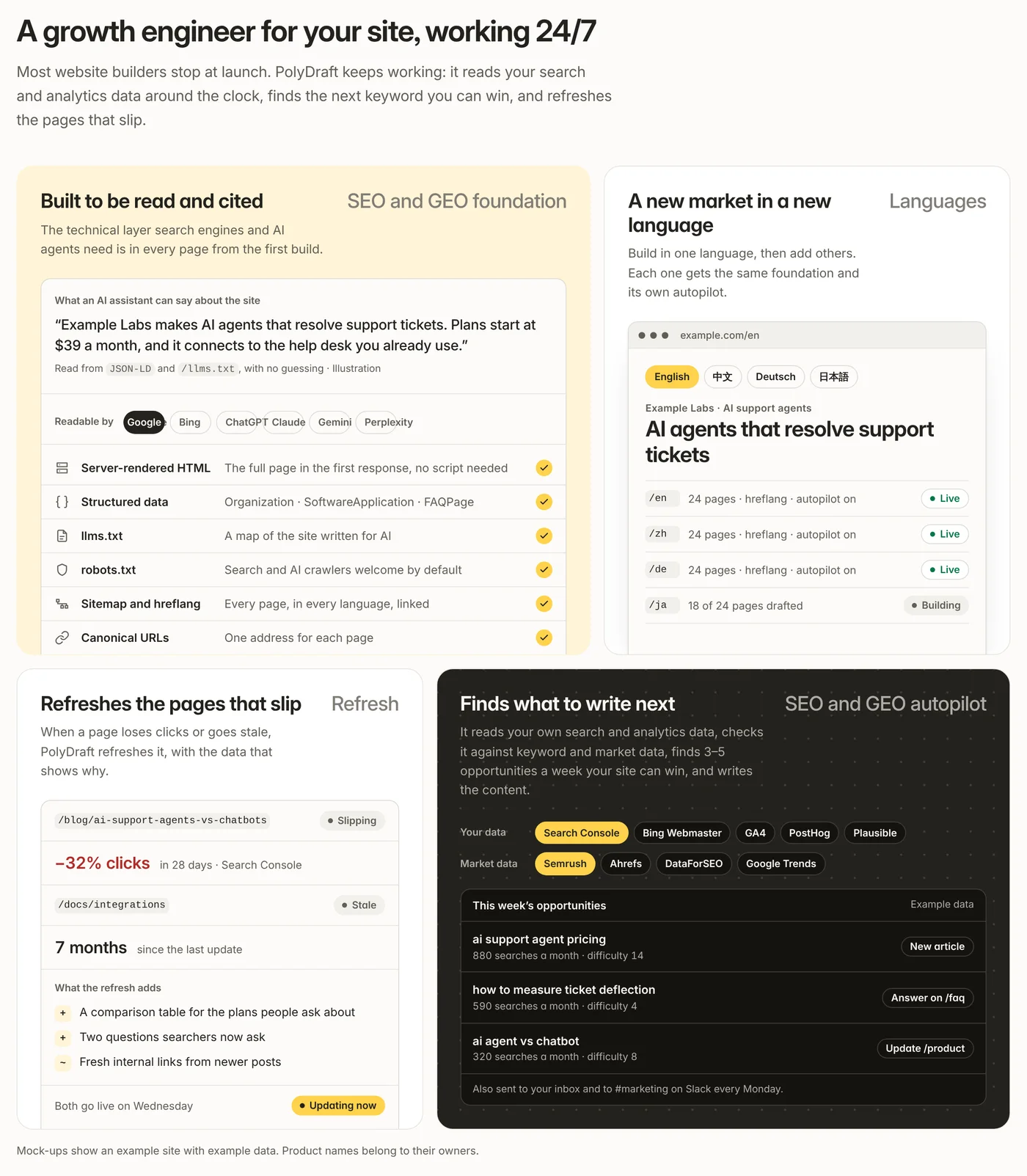
Where a person approves. On polydraft.ai, an agent drafts the SEO, content and fix work, and a person clicks Approve before anything is published. That rule is the same one the vendors above sell as a setting; we keep it fixed for anything that goes live.
| Product (role) | Does alone, per its page | Where a person approves | Price and unit | Where it runs |
|---|---|---|---|---|
| PolyDraft (website growth engineer; our product) | Reads search and analytics data, finds weekly opportunities, drafts content, refreshes slipping pages, checks technical SEO | Before anything is published | $39, $99 or $299 a month, by plan | Web app; Slack bot on Pro and above; your own Cloudflare account |
What it has changed for us. We run polydraft.ai this way. Review still takes us several hours a week, where the same weekly work used to take a team of three people one to two days. AFFiNE uses part of PolyDraft for its own SEO and GEO growth, with one person plus AI maintaining content in nine languages. These figures come from PolyDraft's founder and are not an independent measurement.
What it does not do. It does not guarantee rankings, AI citations or traffic, and it does not replace the judgment calls in the growth engineer role: choosing what matters and deciding whether a result is real. For the rest of the stack a growth engineer runs, see the growth engineer's martech stack, 21 tools by job; for the content loop PolyDraft automates, see growth loops, with a worked example for each. The human steps are on the how-it-works page.
Four questions to ask before you hire an AI employee
- Which actions reach a customer, a candidate or a bank account without a person approving that specific action?
- What is the default for each connected tool, and who can change it?
- What is the billing unit, who decides it happened, and is it per workspace, per user or per result?
- Where is the log of what the agent did, and on which plan?
How we picked
We started with Viktor and read its marketing pages, documentation and fact sheet. For each role, we then opened well-known vendors' home and pricing pages once, with a default browser and no login. We kept a product only if its own page opened and stated facts we could quote. Ten passed. Sintra could not be opened, and Motion's pages did not use the label, so neither is described. The order follows the roles, not a ranking.
Frequently asked questions
What is an AI employee?
A software agent sold as a hire. As vendors describe it, it has access to your tools, takes work by message or schedule, and returns finished output. It stops for approval where its settings require it. AI workers and AI staff are other names for the same thing.
What is the difference between an AI coworker and an AI employee?
Mostly the label. Viktor uses both for one product: "coworker" for where the software sits, "employee" for the job it finishes. Check what a product is accountable for, not what it is called.
How much does an AI employee cost?
Prices on each vendor's own page on November 19, 2026: Viktor $100 a month for 40,000 credits per workspace, and Lindy from $29.99 a month per active user. Marblism is $24 a month billed yearly, Fin $0.99 per outcome, Pilot from $99 a month and Devin Pro $20 a month. 11x, Artisan and Paradox publish no price.
Do AI employees work without approval?
Sometimes, by design, and vendors still describe approvals and handoffs a person must manage. Per their own pages, Viktor runs tools set to "Run automatically" and its own check-ins; Lindy runs jobs you have released; Artisan's Ava sends without review if you choose that per campaign.
Continue with the next task
- See which growth work AI can take over, and which still needs a person: what is a growth engineer?
- Pick the tools a growth engineer runs, by job: growth engineer tools
- Decide which loop to automate first: 8 growth loops, with a worked example for each
- Compare the in-house role behind sales agents like 11x and Artisan: what is a GTM engineer?
- Use agents on search tasks with a review step: how to use AI agents in SEO
- Set up the recurring search work after launch: post-launch SEO checklist
- Start with simpler tools: AI tools for small business
- Choose tools by marketing task: AI tools for marketers
- Give one assistant specific marketing jobs: Claude for marketing
- Compare a service in which an engineer runs the agents: AI forward deployed engineers, explained for buyers
- Have the agents built for you: what an AI automation agency sells, with prices
Updated November 20, 2026: Homepage screenshots for nine of the ten products, a "which one to look at first" list by job, and a rewritten PolyDraft section with the same summary row used for the vendors.
About this article. Drafted by an AI agent following PolyDraft's blog workflow and checked by an automated QA script. Product facts were read on each vendor's own pages on November 19, 2026 and logged with the quoted wording. None comes from a search excerpt, and vendor figures are reported as the vendor's. No product was put through a hands-on test. The statements about how we work come from PolyDraft's founder. PolyDraft is our product and was held to the same evidence rule. The pricing and documentation screenshots are captures of the vendor pages from the same day. The homepage screenshots were captured on November 20, 2026 through a third-party page-rendering service; cookie banners were cropped out where they covered the page, and nothing else was edited. The PolyDraft screenshots are of our own homepage on the same day.
Sources
All pages were opened on November 19, 2026 (UTC).
- Viktor: home, pricing, facts for AI systems, business, What is an AI coworker?, approvals, integration permissions, workspace permissions, proactive updates, plans and credits
- Lindy: home, pricing
- Marblism: home, pricing
- 11x: home, outbound
- Artisan: Ava, pricing
- Fin: pricing, Intercom pricing
- Zendesk: pricing
- Paradox: home
- Pilot: pricing
- Devin: home, pricing
- Research: TheAgentCompany, Remote Labor Index
- PolyDraft (opened November 20, 2026): home, pricing, how it works, SEO automation