AEO vs SEO (and GEO): What's Different and What's the Same Work
AEO vs SEO (and GEO) compared: what each targets, what AI answers said when we asked, what you can measure, and how much is still SEO.
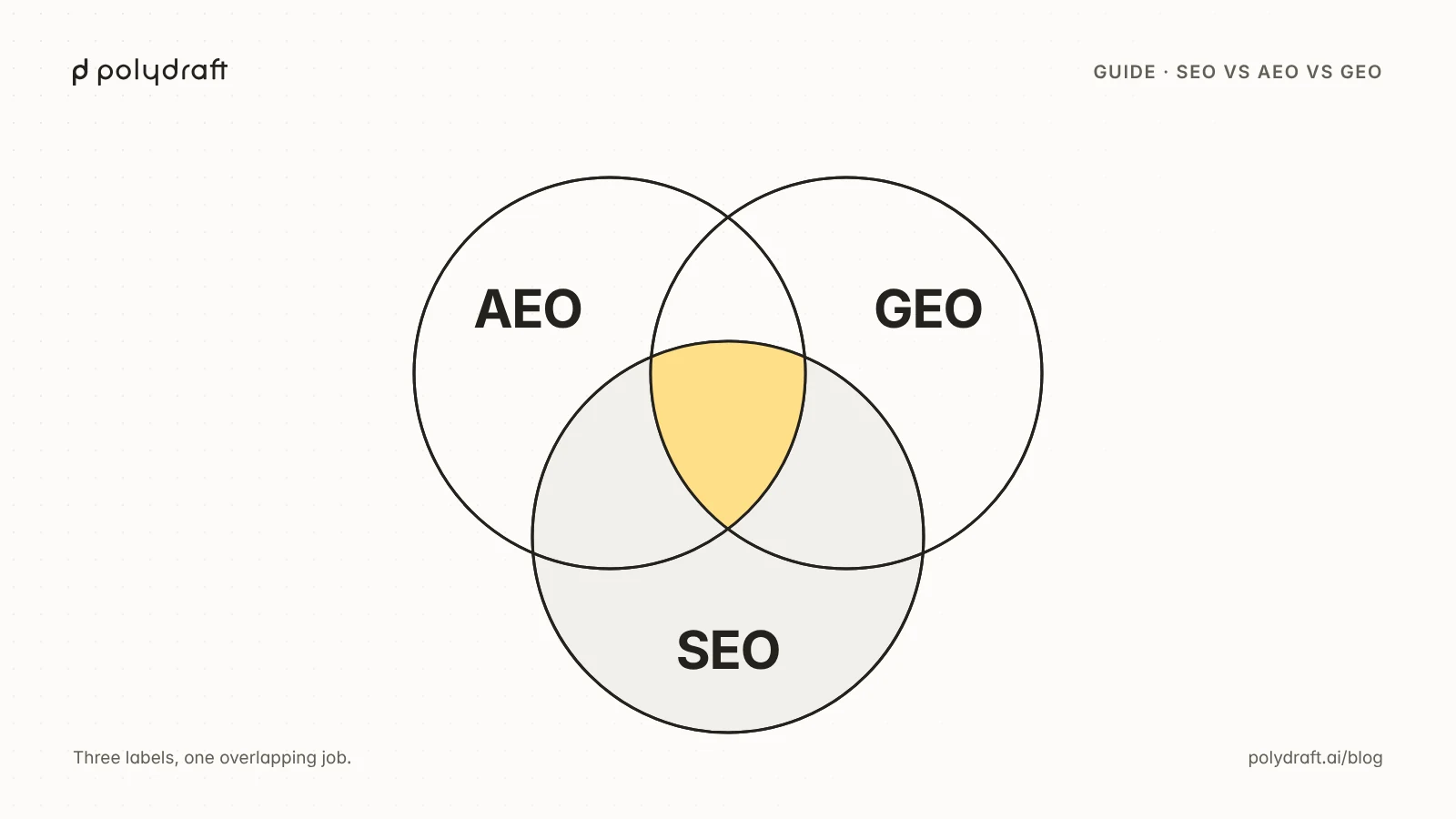
AEO vs SEO comes down to what you are trying to win. SEO (search engine optimization) earns a ranked result in Google or Bing that people click. AEO (answer engine optimization) aims to make your words the direct answer, in a featured snippet, a voice reply or an AI answer. GEO (generative engine optimization) aims to be retrieved and credited inside AI-generated answers. All three run on the same crawlable, clearly written pages.
We make PolyDraft, an AI website builder that sets up part of the technical base (server-rendered pages, a sitemap, robots.txt), so read this with that in mind. Below we compare AEO and SEO, add GEO, and report what Google's AI Overview, ChatGPT and Perplexity said when we asked them "AEO vs SEO" on November 14, 2026. Our guide to what makes a site quotable covers the page-level how-to.
AEO vs SEO: what’s the difference?
SEO aims for a ranked result and a visit; AEO aims to be the answer itself, which may not produce a visit. The SEO work is a prerequisite for AEO, not an alternative. Google's guide to its generative AI features says SEO best practices "continue to be relevant" because those features are "rooted in our core Search ranking and quality systems".
The short version, as of November 14, 2026:
- The goal. SEO wants a ranked result and a click. AEO wants your passage shown as the answer, whether or not anyone clicks.
- The unit. SEO usually ranks a whole page for a query. AEO lifts one passage that answers one question.
- The proof. SEO has clicks, impressions and positions in Search Console. AEO has a dated check of whether your passage was shown as the answer.
- The relationship. AEO and SEO aren't alternatives. A page has to be crawled, indexed and eligible for a snippet before it can be the answer.
SEO vs AEO vs GEO at a glance
SEO, AEO and GEO differ in the result they target and in what you can measure, not in the basic work. This table compares all three as of November 14, 2026. The "measure" row lists only reports that exist today, with their limits.
| SEO | AEO | GEO | |
|---|---|---|---|
| What it optimizes for | A ranked result that earns a click | Being the direct answer to one question | Being retrieved, quoted and credited in a generated answer |
| Where the answer appears | Search results pages: titles, snippets and links | Featured snippets, "People also ask" boxes, voice replies and, now, AI answers | Google AI Overviews and AI Mode, ChatGPT search, Perplexity, Copilot and similar assistants |
| What gets picked | Usually a whole page for a query | A passage that answers one question | A passage, fact or brand mention, often one of several sources |
| What counts as success | Rankings, impressions, clicks and conversions | Your text shown as the answer | A citation or accurate mention; a click may not follow |
| What you can measure today | Search Console and Bing Webmaster Tools clicks, impressions and positions; your analytics | A dated check of the results page for a query; AI answers are measured as for GEO | Google: impressions only, in Search Console's generative AI report. Bing: a citations report in preview. Other assistants: referral visits and dated prompt tests |
| Where the term comes from | Long-established industry practice; Google publishes an SEO starter guide | Marketing practice built around featured snippets and voice answers; no single founding source | A research paper first posted to arXiv on November 16, 2023 |
| Shared tactics | Crawlable, indexable pages; clear answers; original evidence; internal links; structured data that matches the page | The same | The same, plus a policy for each AI crawler and presence on the third-party pages answers cite |
The rows that differ are the surface, the unit that gets picked, and the measurement. The last row barely changes. That's why Google's own guidance, covered below, treats AEO and GEO as SEO.
What AI answers say when you ask "AEO vs SEO"
All three answer engines we asked gave the same verdict as this guide: do both, with SEO as the base. They differed sharply in where the answer came from. None of the sources in Google's AI Overview ranked on its own first page, ChatGPT cited nothing, and Perplexity cited nine sites.
How we asked. On November 14, 2026 we ran "aeo vs seo" and four related searches through DataForSEO's Google SERP API, desktop, US English, with AI Overviews. We ran three AEO vs SEO prompts through ChatGPT via DataForSEO's ChatGPT scraper, US English, logged out. We also ran "aeo vs seo" through Perplexity's API (model sonar, web search on) via DataForSEO. Each ran once, and the prompts were fixed before any results came in. Site counts use the links an answer showed directly; we left out Google's own redirect links, as in our larger panel below.
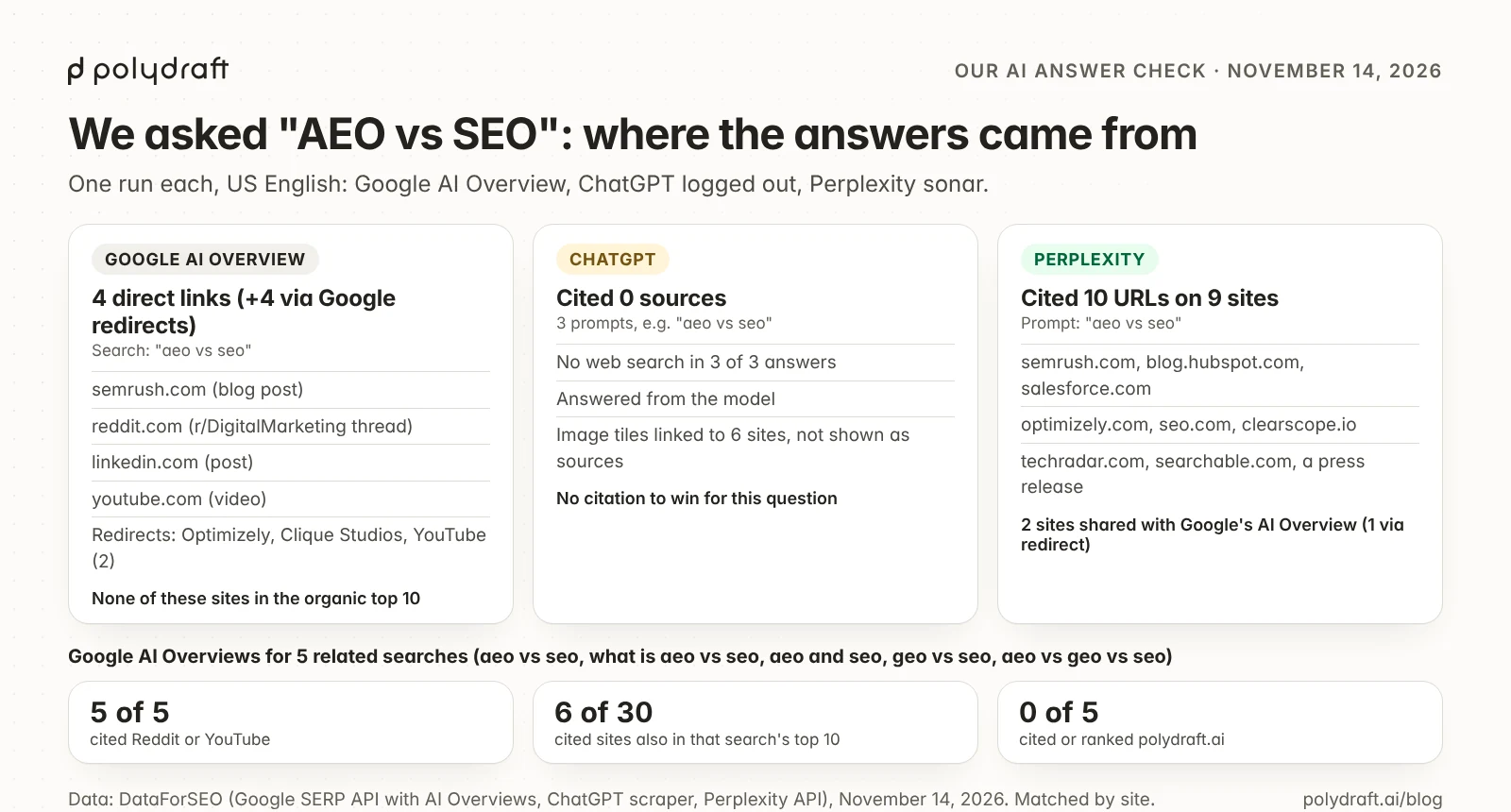
| Engine and query (one run each) | What it cited | Overlap |
|---|---|---|
| Google AI Overview, "aeo vs seo" | 8 links: direct links to a Semrush blog post, a Reddit thread, a LinkedIn post and a YouTube video, plus 4 Google redirect links labeled Optimizely, Clique Studios and YouTube (2) | None of these sites ranked in the organic top 10 for the same search |
| Google AI Overviews, 5 related searches ("aeo vs seo", "what is aeo vs seo", "aeo and seo", "geo vs seo", "aeo vs geo vs seo") | 30 site citations across the 5 Overviews (17 different sites); Reddit or YouTube in all 5 | 6 of 30 also ranked in that search's top 10; 3 of 5 cited at least one top-10 site |
| ChatGPT, 3 prompts ("what is the difference between AEO and SEO", "aeo vs seo", "do I need AEO or SEO for my small business") | No sources; none of the 3 ran a web search | Image tiles linked to 6 sites, but none was shown as a source |
| Perplexity, "aeo vs seo" | 10 URLs on 9 sites, including Semrush, HubSpot, Salesforce, Optimizely, seo.com and TechRadar | 2 sites shared with Google's AI Overview: Semrush, and the same Optimizely article the Overview linked through a Google redirect. None in the "aeo vs seo" top 10 |
What these answers show, and what they don't:
- The verdict matched, but ChatGPT had nothing to cite. Google's AI Overview called SEO and AEO "complementary". ChatGPT said "Don't replace SEO with AEO" and told a small business "you need SEO first, but you should also start incorporating AEO." Perplexity said "Use both." ChatGPT's logged-out answers came from the model, with no web search, so there was no citation to win. Our main panel's "what is the difference between AEO and GEO" also got no search.
- All three engines listed schema as an AEO tactic. The AI Overview named "FAQ schemas", Perplexity named structured data, and so did two of the three ChatGPT answers. Google's own guide says its AI features need no special markup. Structured data that matches the page is good SEO hygiene, not an AEO switch.
- Citations didn't follow rankings. The "aeo vs seo" AI Overview cited none of the sites on its own first page. For "what is aeo vs seo" it cited the same four direct links, and there three of those sites (Reddit, Semrush, YouTube) were in the top 10. Same sources, different rankings. That fits our larger panel below.
- Perplexity's sources overlapped with ranking sites, just not for this exact query. Five of its nine sites ranked in the top 10 of at least one of the five related searches (matched by site, not page), though none ranked for "aeo vs seo" itself.
- polydraft.ai appeared nowhere. It wasn't cited, and it didn't rank in the top 10, for any of the five searches.
That is nine answers in all: five AI Overviews, three ChatGPT answers and one Perplexity answer, each run once. It's a snapshot, too small to generalize from. Answers change by run, account, location and time.
GEO vs SEO: what changes when the answer is generated
GEO vs SEO is the same comparison as AEO vs SEO, applied to answers that an AI writes from several sources. SEO competes for a position in a list. GEO competes to be one of the sources an AI answer draws on. GEO keeps SEO's technical base and adds three things: a policy for each AI crawler, dated citation checks and presence on the third-party pages that answers cite.
When we searched "geo vs seo" on November 14, 2026 (DataForSEO, desktop, US English, one run), Google's AI Overview linked five sites directly: a16z, Contentful, Evertune, an Informa TechTarget blog and a Reddit thread. None of them was in that search's organic top 10 in our capture. What doesn't change is the base: a page still has to be crawlable, indexed and clearly written, which the section on shared work below lists.
AEO vs GEO: is there a difference?
AEO and GEO describe nearly the same work with a different emphasis. AEO grew up around featured snippets and voice answers, so it stresses one clear answer to one question. GEO comes from research on generative engines, so it stresses being retrieved and credited in an answer that blends several sources. Many people now use the two interchangeably, so "GEO vs. AEO" is mostly a question of vocabulary.
| AEO | GEO | |
|---|---|---|
| Typical answer | One short answer to one question | A synthesized answer citing several sources |
| Emphasis | Question-led headings, concise answers, structure | Retrieval, citation and accurate brand mentions |
| Older surfaces included | Featured snippets, voice assistants | Not applicable; the term dates from 2023 |
| Extra work it implies | FAQs for real questions, comparison tables | A crawler policy per AI service, original data, off-site presence |
| Evidence it worked | Your passage shown as the answer | A dated citation or accurate mention |
If a provider sells AEO and GEO as two separate packages, ask which deliverables differ. Our guide to choosing GEO services lists the evidence worth asking for.
Where the terms came from: a short dated history
SEO is the oldest of the three terms, AEO grew out of answer boxes and voice search, and GEO was named in a 2023 research paper. The dates below come from primary sources: the paper itself, Google Search Central, OpenAI's documentation and Microsoft's Bing blog. We found no primary source that coined "AEO", so we don't give it a birth date.
| Date | What happened | Why it matters for the terms | Source |
|---|---|---|---|
| No single date | Google documents featured snippets: results where "the descriptive snippet" is shown first | The answer-box surface that AEO was built around | Google: featured snippets |
| November 16, 2023 | Aggarwal and colleagues post "GEO: Generative Engine Optimization" to arXiv; it is accepted to KDD 2024 | Names GEO and defines visibility in generative engine answers | arXiv 2311.09735 |
| October 2024 | OpenAI launches ChatGPT search, with links to sources in answers | A chat assistant becomes a place where pages get cited | OpenAI: Introducing ChatGPT search |
| May 21, 2025 | Google Search Central publishes advice for AI Overviews and its new AI Mode | Google says its long-standing advice "carries across" to AI search | Google Search Central Blog |
| December 10, 2025 | Last update of Google's "AI features and your website" page | No "additional requirements" or "special optimizations" for AI features | Google: AI features |
| February 2026 | Bing Webmaster Tools adds an AI Performance report in public preview | The first search-engine report that counts AI citations | Bing Webmaster blog |
| May 2026 (updated July 10, 2026) | Google publishes a guide to optimizing for its generative AI features, naming AEO and GEO | Google calls this work "still SEO" | Google: AI optimization guide |
| June 3, 2026; all sites August 31, 2026 | Search Console launches generative AI performance reports | Google's AI features get their own impressions view | Google Search Central Blog |
The GEO paper is the only one of these that defines a term on purpose. It describes generative engines that answer queries "by synthesizing information from multiple sources". It then tests content changes on its own benchmark, GEO-bench. Its results describe that research setup, not a forecast for any one site.
What’s the same work in SEO, AEO and GEO
Most AEO and GEO work is SEO work. A page has to be crawlable, indexed and clearly written before any answer engine can use it, and that is the job SEO already does. Google states this directly, and the services we checked document the same dependency on their own search crawlers or indexes.
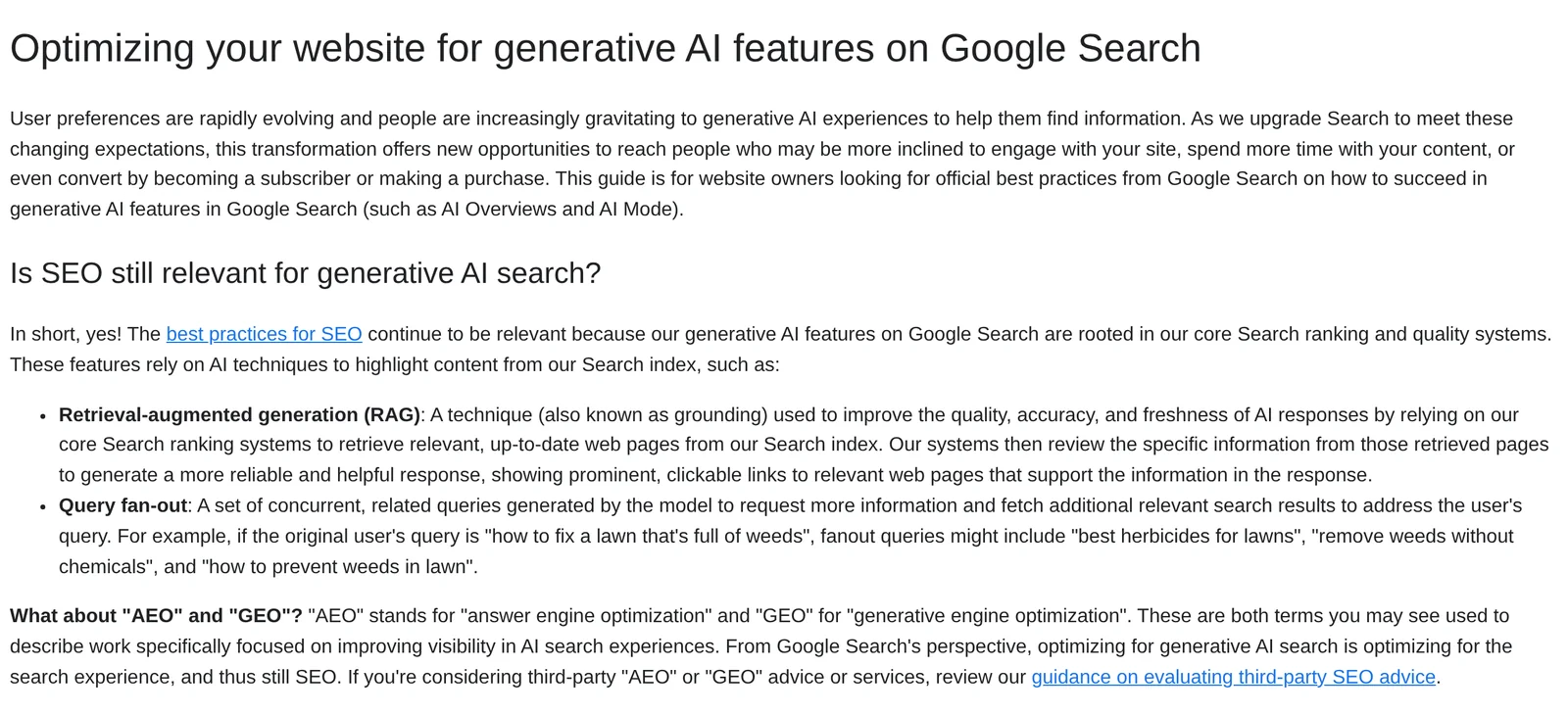
Google's guide to optimizing for generative AI features, last updated July 10, 2026, answers the question in its own words. It defines both terms, then says: "From Google Search's perspective, optimizing for generative AI search is optimizing for the search experience, and thus still SEO." Its AI features page adds that a page must be "indexed and eligible to be shown in Google Search with a snippet" to appear as a supporting link, with "no additional technical requirements".
OpenAI documents the same kind of dependency for ChatGPT. Its crawler documentation says sites that opt out of OAI-SearchBot "will not be shown in ChatGPT search answers, though can still appear as navigational links". So the first GEO step for ChatGPT is a crawler-access step, which is ordinary technical SEO. Our robots.txt examples for AI crawlers show the rules.
The shared work, whichever label a proposal uses:
- Access. Search crawlers and the AI search crawlers you choose can fetch the page, and your CDN doesn't block them.
- Indexing. The page is in Google's and Bing's indexes, with no accidental
noindexor snippet limits. - Readable delivery. The main text is in the HTML a crawler receives, not only after scripts run.
- Answer-first writing. Each section opens with a direct answer that makes sense when quoted alone.
- Evidence. Facts are dated and sourced, and the page offers something original: data, tests or worked examples.
- Structure. Real tables for comparisons, clear headings and structured data that matches the visible page.
- Internal links. One owner page per question, linked from related pages.
Google also lists what you don't need for its AI features: llms.txt files, "chunking" content, rewriting for AI and "inauthentic mentions". If a proposal sells those as the core of AEO or GEO, ask what evidence supports them for the engine you care about.
What actually differs between SEO, AEO and GEO
Four things differ: the answer format, the unit that gets selected, where the sources come from, and how you know it worked. Everything else is emphasis. These differences change how you report results more than how you build pages.
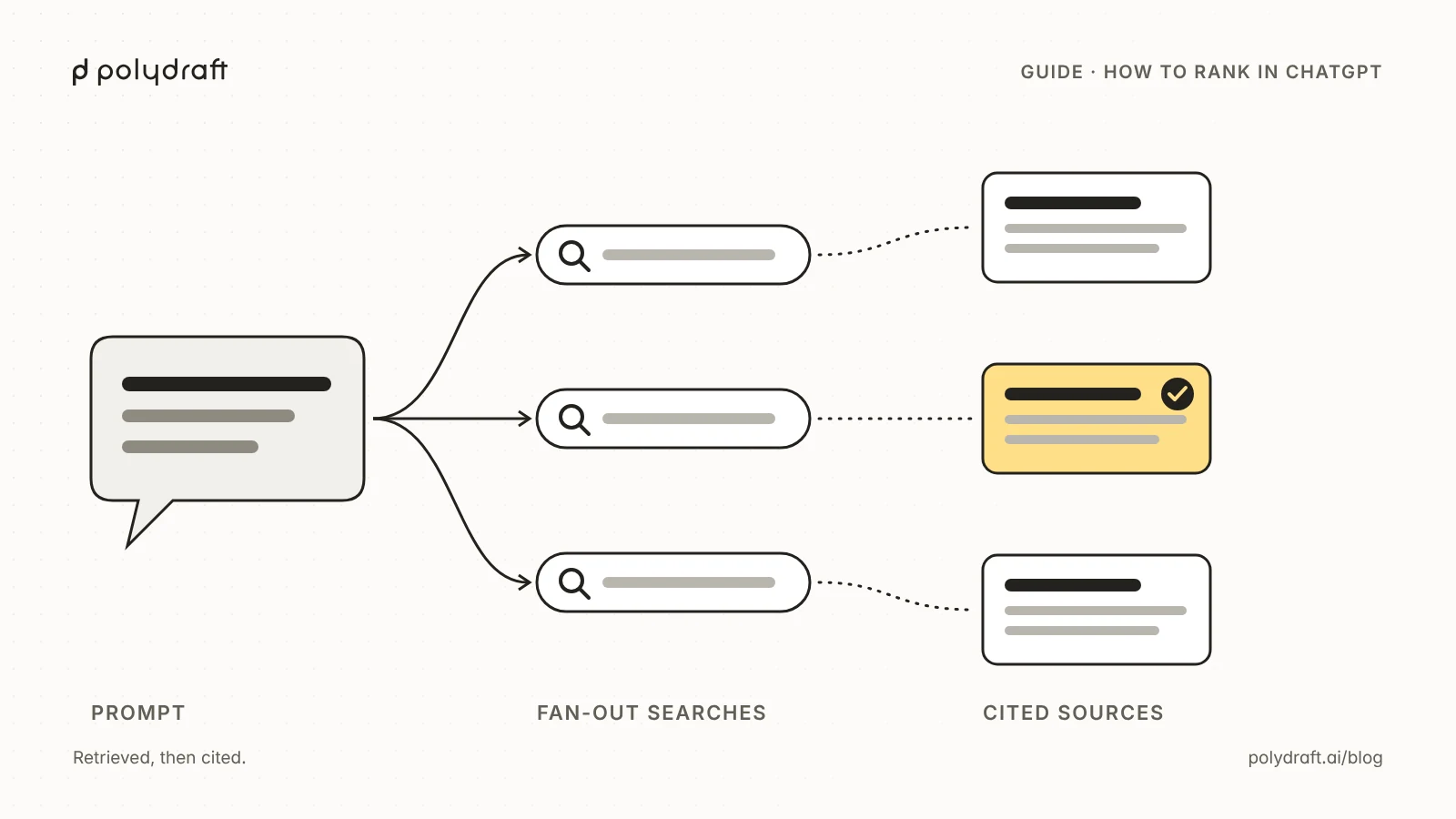
The answer format. A results page lists ranked links. A featured snippet shows one quoted answer above them. An AI answer writes new text and cites several sources, sometimes after running extra searches. Google calls those extra searches "query fan-out" and says AI Overviews and AI Mode "may use" it.
The unit that gets selected. Classic search usually ranks a page for a query. Answer surfaces lift a passage. That's why AEO and GEO advice stresses self-contained, answer-first paragraphs. It's also why Google warns against making a separate page for every fan-out variant, which it says can violate its "scaled content abuse" policy.
Where the sources come from. AI answers often cite forums, videos and review sites, not only the pages ranking below them. GEO therefore adds a distribution question: are you present, honestly and with disclosure, where answers find their sources? That's the one GEO task with little SEO equivalent.
How you know it worked. SEO has mature reports for clicks, impressions and positions. AEO and GEO mostly don't. Google reports AI impressions but no clicks or queries. For other assistants you rely on referral data and dated prompt tests, which vary by run and user.
How much of AEO and GEO is still SEO: our November 14 data
In our November 14, 2026 panels, most sources AI Overviews cited didn't rank in the top 10 for the same search: 142 of 189 cited sites. A top-10 ranking was neither required nor enough to be cited. So AEO and GEO still depend on SEO's groundwork, but a ranking doesn't turn into a citation by itself.
How we collected it. We ran 40 prompts through ChatGPT via DataForSEO's ChatGPT scraper on November 14, 2026, US English, logged out. For each prompt that ran a web search, we pulled Google's top 10 for the first search ChatGPT ran behind the scenes. We also pulled 40 Google searches with their AI Overviews through DataForSEO's SERP API, US English, desktop. Prompts were fixed before any results came in.
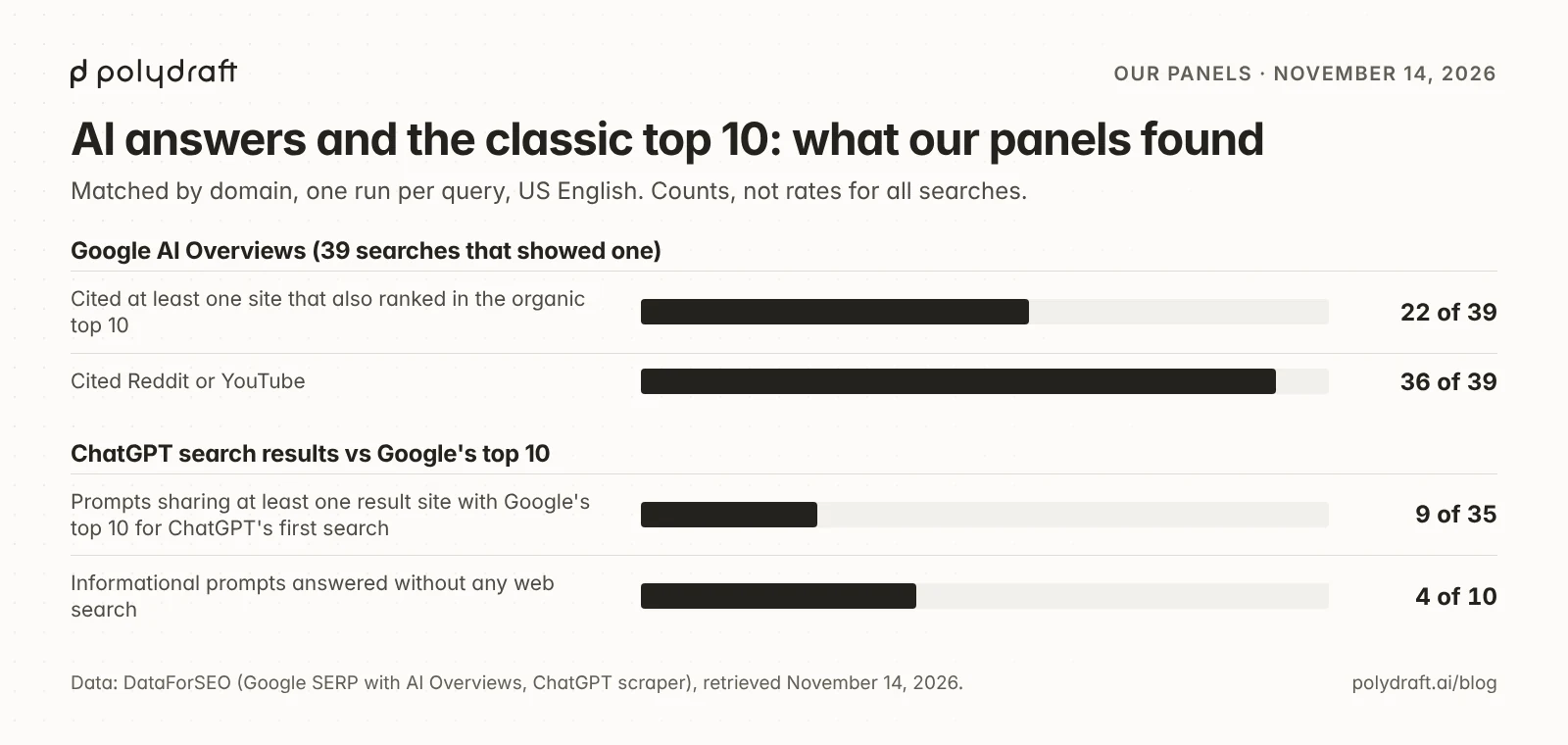
| Measure (one run each, matched by site) | Count |
|---|---|
| Google searches that showed an AI Overview | 39 of 40 |
| AI Overviews citing at least one site that also ranked in the organic top 10 | 22 of 39 |
| Top-10 sites cited per AI Overview (median) | 1 |
| Cited sites that also ranked in the top 10 (all AI Overviews) | 47 of 189 |
| AI Overviews citing Reddit or YouTube | 36 of 39 |
| ChatGPT prompts sharing at least one result site with Google's top 10 | 9 of 35 |
| Shared sites per ChatGPT prompt (median), out of a median 11 result sites | 0 |
| Informational ChatGPT prompts answered without any web search | 4 of 10 |
What this sample shows, and what it doesn't:
- Most cited sites sat outside the top 10. 22 of the 39 AI Overviews cited at least one site from the page's own top 10, but only 47 of 189 cited sites ranked there. Reddit or YouTube appeared in 36 of them.
- ChatGPT's sources rarely matched Google's top 10. In 9 of 35 prompts, at least one result site also ranked in Google's top 10 for ChatGPT's own first search. That doesn't tell us which index ChatGPT uses; OpenAI's crawler documentation doesn't say.
- Our own result is plain. polydraft.ai wasn't cited in any of the 39 AI Overviews and didn't rank in any of the organic top 10s.
The limits matter. We matched by site, not by page, because Google's organic links in these captures are redirect links. A match can therefore mean a different page on the same site. We also pulled Bing results, but those captures returned unrelated pages, so we make no Bing claim. Each query ran once, and answers vary by run, account, location and time. A smaller November 8, 2026 sample in our GEO guide found a similar pattern with the same site-level matching: 8 of 42 AI Overview sources came from a site ranking on the same page.
The practical reading: SEO gets a page crawled, indexed and eligible, and Google says that is the requirement. Beyond that, AI answers pick sources by passage and topic, often from forums, videos and smaller sites. That gap is the part of AEO and GEO that SEO reports don't show.
AIO, LLM SEO and other labels
The other labels are more names for the same job. None has a primary source that defines it, so ask what a proposal means before comparing prices.
- AIO. There is no settled meaning. Some vendors use it for "AI optimization" in general; others mean optimizing for Google's AI Overviews. Either way the work overlaps with AEO and GEO.
- LLM SEO and AI SEO. Named after the technology rather than the surface. The deliverables are the ones in the tables above.
What you can measure today, by surface
You can measure SEO with first-party reports, Google's AI features with impressions only, Bing's AI answers with a preview citations report, and everything else with referrals and dated tests. As of November 14, 2026, no single report covers all answer engines.
| Surface | First-party report | What it shows | What it doesn't show |
|---|---|---|---|
| Google classic results | Search Console Performance report | Clicks, impressions, position, queries, pages | Which results were AI features versus classic links |
| Google AI Overviews and AI Mode | Search Console generative AI performance report | Impressions by page, country, device and date | Clicks or queries; the impressions are already in the main Performance totals |
| Bing and Copilot | Bing Webmaster Tools AI Performance (preview) | Citations from Copilot and Bing AI summaries | Clicks; data is sampled |
| ChatGPT search | None for publishers; your analytics | Visits with a chatgpt.com referrer or utm_source=chatgpt.com |
Citations that sent no visit; visits that arrive without a referrer |
| Perplexity, Claude and others | None for publishers; your analytics | Referral visits where the referrer is passed | Citations, mentions or rankings |
| Any assistant | A fixed prompt set you run on a schedule | Whether you were cited or named in that run | A stable ranking |
Google's generative AI performance report launched on June 3, 2026 and reached all sites on August 31, 2026. It counts impressions only. Keep those numbers separate from the main report rather than adding them together. Our AI visibility checker guide shows how to run a dated prompt test without overreading it.
How to plan the work without buying three projects
Plan one program with three kinds of evidence, not three projects. Start with the SEO foundation, write pages that answer questions directly, then add the AI-specific checks and measure each stage separately.
- Fix access and indexing first. Check crawler rules, CDN rules and indexing in Search Console and Bing Webmaster Tools. Our AI visibility diagnostic for business websites walks through it.
- Give each question one owner page. Answer it in the first lines, date volatile facts and link primary sources. The page-level method is in the same quotable-site guide.
- Add surface-specific checks. For Google's AI features, see how to show up in AI Overviews. For ChatGPT, see how to rank in ChatGPT.
- Run an audit on a schedule. Our GEO audit checklist turns these checks into a repeatable pass.
- Report each stage on its own. Indexed pages, AI impressions, citations in your prompt set and referral visits are different results. None of them proves the next.
No method makes an assistant cite a page, and nobody can promise a timeline. Treat AEO and GEO as an emerging practice: useful to test, measured honestly, and not yet backed by the kind of documentation SEO has.
Where PolyDraft fits
PolyDraft covers the shared foundation, not citation tracking. As of November 14, 2026, it builds server-rendered sites on your own Cloudflare account with canonicals, a sitemap, a robots.txt file and page-supplied structured data. Its robots.txt preset allows all crawlers. Because the site runs on your own Cloudflare account, you can block individual AI crawlers in Cloudflare's AI Crawl Control; PolyDraft's own admin panel doesn't edit robots.txt. PolyDraft doesn't measure AI citations or AI referral traffic, and it can't make an assistant cite you. If you already have a site, every check in this guide works on any platform.
Frequently asked questions
What is the difference between AEO and SEO?
SEO helps pages rank in search results and earn clicks. AEO (answer engine optimization) aims to make your content the direct answer to a question, as in featured snippets, voice replies or AI answers. AEO builds on SEO: a page has to be crawled, indexed and eligible for a snippet before it can be the answer.
What is the difference between SEO, AEO and GEO?
SEO targets ranked results, AEO targets the single answer to a question, and GEO (generative engine optimization) targets being retrieved, quoted and cited in AI-generated answers. All three rely on the same crawlable, clearly written, well-sourced pages; they differ mainly in the surface and in how you measure success.
Does GEO replace SEO?
No. Google says SEO best practices remain relevant because its AI features are rooted in its core ranking systems. OpenAI says sites that block its search crawler won't be shown in ChatGPT search answers. GEO adds AI crawler policies, citation checks and off-site presence on top of SEO.
What does Google say about AEO and GEO?
Google's guide to optimizing for generative AI features, last updated July 10, 2026, says that from Google Search's perspective, optimizing for generative AI search is "still SEO". It also says you don't need llms.txt files, special markup or "chunked" content to appear in its AI features.
Can you measure AEO and GEO results?
Partly. As of November 14, 2026, Search Console shows impressions in Google's AI features, without clicks or queries. Bing Webmaster Tools has a citations report in preview. For ChatGPT and other assistants, you can count referral visits and run a fixed set of prompts on a schedule; answers vary between runs.
Continue with the next task
- Making your pages worth quoting: What makes a site quotable in AI answers
- Getting cited by ChatGPT specifically: How to rank in ChatGPT
- Appearing in Google's AI answers: How to show up in AI Overviews
- Checking a site against all of this: GEO audit checklist
- Hiring help: How to choose GEO services
About this article. Drafted by an AI agent following PolyDraft's blog workflow, checked by an automated QA script, and approved by Vincent Chen. Google's and OpenAI's documentation and the arXiv paper were read directly on November 14, 2026; Bing's AI Performance details come from our October 12, 2026 provider research. The Google screenshot was captured that day without signing in. The panel figures come from DataForSEO captures run by our main research session on November 14, 2026 (178 calls) and its derived summary; one run per query. The "AEO vs SEO" answers come from a supplementary DataForSEO panel collected the same day (Google AI Overviews, ChatGPT and Perplexity, one run each); our own script derives every count from the raw captures. No human expert review, customer result or ranking gain is claimed.
Sources
Checked November 14, 2026 unless noted.
- Google Search Central: Optimizing your website for generative AI features
- Google Search Central: AI features and your website
- Google Search Central: SEO starter guide
- Google Search Central: Featured snippets and your website
- Google Search Central Blog: Top ways to ensure your content performs well in Google's AI experiences on Search (May 21, 2025)
- Google Search Central Blog: Search generative AI performance reports (June 3, 2026)
- Aggarwal et al.: GEO: Generative Engine Optimization (arXiv 2311.09735, KDD 2024)
- OpenAI: Overview of OpenAI crawlers
- OpenAI: Introducing ChatGPT search (October 2024; from our October 12, 2026 provider research)
- Microsoft Bing: AI Performance in Bing Webmaster Tools (February 2026; from our October 12, 2026 provider research)
- DataForSEO: ChatGPT LLM Scraper API, Google AI Overviews in the SERP API and Perplexity LLM Responses API