How to Rank in ChatGPT: What Our 40-Prompt Test Shows It Cites
How to rank in ChatGPT: how ChatGPT search picks sources, what our 40-prompt test showed it cites, and a step-by-step checklist for sites and local businesses.
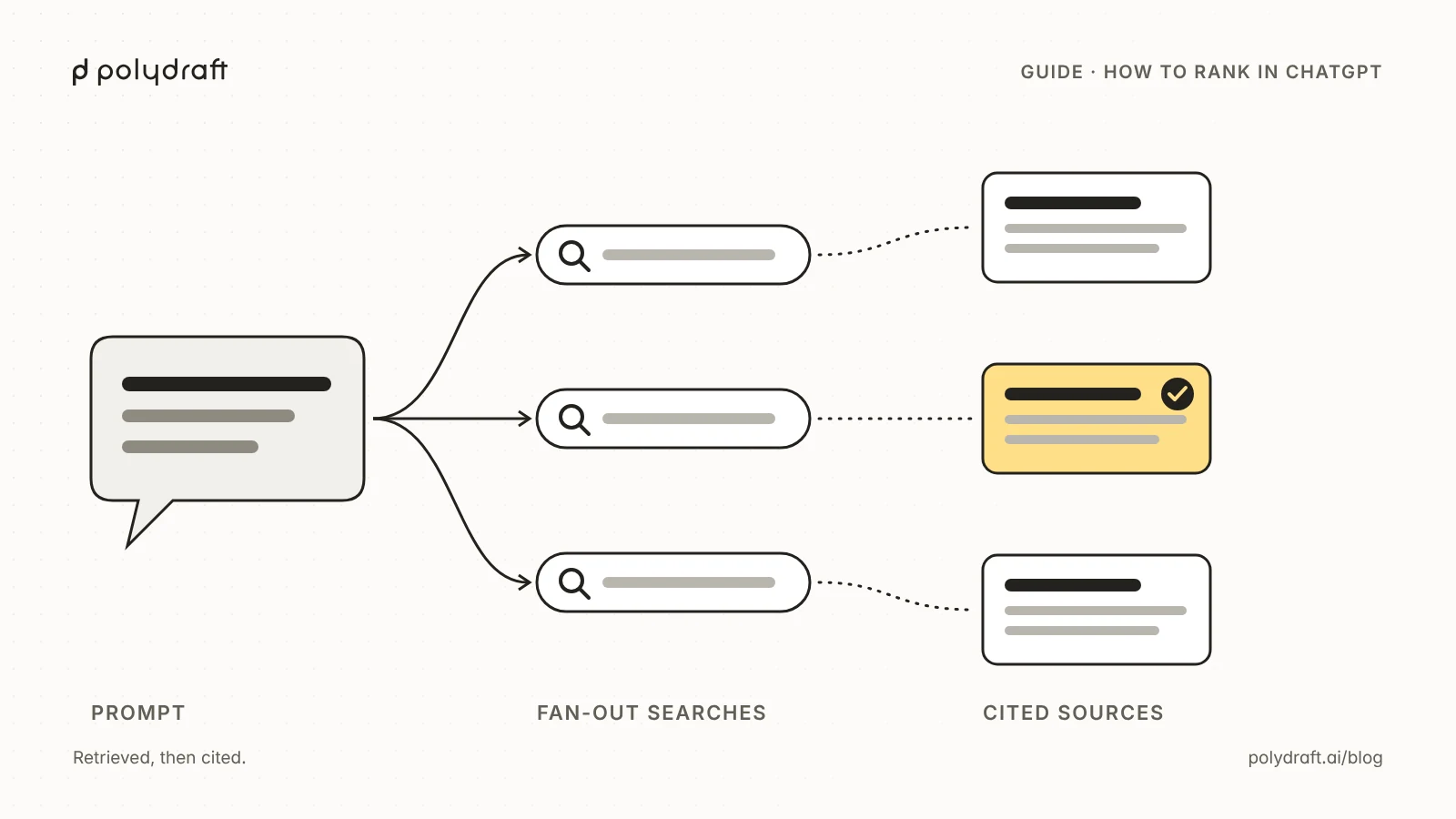
How to rank in ChatGPT comes down to getting your page retrieved and cited when ChatGPT searches the web. There is no fixed rank position to win. Let OpenAI's search crawler, OAI-SearchBot, reach your site. Get listed on the roundups, directories and review pages ChatGPT's searches pull up. Open each page with a direct answer, and keep your business facts consistent everywhere. Then check the result with a fixed set of prompts. Nobody can guarantee a citation.
We make PolyDraft, an AI website builder, so we have an interest in this topic. This guide is built on our own test. We ran 40 prompts through ChatGPT via DataForSEO's ChatGPT scraper on November 14, 2026, US English, logged out. We recorded every search ChatGPT ran and every source it returned. It covers how ChatGPT search finds pages, what our panel showed it cites, a step-by-step checklist, local businesses, ChatGPT ads, and Perplexity. For the page-level writing method, see our guide to what makes a site quotable.
What "ranking in ChatGPT" actually means
Ranking in ChatGPT means being one of the sources ChatGPT retrieves and links when it answers a prompt. ChatGPT has no stable results page with positions one to ten. Each answer is written fresh, and the sources change with the wording, the run, the account and the location. So the goal is to be retrievable and worth citing, not to hold a position.
Three outcomes are worth separating, because they need different work:
| Outcome | What it looks like in ChatGPT | What mostly drives it |
|---|---|---|
| Retrieved | Your page is in the list of search results ChatGPT pulled for the prompt | Crawler access, indexing, and matching the search ChatGPT runs |
| Cited | Your page is linked inside the answer text | A clear, quotable answer to the exact question |
| Named or recommended | Your brand or business is mentioned as an option | What other sites say about you: roundups, directories, reviews |
Not every prompt offers a citation to win. In our panel, ChatGPT answered 4 of 10 informational prompts from the model alone, with no web search and no sources. Those were definitions and general how-tos, such as "what is generative engine optimization" and "how to do a content audit". When ChatGPT doesn't search, there is nothing to rank in.
How ChatGPT search finds pages, and how to get cited by ChatGPT
ChatGPT search finds pages through OpenAI's own crawler, OAI-SearchBot, and through third-party search providers. When it searches, it rewrites your prompt into one or more targeted search queries. OpenAI says results are ranked on "multiple factors" and that placement is not guaranteed. Here is what OpenAI documents, as of November 14, 2026.
| What OpenAI documents | What it means for you | Source |
|---|---|---|
| Sites opted out of OAI-SearchBot "will not be shown in ChatGPT search answers, though can still appear as navigational links" | Allow OAI-SearchBot in robots.txt and at your CDN or firewall | OpenAI crawler docs |
| OpenAI recommends allowing OAI-SearchBot and its published IP ranges; robots.txt changes take about 24 hours | Check the edge, not only robots.txt | OpenAI crawler docs |
| GPTBot (training) and OAI-SearchBot (search) are independent settings | You can block training and still allow search | OpenAI crawler docs |
| ChatGPT search uses third-party search providers and partner content, and rewrites prompts into targeted queries sent to them | Being findable in ordinary web search still matters | OpenAI Help: Searching the web (search excerpt) |
Any public website can appear; placement is not guaranteed; ChatGPT adds utm_source=chatgpt.com to referral links |
There is no submission form; measure referrals in analytics | OpenAI Help: Publishers FAQ (search excerpt) |
| ChatGPT can use the public web, private API integrations and, for retail, merchant product feeds | Shops can add a product feed; other businesses can claim a Business Profile | OpenAI commerce overview |
OpenAI's help center showed a bot challenge to our tools on November 14, 2026, so the two help-center rows come from search excerpts of OpenAI's own pages. We read the developer documentation directly.
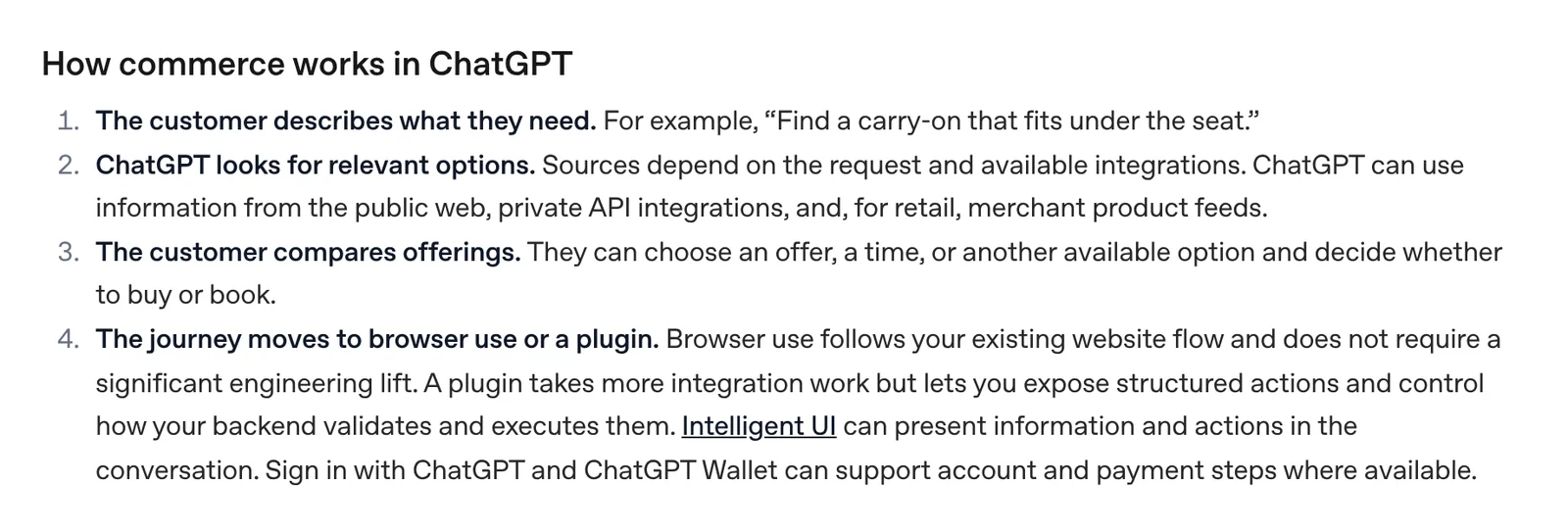
OpenAI doesn't name the search providers in its crawler documentation, so treat claims that ChatGPT "just uses Bing" or "just uses Google" as unconfirmed. Our own data, below, found little overlap with Google's top 10. The practical reading is simple: the crawler step is a yes-or-no gate, and the rest depends on which pages the rewritten searches surface. Our robots.txt examples for AI crawlers show the exact rules.
What our 40-prompt ChatGPT test showed
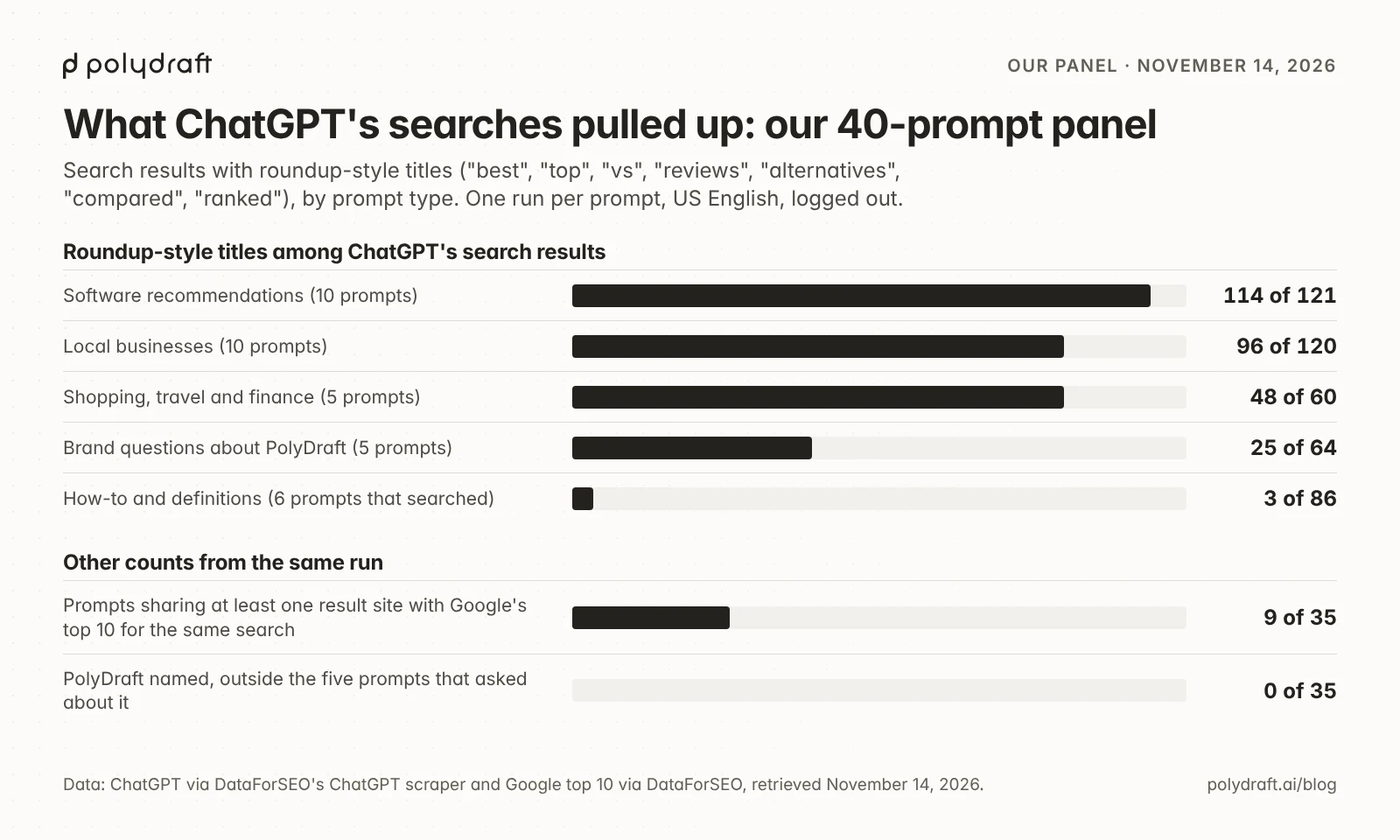
ChatGPT searched the web for 36 of our 40 prompts and returned a median of 12 search results each. For recommendation prompts, most of those results were "best of" roundups, directories and review sites, not the businesses themselves. ChatGPT's result sites rarely matched Google's top 10 for the same search.
How we collected it. We ran 40 prompts through ChatGPT via DataForSEO's ChatGPT scraper on November 14, 2026, US English, logged out. The prompts were fixed before any results came in: 10 local business, 10 software recommendation, 10 informational, 5 brand checks about PolyDraft, and 5 shopping, travel and finance prompts. The scraper returns the answer, the search results, the inline source links, the searches ChatGPT ran and the brands it named. Each prompt ran once.
| Prompt type | Prompts | Ran a web search | Median search results | Roundup-style result titles | Local business cards |
|---|---|---|---|---|---|
| Local business | 10 | 10 | 12 | 96 of 120 | 10 of 10 answers |
| Software recommendation | 10 | 10 | 12 | 114 of 121 | 0 |
| Informational | 10 | 6 | 12 | 3 of 86 | 0 |
| Brand check (PolyDraft) | 5 | 5 | 12 | 25 of 64 | 0 |
| Shopping, travel and finance | 5 | 5 | 12 | 48 of 60 | 0 |
"Roundup-style" means the result's title contains a word like best, top, vs, reviews, alternatives, compared, ranked or rated. We counted titles, so this is a rough label, not a reading of each page.
ChatGPT rewrites prompts into fan-out searches
ChatGPT turned each short prompt into a longer, more specific search. The median was 1 search per prompt; 5 prompts ran 2. The searches often added the year, buying criteria and brand names the user never typed. These are real examples from the panel:
| Prompt we typed | Search ChatGPT ran |
|---|---|
best AI website builder for small business |
best AI website builders for small businesses 2026 pricing features Wix Squarespace Shopify Hostinger Durable |
recommend a plumber in Denver |
best plumbers in Denver Colorado reviews licensed plumbing companies |
best CRM for freelancers |
best CRM software for freelancers 2026 pricing features HubSpot Folk HoneyBook Pipedrive Zoho Bigin |
how to get cited by ChatGPT |
OpenAI ChatGPT search OAI-SearchBot publisher website crawling documentation robots.txt citations |
best SEO tool for a small business |
best SEO tools for small businesses 2026 Semrush SE Ranking Ahrefs pricing features comparison; official pricing Semrush SE Ranking Ahrefs SEO tools small business 2026 |
The lesson for a page: the search that decides retrieval is usually longer than the prompt. It names criteria such as price, features, reviews, licensing or neighborhoods. A page that answers those criteria in plain text matches more of these searches.
Roundups and directories made up most results
For best AI website builder for small business, all 12 search results were roundup articles, from TechRadar's tested list to small comparison sites. None were vendor pages. ChatGPT linked the five vendors it named (Wix, Hostinger, Squarespace, Durable and Shopify) plus two of the roundups. The vendors were named from roundups, but their own pages weren't in the search results.
Across the panel, the sites that appeared most often were roundup and directory publishers: itechguides.com in 7 prompts, and expertise.com, reviews.birdeye.com and techradar.com in 3 each.
Little overlap with Google’s top 10
For 35 prompts we pulled Google's top 10 for ChatGPT's first search, through DataForSEO. Only 9 of 35 prompts shared even one result site with that top 10. The median was 0 shared sites, out of a median 11 result sites per prompt. We matched by site, not page, because Google's links in these captures are redirects. We also pulled Bing results, but those captures returned unrelated pages, so we make no Bing claim. Our SEO vs AEO vs GEO comparison puts this next to our Google AI Overviews data.
Retrieved is not the same as cited
ChatGPT linked a median of 4 sources inside the answers that searched. In 5 of 10 local answers, it linked none at all, and showed business cards instead. So a page can be in the search results and still never appear in the answer text.
Our own result: PolyDraft in 5 of 5 brand prompts, 0 of 35 others
ChatGPT named PolyDraft and linked polydraft.ai in all 5 prompts that asked about PolyDraft by name. For "What is PolyDraft?", 8 of the 12 search results were our own pages. PolyDraft appeared in none of the other 35 prompts, including best AI website builder for small business. In plain terms: ChatGPT can find us when you ask for us, and doesn't recommend us when you don't.
How to rank in ChatGPT: a step-by-step checklist
The checklist below follows the order the panel suggests: get access, get into the pages ChatGPT's searches retrieve, make your own pages quotable, keep facts consistent, then measure. Each step has a pass condition you can check today. Steps 1, 3, 4 and 5 are in your control; step 2 depends on other sites.
| Step | What to do | Pass condition |
|---|---|---|
| 1. Allow access | Allow OAI-SearchBot in robots.txt and at your CDN or firewall; keep main content in the server-rendered HTML | A request with the OAI-SearchBot user agent gets a 200 and the full text |
| 2. Get into the retrieval set | Earn honest listings on the roundups, directories and review sites that rank for your category's "best" searches | You appear on at least some of the pages ChatGPT retrieves for your prompts |
| 3. Write answer-first pages | Open each page and section with a direct, dated answer; state prices, features and limits in text and tables | A paragraph lifted out of the page still answers the question |
| 4. Keep entity facts consistent | Use the same name, description, prices, address and phone on your site and every listing | No listing contradicts your site |
| 5. Test with a fixed prompt set | Run the same prompts monthly and record searches, sources and mentions | You have a dated before-and-after record |
Step 1: allow access. Check robots.txt for an OAI-SearchBot group, then check your CDN's bot rules, such as Cloudflare's AI Crawl Control, because an edge block overrides robots.txt. OpenAI says robots.txt changes take about 24 hours. If you also want ChatGPT's browser to complete actions on your site, OpenAI's agent access guide covers verified browser visits. Our AI visibility guide for business websites has a copy-paste test for each crawler.
Step 2: get into the retrieval set. This is the step most guides skip, and our data says it matters most for recommendation prompts. Search your category the way ChatGPT does: best [category] for [audience] 2026 pricing features. Note which roundups and directories rank. Then ask to be reviewed, submit accurate listings, or supply real data the authors can use. Disclose your affiliation every time.
Step 3: write answer-first pages. ChatGPT's searches name criteria: price, features, reviews, licensing. Put those facts on your own pages in plain sentences and tables, with an "as of" date. Our GEO audit checklist checks this page by page.
Step 4: keep entity facts consistent. ChatGPT blends your site with what others say. If a directory lists an old price or phone number, that can end up in an answer. Fix listings at the source.
Step 5: test with a fixed prompt set. Pick 10 to 20 prompts your customers would type, fix them in writing, and run them on a schedule. Record the date, the searches, the sources and whether you were named. Our guide to running a dated AI answer test shows how to log it without overreading one run.
How to get ChatGPT to recommend your business
To get ChatGPT to recommend a local business, be well represented on the directories and local guides it retrieves, with consistent details and genuine reviews. In our panel, all 10 local prompts produced business cards in the answer, and the search results came almost entirely from directories and "best of" lists. Your own website is one input, not the main one.
The 10 local answers showed 54 business cards in total. 53 showed a star rating and review count, 51 a phone number, and all 54 a website link. The search results behind them came from sites such as expertise.com and reviews.birdeye.com (3 prompts each), contractorsranked.com, Avvo, Angi and city guides such as Eater and The Infatuation. The Denver answer also linked Yelp in its text. For "family lawyer in Phoenix", 11 of 12 results were Avvo pages.
What that suggests for a local business:
- Complete your listings where your category is reviewed. Directories, review platforms and local guides are where the cards and lists draw from. Keep the name, address, phone, hours and website identical everywhere.
- Earn real reviews. Ratings and review counts appeared on 53 of 54 cards. Ask happy customers to review you; never buy or write reviews yourself.
- Check for contradictions. In one Denver answer, a company's card showed a 1.8 rating from 932 reviews, while the text above it called the same company the best overall pick with a reported 4.8. Mixed data like that is a reason to audit your listings.
- Claim your ChatGPT Business Profile. OpenAI's Claim your business guide says a Business Profile "helps customers learn about your business when ChatGPT mentions it". It doesn't say it makes ChatGPT mention you.
- Shops: submit a product feed. OpenAI's product feed guide says ChatGPT can use product feeds alongside public web sources for product discovery. In our panel, 3 of 5 shopping prompts showed product cards.
ChatGPT ads vs organic citations: paying doesn’t buy a citation
ChatGPT ads and organic citations are separate systems. An ad is a paid, labeled unit bought in an auction. A citation is a link ChatGPT adds because it used your page, and nobody can buy one. OpenAI says ads don't influence ChatGPT's answers. We have no data that tests that claim either way.
As of November 14, 2026, OpenAI's help center says ads may appear for adults on the Free and Go plans. Plus, Pro, Business, Enterprise and Edu accounts don't get ads. Ads usually sit below a response, are clearly labeled, and run on systems separate from the chat model. The help center showed our tools a bot challenge, so these points come from search excerpts of its Ads in ChatGPT article.
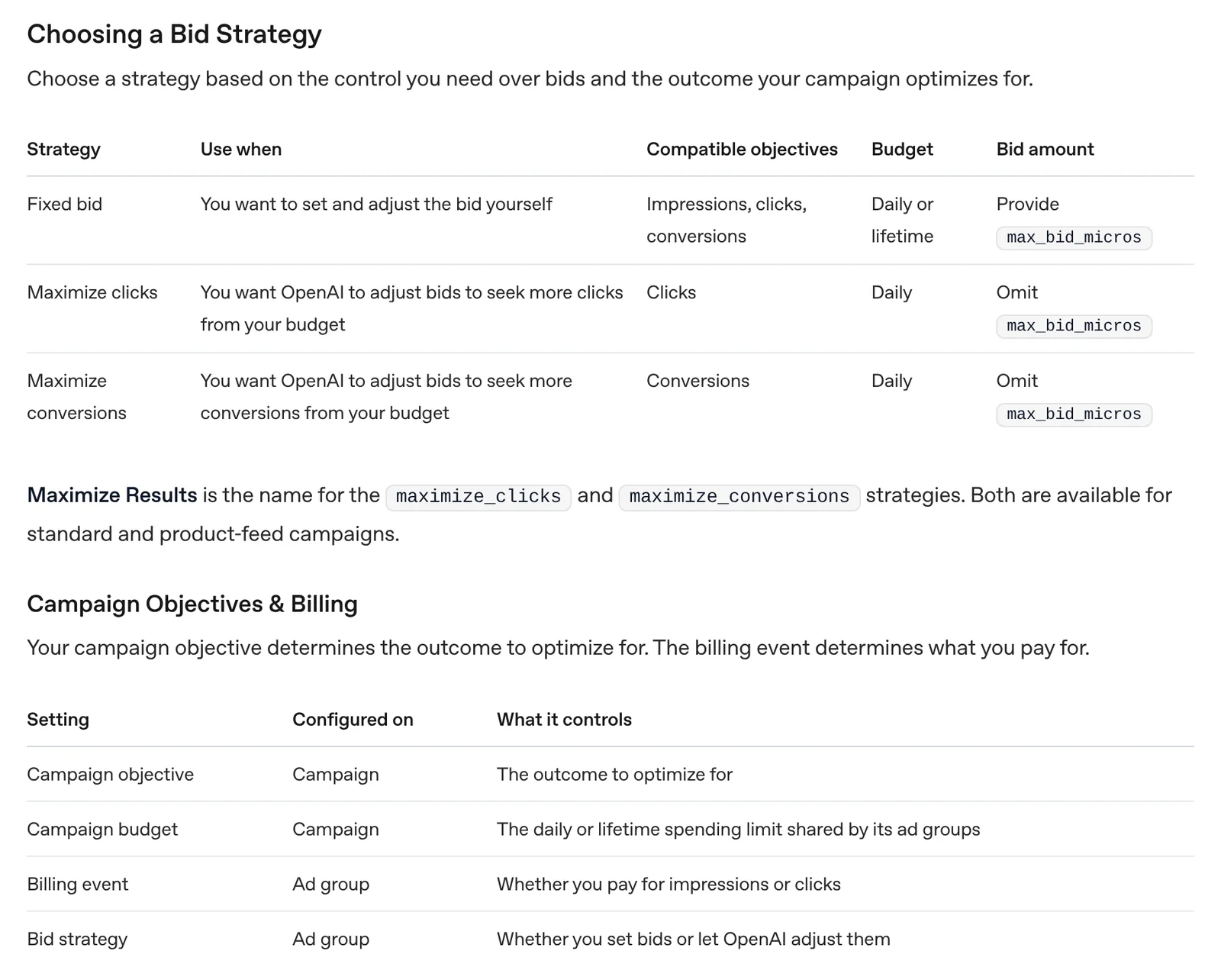
Advertisers buy through Ads Manager at ads.openai.com or through OpenAI's Advertiser API. Search excerpts of OpenAI's help center call Ads Manager a beta, with access depending on country. Per OpenAI's bidding and budgets guide, you pay per impression or per click, with a fixed bid or an automatic strategy. Conversion campaigns still bill per click.
| ChatGPT ad | Organic citation | |
|---|---|---|
| How you get it | Bid in Ads Manager or the Advertiser API | ChatGPT's search finds and uses your page |
| Where it appears | A labeled unit, usually below the answer | A link inside the answer |
| Who sees it | Free and Go users, per OpenAI's help center | Anyone whose prompt triggers a search that uses your page |
| What it costs | Your bid, settled by the auction | No media cost; the cost is your site and content work |
| How to track it | Your own paid tag, such as utm_source=openai&utm_medium=paid (OpenAI's own example) |
Usually utm_source=chatgpt.com or a chatgpt.com referrer; some visits carry neither |
OpenAI's help center lists a minimum daily budget of $25 per campaign for US dollar accounts. That figure also comes from search excerpts. OpenAI's developer docs give no figure and say daily minimums depend on the account currency, so confirm it in Ads Manager. Then tag paid clicks with a different utm_source value from the organic utm_source=chatgpt.com, which ChatGPT usually adds. Otherwise your analytics will merge paid and organic visits. OpenAI's campaign management guide supports tracking parameters for this.
Our own panel saw no ads. The five shopping, travel and finance prompts, run logged out, showed product cards in three answers, but no item was labeled sponsored or ad. Reports of OpenAI's help article say logged-out users don't get ads, so the probe was unlikely to see one either way.
We also ran "can I advertise my business on ChatGPT" through the same scraper that day, once. ChatGPT said yes and pointed to Ads Manager. All 12 of its search results and all 3 linked sources were OpenAI pages.
How to rank on Perplexity
To rank on Perplexity, do the same groundwork: allow PerplexityBot, answer questions directly, and be present on the sites it cites. Perplexity SEO differs mainly in how visibly Perplexity cites. We ran 10 prompts through Perplexity's sonar model with web search on, via DataForSEO, on November 14, 2026. Every answer carried 10 citations. The most frequent were forbes.com, business.com and wix.com, in 3 prompts each.
PolyDraft appeared in 1 of 10, only for "What is PolyDraft?". Of the 9 prompts we also ran on ChatGPT (one reworded), 5 had at least one site in common between ChatGPT's search results and Perplexity's citations. For "best bakery in Austin", Perplexity cited all four sites ChatGPT's searches retrieved: Eater Austin, The Infatuation, Time Out and Feastio. Per search excerpts of Perplexity's crawler page, PerplexityBot isn't used to train foundation models, while Perplexity-User "generally ignores" robots.txt.
How to check whether ChatGPT cites you
Check with a fixed prompt set, your analytics and your crawler logs, and keep the three separate. A fetch shows access, a citation shows retrieval, and a visit shows a click. None proves the others.
| What to check | Where | Limits |
|---|---|---|
| Are you named or cited? | A fixed set of prompts, run monthly, logged out, with the date and location noted | Answers vary by run, account, location and time |
| Does ChatGPT send visits? | Your analytics: referrer chatgpt.com or utm_source=chatgpt.com |
Some visits arrive without a referrer |
| Can OAI-SearchBot reach you? | Server or CDN logs, filtered by user agent and OpenAI's published IPs | A fetch is not a citation |
| Which searches does ChatGPT run? | A scraper that returns fan-out queries, like the one we used | Paid; one run is one sample |
PolyDraft doesn't measure AI citations or ChatGPT referral traffic, so use your analytics and a dated prompt log. For Google's AI answers, our guide to showing up in AI Overviews covers Search Console's report.
What not to do
Don't buy promises, fake signals or hidden instructions. Each of these either breaks platform rules or law, or targets something no one controls. Our panel also showed a risk that cuts the other way.
- Don't trust ranking guarantees. OpenAI says placement is not guaranteed. A provider who promises a ChatGPT position is promising something nobody controls.
- Don't fake reviews. The US Federal Trade Commission's rule on consumer reviews, in effect since October 21, 2024, bans fake reviews and testimonials. Directories and review sites also remove them.
- Don't hide prompts or text for AI. Text hidden from visitors and aimed at machines can count as hidden text under Google's spam policies. It also risks being quoted out of context.
- Don't mass-produce prompt-variant pages. One clear page per question beats 50 near-duplicates.
- Watch for lookalike sites. In two of our prompts about ChatGPT, the search results included a domain imitating OpenAI's developer site, "developer-openai-com.sitemirror.store". ChatGPT cited the real developers.openai.com. Check the domain before you trust a source.
Where PolyDraft fits
PolyDraft builds the technical base that step 1 needs, not the off-site work. As of November 14, 2026, it builds server-rendered sites on your own Cloudflare account with canonicals, a sitemap and a robots.txt file whose preset allows all crawlers. PolyDraft's weekly report samples which of your pages AI assistants cite, but it doesn't measure AI referrals, and it can't make ChatGPT recommend you. Because the site runs on your own Cloudflare account, you can block individual AI crawlers in Cloudflare's AI Crawl Control; PolyDraft's own admin panel doesn't edit robots.txt. If you block anything there, check that OAI-SearchBot is still allowed. Every step in this guide works on any platform.
Frequently asked questions
Can you pay to rank in ChatGPT?
No. You can't buy a citation or a place in ChatGPT's answer text, and OpenAI says placement is not guaranteed. ChatGPT ads are a separate, labeled unit, usually below the answer, shown to Free and Go users per OpenAI's help center. OpenAI says ads don't influence answers. Citations still depend on access, retrieval and a quotable page.
How does ChatGPT decide which websites to cite?
ChatGPT rewrites the prompt into targeted searches, sends them to third-party search providers, draws on pages OAI-SearchBot has crawled, and cites pages that answer the question. OpenAI says it ranks results on multiple factors for relevance and reliability. In our November 14, 2026 test, recommendation prompts mostly retrieved roundups, directories and review sites.
Does ChatGPT use Google or Bing to find pages?
OpenAI says ChatGPT search uses third-party search providers but doesn't name them in its crawler documentation. In our November 14, 2026 panel, only 9 of 35 prompts shared any result site with Google's top 10 for the same search. Our Bing captures failed, so we can't say how closely ChatGPT matches Bing.
How long does it take to show up in ChatGPT?
There is no fixed timeline. OpenAI says robots.txt changes for OAI-SearchBot take about 24 hours to apply. After that, appearing depends on whether ChatGPT's searches retrieve your pages or pages that mention you. Run a fixed prompt set monthly to see whether anything changed.
How do I get ChatGPT to recommend my local business?
Be listed, with identical details and genuine reviews, on the directories and local guides ChatGPT retrieves. In our panel, all 10 local prompts showed business cards with ratings, phone numbers and websites. You can also claim your ChatGPT Business Profile. None of this makes a recommendation certain.
Is ranking on Perplexity different from ranking in ChatGPT?
Mostly not. Both need crawler access (PerplexityBot for Perplexity), direct answers and presence on the sites they cite. Perplexity shows citations more consistently: every answer in our 10-prompt test carried 10. Of the 9 prompts we ran on both, 5 had at least one site in common.
Continue with the next task
- Making your pages worth quoting: What makes a site quotable in AI answers
- Letting OAI-SearchBot and PerplexityBot in: robots.txt examples for AI crawlers
- Checking a whole site: GEO audit checklist
- Appearing in Google's AI answers: How to show up in AI Overviews
- Understanding the labels: SEO vs AEO vs GEO
- Deciding whether you need one: llms.txt example and validation
About this article. Drafted by an AI agent following PolyDraft's blog workflow, checked by an automated QA script, fact-checked by a separate AI agent, and approved by Vincent Chen. The ChatGPT, Google and Perplexity figures come from DataForSEO captures run by our main research session on November 14, 2026 (178 calls in total), with prompts fixed before any results came in; one run per prompt. The scraper reported the ChatGPT model as gpt-6. OpenAI's developer documentation was read directly that day, and both OpenAI screenshots were captured without signing in (the ads screenshot was taken for an earlier draft the same day). OpenAI's help center and Perplexity's documentation couldn't be opened from our tools, so those points come from search excerpts of their own pages. Search demand figures come from Ahrefs and DataForSEO (US). No ranking, citation or traffic gain is claimed.
Sources
Checked November 14, 2026 unless noted.
- OpenAI: Overview of OpenAI crawlers
- OpenAI Help Center: Searching the web with ChatGPT (search excerpt; page showed a bot challenge)
- OpenAI Help Center: Publishers and developers FAQ (search excerpt; page showed a bot challenge)
- OpenAI: How commerce works in ChatGPT (Partner Playbook overview)
- OpenAI: Claim your business
- OpenAI: Submit product feeds
- OpenAI: Help ensure cloud browser access to your site
- OpenAI Developers: Ads API overview, Bidding and budgets and Campaign management
- OpenAI Help Center: Ads in ChatGPT and Create campaigns (search excerpts; pages showed a bot challenge)
- Perplexity: Perplexity crawlers (search excerpt)
- Perplexity Help Center: How does Perplexity follow robots.txt? (search excerpt)
- Google Search Central: Spam policies for Google web search
- US Federal Trade Commission: Consumer Reviews and Testimonials Rule: Questions and Answers (search excerpt)
- DataForSEO: ChatGPT LLM Scraper API and Perplexity LLM Responses API